Skip to content
Yes, you can often still win if you're partially at fault in Texas. If you're 50% or less at fault, you can still recover compensation, but if you're 51% or more at fault, you recover nothing.
A serious crash leaves those involved with the same fear in the first few days. You're hurt, your car is damaged, the insurance company is calling, and somewhere in the back of your mind is one hard question: what if they say this was partly my fault?
That fear is real. In many Texas wrecks, fault isn't clean or simple. Maybe you changed lanes, but the other driver was speeding. Maybe you were turning left, but the oncoming driver ran a stale yellow light. Maybe it was a Houston freeway pileup and several drivers made bad choices within seconds.
On the topic of can you still win if partially at fault in Texas, the most important thing to know is this: partial fault doesn't automatically end your case. It does make your case more vulnerable to blame-shifting. That means the actions you take right after the crash can have a direct effect on whether your claim is treated fairly.
A Serious Accident Can Change Your Life in Seconds
After a Houston freeway crash, many people replay the moment again and again. You may remember one small thing you did wrong and assume that ruins everything. That's one of the most common misunderstandings I hear from injured clients.
It usually starts like this. Traffic slows suddenly. One driver brakes hard. Another swerves. You feel the impact, then confusion. At the scene, everyone has an opinion. One driver says you cut over. Another says the truck behind them never stopped in time. The officer is trying to sort it out while you're still shaking.
The question that keeps people up at night
A lot of injured people don't ask, "Was the other driver negligent?" They ask, "What if they blame me too?"
That's a fair question. Texas personal injury law looks at fault, which means who caused the accident and by how much. In plain English, negligence means failing to use reasonable care. A driver who speeds, texts, follows too closely, or ignores traffic conditions may be negligent. But more than one person can share responsibility in the same crash.
Practical rule: Being partly responsible isn't the same as having no case.
That matters in car wrecks, truck crashes, pedestrian injuries, motorcycle collisions, and even wrongful death claims. Families often assume a loved one must have been completely blameless to recover. That's not how these cases always work.
Why this feels so personal
A fault dispute isn't just a legal argument. It affects medical bills, lost income, car repairs, and your ability to move forward. Insurance companies know that. If they can push more blame onto you, they may reduce what they pay or try to deny the claim altogether.
That's why early legal guidance matters. A Texas personal injury lawyer, a Houston car accident attorney, a truck crash lawyer Houston, or a wrongful death lawyer Texas family trusts isn't just arguing about labels. They're protecting the value of the claim before an unfair narrative hardens.
Understanding Texas's 51% Proportionate Responsibility Rule
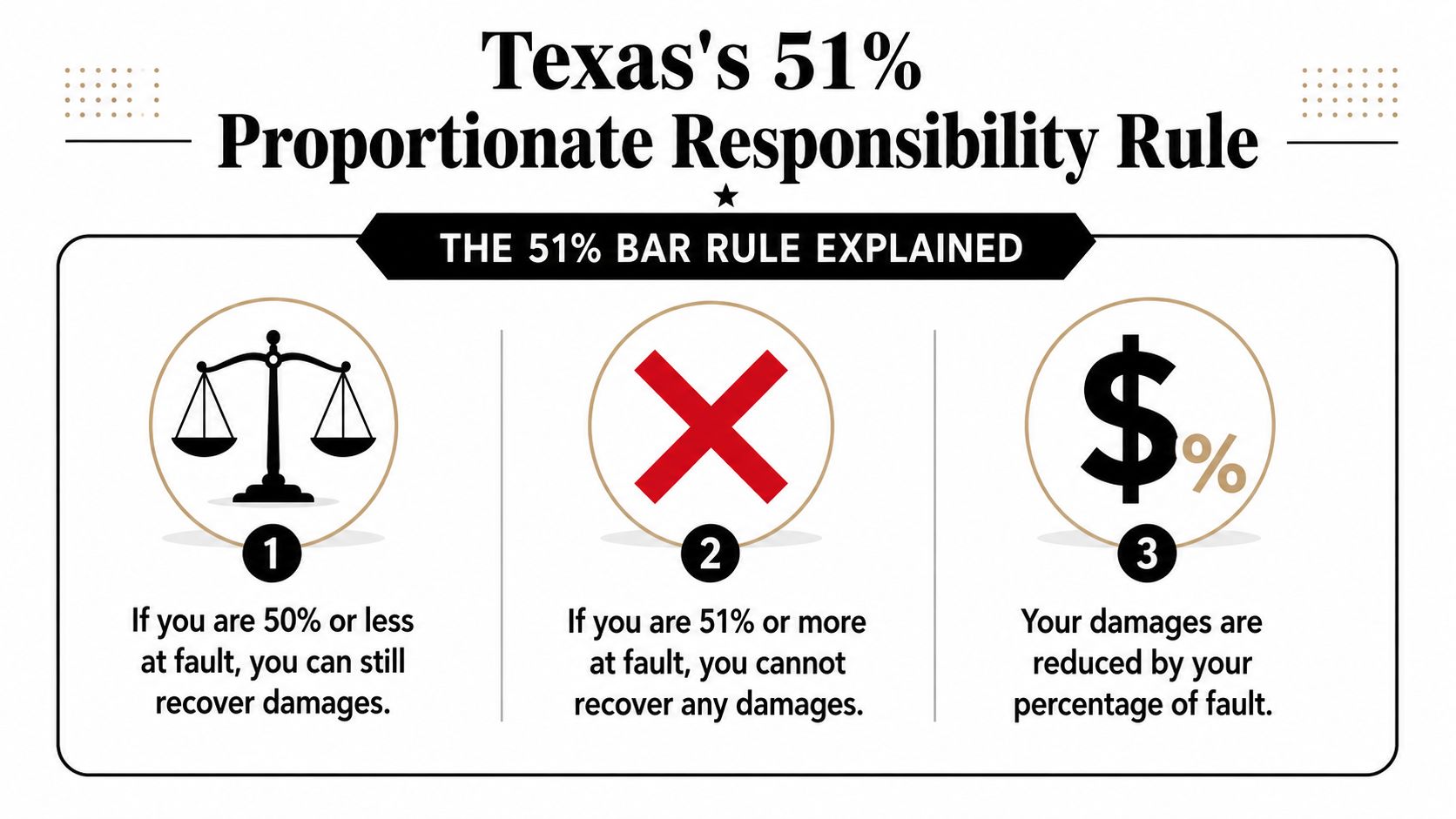
Texas follows a modified comparative negligence system, also called proportionate responsibility. Under Texas law, an injured person can still recover damages if they are 50% or less at fault, but if they are 51% or more at fault, recovery is barred entirely, as explained in this discussion of Texas Civil Practice & Remedies Code §33.001.
Think of it like a sliding scale
The easiest way to understand this rule is to picture a slider.
If the evidence shows the other side caused most of the crash, your claim stays alive. If the evidence moves your share of blame too high, your claim can fall off a cliff. The key point is that fault isn't just about who made a mistake. It's about how much each person's conduct contributed.
Here are the core ideas:
- You can still recover if your share of fault is 50% or less.
- Your recovery is reduced by your percentage of fault.
- You recover nothing if your fault reaches 51% or more.
What damages means in plain English
Damages are the losses the law allows you to pursue after an injury. That can include things like medical expenses, lost income, property damage, and other harms tied to the crash. In a partial-fault case, the fight is often about two things at once: how much your losses are worth, and how much blame gets assigned to you.
One example makes the rule easier to see. If a jury values a claim at $100,000 and assigns the injured person 30% fault, the recoverable amount becomes $70,000, based on the same Texas rule explained in this overview of how comparative fault affects settlement value in Texas.
The most dangerous place in a Texas partial-fault case is not "some fault." It's crossing from 50% to 51%.
Why the rule changes how claims are handled
This law shapes almost every part of a case. The insurance company isn't only looking at your injuries. It's looking for facts it can use to raise your share of blame. A comment at the scene, a poorly worded recorded statement, or missing photographs can all make that job easier for them.
That's why people get confused when they hear, "You may have a case." What that often means is yes, you may still recover, but the outcome depends on where the fault percentage lands. In partial-fault claims, every detail matters because every point of fault can affect what you take home.
How Partial Fault Plays Out in Real-World Accidents
The law sounds straightforward on paper. Real crashes don't.
A Houston freeway chain-reaction crash
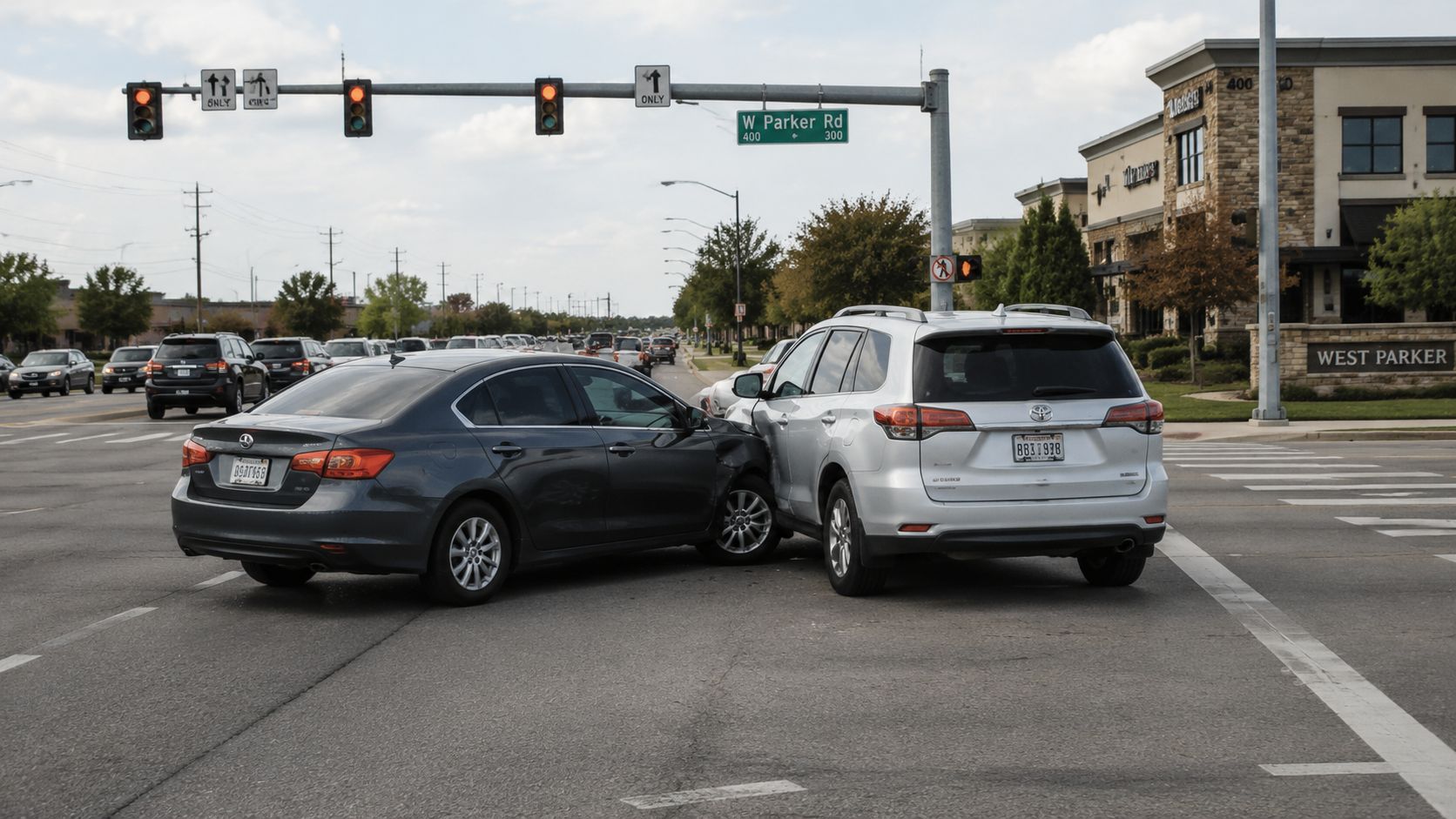
A driver on a busy Houston freeway brakes suddenly. The SUV behind them swerves. A pickup rear-ends that SUV, and another vehicle clips the pickup while trying to avoid the wreck. By the time police arrive, several people are pointing fingers.
In a situation like that, blame may be spread among multiple drivers. One person may have followed too closely. Another may have changed lanes without enough room. Another may have been driving too fast for traffic conditions. Modern crashes often involve multiple liable parties, and fault can be distributed among several actors, especially in multi-vehicle and rideshare scenarios, as discussed in this explanation of shared fault and multiple liability issues in Texas crashes.
A left-turn collision in Dallas
A common example is a left-turn crash. You begin the turn and get hit by an oncoming driver. At first glance, people may assume the turning driver is automatically at fault. But that isn't always the full story.
If the oncoming driver was speeding, distracted, or ignored changing traffic conditions, fault may be shared. The central question becomes how each person's conduct contributed to the crash. That's why these cases often turn on details such as point of impact, witness accounts, and timing.
A truck crash involving more than one company
Truck cases are even more layered. The driver may have made one mistake, but the company that employed the driver, maintained the truck, loaded the cargo, or managed the route may also have played a role. If you're hurt in that kind of collision, identifying every responsible party can make a major difference in how the claim is valued.
Consider these common examples:
- Rideshare collisions: A passenger may be injured while two drivers argue over who caused the wreck.
- Delivery vehicle crashes: A worker rushing to complete a route may share the road with another careless driver.
- Pedestrian incidents: The driver may blame the pedestrian, while roadway conditions or visibility issues also matter.
- Company vehicle cases: Employer responsibility can become part of the claim if the driver was working at the time.
When several people or businesses may share responsibility, the first story you hear after the crash is rarely the final one.
If you've been searching "can you still win if partially at fault Texas," these real-world examples show why the answer is often yes, but only after a careful look at everyone involved. In many crashes, the issue isn't whether you were perfect. It's whether someone else also failed to act safely, and how strongly the evidence proves it.
How Fault Is Determined and How to Fight Back
Insurance adjusters start evaluating fault early. They aren't neutral referees. They work for the insurance company, and the company has a financial interest in paying as little as it can under the law.
That doesn't mean every adjuster is dishonest. It does mean you shouldn't treat their first conclusion as final.
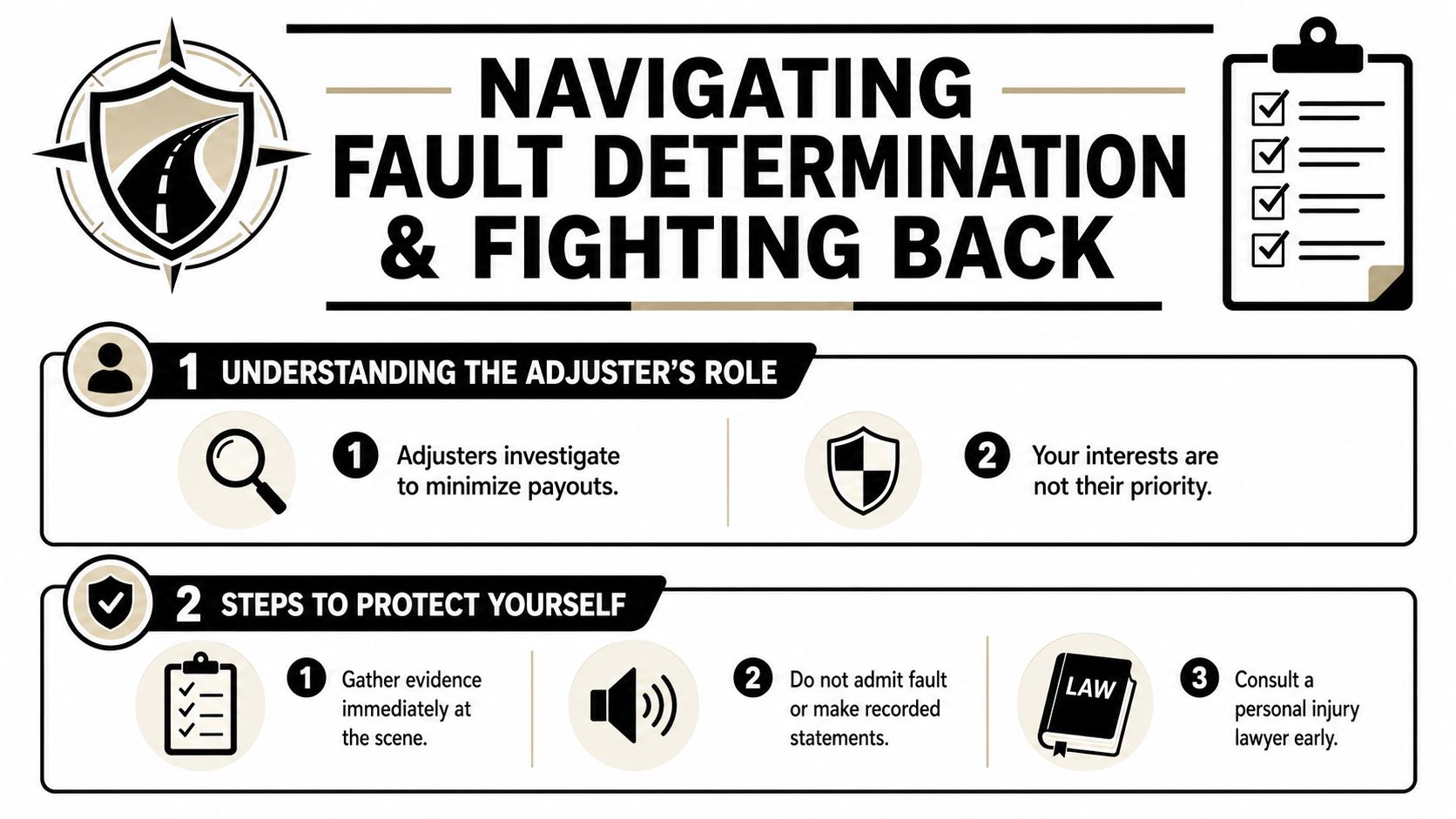
What they look at
Texas uses a proportionate responsibility system where recovery is barred if you're found 51% or more at fault. That makes early evidence preservation critical because police reports, witness statements, vehicle damage analysis, and electronic data can shift the fault percentage enough to change the outcome of a claim, as described in this breakdown of proving fault in a Texas car accident case.
Common evidence includes:
- Police reports: Officers document the scene, statements, and sometimes a preliminary view of what happened.
- Witness statements: Independent witnesses can support or challenge each driver's version.
- Vehicle damage patterns: The location and severity of damage can show movement, angle, and sequence.
- Photos and video: Traffic cameras, dashcams, business surveillance, and phone footage can be powerful.
- Electronic data: In some cases, onboard data helps show braking, speed, or timing.
How to respond when the blame starts shifting
People often hurt their own cases by trying to be cooperative. They give a recorded statement too soon. They agree with loaded questions. They apologize because they're shaken and polite. Later, those words get used as proof of fault.
A better approach is measured and factual.
- Stick to observable facts: Say what happened, not what you think the legal conclusion should be.
- Don't guess: If you don't know speed, distance, or timing, don't fill in the blanks.
- Preserve your evidence: Save photos, messages, tow records, and medical paperwork.
- Get help early: A lawyer can step in before the insurer locks in an unfair theory of the crash.
What protects your claim most is often what you do in the first days, not what you say months later.
One practical option is to have legal counsel send a lawyer letter of representation so the insurance company communicates through counsel instead of pressing you directly. The Law Office of Bryan Fagan, PLLC provides that kind of representation for Texas injury claims, along with case investigation and claim management.
Protect Your Claim After an Accident in Texas
When fault may be disputed, your next steps matter. You don't need to become your own accident reconstruction expert. You do need to avoid giving the insurance company easy arguments against you.
What to do right away
Start with the basics, even if the crash seems minor.
- Call 911 and report the crash. A formal report helps create an early record of what happened.
- Get medical care. Some injuries don't feel serious at first. Medical records also help connect the crash to your condition.
- Take photos and video. Capture vehicle positions, damage, debris, skid marks, road signs, weather, and visible injuries.
- Collect witness information. Names and contact details can matter later if stories change.
What not to say
A lot of people mean well and still damage their claim.
- Don't admit fault: Even saying "I didn't see you" can be twisted into an admission.
- Don't minimize your injuries: Saying "I'm okay" at the scene may be repeated later after symptoms worsen.
- Don't speculate: If you aren't sure what happened in the final seconds, say that plainly.
- Don't give a recorded statement too fast: You have every reason to be careful.
Steps in the days that follow
The period after the wreck is just as important as the scene itself.
Use this checklist:
- Follow your treatment plan: Missed appointments create doubt about how badly you were hurt.
- Save every document: Keep towing bills, repair estimates, prescriptions, discharge papers, and work-loss records.
- Track vehicle issues carefully: If you're worried that collision damage goes deeper than what the body shop first sees, tools that help uncover hidden vehicle damage can give you useful background when reviewing a car's accident history.
- Be careful on social media: Photos, comments, and jokes can be misunderstood and used against you.
A statute of limitations also matters in Texas personal injury cases. In general, injury lawsuits in Texas must be filed within a limited time after the accident. Because deadlines and exceptions can be complicated, it's smart to speak with a lawyer early rather than waiting until records disappear and witnesses become harder to find.
You Are Not Alone, Get Help from a Texas Personal Injury Lawyer
Partial fault cases feel unfair because they often are. You're trying to recover from injuries while the insurance company studies every sentence you say, every gap in treatment, and every fact it can use to push more blame onto you.
That doesn't mean you're powerless.
When legal help makes the biggest difference
A lawyer helps most in the cases where the facts are messy, the injuries are serious, or several parties may share fault. That includes:
- Car wrecks where each driver blames the other
- Truck crashes involving a commercial driver and company records
- Rideshare collisions with layered insurance questions
- Catastrophic injury claims where future care and long-term losses matter
- Wrongful death cases where families need answers and accountability
If your case involves a fatal crash, speaking with a wrongful death lawyer Texas families can trust may help you understand what options your family has. If you're dealing with severe trauma, a catastrophic injury lawyer can help evaluate the full impact of the harm. For motor vehicle cases, these pages may also help: car accident lawyer and truck accident lawyer.
Why waiting can cost you
The longer you wait, the easier it can become for key evidence to disappear. Witnesses forget details. Video gets deleted. Vehicles get repaired or totaled. The insurance company keeps building its version of events while you're trying to heal.
This short video gives more context on what it means to get legal guidance after a serious crash.
You don't need to know every legal rule before making a call. You only need to know that partial fault is not the same as no recovery, and that early action can protect your claim from being unfairly devalued.
You may be hurt. You may be overwhelmed. You may even believe you made a mistake. None of that automatically means you lose your right to seek justice.
A Houston car accident attorney or Texas personal injury lawyer can review the facts, deal with the insurer, gather proof, and fight over the percentage of fault before it controls the outcome. If the crash involved a commercial vehicle, a truck crash lawyer Houston drivers and passengers rely on can help identify every party that may be responsible.
Recovery is possible. Answers are available. And you don't have to carry this alone.
If you were injured and you're worried that partial fault could hurt your case, contact Law Office of Bryan Fagan, PLLC for a free consultation. We can help you understand your rights, explain your next steps, and evaluate whether a car accident, truck crash, catastrophic injury, or wrongful death claim may still move forward under Texas law.