Skip to content
A serious accident can change your life in seconds, but you don't have to face it alone.
If you're reading this after a crash in Houston, a truck collision on I-10, or a sudden injury that turned your routine upside down, you're probably asking a simple question with a complicated answer: what is my case worth? A common assumption is that the answer depends only on medical bills, lost pay, and how badly they were hurt. Those things matter. But in Texas, another issue often shapes the outcome just as much: fault.
That's where many injury claims become confusing. You may know the other driver caused the wreck. The insurance company may still argue that you share part of the blame. And once that argument starts, your settlement can change fast. That's the practical reality behind how comparative fault affects settlement Texas cases. It's not just a courtroom rule. It's a negotiation tool insurers use early and often.
Your Life Changed in an Instant Now What?
The first days after an accident rarely feel orderly. You may be dealing with pain, follow-up appointments, car repairs, missed work, and phone calls from insurance adjusters who sound helpful but are already evaluating your claim. In that moment, it's easy to think the process is only about submitting bills and waiting for a fair offer.
It usually isn't that simple.

In many Texas injury claims, the primary dispute is not whether you were hurt. It's whether the insurer can pin some of the responsibility on you. A rear-end crash may sound straightforward until the adjuster says you stopped too suddenly. A freeway collision may look obvious until someone argues you changed lanes unsafely. A truck wreck may involve not just the driver, but a company, a maintenance issue, or conflicting witness accounts.
That's why the earliest steps matter. If you need a practical checklist, this guide on what to do after a car accident in Texas step by step can help you protect yourself while things are still fresh.
The value of your claim depends not only on your injuries, but also on how convincingly the facts show who caused them.
Many people also find reassurance in hearing how others dealt with the same stress. Reading all MVA lead testimonials can help you see the kinds of concerns accident victims often have before they understand their options.
What Is Comparative Fault in Texas The 51% Rule
Texas uses a rule called modified comparative negligence, which Texas statutes describe as proportionate responsibility. The basic idea is simple. More than one person can share fault for the same accident, and the percentage assigned to you can directly control whether the insurance company has to pay your claim at all.
Under Texas law, you can recover damages only if your percentage of responsibility is 50% or less. Your recovery is then reduced by that percentage. If you are 51% or more responsible, you cannot recover damages under Texas Civil Practice and Remedies Code, Chapter 33.
That cutoff is why people call it the 51% rule.

Why this rule matters so much in settlement talks
In real cases, the biggest fight is often not whether someone was careless. It is whether the adjuster can push enough blame onto you to shrink the claim or wipe it out.
That makes comparative fault more than a legal definition. It becomes a negotiation tool.
An adjuster may say you were speeding, following too closely, distracted, or slow to react. Sometimes those arguments are supported by evidence. Sometimes they are just early settlement pressure. The reason they matter is obvious once you know the rule. If the insurer can move your fault from low to moderate, the value of the case drops. If they can push it over the 51% line, they may argue they owe nothing.
A concrete example
Suppose your damages are $200,000. If you are found 25% responsible, you could still recover $150,000. If you are found 51% responsible, your recovery is barred, as explained in this Texas comparative negligence overview.
That is a dramatic difference from a small change in the fault percentage.
Where people often get tripped up
Clients often hear, "You may have been partly at fault," and assume that means the case is over. Texas law does not work that way.
Two things can be true at once:
- Another driver mainly caused the crash
- The insurance company claims you also contributed to it
Those are separate questions. A lane-change collision is a good example. The other driver may have merged without checking a blind spot. The insurer may still argue you were driving too fast to avoid impact. In a settlement discussion, that disputed percentage is where much of the pressure comes from.
Practical rule: Partial fault can reduce a Texas injury claim. Crossing 51% can destroy it.
This is why the early evidence matters so much. Photos, witness statements, vehicle damage, black box data, and scene details do more than tell the story of the crash. They can keep the insurer from assigning you a larger share of blame than the facts support.
How Your Fault Percentage Reduces Your Settlement
Once fault becomes part of the case, settlement math changes. The same injury can lead to very different outcomes depending on how responsibility is assigned.
Take the example already discussed above: a person has $200,000 in provable damages. If that person is assigned 25% of the fault, the recovery becomes $150,000. If the person is assigned 51%, recovery is barred entirely, based on the Texas rule described earlier.
A simple way to read the reduction
The easiest way to think about it is this: when you stay within the recoverable range, your compensation is reduced by your share of blame. The more fault the insurer can place on you, the less they have to pay.
Here is a plain-language table showing the idea.
| Your Percentage of Fault | Reduction Amount | Your Final Recovery |
|---|---|---|
| Low share of fault | A smaller reduction from total damages | You still recover a substantial part of the claim |
| Moderate share of fault | A more significant reduction | The settlement value drops noticeably |
| Half the fault | Recovery is heavily reduced | The claim may still be viable, but far less valuable |
| More than the legal limit | Recovery is barred | No compensation under the 51% rule |
Why each percentage point matters
After a Houston freeway crash, two people may agree that the collision happened in heavy traffic but disagree about what caused it. One side says the other driver followed too closely. The insurer says you changed lanes abruptly. If the evidence is unclear, the final number often turns on whose version sounds more convincing.
That's why a case with strong injuries can still receive a disappointing offer. The adjuster isn't always saying your medical care lacks value. The adjuster may be discounting that value because they believe they can push your fault percentage upward.
A similar issue comes up in a truck crash case. The trucking company might not deny the collision happened. Instead, it may argue that you were in the wrong position, reacted too late, or failed to avoid the impact. That argument doesn't need to eliminate all responsibility on their side. It only needs to reduce the payout enough to improve their bargaining position.
The emotional trap
Many injured people hear “you were partly at fault” and think that means their case is weak. That's not always true. Sometimes it means the insurer is using a common tactic to lower the settlement range.
The legal system treats fault in percentages. Insurance companies do too. So a disagreement that sounds minor in conversation can become very expensive in negotiation.
How Insurance Adjusters Use Fault to Lower Your Offer
Insurance adjusters understand that fault drives bargaining power. In Texas, that matters because the settlement value often depends less on the headline amount of damages and more on what evidence may persuade a judge or jury to assign fault one way or the other. As explained in this discussion of how comparative negligence affects a Texas injury claim, insurers can discount a claim by arguing over evidence that shifts fault percentage, and the negotiation often centers on the probability of securing a lower fault share for the claimant.
That's the part many people never see coming.
Common arguments adjusters raise
An adjuster may focus on details that sound small on their own but become powerful when grouped together. For example:
- Speed and reaction time. They may argue you were driving too fast for conditions, even if the other driver made the first major mistake.
- Vehicle position. They may say you merged unsafely, stopped abruptly, or failed to maintain a proper lookout.
- Condition-based blame. They may point to weather, visibility, lighting, or vehicle issues and argue you should have done more to avoid the crash.
- Post-accident statements. A simple “I didn't see them” or “maybe I could have braked sooner” may be framed as an admission.
Why they do it
The insurer's goal is not to give the fairest reading of the facts. The insurer's goal is to pay as little as the claim can be settled for. Comparative fault gives them a built-in way to reduce value without denying the accident happened at all.
That's why many negotiations feel strange to injured people. You may expect the discussion to focus on your treatment, your missed work, or the impact on your family. Instead, the adjuster keeps returning to one moment in the crash and suggesting you could have handled it differently.
When an adjuster keeps talking about your choices before impact, they're often building a fault argument, not asking neutral questions.
Protecting yourself during those conversations
You don't have to be rude. But you do need to be careful. Stick to the basic facts. Don't guess. Don't fill in gaps. Don't accept loaded wording just to keep the call moving.
If you're dealing with an insurer now, this article on how to deal with insurance adjusters can help you avoid common mistakes that weaken a claim.
Evidence That Protects Your Claim from Unfair Blame
The best answer to a blame-shifting insurance strategy is evidence. Not broad opinions. Not frustration. Not a long explanation from memory weeks later. Actual proof.
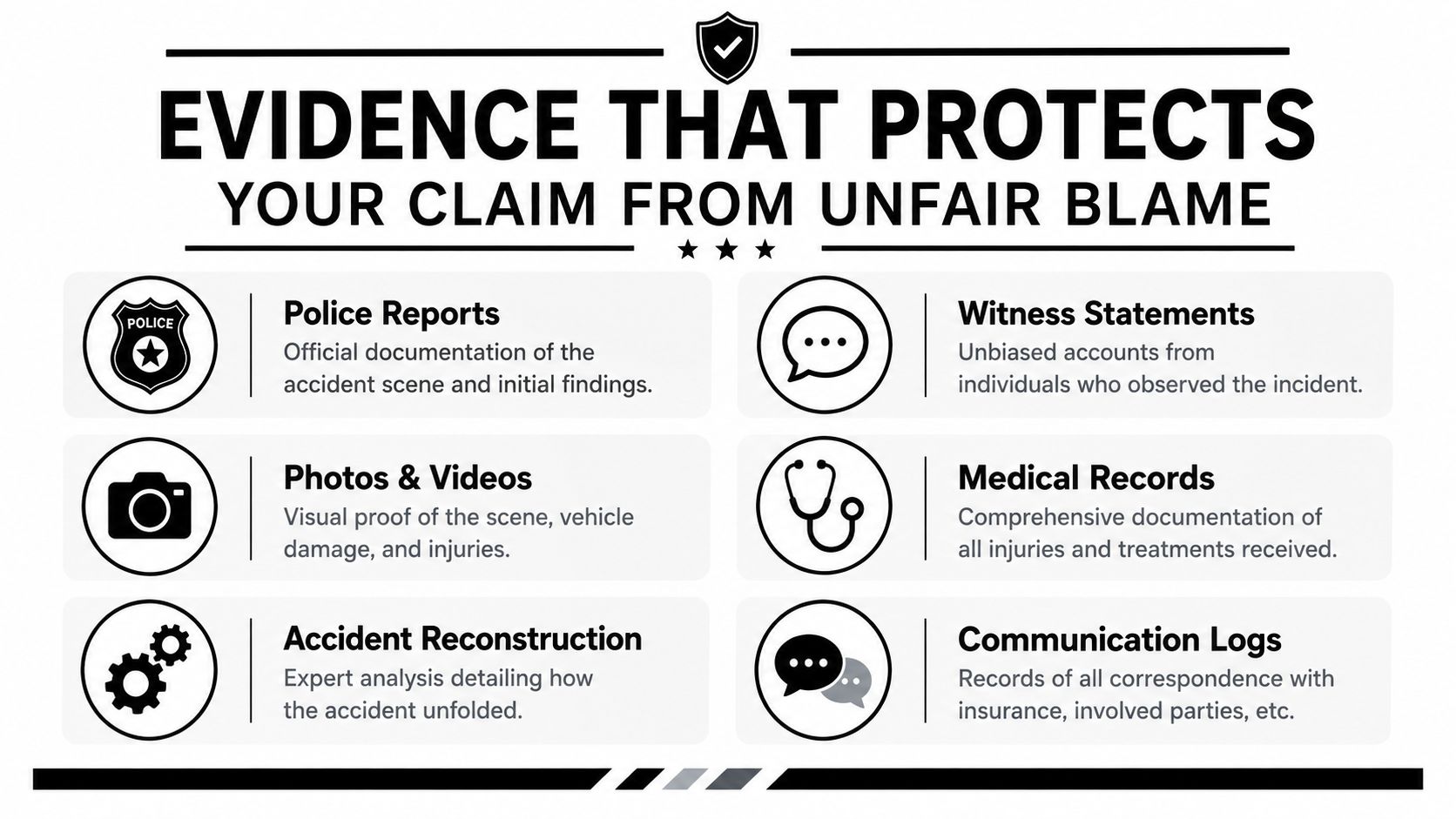
Texas injury negotiations often turn on evidence that can move the fault percentage. According to this overview of comparative fault in Texas personal injury cases, negotiation strategy often revolves around evidence such as crash reports, dashcams, surveillance video, and reconstruction testimony because those materials can materially affect settlement value by influencing how responsibility is allocated.
The evidence that often carries the most weight
Some forms of proof are especially useful because they don't rely only on memory.
- Police report. This can document the scene, identify witnesses, and preserve early observations before stories shift.
- Photos and video. Images of skid marks, lane position, vehicle damage, debris, and traffic controls can tell a clearer story than a later argument over recollection.
- Witness statements. Neutral witnesses can help when both drivers give conflicting accounts.
- Dashcam or surveillance footage. This can be the strongest answer to a weak blame argument because it shows the sequence as it happened.
- Medical records. These don't prove crash mechanics by themselves, but they help connect the wreck to your injuries and counter claims that you weren't really hurt.
- Reconstruction analysis. In more serious crashes, especially those involving commercial vehicles, reconstruction work can explain angles, speed, timing, and impact patterns in a way jurors and adjusters understand.
Why damage patterns matter
People often overlook the physical evidence on the vehicles. But crush damage, scrape direction, transfer marks, and point of impact can support or undercut a fault claim. A truck crash lawyer Houston families trust will often look closely at those details in catastrophic injury cases, because they may reveal whether the insurer's theory fits the collision.
If your case also includes a dispute about vehicle damage value, repair differences, or condition issues, resources like Auto Appraisal Expert's appraisal guide can help you understand one part of the larger insurance process.
A good checklist to follow
If you're still early in the claim, focus on preserving what can disappear:
- Save every image from your phone and back it up.
- Keep a communication log of calls, voicemails, texts, and claim letters.
- Write down witnesses before names and numbers get lost.
- Request records promptly so delays don't create avoidable gaps.
- Avoid social media commentary that can be pulled out of context.
Strong evidence does more than prove what happened. It limits how much room the insurance company has to rewrite the story.
For a more detailed breakdown, this guide on what evidence is needed for an injury claim in Texas is a helpful place to start.
Complex Cases Multiple Defendants and Settlement Releases
Some of the hardest cases involve more than one responsible party. A pileup may include several drivers. A commercial vehicle case may involve the driver, the trucking company, a maintenance provider, or another business connected to the trip. In a wrongful death case, families may face overlapping insurance positions and finger-pointing from every side.
That creates two major problems.
When several parties point at each other
In a multi-party case, each defendant may try to shrink their own share of blame by pushing it onto someone else, or onto you. That can make settlement talks messy. It can also create pressure to accept an early offer from one party before the full picture is clear.
This is one reason catastrophic injury claims, trucking cases, and cases that may require a wrongful death lawyer Texas families rely on often need a broader investigation than a basic two-car crash.
Be careful with release forms
A settlement release is not just a receipt for payment. It is a legal document that may waive future claims. If you sign too early, you may give up the right to pursue other responsible parties or additional compensation tied to the same event.
That's especially risky when injuries are still being evaluated, fault is disputed, or more defendants may be identified later.
Electronic signatures make paperwork fast, and that convenience has real benefits. If you want a plain-language look at how the process works generally, how to e-sign contracts for small businesses gives a useful overview of digital signing. But in an injury case, speed should never replace legal review.
You Don't Have to Fight the Insurance Company Alone
Comparative fault sounds like a technical legal concept. In real life, it's often the reason a strong injury case gets undervalued. The insurer may not challenge that you were hurt. It may focus instead on shifting just enough blame onto you to lower the offer or threaten the claim altogether.
That's why legal help matters. An experienced Texas personal injury lawyer knows how these arguments are built, how evidence changes the negotiation, and how to challenge fault theories that don't match the facts. The same is true whether you need a Houston car accident attorney after a freeway collision, a truck crash lawyer Houston families can trust after a commercial wreck, or guidance in a wrongful death case after a fatal crash.
Texas law also includes filing deadlines, and those time limits can affect your rights even before liability disputes are resolved. If you've been injured, it's smart to get answers early, preserve evidence, and avoid signing anything you don't fully understand.
Recovery takes time. Clarity helps. So does having someone in your corner who knows how to protect the value of your claim.
If you need help understanding your rights after a crash, Law Office of Bryan Fagan, PLLC offers a free consultation for injured Texans and families facing the aftermath of serious accidents. You can talk through fault, insurance tactics, deadlines, and next steps with an experienced team that handles car wrecks, truck accidents, catastrophic injury claims, and wrongful death cases across Texas. Legal help is available, and recovery is possible.