Skip to content
A serious accident can change your life in seconds, but you don't have to face it alone.
If you're reading this after a crash, fall, or other violent impact, you may already know how confusing a brain injury can be. One doctor calls it a concussion. Another talks about cognitive symptoms. Your family sees changes in memory, mood, focus, or sleep, but the insurance company may act like everything should be simple.
It isn't simple.
For TBI settlement amounts in Texas, a single clear number is often sought. What is needed is a clear explanation. Brain injury cases turn on more than a diagnosis. They depend on how the injury affects your work, your relationships, your independence, and critically, how much insurance is available to pay the claim.
A fair settlement can't undo what happened. It can, however, help you pay for treatment, replace lost income, stabilize your household, and plan for the future. That matters when your life has been interrupted by headaches, therapy appointments, anxiety, missed work, or the fear that your loved one is no longer quite the same person they were before the accident.
Many Texas families often get stuck. They hear that severe brain injury claims can be worth a great deal, then receive an offer that doesn't even begin to reflect the harm. That gap often comes down to proof, timing, and insurance policy limits.
A Serious Accident Can Change Your Life in Seconds
A brain injury often leaves families in two battles at once. One is medical. The other is financial.
After a Houston freeway crash, you may be trying to keep up with neurologist visits, follow-up imaging, speech therapy, work notes, and school changes for a child who now struggles to concentrate. At the same time, bills keep arriving. Insurance adjusters start calling. People ask you to make decisions before you even understand what the injury will mean months from now.
That pressure is real. So is the uncertainty.

Why settlement money matters
Compensation in a TBI case is about more than paying an ER bill. It can support rehab, lost wages, future care, transportation to appointments, and the daily strain that invisible symptoms place on a family.
A spouse may need to reduce work hours to become a caregiver. A parent may not be able to drive. A college student may need to pause classes. Those losses are personal, but they're also legally important when a claim is valued.
Practical rule: The value of a brain injury claim comes from how well your losses are documented, not from what the adjuster says the case is “usually worth.”
Why averages can mislead you
“Average” numbers can create false confidence. Two people may both be told they have a mild TBI, yet one fully recovers and another struggles with persistent headaches, memory problems, and emotional changes. Those are not the same cases.
The same problem appears with insurance. A claim may be worth far more on paper than the at-fault driver's policy can pay. That's why a serious injury doesn't always lead to a large check.
If you're overwhelmed, that doesn't mean you're weak. It means you're dealing with a serious injury and a legal process that isn't designed to be easy. You deserve plain answers, steady guidance, and room to focus on healing.
Understanding Your Rights Under Texas Injury Law
Texas personal injury law starts with a simple idea. If someone else's careless conduct caused your injury, you may have the right to recover damages.
Fault and negligence in plain English
Lawyers call that carelessness negligence. In everyday terms, it means someone failed to act with reasonable care.
A common example is a distracted driver running a red light and striking your vehicle. If that driver caused your head injury, their insurer may be responsible for paying damages. The same basic rule can apply in a truck crash, a workplace vehicle collision, or a fatal wreck that leads a family to contact a wrongful death lawyer Texas families trust for answers.
Negligence cases usually revolve around questions like these:
- Who caused the accident: Police reports, witness statements, photos, and vehicle damage often help answer this.
- What harm followed: Medical records, work records, and testimony from family members help show how the injury changed your life.
- Can the losses be linked to the accident: This is especially important in TBI cases because symptoms may be delayed or hard to measure.
Comparative responsibility in Texas
Texas also looks at whether the injured person shares part of the blame. Under Texas law, an injured party who is found 51% or more at fault recovers nothing, while someone who is 50% or less at fault can still recover damages, according to the explanation of Texas's modified comparative fault rule from SetCalc's Texas car accident settlement guide.
That rule matters in settlement talks. If the other side argues that you were partly responsible for the crash, they aren't just making conversation. They're trying to reduce what they pay.
If an insurer can shift enough blame onto you, it can shrink or eliminate the claim.
How long do you have to file a claim in Texas
Texas injury cases also come with a deadline. In most personal injury cases, the filing window is two years, which is explained in The Two-Year Deadline for Texas Injury Claims.
Waiting can hurt your case even before the deadline arrives. Witnesses become harder to find. Video disappears. Treatment gaps give insurers arguments they don't deserve.
What this means for you
You don't need to master every legal rule overnight. You do need to understand that fault, proof, and timing shape everything that follows.
If you're talking with a Texas personal injury lawyer, a Houston car accident attorney, or a truck crash lawyer Houston families call after a major wreck, these are the legal ground rules they're working from.
Key Factors That Determine Your TBI Settlement Amount
A brain injury claim is valued the way a house is appraised. You do not get one number from one label. You look at the full picture. What was damaged, what it will cost to repair, and how daily life has changed.
That matters because two people can both be told they have a “TBI” and still have very different cases.
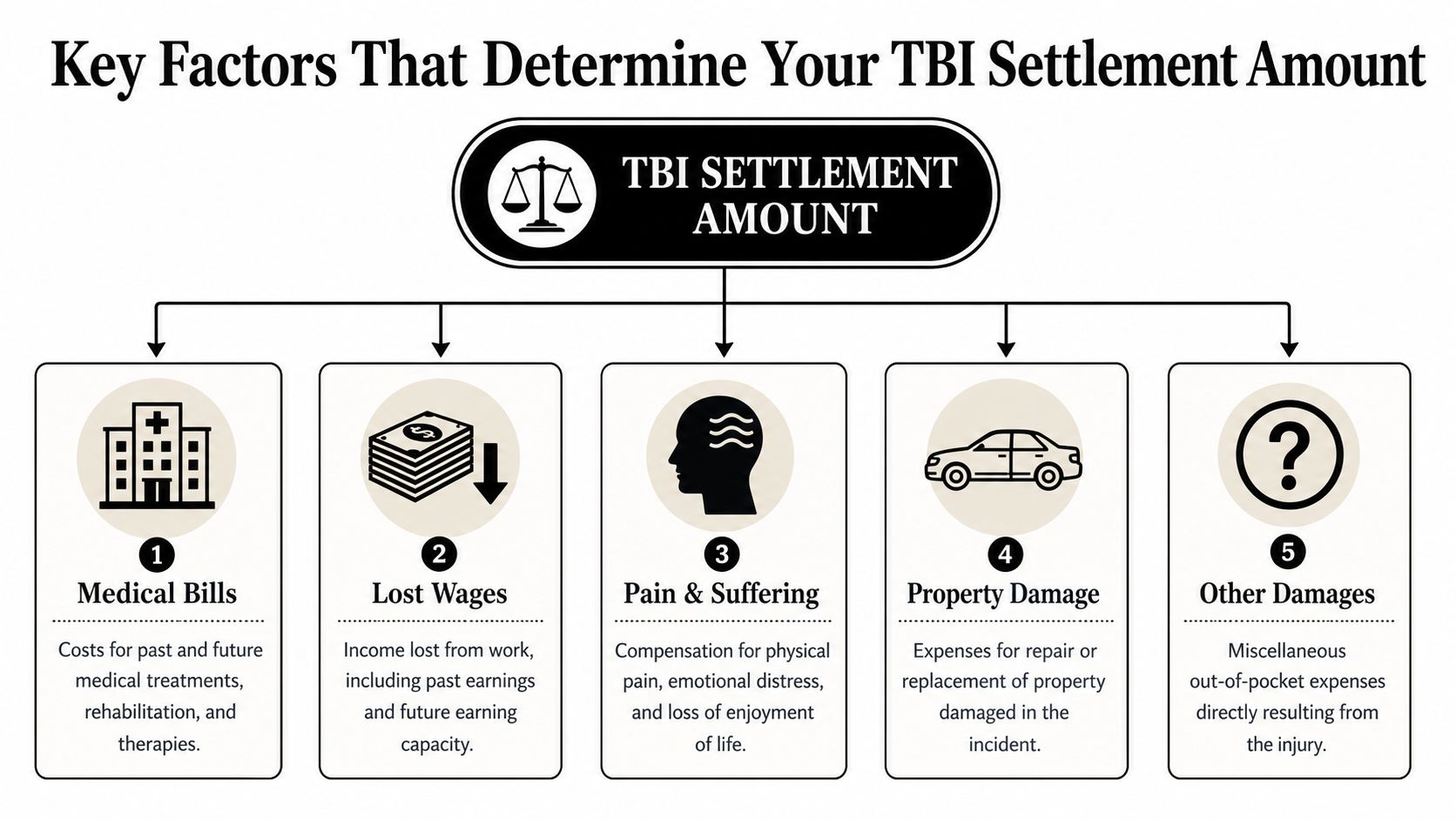
The injury itself matters, but the diagnosis alone does not decide value
Insurance adjusters often start with the medical records, but they do not stop there. A brief concussion with steady improvement usually settles differently than a brain injury that causes memory problems, headaches, poor concentration, mood changes, or trouble returning to work.
This is one reason average settlement numbers can mislead families. An “average” does not show whether the person made a full recovery, needed months of therapy, lost a career, or required help at home. It also does not show whether there was enough insurance to cover the harm, which can become one of the biggest limits on real-world recovery.
Economic damages are the losses you can measure
These are often the easiest damages to document because they leave a paper trail. They may include emergency care, hospital bills, neurologists, therapy, prescriptions, mileage to appointments, lost wages, and reduced earning capacity if the injured person cannot return to the same job.
For many Texas families, the hardest part is looking past the first round of bills. A TBI claim may also involve future treatment, cognitive therapy, in-home assistance, vocational retraining, and the cost of long-term supervision. Those future losses often require records, doctor opinions, and a clear explanation of how the injury will affect life years from now.
Non-economic damages are often the part insurers minimize
A CT scan may look normal while a person's life looks nothing like it did before the crash.
Pain, sleep disruption, irritability, depression, embarrassment, mental fatigue, loss of independence, and changes in personality can all affect settlement value. Spouses and parents usually see this first. They notice the forgotten conversations, the short temper, the missed appointments, and the fact that simple errands now take all day.
Good proof often includes:
- A symptom journal: Notes about headaches, dizziness, confusion, sensory overload, and fatigue over time
- Family or coworker observations: Before-and-after examples that show changes in memory, behavior, focus, or stamina
- Work records: Missed time, reduced duties, poor performance after the injury, or a failed return to work
- Visual exhibits: Tools such as Natomy AI medical legal visuals can help explain anatomy, treatment, and injury mechanics in a way insurers and juries can follow
The quality of your evidence can change the result
A strong claim is consistent from start to finish. The records should match the story. If the ambulance notes mention confusion, the ER records mention a head injury, follow-up visits document ongoing symptoms, and family members describe the same problems at home, the case becomes harder to dismiss.
Gaps in treatment can create trouble, even when the injury is real. Insurers may argue that the symptoms were minor, unrelated, or caused by something else. That is why careful documentation matters so much in brain injury cases, especially when the symptoms are invisible.
A “mild” TBI can still produce a serious claim
The word mild confuses many people. In medicine, “mild” often describes the initial classification of the brain injury, not the effect on the person's life.
A schoolteacher with post-concussion symptoms for eight months may struggle to manage a classroom, grade papers, and remember meetings. A delivery driver with slower processing speed may no longer be safe to work the same route. Those are real losses, even if the original diagnosis used the word mild. A broader explanation of factors that affect an injury settlement in Texas can help you see how these pieces fit together.
Insurance coverage often shapes the final number more than people expect
This is the part many online articles leave out.
A case may be worth far more than the policy the at-fault driver carries. If a driver has low limits, the settlement may be capped unless you find other sources of recovery, such as a company policy, an employer claim, underinsured motorist coverage, or another liable party. In other words, the value of the harm and the amount you can collect are related, but they are not always the same.
That is why families should be careful with average TBI settlement articles. The useful question is not just “What are brain injury cases worth?” The better question is “What is this case worth, and where can recovery come from?”
Typical TBI Settlement Ranges and Case Examples in Texas
Numbers help, but context matters more. The same diagnosis can lead to a very different outcome depending on recovery, disability, and proof.
Estimated TBI settlement ranges in Texas
According to 2025 Texas settlement data summarized by The Super Lawyer's discussion of brain injury settlements in Texas, brain injury claims often fall into these broad tiers.
| TBI Severity | Common Characteristics | Typical Settlement Range |
|---|---|---|
| Mild | Concussion, symptoms improve, full or near-full recovery | $20,000 to $150,000 |
| Moderate | Ongoing therapy, measurable cognitive or functional problems | $252,000 to $850,000 |
| Severe or catastrophic | Permanent disability, major life changes, long-term care needs | Over $1 million, often reaching $5 million or more |
These are ranges, not promises. A claim can also be limited by the insurance available, which is why raw averages can be dangerous.
Real-world examples in plain language
A teacher involved in a Houston freeway crash suffers a concussion. She misses work, treats for headaches, then returns to normal life without lasting symptoms. Her claim looks very different from someone with persistent concentration problems months later.
A construction worker in Dallas sustains a moderate TBI in a vehicle collision. He needs ongoing therapy and can't safely return to the same physically demanding job. Lost earning power becomes a major part of the case, not just the medical bills.
A college student in Austin suffers a severe brain injury after a violent crash. Daily support, future treatment, and permanent cognitive impairment shape the value of the claim because the injury affects nearly every part of adult life going forward.
Settlement ranges make more sense when you ask, “What changed in this person's life?” rather than “What label did the doctor use?”
Why examples matter more than averages
Families often come in after reading a single number online and wondering why it doesn't match their experience. That's because TBI value depends on severity, symptoms, treatment, work loss, and future needs.
If your injury began as “just a concussion,” this resource on a concussion settlement after a car accident in Texas may help you compare your situation more realistically.
How Insurance Policy Limits Can Affect Your Actual Recovery
This is the part many people don't hear until it's too late.
Your case may be worth far more than the other driver's insurance can pay. That's not fair, but it's often true.
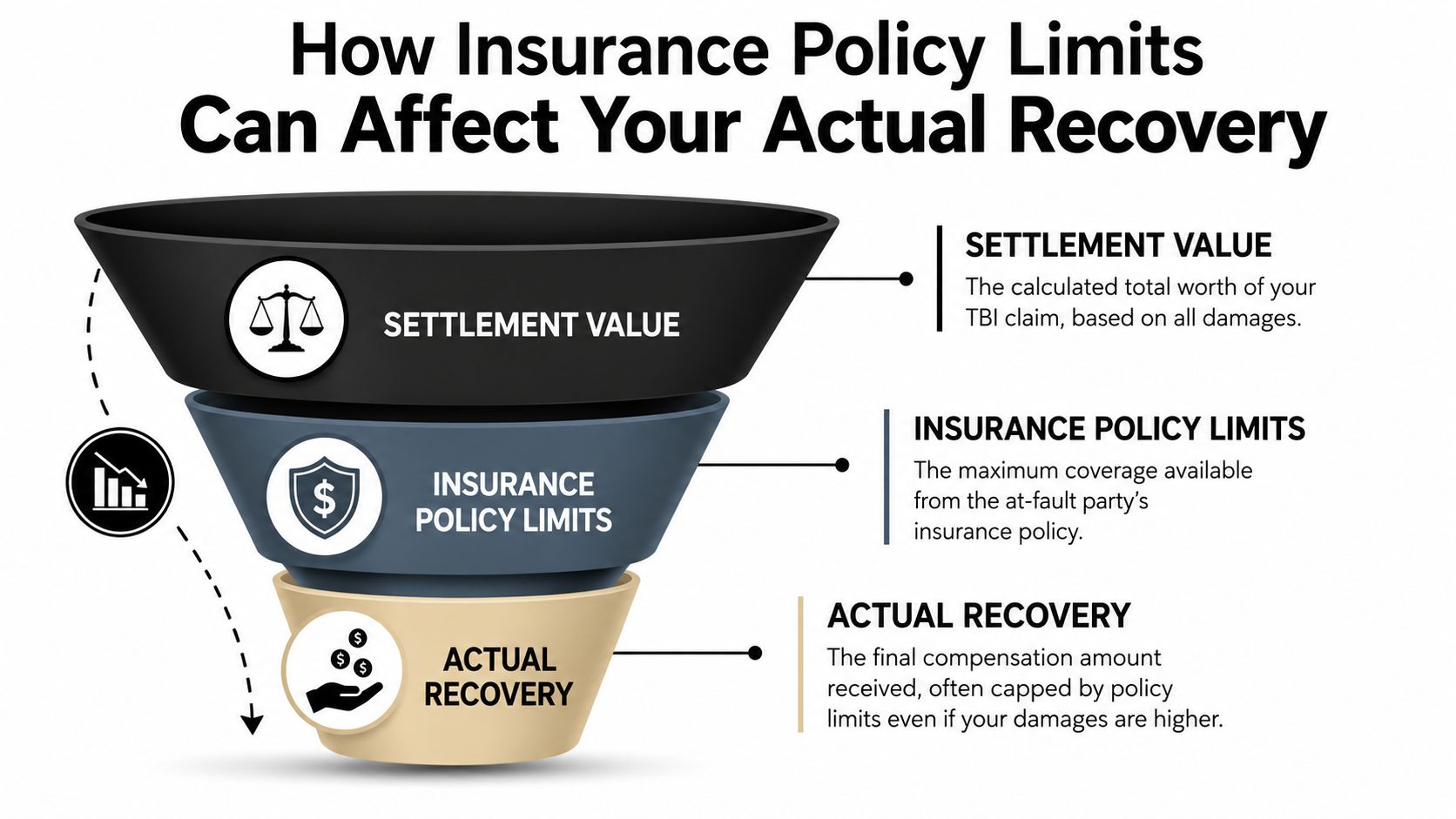
Your claim value and your recovery are not the same thing
A serious TBI can justify a very large damages claim. But if the at-fault driver only carries limited coverage, that policy can act like a ceiling.
That's why severity-based settlement articles can be misleading. As noted in Joe Lopez Law's discussion of Texas car accident settlement amounts, many Texas drivers are underinsured, and recovery may be capped by the at-fault driver's policy limit, often just $30,000, unless the injured person has underinsured motorist coverage.
In practical terms, that means a brain injury case with much higher real value may still hit an insurance wall almost immediately.
A simple example
After a wreck in Houston, a driver develops lasting cognitive issues and can't return to the same work. The damages may support a much larger claim. But if the negligent driver has only minimal liability coverage and no meaningful assets, the available recovery from that driver may be sharply limited.
That doesn't mean the case lacks value. It means the available source of payment is too small.
Where additional recovery may come from
A careful lawyer looks beyond the first insurance card handed over at the scene.
Possible recovery sources can include:
- Your own UM or UIM coverage: This may help when the at-fault driver has no insurance or not enough insurance.
- Other liable parties: In some cases, an employer, vehicle owner, trucking company, or commercial policy may be involved.
- Layered policies: Umbrella or excess coverage may exist, but someone has to investigate for it.
That's why early policy review matters so much. This guide to uninsured and underinsured coverage helps explain one of the most important protections Texas drivers have.
Why legal guidance matters here
Insurance companies rarely volunteer every possible source of recovery. You often have to ask the right questions, demand disclosures, and compare multiple policies.
If your family is focused on healing, that investigation can feel impossible. It shouldn't be your job to decode liability coverage, exclusions, or stacking issues while you're managing a brain injury. It should be your lawyer's job.
Steps to Protect Your TBI Claim and Maximize Your Settlement
In many Texas brain injury cases, the first few weeks shape the claim for months or years. Families are dealing with medical appointments, missed work, confusion, and a stack of insurance calls. At the same time, the record of what happened is being created. If that record is thin, inconsistent, or rushed, the insurer may use those gaps to argue the injury is smaller than it really is.
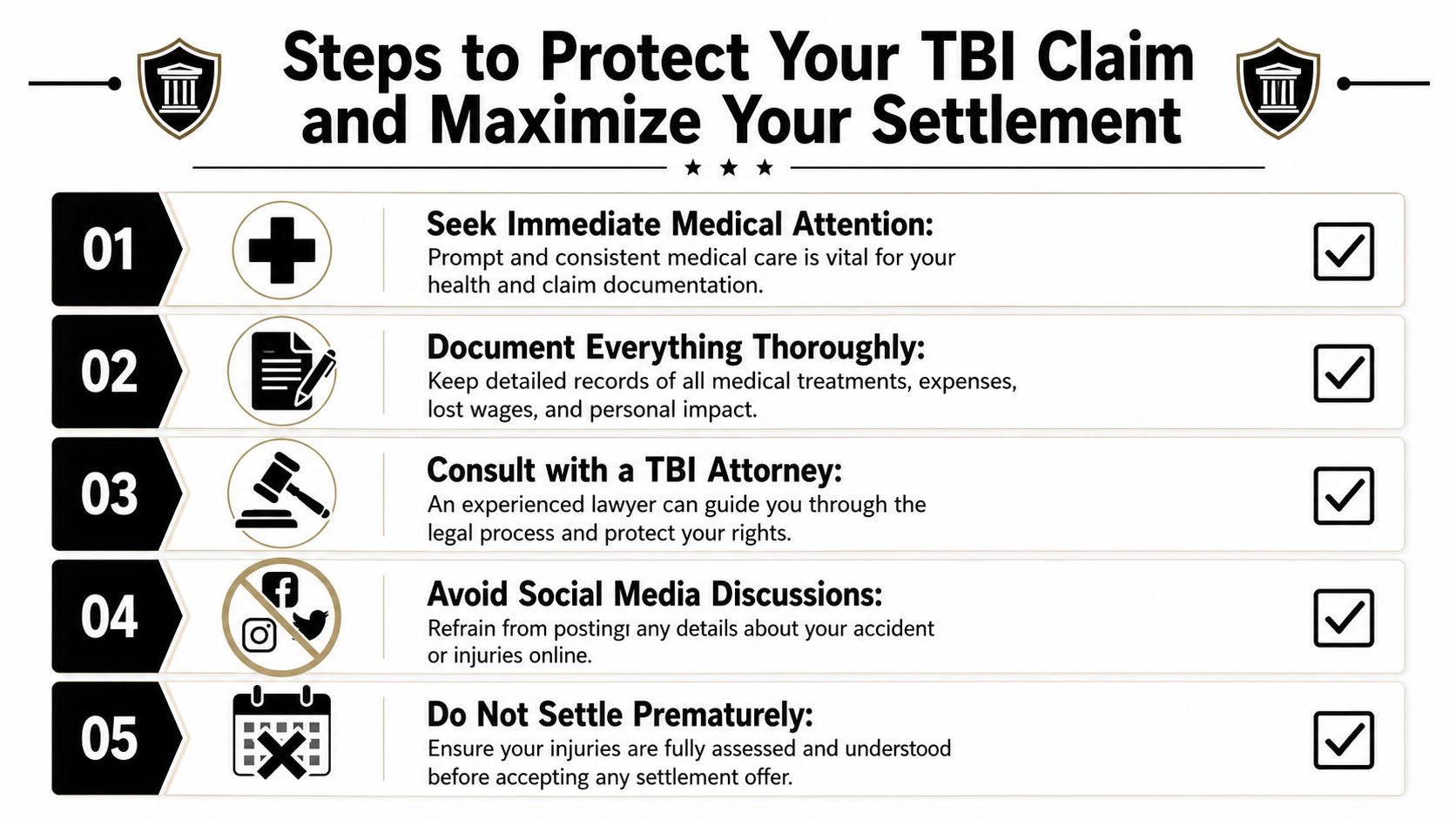
Get medical care early and follow the treatment plan
A traumatic brain injury often looks confusing at first. Someone may talk normally, answer questions, and still be dealing with memory loss, headaches, light sensitivity, mood changes, or slowed thinking. Early medical care helps protect your health. It also creates a timeline that ties the symptoms to the accident.
Keep going to follow-up visits, therapy, specialist appointments, and diagnostic testing. If treatment stops and starts, the insurance company may argue you recovered quickly or that something else caused the symptoms.
Build a simple, organized claim file
Use one folder, paper or digital, for every record connected to the injury. Save discharge papers, imaging results, bills, prescriptions, mileage, work excuses, and emails from insurers.
A short daily journal can be one of the most useful tools in a TBI case. Write down what changed. Headaches after screen time. Missed appointments. Trouble finding words. Irritability with family. Needing help with driving, cooking, or paying bills. Brain injuries are often invisible to strangers, so these day-to-day details help show the full effect on your life.
Be careful what you say to insurance adjusters
Adjusters often call before the full medical picture is clear. A recorded statement given too early can freeze your case at the worst possible moment, before you know how serious the injury is or how long recovery may take.
Give basic facts if needed, but do not guess, minimize symptoms, or agree with phrases like "you're feeling better now." If you are still being evaluated, say so. That is accurate and much safer.
Stay off social media while the claim is open
Insurance companies look for posts they can use out of context. A smiling photo at a family event does not show the migraine that followed, the ride home you could not drive, or the next day spent in bed. Still, that photo may be offered as proof that you are doing fine.
Silence is usually the safer choice.
Talk to a lawyer before accepting any settlement
Quick money can feel tempting when bills are piling up. In a TBI claim, an early offer may come long before anyone knows the cost of future care, reduced earning ability, or whether more than one insurance policy applies.
Many families get misled by online "average settlement" numbers. A claim may have serious damages on paper but limited recovery from one policy. Another case with similar symptoms may have several sources of coverage. A careful lawyer does more than argue about medical records. The lawyer looks for every available source of recovery, reviews policy limits, and checks whether other individuals, employers, business policies, or uninsured or underinsured coverage may be involved.
If you need legal help evaluating options, a Texas Personal Injury Lawyer handles representation for injury victims across Texas on a no-fee-unless-we-win basis. Depending on the facts, you may also need a Houston car accident attorney, a truck crash lawyer Houston families call after a commercial collision, or counsel for a catastrophic injury or wrongful death case involving a loved one.
You Are Not Alone Let Us Help You Recover
A brain injury claim can look straightforward at first, then become complicated very quickly. Medical proof matters. Fault matters. Insurance policy limits matter. The number you see online may have little to do with what's available in your case.
That doesn't mean you're stuck.
It means you need clear advice based on your injury, your records, and the insurance involved. Your job is to focus on treatment, rest, and your family. A lawyer's job is to investigate, preserve evidence, identify coverage, and push back when an insurer tries to undervalue what your life has lost.
Recovery is possible, even when the road ahead feels uncertain. Legal help is available, and you don't have to sort through this alone.
If you or someone you love is dealing with a traumatic brain injury after a crash in Texas, contact Law Office of Bryan Fagan, PLLC to schedule a free consultation. You can speak with a lawyer about your rights, your next steps, and whether insurance policy limits may affect your recovery. Call the firm through the contact information on the website or use the online consultation form to get started.