Skip to content
A serious accident can change your life in seconds, but you don't have to face it alone.
One moment, you're driving home on a Houston freeway, stepping off a curb in Austin, or walking through a grocery store in Dallas. The next, your ankle twists, snaps, or swells so badly that you can't put weight on it. Then the questions start. How bad is this injury? How long will I miss work? Who's paying these bills? What is a fair ankle injury settlement in Texas?
An ankle injury can sound minor until you live with one. It affects almost everything. You need your ankle to drive, stand, work, carry groceries, climb stairs, and sleep comfortably. When it's injured, your whole routine can fall apart fast.
People often come looking for a quick number. They want to know what their case is worth right now. That's understandable. But in Texas, the answer depends on much more than the name of the injury. A sprain is different from a fracture. A fracture treated with a boot is different from one that needs surgery. A case with clear fault is different from one where the insurance company tries to blame you.
Good guidance is vital. Texas law has rules that directly affect what you can recover, how insurers evaluate your claim, and how long you have to act. If you understand those rules early, you're in a much better position to protect both your health and your financial recovery.
Your Life Changed in an Instant Now What
After a Houston freeway crash, many people first notice the ankle pain when they try to get out of the car. After a fall at a store, the pain may hit before you even stand up. Either way, the first day usually feels the same. You're hurting, you're overwhelmed, and you're not sure what to do first.
That reaction is normal.
A serious ankle injury can leave you dealing with swelling, crutches, imaging appointments, missed shifts, and an insurance company that wants answers before you've even seen the full medical picture. If you're in that spot right now, you're not behind. You're just at the beginning of a process that needs to be handled carefully.
What most people are dealing with in the first week
You may be facing several problems at once:
- Medical uncertainty: What looked like a bad sprain may turn out to be a fracture or ligament damage.
- Work pressure: If your job keeps you on your feet, even a short recovery can disrupt your income.
- Insurance calls: Adjusters often reach out early, before the full extent of the injury is clear.
- Family strain: When you can't drive, cook, or move normally, people around you feel the impact too.
Early confusion is one of the biggest risks in any injury claim. People make permanent decisions while they're still learning how serious the injury really is.
In Texas, fault matters. Documentation matters. Timing matters. So does patience. Many ankle injury claims lose value because the injured person settles too soon or says too much before the evidence is in place.
Focus on recovery first, but protect the claim too
If your ankle was injured in a car wreck, truck crash, pedestrian collision, or dangerous property incident, start with medical care and basic documentation. Save discharge papers. Take photos of the swelling and bruising. Keep track of how the injury affects walking, sleeping, and working.
If your family is dealing with a fatal crash tied to a severe lower-body injury or other trauma, the same principle applies. Protecting evidence early can matter in a wrongful death lawyer Texas case just as much as it does in a nonfatal claim.
You don't need to know everything today. You just need to avoid the common mistakes that weaken good cases.
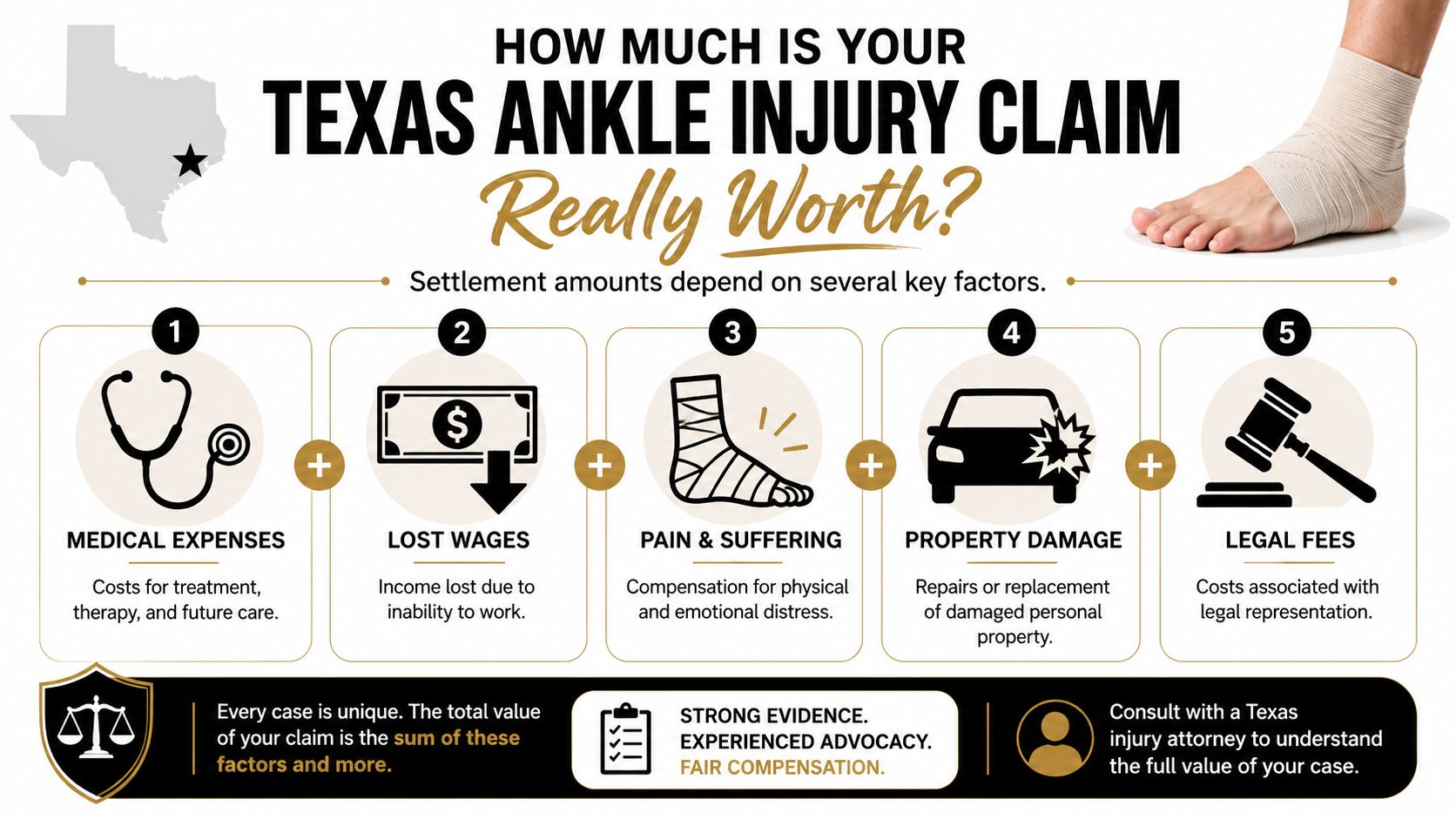
How Much Is Your Texas Ankle Injury Claim Really Worth
The value of an ankle injury claim depends on the injury itself, the treatment required, the effect on your ability to work, and how well the claim is documented. That's why online calculators often mislead people. They can't measure whether your fracture needed surgery, whether you'll need future care, or whether you can return to your normal job.
The range is wide for a reason
Texas ankle injury cases vary sharply by severity. Minor sprains might settle for $10,000 to $30,000, while severe surgical fractures like bimalleolar or trimalleolar breaks can range from $175,000 to over $600,000, especially if future ankle fusion is possible, according to this ankle and foot injury settlement guide.
That spread tells you something important. There is no single “average” that answers your case.
A low-speed rear-end crash that causes a soft-tissue ankle injury is one kind of claim. A pedestrian impact in San Antonio that leads to surgery, hardware, and long-term walking limitations is another. Both are ankle cases. They are not valued the same way.
What usually drives value
Here are the factors that tend to matter most:
- Medical treatment: ER care, orthopedic visits, imaging, therapy, and surgery all shape the claim.
- Lost income: If you can't stand, drive, or return to work, wage loss becomes part of the damages.
- Pain and daily limits: Ankle injuries affect mobility in a very visible way. Stairs, showers, school pickup, and work shifts all become harder.
- Future problems: Chronic pain, instability, arthritis, or additional procedures can increase the value of a serious case.
- Proof: Strong records usually support stronger outcomes.
For a fuller breakdown of these issues, this article on factors that affect an injury settlement in Texas is a useful starting point.
A quick example
After a Dallas intersection crash, one person may have swelling, a brace, and several weeks of treatment. Another may have a displaced fracture, surgery, months of physical therapy, and restrictions that keep them off the job. On paper, both suffered an ankle injury. In practice, the second claim will usually be evaluated very differently because the medical records tell a different story.
Practical rule: Don't measure your case against a friend's settlement unless the injury, treatment, fault issues, and work limitations were all similar. They usually aren't.
Recovery also matters. If your doctor clears movement and rehab, structured exercises can support healing. A resource like this exercise program for ankle injuries can help you understand the kind of mobility work people often discuss during recovery, though your own doctor's advice should come first.
Where legal help fits in
If you're trying to evaluate a case while you're still treating, it often helps to speak with a Texas Personal Injury Lawyer who handles injury claims on a no-fee-unless-we-win basis. That doesn't magically increase value by itself. What it does is give you a clearer read on damages, liability, records, and timing before you sign away your rights.
Inquiries about “ankle injury settlement Texas” often seek certainty. What they need is a realistic case evaluation based on records, treatment, and Texas law.
Building Your Case from Day One Documentation and Evidence
A strong claim is built with details. Not general memories. Not rough guesses. Details.
If your ankle injury happened in a car crash, truck collision, fall, or pedestrian accident, the first days after the incident can shape the whole case. Evidence disappears quickly. Bruising fades. Surveillance footage gets overwritten. People forget what they saw.

Start with the basics and save everything
Create one place for all claim-related records. A folder on your phone and a paper folder at home both work. The goal is simple. If someone asks for proof later, you already have it.
Keep these items:
- Scene photos: Take pictures of the vehicle damage, the roadway, the hazard that caused the fall, and your visible injuries.
- Medical records: Save discharge papers, imaging summaries, prescriptions, therapy notes, and specialist referrals.
- Bills and receipts: Include copays, braces, crutches, parking, medication, and mileage tied to treatment.
- Work documents: Save pay stubs, missed-day notices, work restrictions, and emails showing schedule changes.
- Witness information: Names and contact details matter more than people realize.
For a more detailed checklist, review what evidence is needed for an injury claim in Texas.
Keep a short pain journal
This helps more than is often anticipated.
Write down what the injury feels like and what it stops you from doing. Keep it plain and honest. If you had to crawl upstairs, missed your child's event, couldn't drive, or woke up from pain, note it. These daily limitations often explain the full human impact better than a billing statement can.
A useful entry might include:
- Pain level and swelling
- What you couldn't do that day
- Medical visits or therapy
- Sleep problems
- Mood or frustration tied to the injury
Follow treatment consistently
Insurance companies watch for gaps in care. If you skip appointments, ignore referrals, or stop treatment without explanation, the insurer may argue that you weren't badly hurt or that something else caused the ongoing problem.
That doesn't mean you have to chase unnecessary care. It means you should follow reasonable medical advice, communicate with your doctors, and keep records showing why treatment changed.
Missed appointments create avoidable arguments. If cost, transportation, or work conflicts are a problem, tell the provider and document that issue too.
Real-world example
After a Houston SUV crash, a client may initially think the ankle is “just sore.” A week later, swelling hasn't improved, weight-bearing is difficult, and a specialist orders more imaging. If that person documented the bruising from day one, saved the urgent care records, and reported the problem consistently, the claim is much easier to prove than if the first clear record appears weeks later.
The same principle applies in a truck crash lawyer Houston case, where the defense may already be building a story about fault and injury severity before you're even out of the boot.
Navigating Conversations with Insurance Adjusters
The insurance adjuster may sound polite, calm, and helpful. Don't mistake that tone for alignment with your interests. The adjuster works for the insurance company, and the company's goal is to resolve claims for as little as it can.

This matters in any injury case, but especially in ankle claims. Insurers often treat ankle injuries as routine until the records prove otherwise. If you minimize your pain, speculate about fault, or agree to a recorded statement too early, you can make their job easier.
What the adjuster is trying to do
Most early insurance calls are built around a few goals:
- Lock in your version early: Before imaging, specialist care, or surgery recommendations develop.
- Look for blame: Anything suggesting distraction, poor footwear, speed, lane choice, or inattention may be used against you.
- Test your patience: A quick offer can sound tempting when bills are arriving.
- Open broad medical access: The wider your records release, the more material they have to argue about preexisting issues.
If you're talking to the insurer, keep it simple. Confirm basic identifying information. Confirm where the accident happened. Confirm that you are receiving treatment. Then stop.
Phrases that usually help
You don't need a dramatic speech. You need control.
Try language like this:
- On a recorded statement: “I'm not giving a recorded statement at this time.”
- On injury details: “I'm still being evaluated and don't want to guess.”
- On settlement: “It's too early to discuss resolution before I understand my treatment.”
- On medical records: “Please send any request in writing.”
The safest answer is often the shortest true answer.
A lot of people also want to understand what happens after that first call. This short video gives useful context before you respond further.
Why early offers are risky
You usually don't know the full value of an ankle injury in the first days after a crash. Swelling can hide fractures. Instability may not be obvious until you try to return to normal activity. Surgery discussions can come later.
That's one reason representation often changes the outcome. Insurance company data shows that claimants who hire a personal injury lawyer receive settlements averaging $77,600, compared with $17,600 for people who handle claims alone, according to Atticus ankle injury settlement data.
That doesn't mean every case becomes large. It means unrepresented people often settle before the case is fully understood or properly presented.
A Houston example
After a Houston car wreck, an adjuster may say, “We understand this is a minor ankle issue, and we'd like to resolve it quickly.” If you accept that framing, you've already given up ground. If later imaging shows a fracture or persistent instability, you may be stuck with a settlement that didn't account for the actual injury.
That's why a cautious response matters. A good Houston car accident attorney can take over those communications, keep the record clean, and stop the insurer from using a rushed phone call against you.
Texas Injury Laws That Directly Impact Your Settlement
Texas law doesn't just sit in the background. It directly affects whether you can recover money, how much you can recover, and whether your claim survives at all.
Two rules matter in almost every ankle injury case. The filing deadline and the comparative fault rule.
The two-year deadline is real
Texas gives you a strict deadline to file most personal injury lawsuits. Under Tex. Civ. Prac. & Rem. Code § 16.003, you have exactly two years from the date of your ankle injury to file a lawsuit in Texas. Missing that deadline means you lose your right to sue permanently, as explained in this Texas statute of limitations overview.
People lose good claims by waiting for the “right time” to deal with the legal side. They hope the insurer will be reasonable. They wait for one more appointment, one more conversation, one more bill. Then the deadline gets close, and options shrink fast.
If you think the case may need legal action, get advice early. That doesn't mean you have to file immediately. It means you shouldn't let the clock control the case.
The 51 percent bar rule changes everything
Texas follows a modified comparative responsibility system. The basic version is commonly known: if you share fault, your compensation can be reduced. What many people don't understand is how aggressively insurers use that rule in ankle injury claims.
If you are 51% or more at fault, you recover nothing. If you are less than that, your recovery is reduced by your percentage of fault.
Here's the simple version:
| Fault finding | Effect on recovery |
|---|---|
| You are less than 51% at fault | Your recovery is reduced by your share of fault |
| You are 51% or more at fault | You are barred from recovery |
That's why fault arguments matter so much in Texas.
How insurers use partial blame
Ankle injuries often come from situations where fault isn't obvious at first. A parking lot collision. A low-speed lane change. A slip at a business entrance during bad weather. A pedestrian crossing where both sides tell the story differently.
In those cases, the insurance company may argue that you weren't watching where you were going, changed lanes unsafely, wore unsafe footwear, stepped outside a marked path, or reacted poorly. The goal is straightforward. Push enough blame onto you to reduce the payout or eliminate it entirely.
The issue is especially sharp under the 51% bar rule. Existing Texas settlement content often skips over this, even though it can make or break the case. A finding of partial fault cuts the claim by that same share. A finding at or above the threshold ends it.
If liability is disputed, the case is not only about your injury. It's also about resisting the insurer's effort to rewrite how the accident happened.
A real-world example
After an Austin pedestrian collision, suppose the total value of the claim is established, but the insurer argues you crossed while distracted and assigns you partial blame. If that fault argument sticks, your recovery drops by that percentage. If the defense pushes the number high enough, the claim disappears under Texas law.
That's why negligence evidence matters so much. Photos, witnesses, crash reports, scene conditions, and statements made in the first days can all shape fault.
If you want a clearer explanation of negligence, liability, and related claims involving car accidents, truck accidents, catastrophic injuries, or fatal crashes, speak with counsel before the insurer defines the facts for you.
Why You Don't Have to Face the Aftermath Alone
You don't have to become an expert in medical records, Texas negligence law, and insurance strategy while you're trying to heal. That's not a fair burden, and it's not one you should carry alone.
An ankle injury claim can look simple from the outside. Inside the file, it usually isn't. You may be dealing with incomplete imaging, changing treatment recommendations, lost income, fault disputes, and pressure to settle before the future is clear. The legal work matters because the mistakes are usually hard to undo.
What legal help actually changes
A lawyer's job isn't just to “file a claim.” In a serious ankle case, legal help often means:
- Preserving evidence early: Before video disappears or witness memories fade
- Organizing the medical story: So the insurer can't dismiss the injury as minor
- Managing insurer contact: So you're not boxed in by a recorded statement or rushed offer
- Evaluating fault issues: Especially when the other side is trying to push blame onto you
- Preparing for litigation if needed: Because some insurers only respond when they know the case is being built properly
This is also why timing matters. If you're wondering when to get help, review when you should contact a lawyer after an accident in Texas.
Cost should not be the reason you wait
For many injured people, the biggest hesitation is money. That's understandable. Medical bills are already arriving.
In most personal injury cases, representation is handled on a contingency-fee basis. That means you don't pay attorney's fees unless there is a recovery. A free consultation lets you ask questions, understand your options, and decide what to do next without adding another financial strain.
If your injury came from a collision involving a car, commercial vehicle, rideshare, motorcycle, or unsafe property condition, getting answers early can protect both your case and your peace of mind. The same is true if your family is facing the unimaginable and needs guidance after a fatal crash.
Recovery takes time. Legal clarity helps.
If you're dealing with ankle pain, missed work, medical treatment, and pressure from the insurance company, schedule a free consultation with Law Office of Bryan Fagan, PLLC. You can get clear answers about fault, negligence, comparative responsibility, deadlines, and your next steps under Texas law. Recovery is possible, and legal help is available when you're ready.