Skip to content
A serious accident can change your life in seconds, but you don't have to face it alone.
After a Texas crash, a knee injury can take over your daily life fast. You may be dealing with swelling, missed work, trouble walking, and the stress of calls from insurance adjusters before you even know the full diagnosis. If you're searching for answers about a knee injury car accident settlement, you're probably trying to figure out two things at once: how to heal, and how to protect your financial future.
That's a hard place to be. A knee injury often looks simple from the outside, but anyone living with one knows better. Stairs hurt. Driving hurts. Sleeping can hurt. And if your doctor starts talking about an MRI, injections, or surgery, the claim becomes more serious very quickly.
Texas law gives you the right to pursue compensation when someone else's negligence caused the wreck. A Texas personal injury lawyer can help you prove fault, document your losses, and push back when an insurer tries to downplay your injury. If the crash involved a commercial vehicle, a truck crash lawyer Houston families trust may also need to investigate company records, driver conduct, and insurance coverage. If a crash took a loved one's life, a wrongful death lawyer Texas families rely on can explain the next legal steps with care and clarity.
You Are Not Alone After a Knee Injury Accident
A Houston freeway crash can happen in a moment. One second you're heading home. The next, your knee slams into the dashboard, your car is spinning onto the shoulder, and everything feels loud, then strangely quiet.
In the first hours after a wreck, many people focus on the obvious problems. They call family, deal with police, arrange towing, and try to get home. Then the knee stiffens. By the next morning, it may be hard to stand up, bend your leg, or put weight on it.

That pattern is common. Knee injuries don't always announce themselves at the scene. A strain may improve with time, but a torn meniscus, ligament damage, or a fracture can get worse if you try to push through it.
What many Texas drivers feel right away
You may be asking yourself questions like these:
- How bad is this injury really: Pain and swelling can hide the full problem until imaging and an orthopedic exam are done.
- Who pays for treatment: Texas is a fault-based state, which means the person who caused the crash is generally responsible for the damages.
- Will the insurance company take this seriously: Adjusters often treat knee injuries as minor until strong medical records prove otherwise.
- How long do I have to act: Texas personal injury claims are also controlled by a statute of limitations, which sets a deadline for filing suit. That deadline matters, and waiting too long can put your rights at risk.
A fair claim starts with the truth about how the injury affects your life, not the insurance company's first impression of it.
Negligence is the legal foundation of your case. In plain English, that means showing another driver failed to use reasonable care and caused the crash. Maybe they were speeding through traffic near Dallas, following too closely in San Antonio, or distracted at a light in Austin. When that careless conduct causes your injury, you can seek damages for medical care, lost income, pain, and the ways the injury changed your daily life.
A Houston car accident attorney should be able to explain that process without making it harder than it already is. You deserve direct answers, practical steps, and a path forward.
How Knee Injury Settlements Are Valued in Texas
Individuals often seek a simple number. However, settlement value comes from a set of moving parts. Insurance companies, lawyers, and juries usually look at the same basic categories of harm, then argue about how serious each one is.
The two main types of damages
First are economic damages. These are the measurable financial losses tied to the crash.
- Medical bills: Emergency care, imaging, orthopedic visits, physical therapy, surgery, medication, and future treatment
- Lost wages: Income you missed while recovering
- Reduced earning capacity: When the injury limits the kind of work you can do going forward
- Future care costs: Ongoing rehab, follow-up treatment, and related needs
Second are non-economic damages. These are real losses too, even though they don't come with a single invoice.
- Pain and suffering: The physical pain of the injury and recovery
- Physical impairment: Trouble walking, climbing, kneeling, driving, or doing household tasks
- Mental and emotional strain: Frustration, stress, sleep disruption, and loss of normal routine
- Loss of enjoyment of life: When activities you used to enjoy become difficult or impossible
How the multiplier method works
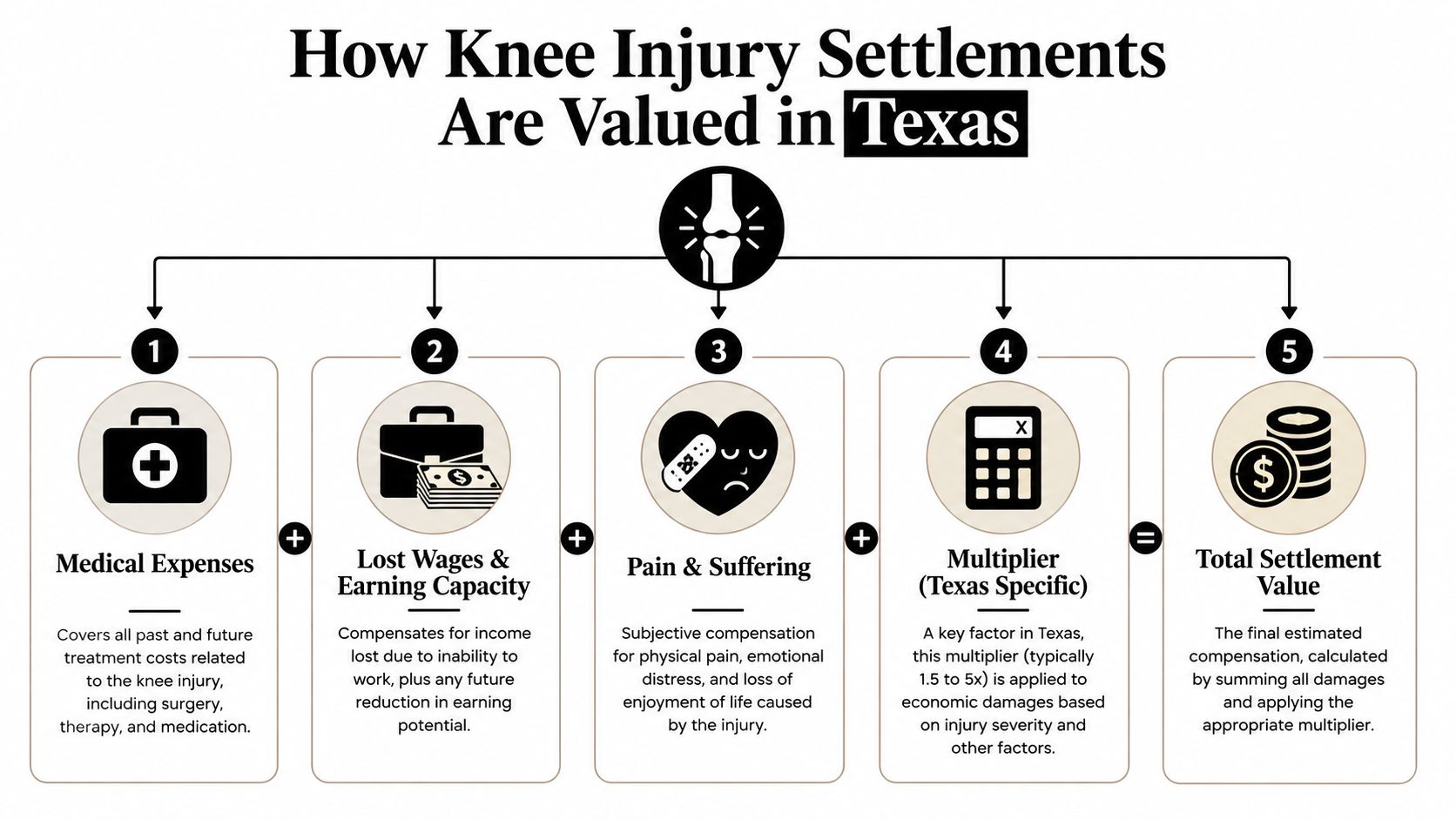
A common benchmark in injury claims is the multiplier method. According to this knee injury compensation chart explanation, the standard formula is Economic Damages × Multiplier (1.5 to 5x based on injury severity) + Economic Damages = Total Settlement, with minor soft tissue injuries often using 1.5 to 2x multipliers and catastrophic permanent injuries using 4 to 5x or higher.
A simple way to think about it is this. Economic damages are the base cost of the harm. The multiplier reflects how significantly the injury changed your life.
If your treatment is short, your wage loss is limited, and you recover well, the multiplier tends to stay lower. If you need surgery, rehab takes months, and your knee never returns to normal, the multiplier usually rises because the human impact is greater.
What affects the value under Texas law
Texas law also shapes the value of the claim itself.
Practical rule: A strong settlement usually comes from three things working together. Clear fault, strong medical proof, and consistent records of how the injury affected work and daily life.
A few legal points matter early:
- Fault matters: Texas is a fault-based system, so liability evidence is central.
- Negligence must be proven: You need evidence that the other driver caused the crash.
- Comparative responsibility can reduce recovery: If the defense argues you contributed to the wreck, that can lower the value or block recovery altogether.
- The statute of limitations matters: If settlement talks stall and suit isn't filed on time, bargaining power can disappear.
Why one knee injury claim can look nothing like another
A mild sprain and a reconstructed ACL don't belong in the same conversation. Neither do a temporary setback and a permanent mobility problem. That's why a true knee injury car accident settlement analysis focuses less on generic averages and more on diagnosis, treatment, work loss, future care, and legal risk.
This is also why early low offers are so often misleading. Before your doctors know whether the injury is structural, whether surgery is likely, and whether impairment will last, nobody can responsibly value the full claim.
Key Factors That Increase Your Settlement Value
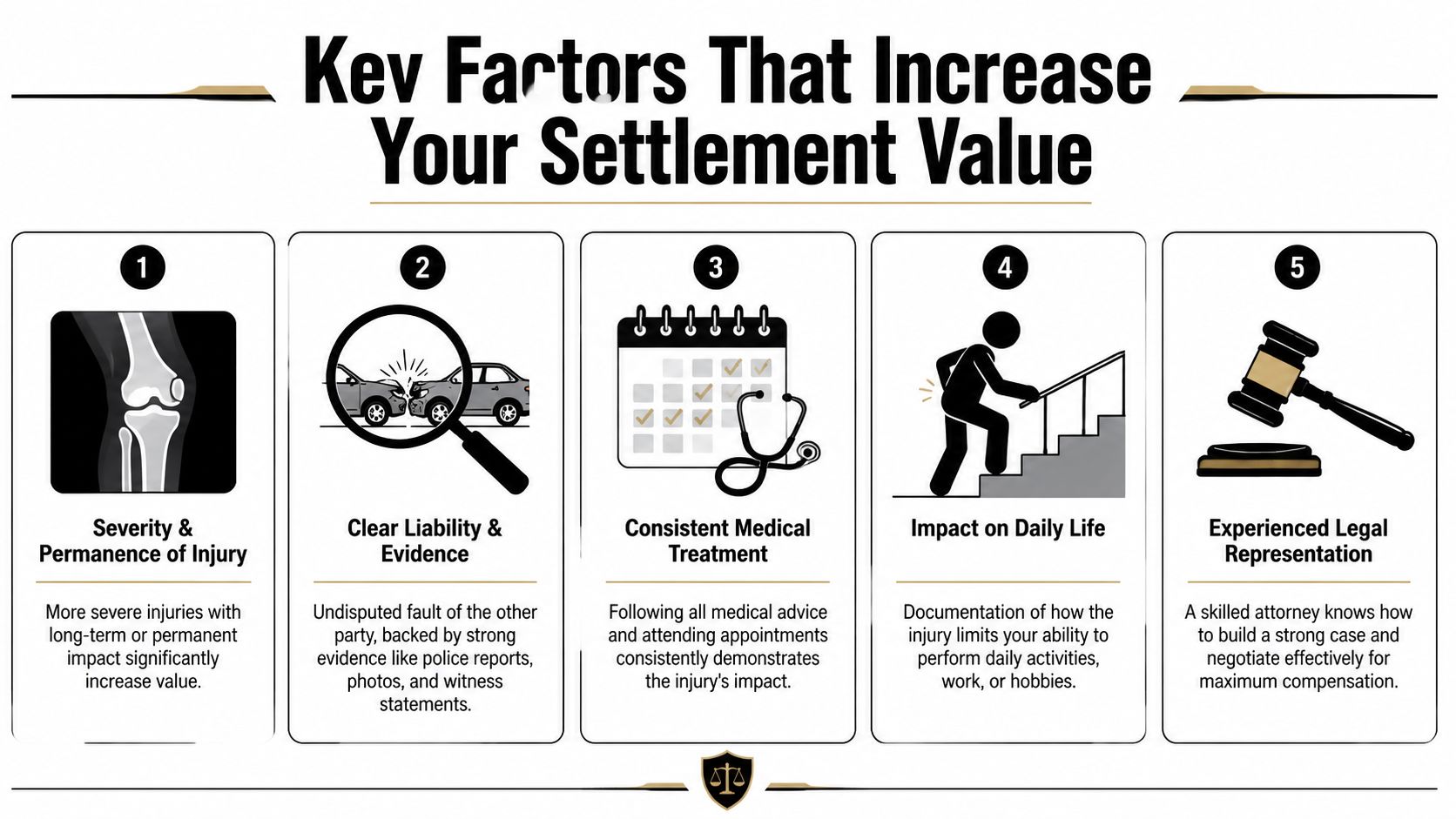
The biggest driver of settlement value is proof. Not just proof that you're in pain, but proof of what is damaged, how doctors treated it, and how the injury changed your ability to work and function.
Objective findings carry more weight
Insurance companies respond differently to a chart note that says “knee pain” than they do to MRI findings, orthopedic measurements, and surgical records. Structural damage documented by testing is harder to dismiss.
According to this discussion of how medical records affect an injury claim in Texas, good records often become the backbone of the case. In knee claims, that usually means imaging, specialist evaluations, range-of-motion findings, and a clear opinion linking the injury to the crash.
Surgery changes the conversation
Surgery often raises claim value because it confirms the injury is more than a short-term strain. It also increases medical expense, recovery time, and the chance of lasting limitations.
Published settlement data on meniscus tears reflects that difference. This analysis of meniscus and knee injury settlement outcomes states that meniscus tears treated conservatively typically range from $20,000 to $70,000, but increase to the low-to-mid six-figure range of $100,000 to $300,000+ when arthroscopic surgery is performed, with medical bills ranging from $25,000 to $60,000+.
That doesn't mean surgery guarantees a large payout. It means surgery usually gives the insurer much less room to argue that the injury was minor.
The facts that tend to push value upward
Some factors repeatedly strengthen a knee claim:
- A clear diagnosis: ACL tear, PCL tear, meniscus tear, fracture, or dislocation usually presents a stronger case than a vague sprain complaint.
- Consistent treatment: Showing up for appointments, therapy, follow-ups, and specialist care tells a coherent story.
- Documented work impact: Missed shifts, modified duties, or inability to return to prior work can materially change value.
- Permanent impairment: If the knee won't fully recover, the claim often becomes much more serious.
- Strong liability evidence: A rear-end crash with clean police findings is usually easier to value than a fact-disputed collision.
Daily limitations matter more than many people think
Juries and insurers both look at the practical effect of the injury. Can you get through a grocery store without limping? Can you kneel to help your child? Can you climb in and out of a work truck? Can you stand through a shift?
The best evidence often sounds ordinary. “I can't take the stairs normally.” “My knee gives out when I carry groceries.” “I had to stop doing part of my job.” Those details make the injury real.
If your records only show treatment dates and billing codes, part of the story is missing. The stronger claims show both the medical diagnosis and the human impact.
Common Issues That Can Reduce Your Settlement
Strong claims can still lose value. Sometimes the problem is liability. Sometimes it's a medical gap. Sometimes it's a sentence spoken too casually to an adjuster.
Texas follows the 51 percent bar rule
Texas uses modified comparative responsibility. According to this explanation of Texas comparative fault rules, an injured person can still recover damages if their responsibility does not exceed 50%, but if they are 51% or more responsible, they are barred from recovering damages.
That rule changes how a claim is handled from day one. If the other side can shift enough blame onto you, they don't just reduce value. They may eliminate the claim entirely.
A common example is a busy intersection collision in Houston where both drivers say they had the light. Another is a lane-change crash on I-35 where each side blames the other. The knee injury may be real and serious, but if fault is muddy, settlement becomes harder.
Gaps in treatment hurt credibility
Insurance carriers often attack the timeline.
If you waited too long to get checked, stopped therapy early, or missed follow-ups without a good reason, the insurer may argue one of two things:
- The injury wasn't serious
- Something else caused the ongoing symptoms
That doesn't mean every gap destroys a case. Life happens. People lose transportation, insurance issues come up, and work schedules interfere. But unexplained gaps create openings the defense will use.
Pre-existing problems and minor vehicle damage arguments
Knees are vulnerable joints. Many adults have old sports injuries, arthritis, or prior strains. Insurers know that. They often try to frame the crash as a temporary flare-up rather than a new injury or a worsening of an existing one.
They also like to point to low property damage. The argument usually sounds like this: if the cars weren't badly damaged, the knee couldn't have been badly hurt. That isn't always true, but it's a common strategy.
If you had prior knee issues, honesty helps more than avoidance. A lawyer can often build the claim around aggravation of a pre-existing condition if the records are handled carefully.
Statements that seem harmless can cost you
Be careful with early conversations. “I'm okay.” “It's just sore.” “I think I'll be fine.” People say these things out of politeness or uncertainty. Adjusters may treat them as admissions.
A Car Accident Lawyer in Texas handles representation for drivers and passengers injured in Texas car accidents. In disputed cases, that kind of representation can help organize records, preserve evidence, and respond to blame-shifting before it hardens into the insurer's settlement position.
Texas law also has a statute of limitations for personal injury lawsuits. That deadline can become critical if the insurance company delays, disputes liability, or refuses to make a reasonable offer. Waiting too long can leave you with fewer options than you had at the start.
Your Step-by-Step Guide to Maximizing Recovery
What you do in the first days and weeks after a crash can affect both your recovery and your settlement. Good cases usually aren't built by luck. They're built by clear, steady decisions.
Start with medical care and documentation
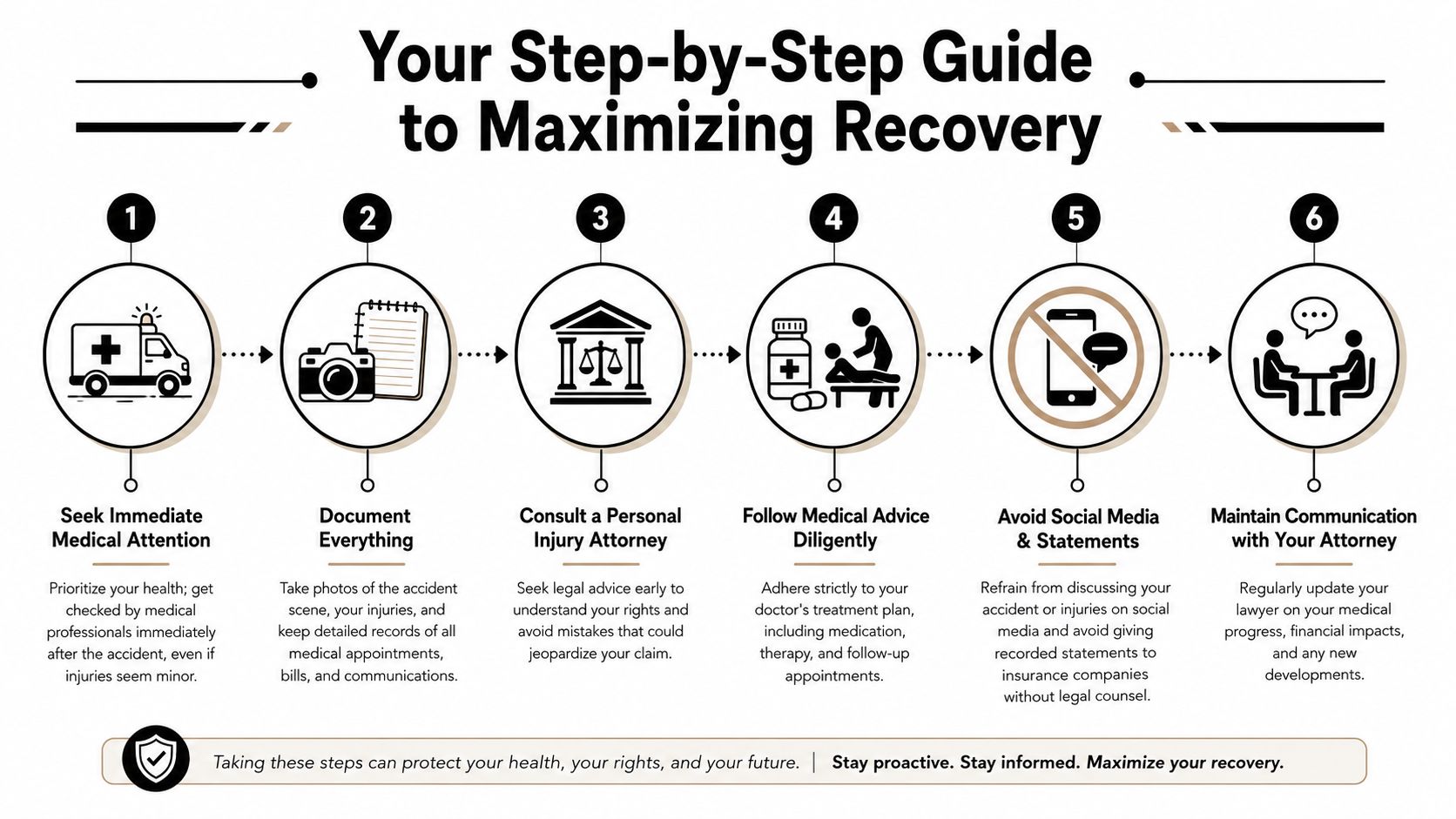
Get evaluated promptly, even if the pain seems manageable at first. Knee injuries can worsen over time, and early documentation helps connect the injury to the crash.
Then build a file.
- Take photos: The vehicles, your bruising or swelling, and the scene if you can do so safely
- Save every record: Discharge papers, imaging reports, prescriptions, therapy instructions, and bills
- Track your symptoms: Note pain, instability, sleep problems, missed work, and daily limitations
If you want a plain-language overview of the personal injury claims process, that guide can help you understand how medical treatment, documentation, and negotiation fit together after a crash.
Be careful with insurance communication
Report the collision to the proper insurer, but don't guess about your medical condition. If the at-fault insurer asks for a recorded statement, slow down and get legal advice first.
A short answer is usually safer than a broad one. You don't need to minimize your pain, and you don't need to predict your recovery before your doctors know what's wrong.
A Texas Personal Injury Lawyer provides representation for injury victims across Texas on a no-fee-unless-we-win basis. For many people, that means the lawyer can take over insurer communication while the client focuses on treatment.
Here is a helpful video that walks through common post-accident issues:
Follow treatment and protect the record
This part matters more than people think. If your doctor recommends physical therapy, specialist follow-up, bracing, imaging, or restrictions, take those instructions seriously.
Use this checklist:
Attend appointments consistently
Missed visits give insurers room to argue you recovered sooner than you did.Tell your doctors exactly what you can't do
If stairs hurt, if your knee buckles, or if work tasks are impossible, say so clearly.Keep wage-loss proof
Save pay stubs, attendance records, and any note showing reduced duties or missed shifts.Stay off social media when possible
A single photo taken out of context can create needless disputes.
You can also review practical ways to maximize a personal injury settlement in Texas if you want a broader strategy beyond knee-specific issues.
Don't ignore liens and benefit issues
This is one of the most overlooked parts of a settlement. Gross recovery and net recovery are not the same thing.
Medical providers, health plans, and government benefit programs may have reimbursement rights. Medicaid issues deserve special attention. This Medicaid planning discussion about personal injury settlements notes that a settlement can affect eligibility, and that for Texans relying on Medicaid, a $150,000 settlement could wipe out healthcare access if it isn't properly structured or used to address medical liens first.
That can be devastating if you still need surgery, therapy, or follow-up care.
Don't evaluate a settlement by the headline number alone. Ask what liens must be paid, whether benefits are at risk, and what you will actually keep.
Know when to call a lawyer
You should strongly consider legal help when any of these are true:
- Surgery is being discussed
- Fault is disputed
- You're missing work
- The insurer is pushing a fast settlement
- You have Medicaid, Medicare, or major medical liens
- The crash involved a commercial truck or a fatality
That doesn't mean every case has to become a lawsuit. It means early guidance often prevents expensive mistakes.
Sample Knee Injury Settlement Scenarios in Texas
Settlement numbers make more sense when you see how facts change the outcome. These examples are illustrative, but they mirror the kinds of patterns lawyers see in real Texas claims.
Scenario one with a milder knee injury
After a Houston rear-end collision, a driver develops knee pain and swelling from bracing at impact. Urgent care documents the injury, physical therapy follows, and the symptoms improve without surgery.
This kind of claim usually depends on consistency. If the person sought treatment quickly, followed medical advice, and had clear proof the other driver caused the crash, the case can still resolve fairly. But if treatment is spotty, the insurer will likely argue the injury was temporary and limited.
Scenario two with a torn meniscus and surgery
After a Dallas highway crash, a passenger is diagnosed with a torn meniscus. Conservative care doesn't solve the problem, so arthroscopic surgery is performed. The person misses work and struggles with stairs for months afterward.
A knee injury car accident settlement often becomes much more valuable. Surgery creates objective proof of structural injury. It also gives the claim a clearer timeline of medical care, pain, restrictions, and recovery.
For additional reading on related lower-extremity claims, see leg injuries from car accidents in Texas.
Scenario three with a catastrophic truck wreck injury
Near Austin, a driver is hit by a large commercial vehicle and suffers a severe knee injury requiring extensive treatment. The records show major structural damage, prolonged rehabilitation, and lasting limitations that affect future work.
These are the cases that often drive average verdict numbers upward. According to published verdict data on knee injury settlements and verdicts, the median jury verdict for knee injuries in car accident cases is $94,406, the middle 50% fall between $26,255 and $216,726, and the average jury verdict is approximately $360,000, which shows how catastrophic cases can sharply skew the average.
That spread matters. The median often reflects a more typical result. The average includes the unusual high-value cases that involve much more serious damage.
Estimated Texas Knee Injury Settlement Ranges by Severity
| Injury Type | Treatment | Typical Settlement Range |
|---|---|---|
| Minor soft tissue injury | Conservative care | Around $20,000 average for minor soft tissue injuries in Texas |
| Moderate knee injury requiring surgery | Surgical repair | Approximately $45,596 average in Texas |
| Torn meniscus without surgery | Conservative care | $15,000 to $50,000 |
| Torn meniscus with arthroscopic surgery | Surgical treatment and recovery | $50,000 to $200,000 |
The lesson isn't that your claim will land in one exact slot. It's that diagnosis, surgery, permanency, and work loss move the number far more than guesswork or internet averages.
Why You Need a Texas Personal Injury Lawyer for Your Claim
A lot of knee injury cases look straightforward in the first week after a crash. Then the insurance company claims your knee problem was preexisting, argues you stopped too long at treatment, or says you were partly to blame for the wreck. In Texas, that is not a side issue. If the evidence puts you at 51% fault, you are barred from recovery.
That is why legal help affects more than paperwork. A lawyer's job is to build the parts of the claim that control value under Texas law: fault proof, medical support, future treatment evidence, lost income, and lien resolution. I have seen cases where the proposed settlement sounded decent until Medicaid, medical bills, and reimbursement claims were addressed. What matters is the amount you keep, not just the number on the release.
Representation also changes how the insurer evaluates risk. As noted earlier, published claim data shows represented injury victims often recover more than people who handle claims alone. The reason is practical. Insurers respond differently when the file is organized, the records are complete, the damages are documented, and the other side is prepared to try the case if the offer stays too low.
Knee claims often turn on details injured people do not know they need to prove. A lawyer can gather orthopedic records, connect the crash to the knee condition, answer arguments about degeneration, document work restrictions, and address whether future injections, surgery, or permanent limitations belong in the demand.
Timing matters here too. Knee injuries can worsen over time, and gaps in care give insurers an opening to argue the crash was not the actual cause. Early legal guidance helps protect evidence and keeps you from settling before the full medical picture is clear.
The Law Office of Bryan Fagan, PLLC handles Texas personal injury matters involving car accidents, truck crashes, wrongful death claims, and catastrophic injuries. If you are dealing with a painful knee injury and an uncertain claims process, a free consultation can help you understand how Texas comparative fault rules, medical evidence, and Medicaid liens may affect your final recovery. Learn more at https://texaspersonalinjury.net.