A serious accident can change your life in seconds, but you don’t have to face it alone.
After a crash, individuals aren’t thinking about legal strategy. They’re trying to get medical care, explain missed work, answer calls from insurance adjusters, and figure out how the bills are going to get paid. In Texas, that pressure often starts fast. A Houston driver may still be sore from a freeway collision when the adjuster calls asking for a recorded statement. A family in Dallas may still be arranging a funeral after a fatal truck wreck when an insurer starts asking questions that feel polite, but are really designed to limit exposure.
One of the first ways a Texas personal injury lawyer takes control of that chaos is with a lawyer letter of representation. It’s a formal notice that tells the insurance company and other involved parties that you now have counsel, and that all communication must go through your lawyer. That one move can change the tone of the entire claim.
You Don’t Have to Face the Insurance Company Alone
A woman is rear-ended on I-10 in Houston. By the next morning, her neck is stiff, her car is in the shop, and the other driver’s insurer is calling. The adjuster sounds friendly. They say they just need her side of the story. They ask whether she’s “feeling a little better today.” They ask whether she might have stopped suddenly.
That’s how many injury claims begin. Quiet pressure. Casual questions. Early attempts to lock in facts before you know the full extent of your injuries.

The first real shift in power
A lawyer letter of representation is often the first document that tells the insurer the conversation has changed. You’re no longer handling the claim alone. A lawyer now speaks for you, requests records, preserves evidence, and sets boundaries.
That matters because represented claimants generally do better than people who try to handle serious injury claims on their own. As discussed in analysis of how and why legal representation matters, represented injury victims are far more likely to secure favorable outcomes, and unrepresented claimants may settle for up to 50% less on average.
Practical rule: If the insurer is moving quickly, you should assume they’re trying to shape the claim before the evidence and medical picture are complete.
Why this feels like relief for many families
The benefit isn’t only legal. It’s practical.
Once your lawyer sends the letter, you no longer have to field every call, wonder whether you should answer a claims email, or worry that one poorly worded sentence will hurt your case. Your focus can return to treatment, your family, and your recovery.
This is especially important after serious crashes involving:
- Houston car accidents: where liability can look simple at first, then become disputed after witness statements and scene evidence are reviewed
- Truck collisions: where a trucking company may control critical evidence such as logs, maintenance records, and onboard data
- Wrongful death claims: where grieving families need protection from insurer pressure during the hardest weeks of their lives
If you’re trying to understand the broader tactics insurers use when evaluating and denying claims, a plain-English review of common insurance claim denial reasons can help you see why early legal boundaries matter.
What this step really means
A lawyer letter of representation is not a lawsuit. It doesn’t mean you’re being aggressive for no reason. It means you’re taking your rights seriously.
In Texas, fault, negligence, and comparative responsibility can all shape the value of a case. The earlier your lawyer starts controlling communication and preserving proof, the better your position usually is. That’s true whether you’re looking for a Houston car accident attorney, a truck crash lawyer Houston, or guidance from a Texas personal injury lawyer after a catastrophic injury.
What Is a Lawyer Letter of Representation
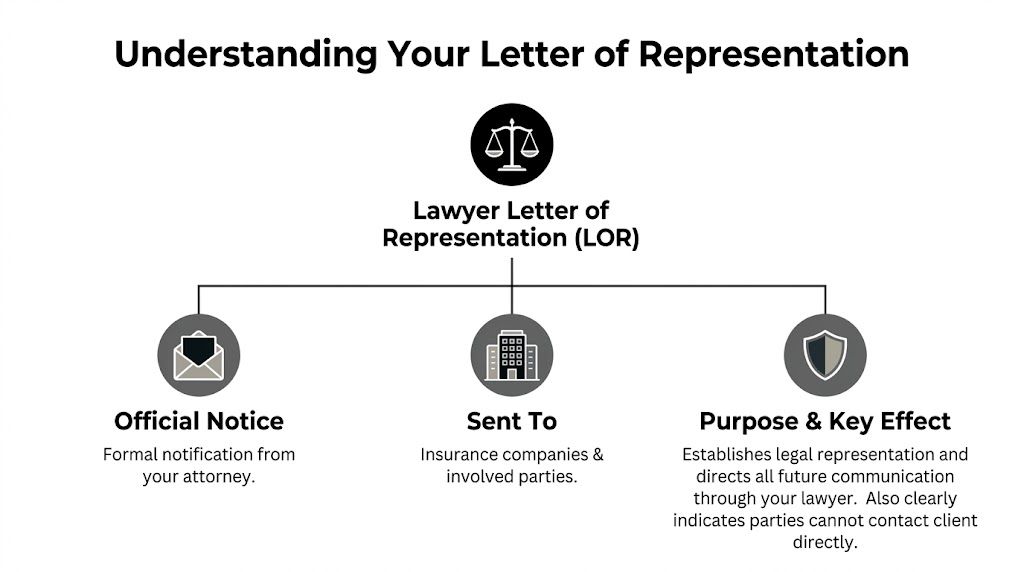
A lawyer letter of representation is the formal written notice your attorney sends after you hire them. In plain English, it tells the insurance company and other involved parties: this injured person now has legal counsel, and future communication must go through that lawyer.
It’s one of the first meaningful documents in a personal injury claim because it marks the start of an organized case. The insurer is no longer dealing directly with a stressed accident victim. It’s dealing with a legal representative who understands how claims are investigated, valued, and disputed.
What the letter usually includes
The exact wording can vary by case, but a proper letter commonly includes the core information the insurer needs to identify the claim and respect the representation.
A strong letter often contains:
- Your identifying details: your name, contact information, and the accident date and location
- Claim information: claim number if one already exists, plus the parties involved
- Attorney contact information: who the insurer must contact from this point forward
- A no-direct-contact instruction: a clear direction that the insurer should stop communicating with you directly
- An evidence preservation request: notice that important records, footage, vehicle data, and related materials must be preserved
- A document request: a demand that claim materials and future correspondence be sent to counsel
Why it’s more than paperwork
People sometimes assume this is just an administrative letter. It isn’t. It’s a strategic opening move.
Suppose a family is dealing with a major truck crash on I-45 near Houston. The trucking company may have records tied to driver activity, maintenance, dispatch, and vehicle systems. The insurance company may already be evaluating exposure. If counsel sends a prompt representation letter, it helps set professional boundaries and puts preservation demands in writing early.
That early intervention matters. In Texas personal injury practice, the letter serves as a foundation of the attorney-client relationship and notifies all parties, including the at-fault driver’s insurer and your own UM/UIM carrier, that your lawyer controls communications. According to this explanation of attorney letters of representation, represented injury victims often secure 3-4 times more in settlements than people negotiating alone.
The letter tells the insurer you are no longer an easy target for rushed statements, pressure calls, or quick undervalued offers.
Who receives the letter in a Texas case
In a straightforward two-car collision, the letter may go to the at-fault driver’s liability insurer and sometimes your own carrier. In a more complex case, the list expands.
Depending on the facts, your attorney may send it to:
| Recipient | Why they matter |
|---|---|
| At-fault driver’s insurer | They evaluate liability and damages |
| Your UM/UIM carrier | They may owe benefits if the other driver lacks enough coverage |
| Commercial insurer | Common in truck, delivery, or company-vehicle wrecks |
| Employer or business representatives | Relevant in work-related or fleet cases |
| Other counsel or parties | Helps establish formal notice across the claim |
What it is not
A representation letter is not the same thing as a demand letter.
A representation letter starts control and protects the claim. A demand letter usually comes later, after the evidence and medical records are developed, and it sets out liability, injuries, damages, and the compensation being sought. Keeping that distinction clear matters because timing matters. Sending a demand too early can undervalue a serious case. Sending a representation letter too late can leave you exposed during the most vulnerable part of the claim.
Why Texas clients benefit from sending it fast
Texas is a fault-based state. To recover compensation, you usually need to prove another party’s negligence and defend against arguments that you caused some of the crash. If evidence disappears or your statements are taken out of context, that task gets harder.
That’s why a lawyer letter of representation often becomes the first real protective step after a serious wreck, a catastrophic injury, or a fatal collision handled by a wrongful death lawyer Texas families can trust.
The Immediate Legal Effects of Sending the Letter in Texas
Once the representation letter is sent and received, the case changes in practical ways right away. The biggest change is control. The insurer should no longer be trying to manage you directly. It must deal with your lawyer.

Direct adjuster pressure should stop
Texas personal injury claims often start with calls that sound routine. The adjuster says they just need a few details. They ask whether you saw the other car. They ask if you were in a hurry. They ask if you’ve had similar pain before.
After a valid letter of representation is delivered, those conversations should go through counsel. That boundary is tied to Texas Disciplinary Rules of Professional Conduct 4.02, which generally prohibits communication with a represented person without consent from that person’s lawyer. In practice, that means the insurer’s side is on notice that direct contact is off-limits.
According to this Texas-focused discussion of representation letters, Texas insurers often reassign represented claims to litigation units and may increase reserves 2-3x after receiving the letter. The same source states that 91% of represented victims receive a payout, compared to 51% of unrepresented claimants, with net recoveries three times higher after fees.
Evidence preservation becomes harder to ignore
This is one of the most important effects in a serious injury case.
In a simple car crash, evidence might include photographs, witness information, and vehicle damage documentation. In a truck case, it can include far more: onboard data, inspection history, maintenance records, internal reports, and communications tied to the trip. In a wrongful death claim, preserving that evidence can shape the entire case.
Texas negligence law depends on proof. You need evidence to show what happened, why it happened, and how the other party’s conduct caused the harm. You also need that proof to answer comparative responsibility arguments. If the defense says you were partly at fault, your evidence is what allows your lawyer to challenge that.
When evidence disappears early, the defense gains room to argue. When evidence is preserved early, your lawyer gains room to prove.
Why file handling changes after representation
Unrepresented claims are often handled with a different rhythm. The insurer may move quickly, test your knowledge, and see whether a low offer will close the file.
Represented claims usually go on a different track. The adjuster knows someone is gathering records, reviewing policy language, and preparing the case with litigation in mind if needed. Even when the case settles without trial, the insurer treats the file differently because the risk analysis changes.
That shift can matter in cases involving:
- Rear-end crashes with disputed injuries
- Commercial vehicle collisions with multiple insurers
- Drunk-driving wrecks where punitive facts may affect negotiation
- Fatal Texas crashes handled by a wrongful death lawyer Texas families retain after sudden loss
The letter also helps frame future disputes
Not every insurer responds cleanly. Some acknowledge the letter and cooperate. Others delay, request broad authorizations, or issue coverage-related correspondence that creates confusion.
If you later receive a coverage letter from an insurer, it may help to understand how a reservation of rights letter works in a Texas injury claim. That issue is separate from representation, but the two often appear in the same file when liability or coverage is contested.
After the letter goes out, the legal work also starts accelerating behind the scenes. This overview gives a useful look at how accident claims are positioned early in the process.
How this fits with Texas fault and comparative responsibility
Texas follows a fault-based approach in injury cases. The party who caused the wreck is generally responsible for the resulting damages. But insurers often try to reduce what they pay by shifting some blame onto the injured person.
That’s where early legal action matters. A prompt representation letter helps preserve the proof your lawyer may need to show:
- Negligence: the other driver, trucking company, or business failed to act reasonably
- Causation: that failure caused your injuries
- Damages: your medical bills, lost wages, pain, and future losses are tied to the crash
- Comparative responsibility defense: attempts to blame you are unsupported or overstated
The letter itself doesn’t win the case. It creates the conditions for a stronger case. In Texas personal injury practice, that’s often the difference between reacting to the insurer’s timeline and forcing the claim to proceed on your terms.
Your Role and What to Expect After We Send Your Letter
A lot of clients have the same concern after signing up. They want to know whether they still have to deal with adjusters, paperwork, and constant follow-up while trying to heal.
In a well-run Texas injury case, the pressure shifts off you quickly. After we send the representation letter, the insurance company should route calls, letters, and claim questions to your lawyer. That matters in Houston, Dallas, and smaller Texas markets alike, but it matters even more in truck wreck and wrongful death cases where a carrier or corporate insurer may start building its defense early.
What you need to do first
Your part is important, but it is manageable.
Give a clear timeline of what happened
Share how the wreck happened, where it happened, what symptoms started right away, and which insurers have contacted you.Sign the representation agreement
In many Texas personal injury cases, the fee is contingent on recovery. You are not paying an hourly bill while the case is being investigated.Send over the documents already in your hands
That may include crash report information, photos, tow records, hospital paperwork, health insurance cards, auto policy information, and any letters or emails from adjusters.Stay off claim discussions
Do not give casual updates to the other driver’s insurer. Do not try to explain your injuries in a quick phone call. Once counsel is hired, those conversations usually create more risk than benefit.
What your legal team should do next
Good lawyers do not send the letter and then sit still. The first days usually set the tone for the whole claim.
After being retained, counsel should send the representation notice promptly, identify every relevant insurance carrier, and start gathering the records that will matter later. In a standard car wreck, that often means the police report, vehicle photos, witness information, and medical records. In a truck crash, it may also mean preservation letters for driver logs, electronic data, dispatch records, maintenance files, and onboard video. In a wrongful death case, the file often expands fast because liability, coverage, and family damages all need immediate attention.
As noted by Naqvi Injury Law, represented injury claimants often recover more than unrepresented claimants, but the practical reason is straightforward. Early legal work usually means better control over evidence, fewer harmful client statements, and a clearer damages record.
Your main job during this stage is simple. Get medical care, follow treatment advice, keep your lawyer updated, and save documents.
What usually changes right away
The first change many clients notice is quiet.
The repeated adjuster calls often stop. Mail starts going to counsel. Questions that used to hit your phone now go through the office handling your case. That does not mean the claim is stalled. It means the insurer has been told, in writing, to deal with counsel instead of trying to manage the claim through you.
For serious injury cases, that change is more than a convenience. It protects the file from rushed statements, partial medical updates, and pressure to settle before the full picture is known.
A realistic Texas example
Take a Dallas collision involving a passenger vehicle and a delivery truck. In week one, it may look like a property-damage case with an emergency room visit. By week four, the client may still be in treatment, missing work, and hearing the insurer hint that they were partly at fault.
That is why prompt legal control matters. By the time the medical story becomes clearer, your lawyer should already be handling communications, preserving proof, and preparing the claim for a proper demand package. If you want to see how that later stage is usually organized, this Texas personal injury demand letter example helps show what the insurer will eventually be asked to evaluate.
What helps your case and what hurts it
Small decisions can affect the value and credibility of a claim.
| Action | Why it helps |
|---|---|
| Following treatment recommendations | It creates a consistent medical timeline |
| Saving receipts and out-of-pocket expense records | It supports the damages claim |
| Reporting new symptoms promptly | It keeps the medical chart accurate |
| Forwarding insurer letters to counsel | It helps avoid missed deadlines or careless responses |
Problems usually start in familiar ways:
- Skipping treatment without a reason: insurers may argue your injuries were minor or resolved quickly
- Posting online about the wreck or your activities: defense lawyers may take statements or photos out of context
- Talking to an adjuster after representation begins: one loose comment can create a dispute your lawyer now has to fix
- Waiting too long in a complex case: delay can cost proof, options, and a cleaner liability record
For people comparing options, Law Office of Bryan Fagan, PLLC handles Texas vehicle accident and injury claims, including car, truck, catastrophic injury, wrongful death, and UM/UIM matters, with consultation and contingency-fee representation.
If the case does not settle fast
A slower case is not necessarily a weaker case.
In many Texas injury claims, especially those involving surgery, future care, trucking issues, or disputed fault, an early settlement offer is often built around incomplete information. A careful lawyer will usually wait until the medical course makes sense and the damages can be valued with more confidence. That approach can feel slow, but it often protects clients from signing away a claim before the actual losses are known.
Sample Letter of Representation and Key Phrases Explained
The best way to understand a lawyer letter of representation is to see what it sounds like in plain English. The exact wording will vary by case, but the structure is usually recognizable.
A simplified sample
Re: Our representation of [Client Name]
Date of loss: [Accident Date]
Location: [City, Texas]
Claim number: [If known]Please be advised that our office represents the above-named client regarding injuries arising from the motor vehicle collision referenced above. Effective immediately, please direct all future correspondence, telephone calls, and requests for information to our office.
Please preserve all evidence related to this incident, including recorded statements, photographs, video, vehicle data, maintenance records, driver logs, investigative materials, and policy information.
Kindly provide confirmation of coverage and forward all relevant claim documentation to our office.
Thank you.
What the key phrases actually mean
Some lines look formal, but each one does real work.
Please direct all future correspondence to our office
This is the boundary-setting language.
It tells the insurer they are not to keep contacting you directly about the claim. In a Texas car wreck case, that can stop the cycle of repeated calls asking for a recorded statement or broad medical authorizations.
Please preserve all evidence related to this incident
This is the preservation clause.
In a truck crash on a Dallas highway, this language can become very important. It puts the other side on written notice to preserve the material that may prove negligence, such as records tied to the vehicle, the driver, and the company’s handling of the trip.
A preservation request won’t fix lost evidence after the fact. It helps your lawyer create a record early, before the defense claims the evidence is gone.
Kindly provide confirmation of coverage
This helps your lawyer identify the insurance picture.
That may sound routine, but it matters in real cases. A crash can involve multiple policies, commercial layers, or your own uninsured or underinsured motorist benefits. Without that information, it’s harder to evaluate the full path to recovery.
Re line with date and location
This identifies the event cleanly.
Insurers handle many claims at once. A clear reference line reduces confusion and helps prevent the carrier from later claiming it didn’t understand which incident or claimant the letter addressed.
Why this letter is different from a demand letter
The representation letter opens the file and secures the communication channel. A demand letter comes later, after the evidence and damages are developed.
If you want to see how that later stage usually works, this guide to a sample personal injury demand letter in Texas is a useful companion. The two documents serve different purposes, and sending the wrong one at the wrong time can weaken your position.
What you should notice as a client
You don’t need to memorize legal phrases. What matters is understanding the function behind them.
A well-drafted lawyer letter of representation tells the insurer four things at once: this person has counsel, direct contact must stop, evidence must be preserved, and the claim will now proceed through a professional legal process. For an injured driver, a grieving spouse, or a family looking for a truck crash lawyer Houston residents can call after a major wreck, that is often the first moment the case begins to feel manageable.
Navigating Timelines and the Texas Statute of Limitations
A case can look strong on day one and become much harder to prove six months later.
In Texas, the statute of limitations for many personal injury and wrongful death claims is generally two years. In plain terms, that usually means a lawsuit must be filed within that window or the claim can be lost. For families in Houston, Dallas, and across Texas, that deadline matters in car wreck cases, truck crashes, and wrongful death claims alike.
The filing deadline is only part of the problem. Evidence starts changing much sooner.
Skid marks fade. Surveillance footage gets deleted. Vehicles are repaired, sold, or destroyed. In commercial truck cases, driver logs, onboard data, dispatch records, and maintenance documents may not stay available unless someone requests and presses for them early. In a wrongful death case, the same delay can make it harder to secure statements, scene evidence, and the records needed to prove both liability and the full loss to the family.
Insurance companies know this. If they can run time off the clock while the evidence gets thinner, the value of the claim often drops.
Why early action matters before any lawsuit is filed
A lawyer letter of representation does more than announce counsel. In the right case, it starts the timing strategy.
Once we send that letter, we can identify the correct carriers, confirm claim numbers, request policy information, and begin pushing for preservation of evidence before the insurer shapes the story around incomplete facts. That matters in Texas because comparative fault arguments show up early. If an adjuster can pin part of the blame on you before the evidence is gathered, settlement discussions usually get harder.
Early action also helps with medical proof. Long gaps in treatment give the defense room to argue that the injury was minor, unrelated, or made worse by something else. That argument appears in routine car wreck claims and in high-damage truck cases.
Government cases can have much shorter notice deadlines
Some claims do not wait for the standard two-year lawsuit deadline.
If a city bus, county vehicle, police unit, or other government-owned vehicle was involved, special notice rules may apply. Those cases can require formal notice far sooner than an ordinary claim against a private driver or trucking company. Missing that notice deadline can damage the case before settlement talks ever get serious.
That is one reason I tell clients not to wait to see whether the pain “goes away” if a government entity may be involved. Delay creates risk fast.
UM and UIM claims have their own timing problems
Uninsured and underinsured motorist claims also deserve quick attention. Your own carrier may owe coverage, but those claims still need prompt notice, careful documentation, and a clear presentation of how the crash happened and why the at-fault driver’s coverage is not enough.
Shouse Law Group notes that prompt notice to the UM or UIM carrier matters because late notice can create coverage disputes. In practice, that issue comes up often after serious wrecks where a client is dealing with medical care, missed work, and property damage all at once. A representation letter helps put that carrier on notice early while we sort out the liability case and all available insurance.
For a closer look at filing deadlines, review this guide to the Texas personal injury statute of limitations.
Waiting rarely improves an injury claim. Early action usually preserves more evidence, gives your lawyer more options, and puts more pressure on the insurer to take the case seriously.
Frequently Asked Questions About Representation Letters
Can I write my own letter to the insurance company
You can send a letter yourself, but it won’t do what a lawyer’s representation letter does.
The problem isn’t just wording. It’s authority. An insurer responds differently when a licensed attorney enters the claim, asserts representation, requests preservation, and begins building a record. A self-written letter may notify the carrier that you’re serious, but it doesn’t replace legal counsel, and it won’t protect you from the mistakes people often make when discussing fault, injuries, or settlement value.
Does sending a lawyer letter of representation mean I have to go to court
No. It usually means the opposite.
The letter is often the first move in organized settlement work. It opens the file properly, controls communication, and gives your lawyer room to investigate before negotiation gets serious. Many injury claims resolve without trial, but they tend to resolve more responsibly when the insurer knows your case is being handled as if litigation is possible.
What if the insurer ignores the letter and contacts me anyway
Tell your lawyer right away.
If an insurer or its representatives contact a represented person after receiving notice, that can create legal and ethical issues. Don’t argue with the adjuster. Don’t explain the accident again. Just document the contact and forward it to counsel.
Will the letter make the insurance company hostile
Not in the way many people fear.
Insurance companies handle represented claims every day. A proper letter doesn’t “anger” the carrier. It signals that the case is now being handled professionally. That may make the insurer more careful, but careful is usually better for an injured person than casual.
What if I already gave a recorded statement before calling a lawyer
You should still get advice.
An early statement doesn’t automatically destroy your claim. It may create issues that need to be addressed, especially if you were in pain, medicated, confused, or unaware of the full injury picture. A Texas personal injury lawyer can review what was said, compare it to the physical evidence and medical records, and decide how to move forward.
Is a lawyer letter of representation important in wrongful death cases too
Yes. In many wrongful death cases, it’s one of the most important early steps.
Families are often contacted before they understand what claims may exist, who can bring them, or what evidence needs to be preserved. A prompt representation letter can help protect the claim while the family focuses on grieving and practical decisions.
If you were injured in a crash, or your family is facing the aftermath of a fatal collision, legal help is available. A timely lawyer letter of representation can protect your claim, reduce insurer pressure, and give you room to recover while a legal team handles the case. To speak with a Texas attorney about your options after a car wreck, truck collision, catastrophic injury, UM/UIM dispute, or wrongful death claim, schedule a free consultation with Law Office of Bryan Fagan, PLLC. Recovery is possible, and you don’t have to carry this alone.