Skip to content
A serious accident can change your life in seconds, but you don't have to face it alone.
One moment you're driving home on a Houston freeway, heading through downtown Dallas, or taking a short trip across town in San Antonio. The next, your airbag deploys, your heart is racing, and you're trying to understand what just happened. If you're reading this, you may be dealing with pain, vehicle damage, missed work, and calls from insurance adjusters who already seem to have an opinion about the crash.
Those in that situation often ask the same question: How do I prove this wasn't my fault?
That question matters more than most drivers realize. In Texas, your ability to recover compensation often turns on whether you can show that the other driver's conduct caused the collision and whether you can keep the blame assigned to you low enough to preserve your claim. That's why proving fault isn't just about telling your side clearly. It's about backing up your version with the right evidence, preserving what can disappear, and understanding how insurance companies try to shift responsibility.
If you're trying to learn how to prove fault in car accident Texas cases, the path is usually more practical than dramatic. Strong cases are built from photos, records, witness accounts, vehicle damage, medical treatment, and careful follow-up. Weak cases often fall apart because someone waited, guessed, apologized at the scene, or trusted the insurer to “figure it out.”
A Texas personal injury lawyer or Houston car accident attorney can help organize that proof, but it also helps to know what matters from the start. The clearer your evidence, the harder it becomes for an adjuster to argue that you caused your own injuries. That's true in car wrecks, truck crash cases, catastrophic injury claims, and fatal collisions that may lead a family to speak with a wrongful death lawyer Texas families trust.
Your Life Changed in an Instant Now What
After a wreck, people rarely think in legal terms. They think about pain, shock, kids in the back seat, a totaled vehicle, and whether they can afford to miss work. A driver hit from behind on a Houston feeder road may assume the case is simple, then learn a few days later that the insurer is questioning how hard they braked. A family leaving the hospital after a serious crash may believe the police report settles everything, then discover the other side is disputing injury causation.
That's why the first phase after a crash feels so confusing. You know something serious happened. You know the other driver made a bad decision. But you may not know how Texas law turns those facts into a claim.
Practical rule: The question isn't just who caused the crash. The question is what you can prove, preserve, and connect to your injuries.
Real-world crashes rarely arrive packaged as perfect cases. On paper, a rear-end collision may look straightforward. In practice, the insurer may argue you stopped suddenly, had a prior neck problem, waited too long for treatment, or gave a statement that sounded uncertain. Every one of those arguments is aimed at the same result: assigning more blame to you or reducing what the company pays.
What matters in the first days
The early days after a collision often shape the entire case. Your actions can either protect the claim or make it easier for the insurer to dispute it.
- Get medical care: Your health comes first, and treatment also creates the records that connect the crash to your injuries.
- Preserve what you have: Save photos, videos, repair estimates, discharge paperwork, and messages about the collision.
- Be careful with statements: You don't have to guess about speed, distance, or fault.
- Watch for delayed symptoms: Pain, headaches, stiffness, and numbness don't always show up immediately.
The goal from here
You don't need to become your own investigator overnight. You do need a clear sense of what Texas requires and what evidence moves a claim forward. Once you understand that, the process becomes less mysterious and much more manageable.
Understanding Fault and Negligence Under Texas Law
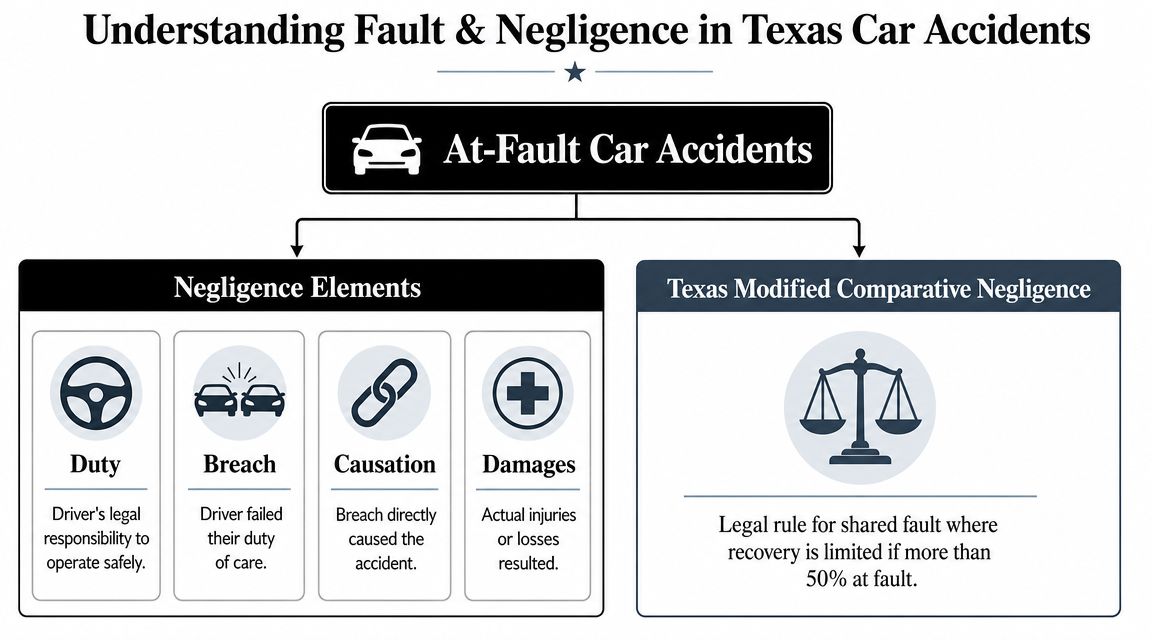
Texas is an at-fault state. That means the injured person has to show that another driver's carelessness caused the crash and the losses that followed. Texas also applies modified comparative fault. You can still recover damages if you were partly responsible, but only if your share of fault is 50% or less. At 51% or more, recovery is barred.
That rule shapes nearly every insurance dispute after a wreck.
In practice, many claims are not fought over whether a collision happened. They are fought over why it happened, whether your conduct contributed, and whether the crash caused the injuries you are now treating. Insurance adjusters know that if they can raise your percentage of fault high enough, they reduce what they owe or avoid payment altogether.
The four parts of negligence
A Texas car accident case usually turns on four legal elements. Each one needs proof.
| Element | What it means in plain English | Example |
|---|---|---|
| Duty | A driver had a legal responsibility to operate safely | Every driver must keep a proper lookout and follow traffic laws |
| Breach | The driver failed to use reasonable care | Running a red light, following too closely, unsafe lane change |
| Causation | That failure caused the crash and your injuries | The rear-end impact caused the neck injury treated after the wreck |
| Damages | You suffered real losses | Medical bills, lost income, pain, vehicle damage |
The success or failure of strong cases is often decided at this stage. A driver may clearly have made a mistake, but a claim still weakens if the evidence does not connect that mistake to the collision, or the collision to your medical condition. I often see insurers concede one element and attack another because that is enough to cut value from the case.
For example, an insurer may accept that its driver changed lanes carelessly, then argue your shoulder injury was preexisting. Or it may accept that you were hurt, then say you caused the wreck by speeding or failing to react in time. The legal test stays the same, but the fight shifts to the weakest link in the chain.
The fight over percentages
The 51% rule gives insurers a clear target. They do not need to prove their driver did nothing wrong. They need enough evidence, or enough doubt, to assign you a larger share of blame.
That is why fault evidence must do more than tell your side of the story. It must also answer the defenses that usually appear in Texas claims. A crash report may support the basic sequence of events. Witness statements may counter the claim that you drifted into another lane. Vehicle damage patterns may show the point of impact and undercut a sudden-stop argument. If you need a copy of the officer's report, you can request a Texas crash report and review how the incident was documented.
The evidence must tip the scale so your version is more likely true than not. That is the civil burden of proof, called preponderance of the evidence, and it is lower than the standard used in criminal court. Lower does not mean easy. It still requires proof that fits together in a credible, consistent way.
For someone trying to prove fault in a Texas car accident claim, this is the core answer. Match each legal element to specific proof, then use that proof to block the insurer's attempt to shift blame onto you. Show what the other driver should have done, how the driver failed, how that failure caused the impact, and how the wreck caused your losses.
Critical Evidence You Must Preserve After the Crash
The strongest cases are built from evidence gathered immediately after the collision, including official crash reports, eyewitness accounts, photos and videos of the scene and vehicles, and available dashcam or surveillance footage. That immediate proof is essential for staying below Texas's fault threshold and protecting your claim, as described in this Texas liability overview.
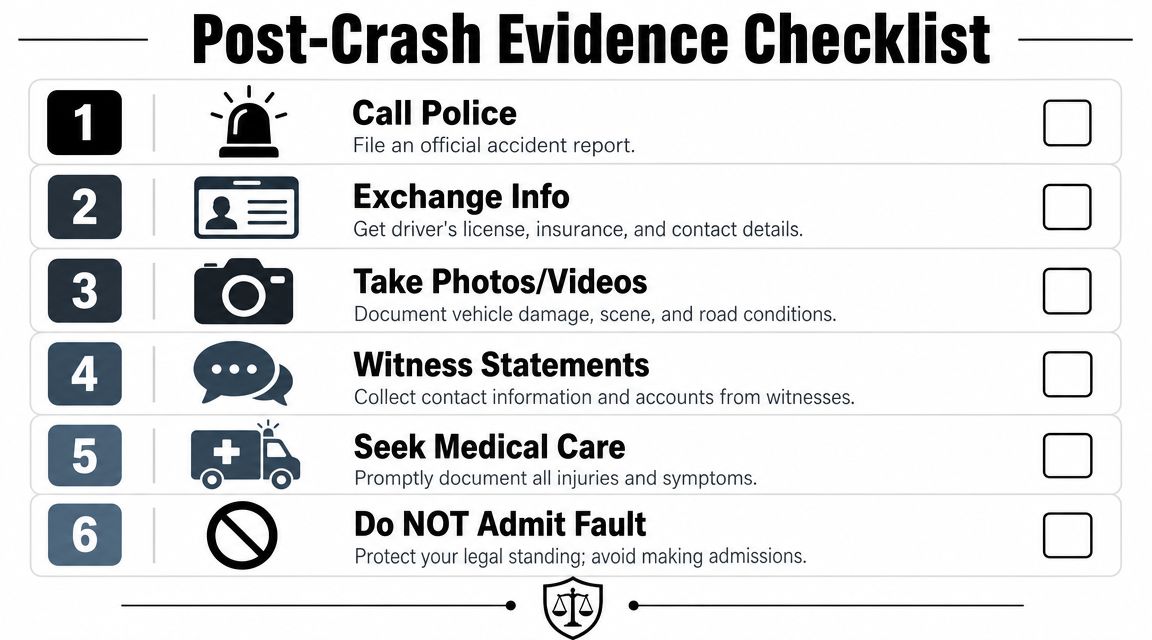
The scene of the crash is where your case begins. If you're physically able, your phone becomes one of your most useful tools.
What to document before vehicles are moved
Don't just take a few close-ups of a dented bumper. Try to capture the scene in a way that tells the story of the impact.
- Vehicle positions: Show where each vehicle came to rest.
- Damage from multiple angles: Wide shots and close shots both matter.
- The roadway itself: Include lane markings, intersections, shoulder conditions, debris, and skid marks.
- Traffic controls: Photograph lights, stop signs, yield signs, and any obstructed view.
- Visible injuries: Bruising, cuts, swelling, and other immediate signs of harm can matter later.
If there are nearby businesses, homes, or traffic cameras, make a note of them. Video often disappears quickly, and that can be decisive in a disputed case.
A police report can also help anchor the timeline. If you need guidance on obtaining that documentation, review this page about a Texas crash report.
What to say and what not to say
People often hurt their cases by trying to be polite. A simple “I'm sorry” may later be framed as an admission. So can speculation like “I never saw you” or “Maybe I was going a little fast.”
After a crash, stick to facts. Identify yourself, call for help, answer basic questions, and avoid guessing.
Use this mental checklist:
- Call law enforcement: An official report creates a starting point for the claim.
- Exchange information: Get names, contact details, insurance details, and vehicle information.
- Gather witnesses: Independent witnesses can matter when drivers disagree.
- Keep your explanation short: You're not required to solve the case on the roadside.
A short explainer can also help if you want a visual overview of immediate post-crash steps.
What works and what doesn't
Some evidence consistently helps. Some evidence sounds useful but often isn't enough by itself.
| Usually helpful | Often weaker on its own |
|---|---|
| Scene photos | Your memory alone |
| Witness names | An argument with the other driver |
| Police response | A casual text saying “I'm okay” before symptoms worsen |
| Dashcam or nearby video | A single blurry photo |
| Immediate medical notes | Waiting and hoping pain goes away |
The practical point is simple. The farther you move from the moment of impact without preserving proof, the easier it becomes for the insurer to rewrite what happened.
Building Your Case Beyond the Crash Scene
You got the photos. The vehicles were towed. A report was made. Then the harder part starts. In Texas, proving fault often turns on what can still be shown days or weeks later, especially if the other driver changes the story or the insurer argues you were partly to blame. Because Texas uses a 51% comparative fault rule, the evidence has to do more than suggest what probably happened. It has to hold up when the insurance company tries to shift enough blame to cut or block recovery.
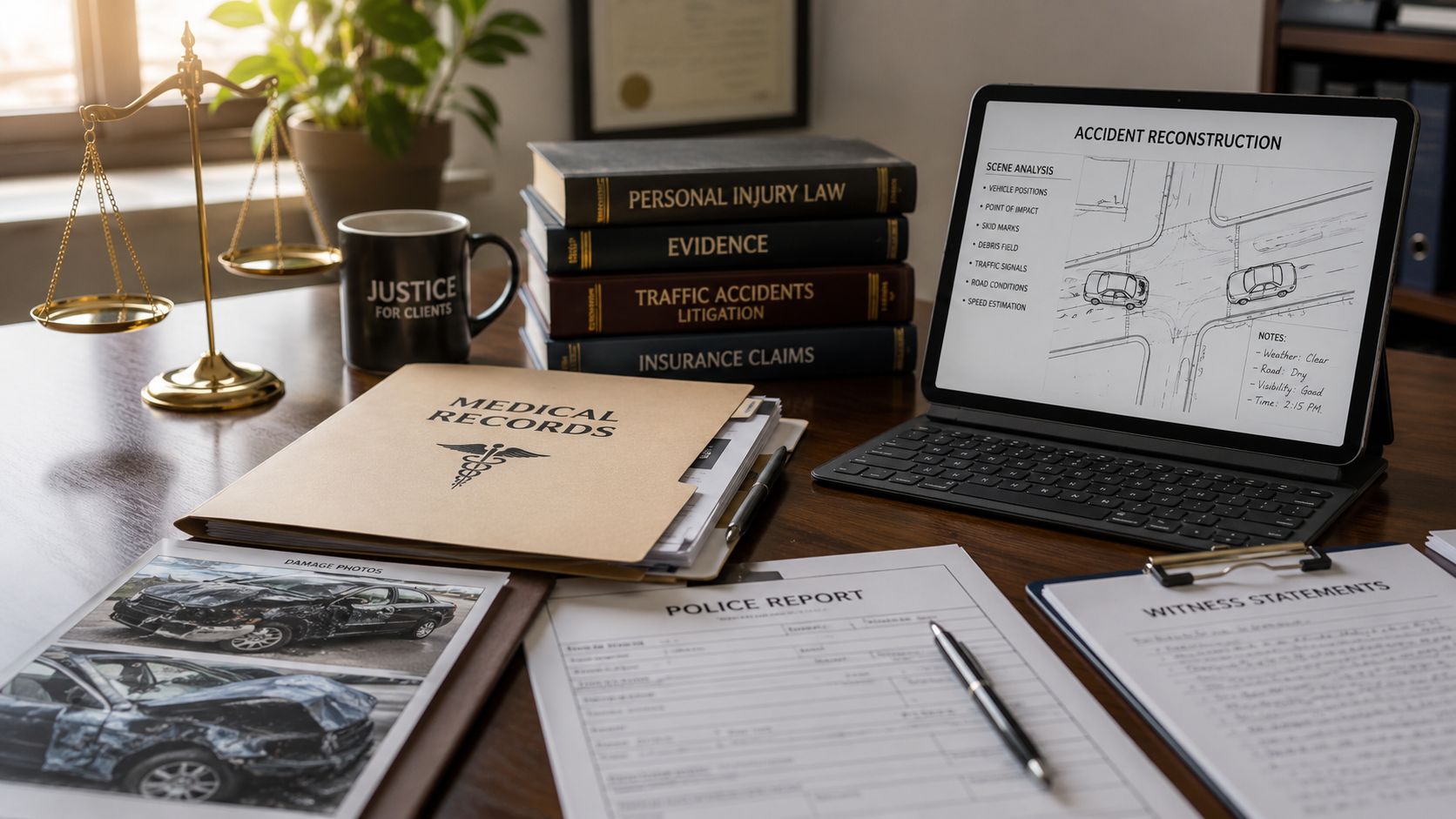
Medical records are more than treatment notes
Medical care does two jobs in a car wreck case. It helps you heal, and it documents causation.
Insurance companies often argue that pain came from a prior condition, normal wear and tear, or something that happened after the crash. Good medical records answer that argument. They show when symptoms began, how they progressed, what body parts were affected, and whether your complaints match the mechanics of the collision.
Details matter. If your shoulder pain started the same day but the numbness appeared two days later, say that. If headaches began after a rear-end collision and get worse with light or screen time, report it. Clear, consistent histories make it harder for an adjuster to say your symptoms are vague, exaggerated, or unrelated.
Gaps in treatment create problems too. A gap does not automatically defeat a claim, but it gives the insurer an opening. They may say you recovered, were never seriously hurt, or failed to follow medical advice. Part of building a strong case is closing those openings before they become the theme of the defense.
Physical evidence helps answer disputed fault
Police reports help, but they are starting points, not final answers. Officers usually arrive after the impact and work with limited time, limited witnesses, and incomplete information. If a report gets the lane position wrong, misses a witness, or accepts one driver's explanation too quickly, the case needs more support.
That support often comes from objective proof:
- Vehicle damage patterns: The crush damage can show angle of impact, lane movement, and whether the claimed sequence fits the physical evidence.
- Skid marks and debris: These can help establish braking, direction of travel, and the likely point of impact.
- Event Data Recorder data: In some cases, the vehicle's system preserves information about speed, braking, steering input, or seat belt use shortly before impact.
- Video from nearby businesses or homes: Footage can confirm signal changes, following distance, lane position, and timing better than memory alone.
Each item has a job. Damage patterns may rebut a claim that you swerved into the other car. EDR data may undercut a statement that the other driver had no time to brake. Video may resolve the dispute in a way witness recollections cannot.
In higher-stakes cases, lawyers often bring in a reconstruction professional to examine roadway evidence, vehicle movement, and impact forces. A good accident reconstruction expert witness does more than create diagrams. The expert helps connect the physical facts to Texas negligence standards and answer the insurer's favorite argument: that you were at least as responsible as their driver.
Strong claims are built in layers
A solid liability case usually comes together as a chain of proof.
A witness places your vehicle in the proper lane. The damage pattern matches that account. Surveillance video confirms the timing. Medical records show injuries consistent with that impact. Once those pieces line up, the insurer has less room to argue that you caused the crash or that your injuries came from somewhere else.
I often tell clients that no single record wins most contested cases. The value comes from how the records support each other. That is especially true when the defense is trying to push comparative fault onto the injured driver.
The same method applies in more serious collisions. A truck crash case may require company records, onboard data, driver logs, and evidence from multiple impact points. A fatal crash case may require very careful proof of crash mechanics because the person most affected cannot explain what happened. This is why firms like the Law Office of Bryan Fagan, PLLC often focus on investigating motor vehicle injury claims from several angles instead of relying on the police report alone.
How Insurance Companies Try to Deny Your Claim
Insurance adjusters often sound calm, organized, and helpful. That doesn't mean their interests match yours. Their job is to evaluate exposure for the company, and one common way to reduce that exposure is to challenge fault, minimize injuries, or both.
That pressure often starts early. An adjuster may call while you're still sore, confused, and unsure whether you need follow-up care. The conversation can feel informal. It isn't.
Common tactics after a Texas crash
Some denial strategies are obvious. Others are subtle.
| Tactic | What the insurer is trying to do | Better response |
|---|---|---|
| Recorded statement requests | Lock you into wording that can be used against you later | Give basic notice of the claim, then get legal advice before a detailed statement |
| Quick settlement pressure | Close the claim before the full injury picture is known | Wait until treatment and damages are clearer |
| Partial fault arguments | Shift enough blame to reduce or defeat recovery | Answer with evidence, not assumptions |
| Gaps in treatment attacks | Suggest you weren't really hurt | Follow medical advice and keep records |
| Prior condition arguments | Claim the crash didn't cause your symptoms | Use consistent medical records to show what changed after the wreck |
The recorded statement trap
The adjuster may say they “just need your side.” What they often want is a version they can parse line by line.
If you say, “I think I was fine at first,” they may later use that to argue you weren't injured. If you say, “It happened so fast,” they may suggest you don't know who entered the lane. If you estimate your speed and later a report differs slightly, they may call your whole account unreliable.
You don't help your case by guessing. You help it by being accurate and measured.
“I don't know” is better than a bad estimate.
The low offer before the full story is known
Another familiar move is the early settlement offer. It can look tempting when bills are arriving and your vehicle is in the shop. But early offers usually arrive before the insurer has paid attention to the long tail of a case, such as follow-up care, work disruption, or lasting symptoms.
This is especially risky for people dealing with serious trauma, ongoing pain, or a loved one's death. Families considering a wrongful death lawyer Texas residents often need are already under emotional strain. They shouldn't have to sort through insurer tactics while grieving. The same is true for someone with a spinal injury, brain injury, or severe fractures. Catastrophic cases demand a longer view.
For many people, the smartest move is simple: don't let the insurer define the case before the evidence does.
Why You Must Act Quickly The Texas Statute of Limitations
Texas law generally gives injured people two years from the date of the accident to file a personal injury lawsuit. That deadline is commonly called the statute of limitations. Waiting can be costly, and not just because of the filing deadline.
A delay changes the evidence. Video may be overwritten. Witnesses may become difficult to reach. Memories fade, and the insurance company may use that gap to argue that your injuries were minor or unrelated. If you want a fuller overview, this page on the Texas car accident statute of limitations explains the timing rules in more detail.
Delay helps the other side
Time doesn't preserve a car accident claim. It usually weakens it.
A store camera near the intersection may not keep footage long. A witness who clearly remembered the lane positions right after the crash may later be unsure. Your own recollection can blur too, especially if you were hurt. Meanwhile, the insurer builds its file and looks for inconsistencies.
Faster action usually means better proof
Prompt action doesn't mean rushing into a lawsuit without thought. It means protecting the evidence while it still exists.
- Early investigation helps: Video requests, scene review, and witness contact are stronger when done quickly.
- Medical documentation is cleaner: A prompt treatment record is harder to dispute.
- The claim develops on your timeline: You don't want the insurer shaping the narrative while you wait.
This is one reason people often contact a Houston car accident attorney early, even when they aren't sure whether they want to file suit. The first benefit is usually not litigation. It's preservation.
If your crash involved a commercial vehicle, rideshare driver, pedestrian injury, or fatal collision, speed matters even more because there may be additional records to secure and more parties involved.
You Don't Have to Do This Alone We Can Help
A serious wreck can divide life into before and after. Before the crash, ordinary things felt easy. After the crash, everything takes more energy. Medical appointments, car repairs, missed work, pain at night, phone calls from adjusters, and worry about the future can pile up fast.
You shouldn't have to carry the legal side by yourself while you're trying to recover.
What legal help actually changes
A lawyer's role isn't just to file paperwork. In a fault dispute, legal help often means someone is actively protecting the evidence, checking the report against the physical facts, handling insurer communication, and making sure your injuries are documented clearly.
That can matter whether your case involves a standard wreck, a commercial collision, or something much more severe. People searching for a Texas personal injury lawyer are usually not looking for abstract legal theory. They want someone to take the pressure off and deal with the parts of the case that insurers use against unrepresented people.
You focus on healing. Your legal team focuses on proving what happened and pushing back when the insurer tries to distort it.
A practical next step
If you were hurt in a crash, or if your family lost someone in a collision, getting answers early can protect your options. The same is true if you're dealing with a truck case, a disputed rear-end crash, a pedestrian impact, or a major injury that may affect you for years.
A Houston car accident attorney can review the facts, identify what evidence still needs to be preserved, and help you avoid the mistakes that commonly damage claims. If the crash involved a death, a wrongful death lawyer Texas families trust can help pursue accountability. If it involved a commercial vehicle, a truck crash lawyer Houston residents rely on can evaluate additional records and parties.
Recovery is possible. Legal help is available. You don't have to guess your way through this.
If you need guidance after a Texas crash, the Law Office of Bryan Fagan, PLLC offers free consultations for injury and wrongful death matters. We can listen to what happened, explain your options in plain English, and help you understand what evidence may be needed to prove fault and protect your claim.