Skip to content
Yes, you can still win if you were partially at fault in Texas. If you're 50% or less at fault, you can still recover money, but if you're 51% or more at fault, Texas law bars you from recovering anything.
A serious accident can change your life in seconds, but you don't have to face it alone. Many people start searching for answers after an adjuster says something like, “You may have contributed to the crash,” and panic sets in. They assume the case is over.
It usually isn't.
One of the most confusing parts of a Texas injury claim is that fault isn't always all-or-nothing. Two drivers can both make mistakes. A pedestrian can be injured and still be accused of poor judgment. A family dealing with a fatal crash can hear the insurance company blame their loved one before the full evidence is even gathered.
If you're asking, “Can you still win if partially at fault Texas,” the underlying question is often this: Do I still have options if the insurance company is trying to pin blame on me? In many cases, the answer is yes. The key is understanding how Texas handles shared blame, what damages may still be available, and how to push back when the fault percentage feels unfair.
You Can Recover Money Even If You Are Partially at Fault
Texas uses a rule called proportionate responsibility. That name sounds technical, but the idea is simple. If more than one person helped cause the accident, the law tries to divide responsibility between them.
That matters because a lot of crashes don't fit into a neat story. After a Houston freeway collision, one driver may have changed lanes carelessly while the other may have been driving too fast. After a truck crash, the trucking company may blame the smaller vehicle right away. After a fatal wreck, surviving family members may hear conflicting stories before they've even had time to grieve.
Partial fault doesn't automatically end your claim
Being partly at fault is not the same as losing your case.
You may still be able to recover compensation for losses tied to the wreck, including things like medical care, missed work, and the personal harm the crash caused. That's why it's so important not to accept an insurer's first version of events as final.
Practical rule: An insurance adjuster's early opinion is not the same thing as a final legal decision.
A lot of injured people get tripped up here. They hear that they “share fault” and think that means they can't bring a claim. In Texas, that's not how the rule works. Shared fault can reduce a recovery. It doesn't always erase it.
Why this rule feels unfair to so many people
The hard part is that fault percentages can sound more precise than they really are. An adjuster may act as if assigning blame is simple. In reality, fault depends on evidence, context, and how well your side of the story is documented.
For example, after a Houston car crash, an insurer might say you “should have reacted sooner.” But that statement alone doesn't prove how the wreck happened. It doesn't account for road layout, traffic signals, witness accounts, damage patterns, or what the other driver was doing.
Here's what often helps most in the early days after a crash:
- Get medical care quickly: Your health comes first, and your records also help connect your injuries to the collision.
- Preserve what you can: Photos, names of witnesses, and vehicle damage can matter later.
- Be careful with insurance calls: You can report the crash, but you don't need to guess about fault.
- Talk to a lawyer early: A Texas personal injury lawyer can look at whether the blame being assigned to you is supported.
Don't wait too long to ask about deadlines
Texas injury claims are also affected by filing deadlines, often called the statute of limitations. In plain terms, that's the legal time limit for filing a lawsuit. The exact deadline can depend on the type of case and the facts involved, so it's smart to ask about timing early instead of assuming you have plenty of time.
That's true whether you need help from a Houston car accident attorney, a truck crash lawyer Houston families trust after a commercial vehicle wreck, or a wrongful death lawyer Texas families call after a fatal collision.
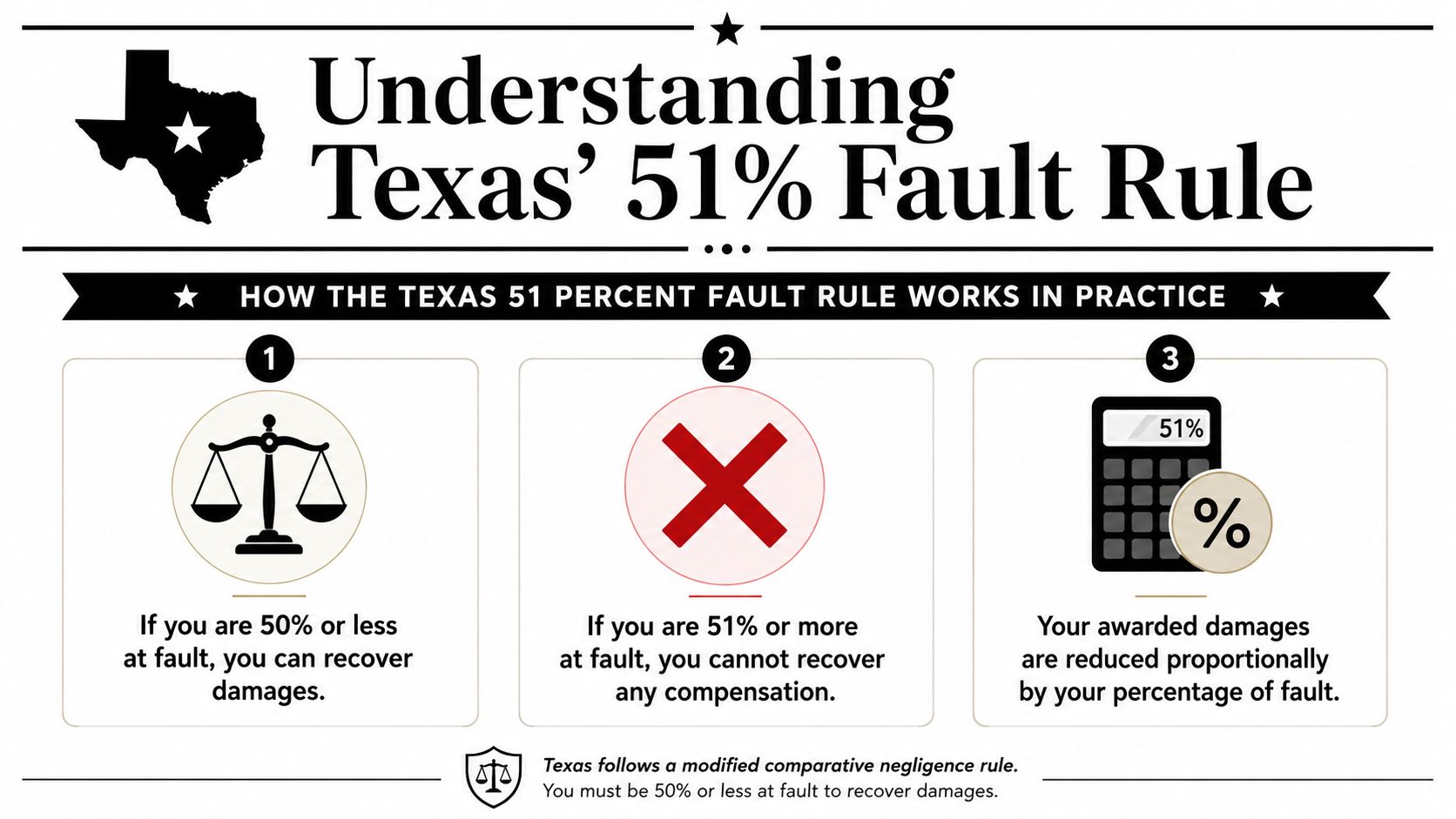
How the Texas 51 Percent Fault Rule Works in Practice
Think of the rule like a line on the road. If you stay on one side of that line, you can still recover compensation. If the facts push you just over it, your claim can disappear.
Under Texas proportionate responsibility law, an injured person can recover damages if they are 50% or less at fault, but if they are 51% or more at fault, they recover nothing. The same rule also means that a person found 20% at fault would typically have their compensation reduced by 20%, while a person found 50% at fault could still recover the remaining 50% of damages, as explained in this discussion of Texas proportionate responsibility and the 50 or 51 percent cutoff.
Why one percentage point can change everything
Many people find this frustrating. Moving from 50% fault to 51% fault may sound small, but legally it's a cliff.
Here's the simplest explanation:
| Fault finding | What happens |
|---|---|
| 50% or less | You can still recover compensation, reduced by your share of fault |
| 51% or more | You recover nothing from the other negligent party |
That's why these cases are often fights about details. Did the other driver run the light? Were you already established in the lane? Did road markings or traffic-control devices matter? Did the impact pattern support the insurer's story, or contradict it?
A plain-language example
Let's say you were hit after merging on a busy Dallas roadway. The other driver says you moved into their lane without enough space. You say they were speeding and had room to avoid the crash.
If the evidence shows you share some blame, you might still recover. But every piece of proof matters because the fault number affects whether the case remains viable at all.
When a case is close, the dispute often isn't about whether fault is shared. It's about whether the insurer is exaggerating your share.
That's one reason many people look deeper into how comparative fault works in Texas injury claims after an adjuster raises the issue.
Who actually decides fault
A police report can influence the process, but it isn't the final word. Insurance companies make their own evaluations, and if a case goes into litigation, a judge or jury may decide how fault should be assigned.
That's why you should be cautious about statements like, “The officer blamed you, so you have no case.” Sometimes the report is incomplete. Sometimes the officer didn't see the crash happen. Sometimes later evidence changes the picture.
If you were hurt and you're worried about shared blame, the main takeaway is simple. A partial fault allegation is a problem to address, not a signal to give up.
What Types of Damages Can Be Reduced by Partial Fault
When fault is shared, the reduction doesn't apply only to one small part of your claim. It can affect the full range of damages commonly requested after a Texas crash.
Texas shared-fault rules can apply to medical bills, future medical treatment, lost income, reduced earning capacity, pain and suffering, emotional distress, vehicle repair or replacement, disability, and disfigurement, as described in this overview of the types of losses affected by partial fault in Texas crash claims.

The reduction reaches both financial and personal losses
People sometimes assume partial fault only affects car repairs. In reality, it can touch nearly every category of compensation.
A claim may include losses such as:
- Treatment costs: Emergency care, follow-up appointments, therapy, and future care needs
- Work-related losses: Missed paychecks and harm to your ability to earn a living going forward
- Human losses: Pain, emotional suffering, disability, and visible injury effects
- Property damage: Repairing or replacing your vehicle
If you want a broader explanation of recoverable losses, this page on types of damages in Texas personal injury cases is a helpful starting point.
What the math looks like
The easiest way to understand the rule is to see how it changes dollars.
One example states that a $10,000 settlement reduced by 10% fault becomes $9,000. Another example explains that $50,000 in total damages reduced by 10% leaves $45,000. Those examples show why even a relatively small fault percentage can make a meaningful difference to an injured person's recovery.
| Total damages | Fault assigned to injured person | Amount left |
|---|---|---|
| $10,000 | 10% | $9,000 |
| $50,000 | 10% | $45,000 |
Small percentages don't always feel small when the bills are already piling up.
Why this matters during insurance negotiations
In this scenario, adjusters have an advantage. If they can raise your fault percentage, they can lower what they pay. If they can push it too far, they may try to deny the claim completely.
That's why an injured person shouldn't focus only on whether compensation is available in theory. The practical question is how much of the claim survives once fault is assigned.
After a truck wreck outside Houston, for example, a family may be dealing with hospital care, missed work, and long-term limitations all at once. In a catastrophic injury case, even a modest increase in assigned fault can change how much support is available for treatment and daily life. The same concern can arise in a wrongful death claim, where surviving relatives may already be facing financial pressure and emotional loss.
Real-World Examples of Shared Fault Accidents
Shared fault often shows up in ordinary traffic situations. The facts don't have to be dramatic for blame to be divided. What matters is whether both sides did something that may have contributed to the collision.
A left-turn crash on a Houston roadway
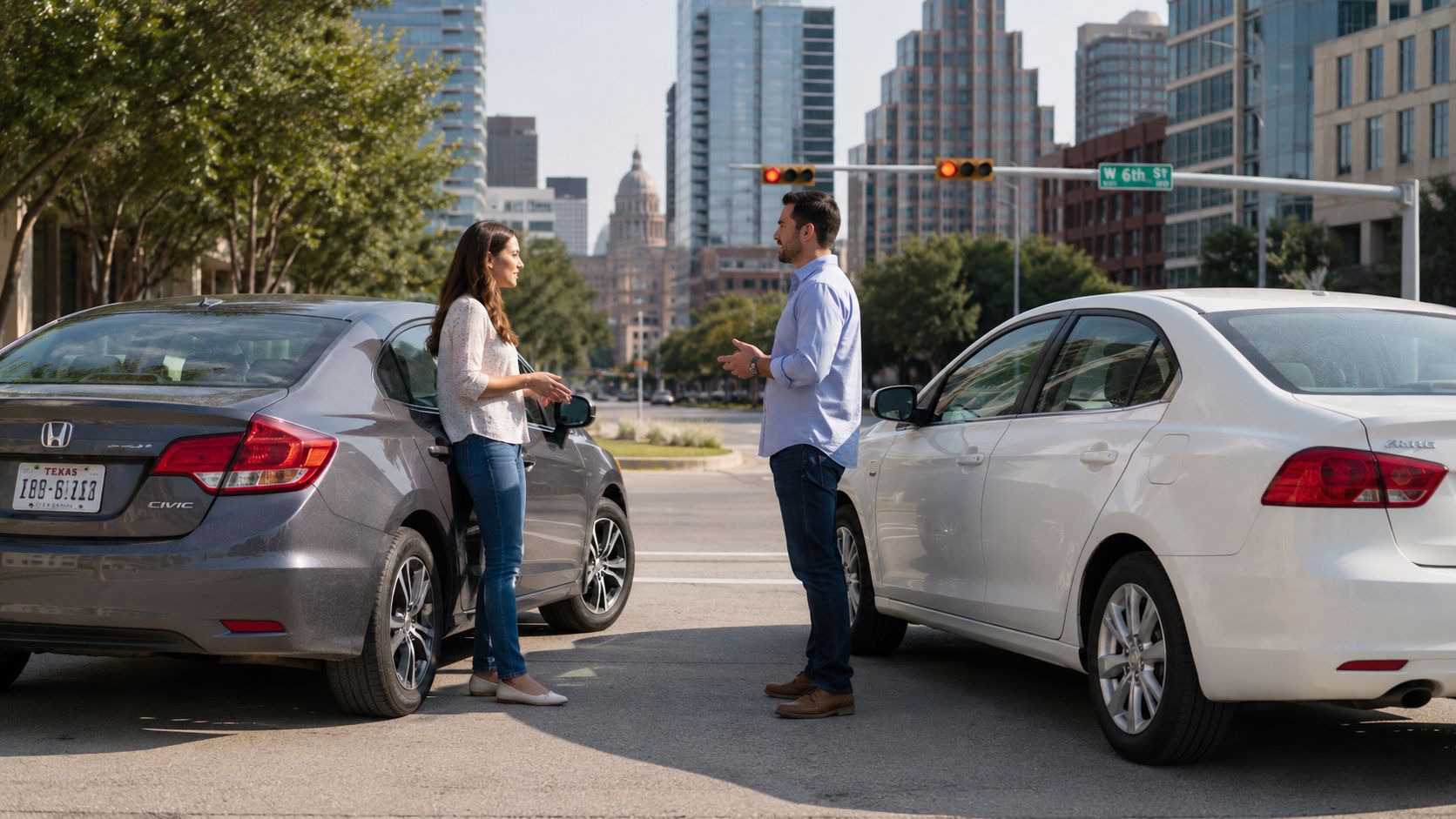
A driver turns left at a busy Houston intersection. An oncoming vehicle slams into the passenger side.
The turning driver may be blamed because left turns usually require yielding to oncoming traffic. But that may not end the story. If the oncoming driver was speeding, distracted, or entered the intersection late, fault may not rest on one person alone.
In a case like this, both sides often point to different facts. One focuses on the duty to yield. The other focuses on speed, timing, and whether the crash could have been avoided.
A pedestrian struck outside a marked crosswalk
A person crosses mid-block in downtown Austin and is hit by a vehicle. The driver says the pedestrian stepped out unexpectedly. The pedestrian says the driver wasn't watching the road.
That scenario often leads to shared-fault arguments because both behavior and visibility matter. A pedestrian may face criticism for crossing outside a designated area. At the same time, a driver still has a duty to stay alert and react to hazards in the roadway.
A shared-fault case often turns on a simple question. Whose choices played the larger role in causing the injury?
This kind of claim can become even more serious when the injuries are permanent. Families then may need guidance not only from a Texas personal injury lawyer, but sometimes from counsel experienced in pedestrian, catastrophic injury, or wrongful death litigation.
A short video can help illustrate how these disputes often play out in practice.
A truck lane-change collision on I-35
A commercial truck starts moving into another lane on I-35 near Dallas. A passenger vehicle is struck during the merge.
The truck driver may be blamed for an unsafe lane change or failing to account for a vehicle in a blind spot. But the defense may respond that the smaller vehicle lingered next to the trailer, accelerated at the wrong time, or failed to react.
Truck cases are especially complex because more than one party may be involved. The driver, the company, and other entities may all point fingers. That's one reason people often look for a truck crash lawyer Houston families can call or another attorney familiar with commercial-vehicle evidence.
Why these examples matter
The lesson in all three situations is the same. Fault is often argued, not obvious.
If you're dealing with a disputed crash, it helps to think in terms of proof, not assumptions:
- Road position matters: Where each vehicle or person was located can change the analysis.
- Timing matters: A second earlier or later can affect who had a chance to avoid impact.
- Conduct matters: Speeding, distraction, unsafe turns, and poor lookout all shape blame.
- Evidence matters most: The stronger your documentation, the harder it is for the other side to oversimplify the story.
Strategies to Challenge an Unfair Fault Assessment
The most important thing to know is this. The insurance company's first fault decision is not sacred. It can be challenged.
In Texas shared-fault claims, fault allocation is driven by evidence such as crash reports, scene photos, traffic-control evidence, vehicle-damage patterns, witness statements, and timing-related proof gathered early after the collision. That matters because moving from 50% fault to 51% fault changes the result from partial recovery to zero recovery, which is why early evidence preservation and liability reconstruction can be so important, as explained in this discussion of evidence-driven fault disputes in Texas crash cases.
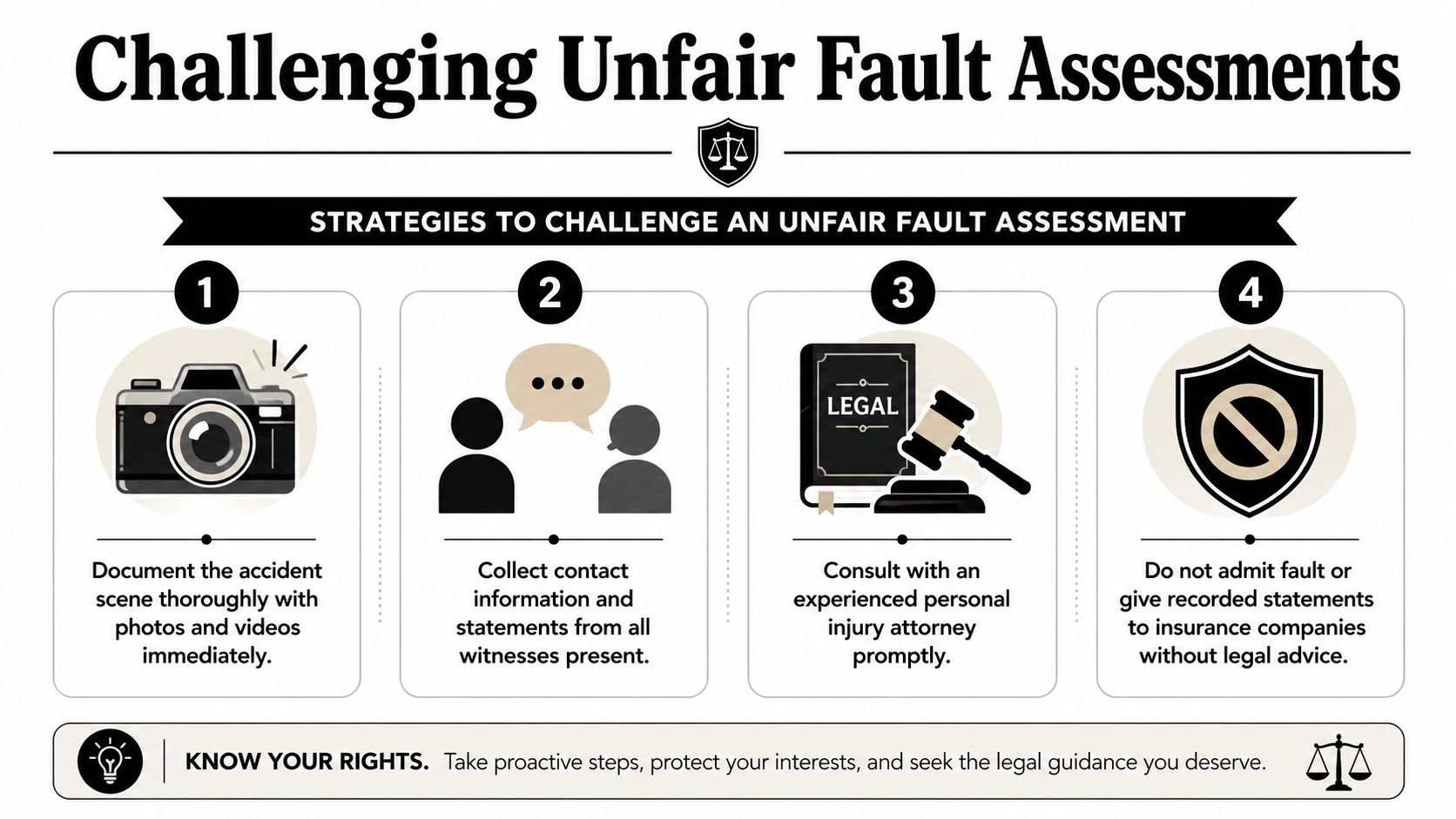
Start with the evidence you can preserve
The strongest response to an unfair percentage is usually a better factual record.
Focus on gathering and protecting:
Scene images
Photos of skid marks, debris, lane markings, traffic lights, weather, and vehicle placement can tell a clearer story than memory alone.Witness information
Neutral witnesses often help when both drivers blame each other.Medical records
Prompt care documents what injuries appeared after the wreck and can support your timeline.The crash report
Even when it isn't perfect, it may contain names, statements, diagrams, and other leads.
A more technical case may also call for deeper review of impact angles, crush damage, and roadway design. In some claims, an accident reconstruction expert witness can help analyze how the collision likely happened.
Be careful what you say to the other insurer
A lot of valid claims are weakened by early conversations. People want to be polite. They want to explain. They want to sound reasonable.
That instinct can backfire.
- Don't guess about speed or distance: If you're unsure, say you're unsure.
- Don't accept blame casually: Statements made in shock can be twisted later.
- Don't give a recorded statement lightly: The other insurer is evaluating how to reduce its payout.
- Don't assume the police report settles everything: Additional evidence may change the analysis.
If you're injured, your job is to protect your health and preserve facts. Your job is not to build the insurer's case against you.
Get help before the story hardens
Once an adjuster builds a blame narrative, it can become harder to unwind. That's why quick legal review matters, especially when the other side claims you caused most of the crash.
The Law Office of Bryan Fagan, PLLC handles Texas motor-vehicle injury claims by investigating collisions, gathering evidence, interviewing witnesses, and evaluating liability issues that can affect recovery. For many injured people, getting legal help early means there's a better chance to challenge an unfair fault percentage before it shapes the entire claim.
This is especially important after a Houston car accident, a commercial vehicle wreck, or a fatal crash involving a loved one. A Houston car accident attorney or wrongful death lawyer Texas families trust can step in before key evidence is lost.
You Do Not Have to Figure This Out Alone
When you've been hurt, legal rules can feel cold and confusing. You're trying to heal, keep up with bills, talk to doctors, and deal with insurance calls at the same time. That's a lot for anyone.
The good news is that partial fault does not automatically erase your rights. If the blame being assigned to you is unfair, it can be challenged. If the evidence tells a better story than the insurance company's first report, that story deserves to be built carefully and presented clearly.
What many injured Texans need most
People don't need a lecture after a crash. They need answers.
They want to know:
- Can I still bring a claim?
- What should I say to the insurance company?
- What evidence matters most right now?
- How long do I have to file a claim in Texas?
- Should I accept the adjuster's fault decision, or fight it?
Those are fair questions. They're also questions a Texas personal injury lawyer handles every day.
Legal help can reduce stress while protecting your claim
A lawyer can do more than file paperwork. In the right case, counsel can step between you and the insurer, gather the evidence the adjuster ignored, identify weaknesses in the blame argument, and push for a fairer evaluation of liability and damages.
That can matter in a routine car wreck. It can matter even more in a truck collision, a catastrophic injury case, or a wrongful death claim involving a spouse, parent, or child.
Recovery is possible, even when the other side is trying to make the case sound hopeless.
If you're unsure where you stand, asking questions early is usually the safest move. Waiting often helps the insurance company more than it helps you.
A final word of reassurance
You don't have to know all the legal terms. You don't have to solve the fault dispute by yourself. And you don't have to accept an unfair percentage just because an adjuster said it with confidence.
If you were injured and you're wondering whether you can still win if partially at fault in Texas, take the next step and get clear advice based on your facts. With the right support, many people find that their case is stronger than they were first led to believe.
If you need answers after a crash, Law Office of Bryan Fagan, PLLC offers a free consultation to discuss your rights, the evidence in your case, and the next steps available to you. Whether you need a Texas personal injury lawyer, a Houston car accident attorney, help with a truck wreck, or guidance after a fatal collision, you can reach out for straightforward advice and compassionate support.