Skip to content
No, Texas is not a no-fault state; it is an at-fault state, which has significant implications for how you recover compensation after an accident. If another driver caused the crash, you usually pursue payment through that driver's liability insurance, and your own share of fault can affect what you recover.
A serious accident can change your life in seconds, but you don't have to face it alone.
If you're reading this after a wreck in Houston, Dallas, Austin, or anywhere else in Texas, you're probably dealing with more than one problem at once. Your car may be in the shop. Medical bills may already be showing up. An insurance adjuster may be calling before you've even had time to understand what happened.
The question “Is Texas a no fault state?” matters because the answer affects almost every step that comes next. It affects who pays for your medical care, who handles property damage, how fault is investigated, and whether the insurance company will try to blame you for part of the crash.
Many people assume their own insurance automatically pays everything after a collision. That's a common misunderstanding. In Texas, fault drives the claim. If another driver was careless, your case depends on showing what that driver did wrong and how that mistake caused your injuries.
At the same time, this system can work in your favor. Texas law allows injured people to seek compensation for both financial losses and the human impact of an accident, including pain and suffering, when the evidence supports the claim.
When you're hurt, the legal question isn't just who hit whom. It's who was negligent, what evidence proves it, and how to protect your recovery before the insurance company shapes the story first.
You've Been in an Accident and Need Answers
The first hours after a crash are often a blur. A Houston freeway collision, a Dallas intersection wreck, or a truck crash outside San Antonio can leave you shaken, hurting, and unsure what to do next. Legal rules are far from one's mind in that moment. The immediate concern is getting home, finding medical care, and keeping their family stable.
That's why the no-fault question comes up so often. People want a simple answer to a hard situation. In Texas, the answer means the driver who caused the crash is generally the one who must pay for the damage through that driver's insurance.
What that means for you right now
In practical terms, you usually need to do more than report the crash. You need to protect the proof. That includes photos, witness names, the police report, your medical records, and anything else that shows how the collision happened and how badly you were hurt.
If fault seems obvious to you, don't assume the insurance company will see it the same way. Adjusters often look for ways to narrow the claim. They may question whether you were injured, whether treatment was necessary, or whether you did something that contributed to the crash.
A Texas personal injury lawyer looks at those pressure points early. That can matter in a car case, a trucking case, a catastrophic injury claim, or a case involving the loss of a loved one.
A familiar example
After a Houston freeway crash, one driver may insist traffic stopped suddenly and there was nothing they could do. The injured person may know the other driver was texting or following too closely. The difference between those two stories can decide who pays the bills.
If you're searching for answers after a serious wreck, it helps to think in this order:
- Safety first: Get medical care and make sure the collision is reported.
- Evidence second: Save what shows what happened.
- Communication third: Be careful with insurance statements.
- Legal review early: Get advice before fault gets assigned in a way that hurts your claim.
People also often need help outside a standard car claim. Depending on the facts, you may need guidance for a car accident case, a truck accident claim, a wrongful death case, or a catastrophic injury claim.
How Texas At-Fault Law Compares to No-Fault Systems
Texas follows an at-fault system, also called a tort system. That means the driver who caused the accident is financially responsible for the harm that follows. In a no-fault system, the starting point is different. Drivers typically turn first to their own insurance for injury-related benefits, regardless of who caused the crash.
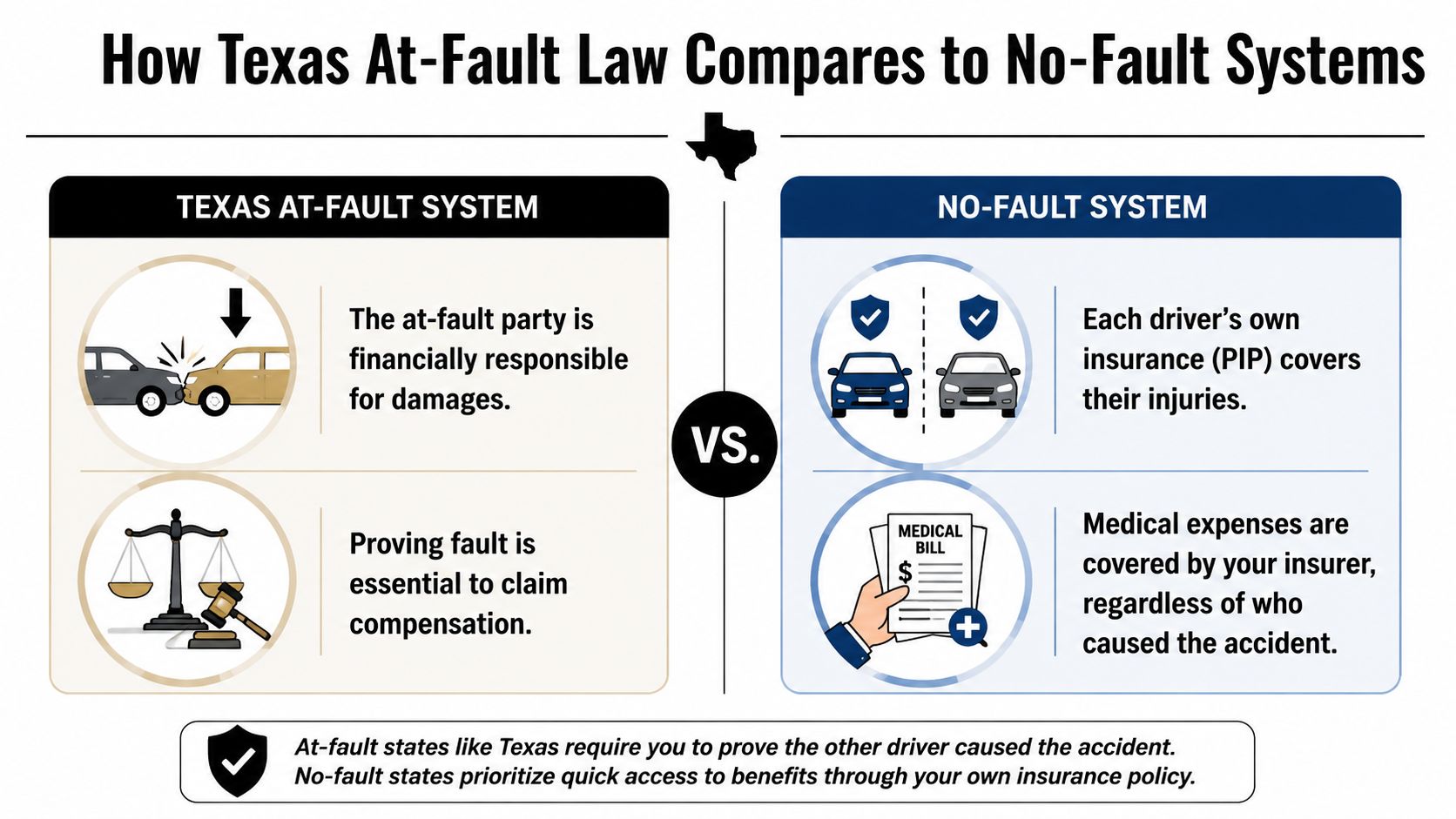
The clearest published summary is this: Texas is not a no-fault state and instead uses a strict at-fault system where the responsible driver must pay for resulting damages, with claims filed against the at-fault driver's liability insurer rather than through your own insurer as happens in the 12 pure no-fault states (Texas at-fault vs no-fault comparison).
The simplest way to think about it
A no-fault system is like each driver carrying their own first-aid kit for certain losses. Fault may still matter later, but the first stop is usually your own insurer.
Texas works more like a responsibility system. If Driver A caused the wreck, Driver B generally seeks payment from Driver A's liability coverage. That sounds straightforward, but it puts a lot of weight on evidence.
Here's a side-by-side look:
| Issue | Texas at-fault system | No-fault system |
|---|---|---|
| First question | Who caused the crash? | What does your own policy cover first? |
| Injury claim path | Usually against the at-fault driver's insurer | Usually first through your own insurer |
| Main dispute | Fault and damages | Coverage and threshold rules |
| Why evidence matters | It helps prove negligence | It still matters, but often later |
Why people get confused
Drivers often mix up health insurance, auto insurance, liability insurance, and optional protections under their own policy. They may also hear the term “no-fault” used casually after an accident and assume it means no one has to prove anything.
That isn't how Texas works. If the other insurer is going to pay, you usually must show that their driver acted negligently. That might mean speeding, failing to yield, rear-ending another car, drifting into a lane, or driving distracted.
For readers trying to sort out accident claims versus workplace injury rules, workers' comp vs. personal injury in Texas explains a different legal path that can apply when someone is hurt on the job.
You may also want practical guidance on Dealing With Insurance Companies After a Texas Accident, especially if you're already hearing questions that seem designed to narrow your claim.
In Texas, fault is not a side issue. It is the engine that drives the claim.
How Proving Fault Determines Your Compensation in Texas
You leave the crash scene shaken, your car is damaged, and the medical bills start arriving before you even know who is paying them. In Texas, the answer usually turns on fault. Fault does more than decide who caused the wreck. It affects whether an insurer accepts responsibility, how much they offer, and whether your own actions will be used to cut down the value of your claim.
That is why proving fault is not just a legal label. It is the part of the case that connects the crash to your treatment, your lost income, and the money needed to put your life back together.
The legal term for this is negligence. It means a driver failed to use reasonable care, and that failure caused harm. A rear-end crash may seem simple at first, but even there, an insurer may ask whether the lead driver stopped suddenly, whether road conditions played a role, or whether both drivers were distracted. In a left-turn collision, the questions often become even sharper. Who had the right of way? Was the light changing? Did anyone misjudge speed or distance?
Why partial fault can reduce what you recover
Texas follows modified comparative responsibility under the Texas Civil Practice and Remedies Code. If you are partly at fault, your recovery is reduced by your percentage of responsibility. If you are more than half responsible, you generally cannot recover damages from the other side. The rule appears in Texas Civil Practice and Remedies Code Chapter 33.
That rule has real financial consequences. If your damages are valued at $100,000 and you are found 20% responsible, the recovery can drop to $80,000. If the insurer can push your share of fault high enough, the claim may shrink sharply or disappear altogether.

A Dallas intersection case shows how this works in everyday terms. Suppose the other driver failed to yield while turning left, but the evidence also suggests you were driving above the speed limit. The other driver may still bear most of the blame. Even so, the insurer will focus on your speed because every percentage point assigned to you can lower what they pay for medical care, wage loss, pain, and future treatment.
Insurers do this often. They look for statements, photos, black box data, road conditions, and gaps in treatment that help them argue you share responsibility. From their side, fault is a money question.
What compensation fault affects
In Texas, proving fault can support a claim for several kinds of damages, including:
- Medical expenses, such as emergency care, follow-up visits, therapy, medication, and expected future treatment
- Lost income, if your injuries kept you from working or reduced your ability to earn
- Property damage, including vehicle repair or replacement
- Pain and suffering, which covers the human impact of the injury, not just the bills
- Physical impairment or disfigurement, when injuries change daily life in lasting ways
A helpful way to view it is this: fault acts like the gatekeeper for compensation. First, you must show the other driver caused the harm. Then you must show how that harm affected your body, your work, and your daily life. If either part is weak, the insurer has room to argue.
If you want a clearer picture of the evidence that supports these arguments, how to prove fault in a Texas car accident explains what helps and what can hurt a claim.
Practical rule: In Texas, compensation does not depend only on how badly you were hurt. It also depends on how clearly you can show who caused the crash, and how well you can protect yourself from blame that reduces the value of the case.
Navigating Insurance Claims After a Texas Car Accident
A lot of people assume the hard part is over once the police report shows the other driver caused the crash. In Texas, that is often just the point where the insurance fight starts. Fault may open the door to a claim, but insurance limits, policy language, and adjuster tactics often decide how much help you receive with medical bills, lost income, and car repairs.
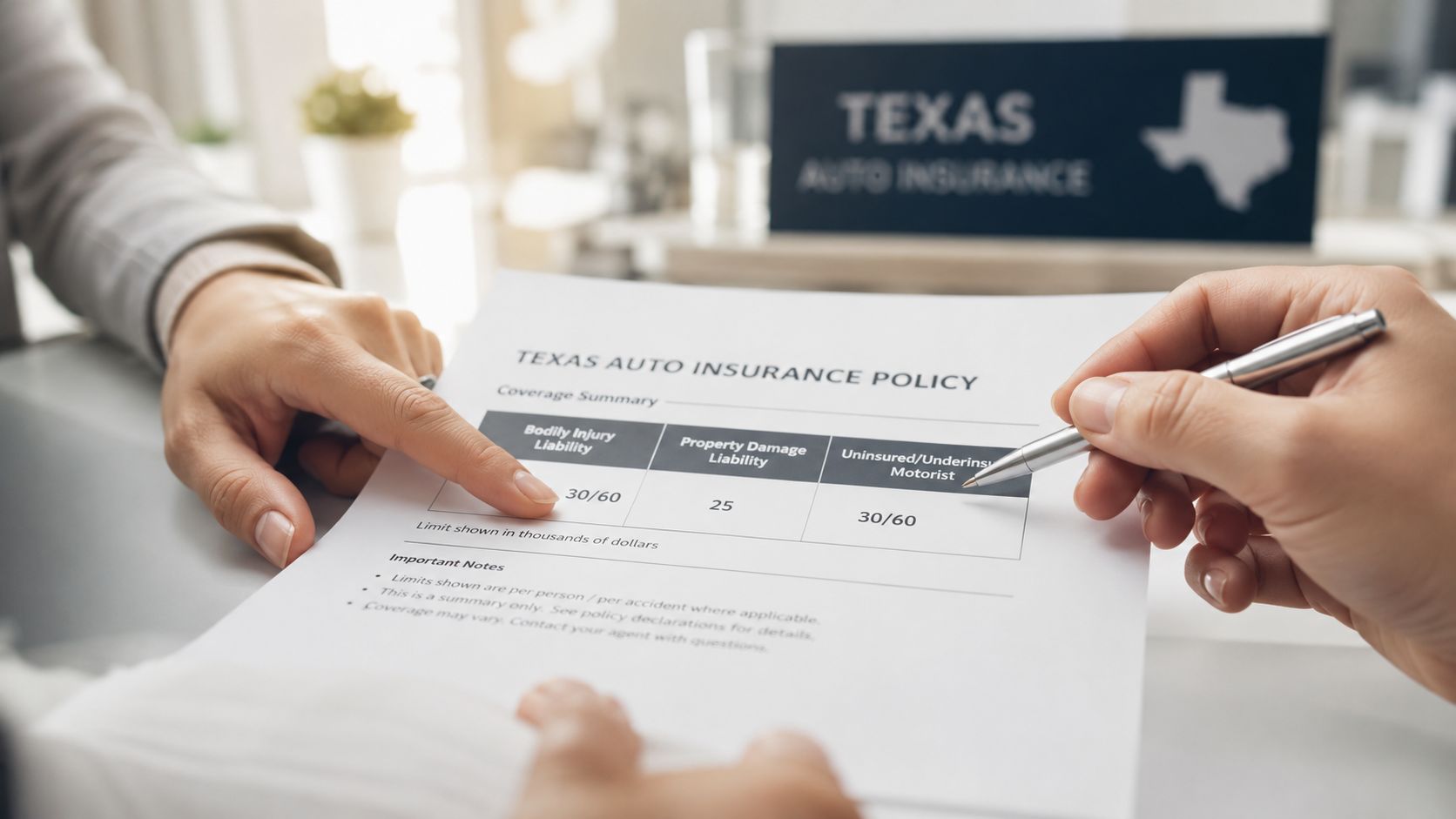
Texas drivers are required to carry liability coverage, and the state minimum is commonly described as 30/60/25. The Texas Department of Insurance explanation of auto insurance coverages breaks that down into bodily injury and property damage limits. The practical problem is simple. Serious injuries can cost far more than a minimum policy will pay.
Take a common example. You are rear-ended on I-35. The other driver gets the ticket. You go to the ER, miss work, start physical therapy, and learn you may need more treatment. On paper, liability looks clear. In real life, the claim can still hit a ceiling if that driver bought only the minimum coverage. Fault answers who should pay. Coverage limits answer how much insurance money is available.
That gap catches people off guard.
Your own policy can become the next source of help. Texas insurers must offer uninsured and underinsured motorist coverage, although drivers can reject it in writing. Many drivers also carry PIP, or Personal Injury Protection. PIP works a little like a first-aid fund inside your own policy. It can help with certain accident-related costs without waiting for the liability claim to finish, which matters when bills start arriving long before the insurance companies finish arguing.
The claim process also feels different in an at-fault state because each insurer is protecting its own money. The other driver's adjuster may sound friendly, but their job is to look for reasons to pay less. They may ask about old injuries, gaps in treatment, or whether you are "feeling better now." Those questions are not casual conversation. They are often attempts to narrow what the company owes.
A safer approach is to slow down and get organized before giving detailed statements.
- Review every policy that may apply, including the at-fault driver's liability coverage and your own auto policy.
- Keep medical records, bills, prescriptions, and work-loss documents in one place.
- Read settlement language carefully before signing anything.
- Check whether PIP, Med Pay if available, or UM/UIM coverage may help fill a shortfall.
- Be careful about recorded statements, especially early in the claim.
If you are unsure what to say, this guide on whether you should talk to insurance after a Texas accident explains how to avoid giving the adjuster words they can later use against you.
This overview also helps explain why some claims become more complicated than they first appear:
One more point matters here. In a no-fault state, your own coverage often pays certain medical costs first, no matter who caused the wreck. Texas does not work that way by default. As a result, accident victims often wait longer, argue more over fault, and depend more heavily on policy limits and optional coverages. For many families, that is the practical meaning of Texas being an at-fault state. It shapes how quickly bills get paid, how much pressure an insurer can apply, and how careful you need to be from the first phone call onward.
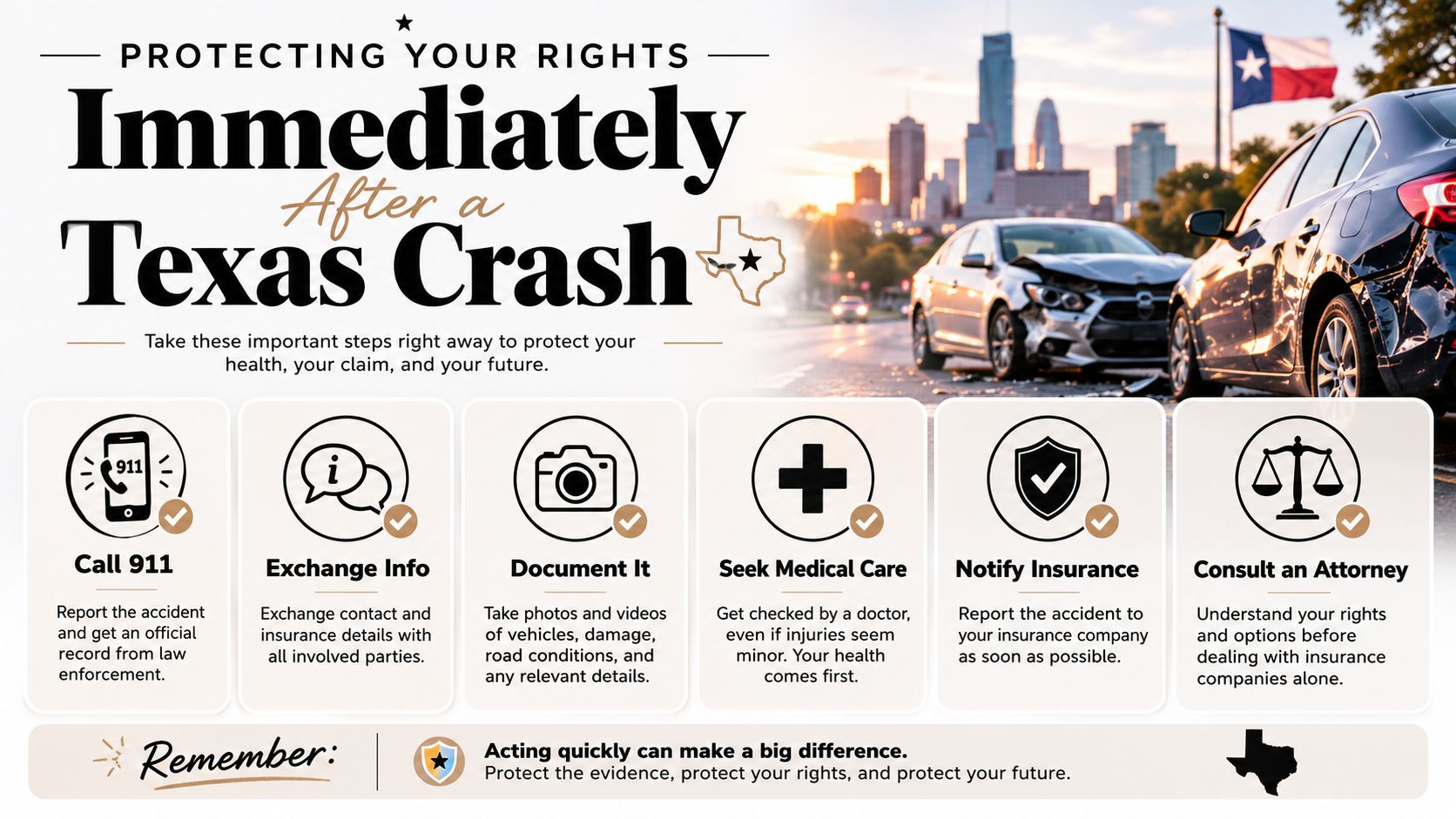
Protecting Your Rights Immediately After a Texas Crash
The first steps after a crash can strengthen your case or weaken it. When you're in pain or still in shock, simple decisions matter.
Document everything
Start with the basics at the scene if you're physically able.
- Call 911: A reported crash creates an official record.
- Exchange information: Get names, contact details, insurance information, and vehicle details.
- Gather witness names: Neutral witnesses can matter when drivers tell different stories.
- Take photos and video: Capture vehicle positions, damage, skid marks, debris, traffic signs, and visible injuries.
A lot of strong cases begin with ordinary phone photos taken in the first few minutes after impact.
Seek medical care immediately
You may feel “mostly okay” right after the crash and still have meaningful injuries. Adrenaline can hide pain. Some symptoms show up later, and delayed treatment can give the insurer room to argue that you weren't seriously hurt.
See a doctor promptly and follow through with recommended care. Consistent treatment protects both your health and your claim.
Get checked out even if you hope the pain will pass. Early records often become the clearest evidence tying the injury to the crash.
Be careful with insurance communications
Notify your own insurer promptly. But when the at-fault driver's adjuster asks for a recorded statement, slow down. You are not required to guess, speculate, or minimize what happened just to seem cooperative.
It's often wise to speak with a lawyer before giving a recorded statement to the other side. That is especially true if fault is disputed, injuries are significant, or the crash involved a commercial vehicle.
Don't lose track of the filing deadline
Texas law gives injured people a two-year statute of limitations from the date of injury to file a personal injury lawsuit, and missing that deadline can permanently end the right to sue, as explained under Texas Civil Practice and Remedies Code section 16.003.
That deadline can feel far away right after a crash, but evidence rarely improves with time. Vehicles get repaired. Witnesses forget details. Camera footage can disappear.
If you want help understanding that filing window and why acting early matters, a Texas personal injury lawyer can review the timing and the evidence before critical details are lost.
When to Call a Texas Personal Injury Lawyer
Some accident claims are manageable without much conflict. Others become legal fights almost immediately. You should strongly consider calling a lawyer when the injuries are serious, fault is disputed, the insurance offer doesn't cover your losses, or the crash caused a death.
A rear-end crash with minor damage may still turn into a major claim if the insurer argues your treatment was unrelated. A truck wreck can become even more complicated because multiple parties may point fingers at each other. In that setting, many people start looking for a truck crash lawyer Houston drivers can call when a commercial carrier and its insurer move fast after a collision.
Situations where legal help matters most
A lawyer can be especially important when any of these are true:
- Serious injuries changed your routine: If you can't work, need ongoing treatment, or face long-term limitations, the value of the case usually goes beyond a simple bill review.
- The insurer says you caused part of the crash: Comparative fault arguments can reduce or destroy a claim if they go unanswered.
- A loved one died in the collision: Families often need a wrongful death lawyer Texas residents can turn to for guidance during an overwhelming time.
- The wreck involved a commercial truck: A Houston car accident attorney may handle standard collision cases, but truck crashes often require focused investigation into company records, driver conduct, and insurance layers.
Cost concerns shouldn't stop you from asking questions
Many injured people wait too long to get legal advice because they assume a lawyer will be expensive. In reality, personal injury cases are often handled through a free consultation and a contingency-fee arrangement, which means the fee depends on recovering compensation in the case.
That early conversation can answer practical questions fast. Who should talk to the insurer? What records should be preserved? Is the settlement offer too low? Is a lawsuit necessary, or can the claim still be resolved through negotiation?
If you want another option for evaluating next steps, the Law Office of Bryan Fagan, PLLC handles Texas motor vehicle accident and serious injury matters, including car, truck, catastrophic injury, and wrongful death claims.
You don't have to sort through all of this by yourself. A Texas personal injury lawyer can help you understand fault, protect the evidence, deal with insurers, and push for compensation that reflects what the crash has really cost you and your family.
If you were hurt in a crash or lost someone you love, schedule a free consultation with Law Office of Bryan Fagan, PLLC. You can get clear answers about your rights, your insurance issues, and your next steps from a team that handles Texas car, truck, catastrophic injury, and wrongful death cases. Recovery is possible, and legal help is available when you're ready to take the next step.