A serious accident can change your life in seconds, but you don't have to face it alone.
If you're reading this with a sore shoulder, a stack of medical papers, and a growing fear about missed work, you're in the right place. Many people walk away from a crash thinking they're “just banged up,” only to realize days later that lifting a child, turning a steering wheel, reaching into a cabinet, or sleeping through the night suddenly hurts. Shoulder injuries are like that. They often disrupt ordinary life in ways that don't show up on the property damage estimate.
A shoulder injury car accident settlement in Texas depends on more than pain alone. It depends on what your doctors find, how the injury affects your daily life, who caused the crash, what insurance is available, and how well the claim is documented. Two issues create confusion for injured Texans more than almost anything else. One is the insurance policy limit. The other is a prior shoulder problem that the insurer tries to use against you.
At our firm, we've seen how overwhelming this process can feel after a Houston freeway crash, a distracted driving wreck in Dallas, or a truck collision outside San Antonio. You may need answers about fault, medical records, deadlines, and whether it's worth calling a Texas personal injury lawyer. You may also be wondering whether your case belongs with a Houston car accident attorney, a truck crash lawyer Houston, help for catastrophic injuries, or even a wrongful death lawyer Texas if your family lost someone.
Your Life Changed in an Instant But You Are Not Alone
After a Houston freeway crash, a lot of clients tell us the same thing. At first, they were focused on the shock of the collision. Then the shoulder pain set in. A seat belt grabbed across the chest. An arm slammed into the door. The steering wheel jerked their shoulder in a way it was never meant to move.
By the next morning, they couldn't lift a coffee mug without pain. A few days later, work became a problem. A parent couldn't carry a child. A warehouse worker couldn't reach overhead. A nurse couldn't safely help patients. That's when pressing questions started. Who pays for treatment? What if the MRI shows a tear? What if the insurance company says the injury was already there?
You don't have to know the value of your case on day one. You do need to protect it from day one.
Shoulder injuries can look simple from the outside and be life-changing in practice. Even a “soft tissue” injury can interfere with sleep, driving, bathing, dressing, cooking, and earning a living. A torn rotator cuff, dislocation, or fracture can lead to months of treatment. Some people recover fully. Others are left with lasting weakness or limited motion.
Texas law gives you the right to seek compensation when another driver's negligence caused the crash. That includes carelessness like texting while driving, unsafe lane changes, running a red light, following too closely, or failing to yield. But the process isn't automatic. Insurance companies test every part of a claim. They look at your records, your statements, your timing, and any chance to shift blame.
What most injured drivers need first
The first step isn't arguing with the adjuster. It's getting proper medical care and making sure the injury is documented clearly.
A second practical step is staying organized. Keep every discharge paper, imaging report, work restriction note, prescription receipt, and therapy appointment summary. If your shoulder injury worsens over time, that paper trail matters.
Why hope is still realistic
Most injury cases resolve through settlement rather than trial. Your job is to heal and to avoid common mistakes that shrink claim value. A lawyer's job is to connect the crash, the medical proof, and the financial losses in a way the insurer can't easily dismiss.
That's how people move from confusion to a plan.
Understanding Your Shoulder Injury and Its True Cost
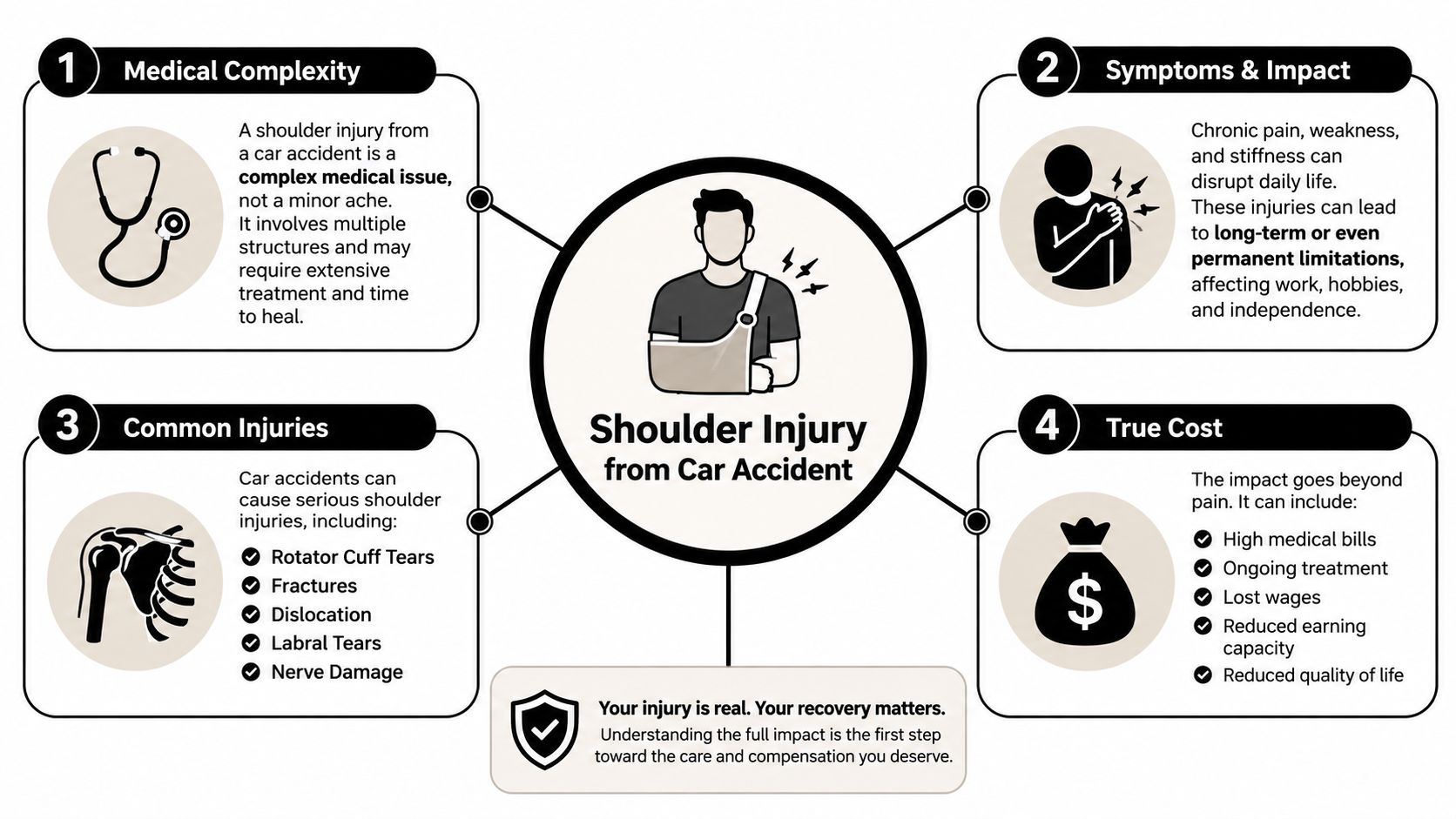
Some shoulder injuries heal with rest and therapy. Others don't. The problem is that the shoulder is one of the most mobile joints in the body, which also makes it vulnerable in a crash.
Common injuries after a wreck
A rotator cuff tear affects the muscles and tendons that help you lift and rotate your arm. People often notice weakness, pain reaching overhead, or a catching sensation.
A SLAP tear involves damage around the rim of the shoulder socket. It can cause deep pain, popping, and trouble with lifting or throwing motions.
A fracture or dislocation is usually more obvious. These injuries can bring severe pain, visible deformity, and a longer recovery. Some require surgery, immobilization, or extensive rehabilitation.
For people trying to manage pain between appointments, some find basic mobility work helpful when cleared by a medical provider. Resources like MEDISTIK's expert-backed routines can give you a general sense of gentle shoulder pain relief exercises, but they should never replace a doctor's advice after a crash.
The real cost isn't just the hospital bill
The shoulder matters in almost everything you do. If your dominant arm is injured, even ordinary tasks can become exhausting.
- Work gets harder: Electricians, teachers, drivers, nurses, mechanics, office workers, and parents all use their shoulders constantly.
- Sleep is disrupted: Many clients say nighttime pain becomes one of the worst parts of recovery.
- Household tasks pile up: Cooking, cleaning, carrying groceries, and getting dressed can turn into daily reminders of the injury.
- Family roles change: You may need help with childcare, transportation, or basic chores.
Practical rule: Don't describe your injury only as “shoulder pain.” Tell your doctor exactly what you can't do now that you could do before the crash.
That detail belongs in your medical record. It can make the difference between a claim that looks minor on paper and one that reflects the truth of your daily life.
Why diagnosis matters to settlement value
Insurers pay close attention to diagnosis, treatment, and consistency. If imaging confirms a tear, if therapy notes show limited range of motion, and if your doctor documents ongoing restrictions, your claim becomes stronger.
If your injury involves a torn cuff, this discussion of a torn rotator cuff claim after a crash in Texas can help you understand how that diagnosis is commonly evaluated.
How a Texas Shoulder Injury Settlement Is Calculated
Insurance companies don't just pick a number at random. They look at documented losses and then argue about what those losses are worth.
Economic damages
Economic damages are the financial losses you can prove with records. These are often the easiest part of the claim to identify, even when there's still disagreement over the total amount.
| Damage Type | Description | Examples |
|---|---|---|
| Economic damages | Direct financial losses tied to the injury | Emergency care, imaging, surgery, physical therapy, prescriptions, lost wages |
| Non-economic damages | Human losses that don't come with a fixed invoice | Pain, suffering, emotional distress, reduced enjoyment of life |
Economic damages may include emergency room care, orthopedic visits, MRI testing, injections, surgery, follow-up appointments, therapy, medication, and income lost while you're unable to work. If your doctor says you'll need future treatment, that can matter too.
Clear records make these damages easier to prove. This is why how medical records affect a Texas injury claim is such an important issue in shoulder cases.
Non-economic damages
Non-economic damages cover what the injury has taken from your day-to-day life. Pain matters. So does the frustration of not being able to sleep comfortably, reach overhead, exercise, drive normally, or work without restrictions.
Texas lawyers and insurance adjusters often discuss these damages using a common valuation approach. Expert valuation of shoulder injury claims in Texas relies on the multiplier method, where total economic damages are multiplied by a factor of 1 to 5 based on injury severity, pain duration, and impact on daily life according to Crosley Law's discussion of Texas injury valuation.
That doesn't mean every case fits neatly into a formula. It does mean the seriousness of your injury affects how your pain and suffering may be argued.
A simple example
Say one person has a shoulder strain, several doctor visits, and a short round of therapy. Another person has a torn rotator cuff, misses substantial work, and undergoes surgery. Their medical costs and their daily limitations are very different. The second claim will usually be valued much higher because the injury lasted longer, cost more to treat, and affected life more significantly.
For a fuller look at the categories involved, What Damages Can You Recover in a Texas Injury Case? outlines the compensation categories available to injured Texans.
What strengthens the calculation
A strong settlement presentation usually includes:
- Consistent treatment: Gaps in care give insurers something to attack.
- Specific work records: Missed time, reduced duties, or lost opportunities should be documented.
- Detailed symptom reporting: Tell providers when pain interferes with sleep, driving, lifting, or daily chores.
- Future care support: If your doctor expects ongoing therapy or lasting limitations, that should be recorded.
The value of a shoulder injury claim rises when the records tell a complete, credible story.
Key Factors That Drive Your Settlement Value
Not every shoulder injury claim with the same diagnosis ends the same way. A few case details have an outsized effect on value.
Treatment level and long-term impact
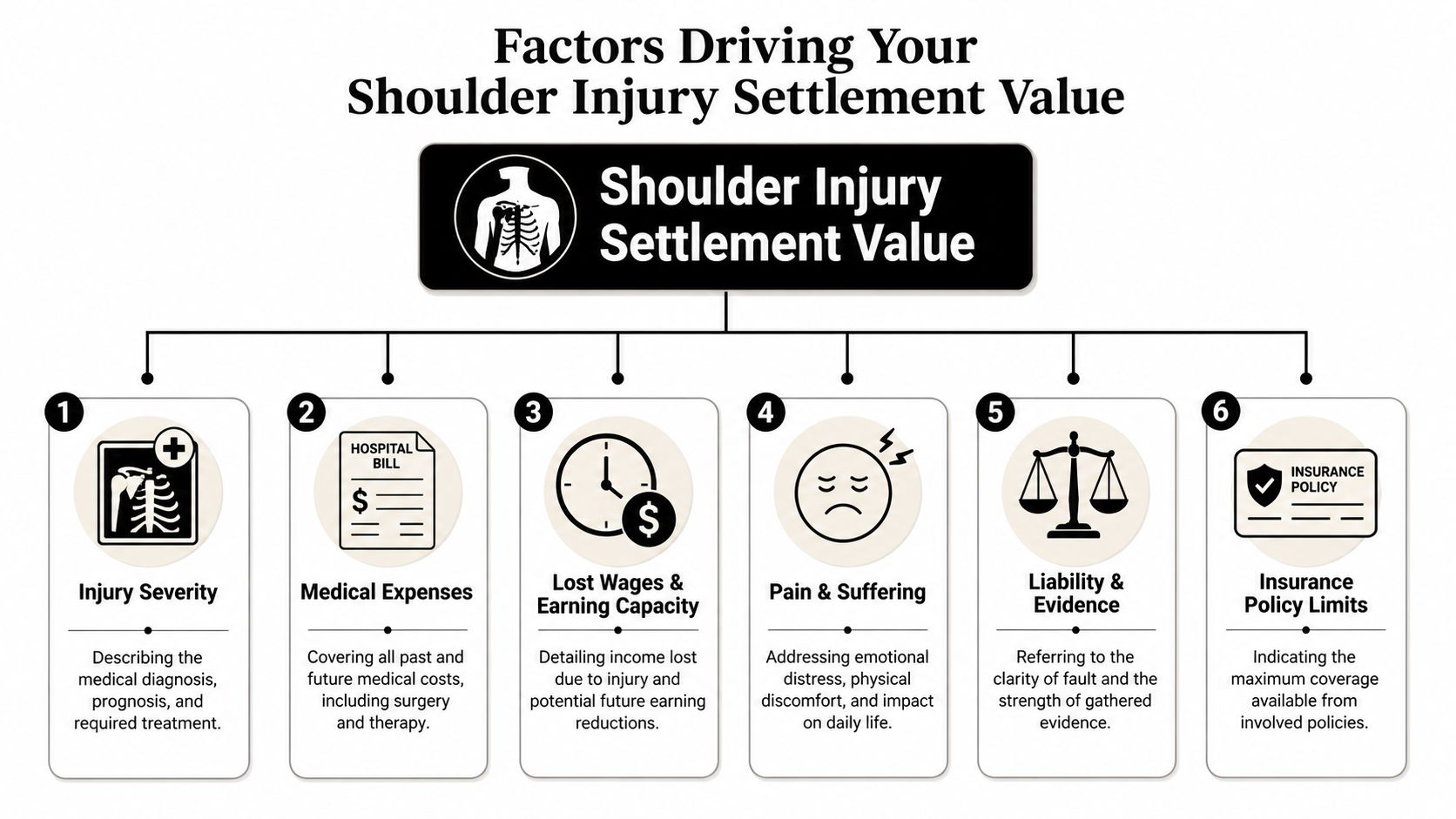
Surgery changes the conversation. So does permanent weakness, reduced range of motion, or a doctor's opinion that you may never return to full function.
In Texas shoulder cases, settlements can vary widely depending on severity and treatment. One Texas source reports ranges from $30,500 to $1,400,000, with minor soft tissue cases often settling between $5,000 and $25,000, cases involving rotator cuff repair or arthroscopic surgery ranging from $35,000 to $150,000, and severe injuries with permanent disability reaching $100,000 to $400,000 or more when policy limits allow. The same source notes that a shoulder injury settlement requiring surgery typically pays around $175,000 and up, while non-surgical cases can be much lower, as discussed in this Texas shoulder injury settlement overview.
That's why “Do I need surgery?” isn't just a medical question. It often becomes a major value driver.
A closer look at what factors affect an injury settlement in Texas can help you see how treatment, evidence, and liability work together.
The pre-existing condition problem
This is one of the most misunderstood parts of a shoulder injury case. Having a prior shoulder issue does not automatically destroy your claim. Texas law can still allow recovery when a crash aggravated a pre-existing condition.
But insurers often use old records aggressively. A frequently unaddressed gap is the “pre-existing condition multiplier.” Insurers often deduct 40–60% of the claim value if the victim had prior shoulder pain, requiring independent medical evidence to reverse this deduction, as explained in this discussion of pre-existing condition claim valuation.
That means an old sports injury, arthritis finding, or prior complaint in your chart can become the insurer's main excuse for a low offer.
If your shoulder felt manageable before the crash and became significantly worse after it, that difference matters. The key is proving it with medical evidence.
One effective response is an orthopedic opinion that addresses the before-and-after change directly. The doctor doesn't need to say your shoulder was perfect before the wreck. The doctor needs to explain how the collision made it worse.
Later in the claim process, video explanations can also help people understand how lawyers evaluate these issues in real cases.
Liability still matters
A serious diagnosis helps, but it doesn't replace proof that the other driver caused the crash. Police reports, witness statements, scene photos, vehicle damage, and prompt treatment all affect how the insurer views the claim.
If fault is disputed, even a strong medical case can lose value quickly. That's why your evidence on liability and your evidence on injury have to support each other.
Navigating Critical Texas Laws That Affect Your Claim
A strong case can still fail if Texas deadlines or fault rules are mishandled.

How long do you have to file a claim in Texas
For most Texas personal injury cases, including shoulder injuries from car accidents, Texas Civil Practice and Remedies Code Section 16.003 sets a two-year statute of limitations that usually begins on the date of injury, as outlined by Crain Brogdon's summary of Texas negligence deadlines.
If you miss that deadline, you can lose the right to pursue compensation in court. Some exceptions may apply in limited situations, but it's generally ill-advised to rely on them.
That's one reason early record gathering matters. Hospitals, therapy providers, employers, and insurers all create records that may later become evidence. If you need to send or organize medical paperwork securely, practical tools for creating HIPAA-compliant fax cover sheets can help when requesting records from providers.
How comparative responsibility can shrink or erase a case
Texas follows a modified comparative responsibility rule. Under Texas Civil Practice and Remedies Code Chapter 33, a victim is barred from recovering any compensation if their percentage of responsibility exceeds 50%. A finding of 51% fault results in a $0 recovery, as explained in this Texas comparative negligence breakdown.
Here's the practical effect. If a jury believes you were partly responsible, your recovery can be reduced by your share of fault. If the other side pushes you over that 50% line, the claim can disappear entirely.
Insurance adjusters often ask questions designed to build a blame argument. Be careful with recorded statements, especially early in the case.
What to do with this information
You don't need to memorize statutes. You do need to act with purpose.
- Get medical care quickly: Delays can hurt both your health and your claim.
- Preserve evidence: Save photos, names of witnesses, and all treatment records.
- Watch what you say to insurers: Keep your statements short and factual.
- Don't wait on legal advice: Deadlines move faster than anticipated.
Texas law gives you rights, but it also gives insurers tools to reduce claims. Knowing the rules early helps you protect your options.
Common Settlement Ranges and the Policy Limit Trap
A driver runs a red light, your shoulder slams into the seat belt, and a few weeks later you learn you may need imaging, injections, or even surgery. Then the insurance company offers a number that does not come close to what this injury is costing you.
That gap confuses many injured Texans. A shoulder claim can have real value on paper, but the amount you can recover often depends on two limits people do not see at first: the amount of insurance available and whether the insurer can blame your symptoms on an older shoulder problem.
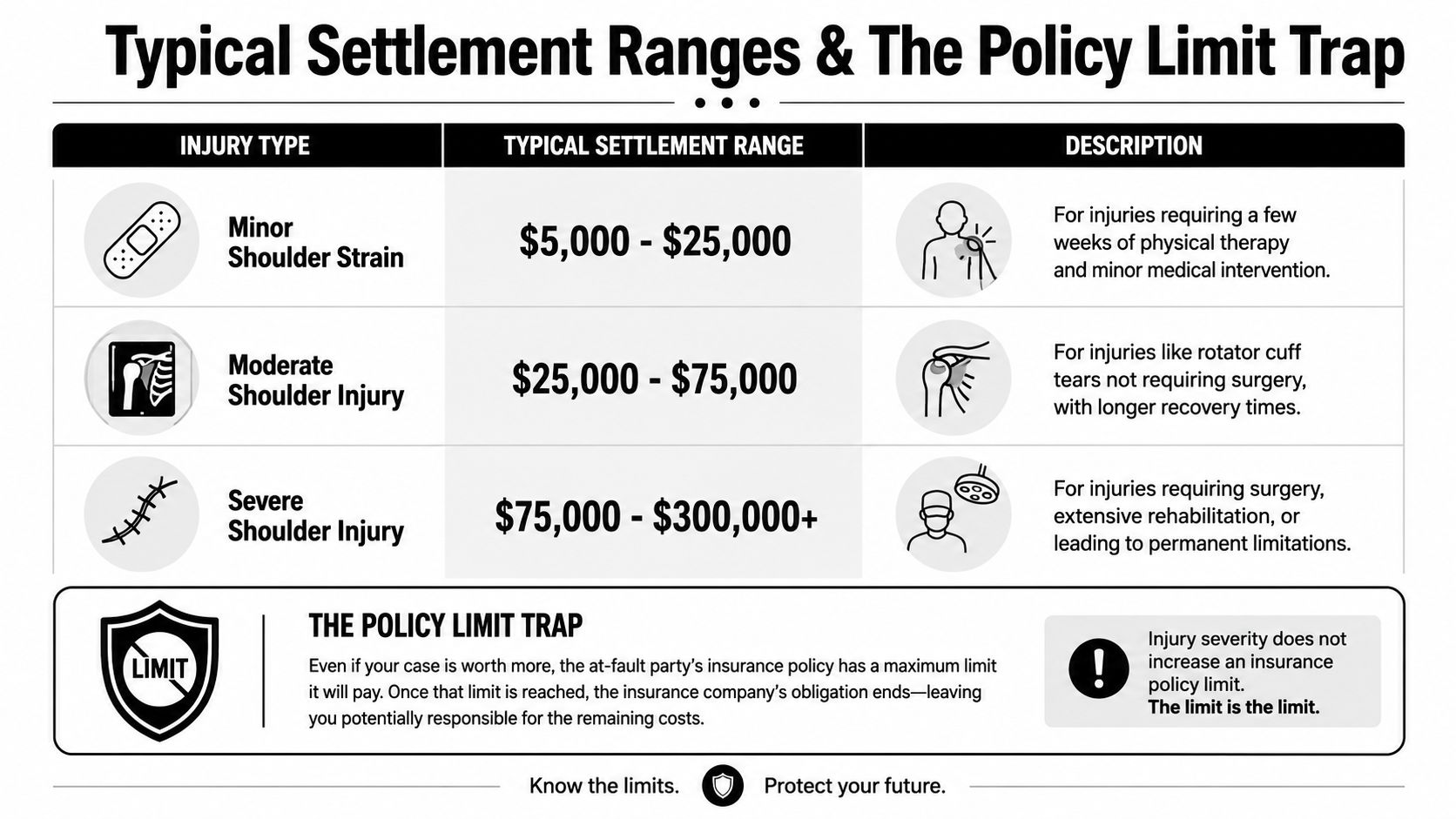
Why settlement ranges vary so much
You will see broad ranges online for shoulder injury cases because shoulder injuries are not all the same. A strain that improves with rest and therapy is very different from a torn rotator cuff, a labral tear, nerve involvement, or surgery with months away from work.
The settlement amount usually rises or falls based on a handful of facts working together:
- the diagnosis and whether imaging confirms it
- how long treatment lasts
- whether you missed work or lost earning ability
- whether pain limits lifting, reaching, driving, sleeping, or caring for family
- whether future treatment is expected
- how clear it is that the crash caused the problem
A simple way to view it is this. The injury sets the size of the claim. Insurance and medical history often set the ceiling.
The policy limit trap
This is one of the hardest parts of Texas injury claims to accept. Even if your shoulder case is worth more, the at fault driver's policy may not be large enough to pay it.
Texas requires minimum liability limits, and many drivers carry only that minimum. Miller & Zois notes in its discussion of rotator cuff injury claim value and policy limits that policy limits can cap recovery in serious injury cases. In plain terms, a case with high medical costs can still hit an insurance ceiling early.
Insurance works a lot like the size of a bucket. Your damages may pour in far above the rim, but the insurer may only be responsible up to the amount of coverage in that bucket.
That does not always end the analysis. You may also have other sources of recovery, including your own underinsured motorist coverage, a policy covering a household vehicle, or, in less common cases, an umbrella policy. If you want to understand how higher layers of coverage work, you can Compare umbrella liability plans.
The other cap people overlook: pre-existing shoulder problems
This issue shows up often in shoulder claims because many adults already have some wear and tear, past sports injuries, prior therapy, or old imaging. Adjusters use that history to argue the crash did not really cause your pain. They may say the collision only stirred up arthritis, tendon fraying, or a prior tear.
Texas law does not let an insurer escape responsibility just because you were not in perfect shape before the wreck. If the crash aggravated a pre-existing condition, that worsening can still be part of your claim. The problem is proof.
Here is what helps:
- records showing your shoulder was functioning before the crash
- a clear timeline of new symptoms after the collision
- imaging and orthopedic notes comparing old findings to new ones
- therapy records showing new limitations in strength or range of motion
- doctor opinions that explain aggravation in plain language
An old condition is not a free pass for the insurance company. It is a defense argument that has to be answered with good medical evidence.
What to do if the offer feels too low
Start by asking a simple question: is the offer low because the insurer disputes the injury, or because the policy is small? Those are different problems, and they require different responses.
If the policy is the problem, investigate every available policy before accepting less than the claim is worth. If the insurer is blaming a prior condition, focus on building a before and after picture with records, imaging, and treating doctor opinions.
You should also keep careful proof of every loss tied to the shoulder injury, including bills, mileage, prescriptions, missed work, and the daily activities you can no longer do without pain. In many cases, the difference between a weak claim and a stronger one is not the injury itself. It is how clearly the claim shows what changed after the crash.
A shoulder injury settlement is not just about picking a number from a chart. In Texas, the key question is how to prove the full harm and find every dollar of coverage available.
How a Houston Car Accident Attorney Maximizes Your Recovery
You report the crash, start treatment, and assume the insurer will look at your records and make a fair offer. Then the adjuster says your shoulder problem looks old, or the policy may not be large enough to cover what you have lost. That is the point when many Texans realize the claim process is less like submitting a bill and more like building a case.
A Houston car accident attorney helps turn scattered facts into a clear, supported demand. In a shoulder injury claim, that often matters most in two places that effectively limit recovery under Texas law. First, the available insurance may be smaller than the harm. Second, the insurer may try to blame your pain on arthritis, an old tear, or prior treatment instead of the crash. A lawyer works on both problems at the same time.
What legal representation changes
An attorney handles the conversations that can hurt your claim if they go badly. That includes recorded statements, medical authorizations, fault disputes, wage-loss proof, and settlement timing. More important, your lawyer organizes the story of the injury so the adjuster, mediator, or jury can see what changed after the wreck.
That work is practical, not theatrical.
A strong claim file often includes medical records placed in chronological order, imaging matched to symptoms, job records that show missed time or reduced duties, and doctor opinions that explain why the crash caused a new injury or worsened an existing one. Shoulder claims often need that extra clarity because insurers like to argue that shoulder pain develops over time and was bound to happen anyway.
A lawyer also looks beyond the first insurance disclosure. If the other driver has a small liability policy, your own uninsured or underinsured motorist coverage may matter. In some cases, there may be other policies to investigate as well. Finding coverage is like checking every faucet before deciding the water has stopped. You do not want to settle based on one policy if another source of recovery exists.
The work behind the scenes
After a serious shoulder injury, an attorney is usually doing several jobs at once:
- Proving fault clearly: collecting the crash report, witness statements, photos, video, vehicle damage evidence, and scene details
- Building medical proof: organizing ER records, imaging, orthopedic evaluations, therapy notes, work restrictions, and future treatment recommendations
- Answering pre-existing condition arguments: comparing your condition before and after the collision with records and doctor opinions stated in plain language
- Checking every layer of coverage: reviewing the at-fault driver's policy, your UM/UIM coverage, and any other available insurance
- Valuing the case before settlement talks: adding up bills, lost income, future care, pain, physical limits, and the effect on daily life
Some families also use the accident as a reminder to review their own protection for the future. If you want a plain-English overview of added liability coverage, resources that Compare umbrella liability plans can help at a general level.
How a lawyer counters low offers
Low offers usually come from one of two places. The insurer is saying the claim is worth less because your shoulder was already damaged, or the insurer is dealing with a policy that is too small.
Those require different responses.
If the insurer is focused on a prior condition, your lawyer builds a before-and-after record. That may include older medical records showing you were functioning, newer records showing a sharp change after the crash, and treating doctors who can explain aggravation in simple terms. Texas law does not let an insurer avoid paying just because you were not medically perfect before the collision.
If the problem is the policy limit, the strategy shifts. Your attorney can press for confirmation of all available coverage, look for UM/UIM benefits, examine whether more than one party may share fault, and avoid settling too early for an amount that reflects only part of the insurance picture. This issue gets overlooked often, and it can cap a claim even when the injury is serious.
When to call a lawyer
Early legal help makes the biggest difference when the facts are likely to get contested or the financial stakes are growing. That is especially true if:
- your shoulder injury may require surgery
- the insurer says you were partly at fault
- you had shoulder symptoms or treatment before the crash
- the other driver may be uninsured or underinsured
- you are missing work or cannot return to the same duties
- the adjuster is asking for a broad medical release
The Law Office of Bryan Fagan, PLLC handles Texas motor vehicle injury cases, including claims involving car wrecks, truck collisions, catastrophic injuries, wrongful death, and uninsured or underinsured drivers. In a shoulder injury case, that usually means gathering evidence, reviewing insurance, presenting the claim with supporting medical proof, and filing suit if the insurer refuses to value the case fairly.
A good Houston car accident attorney improves your recovery by proving what changed, identifying what insurance is available, and pushing back when the carrier treats a real shoulder injury like a paperwork problem.