A serious accident can change your life in seconds, but you don’t have to face it alone.
If you’re reading this after a collision with an 18-wheeler, delivery truck, tanker, or other commercial vehicle, you’re probably dealing with more than pain. You may be worried about missed work, medical bills, a totaled vehicle, calls from insurance adjusters, and the fear that your life won’t look the same for a long time.
Truck accident injury cases are different from ordinary car wrecks. The injuries are often worse. The evidence is more technical. The company behind the truck usually has an insurer and defense team working early to limit what they pay. In the U.S., over 5,100 people were killed in crashes involving large trucks in 2023, about 125,000 people were injured, and nearly 76% of those fatalities were occupants of passenger vehicles according to commercial truck accident statistics. Large trucks can weigh 20 to 30 times more than a standard car, which is why even a crash that starts as a “moderate” impact can leave a family facing catastrophic losses.
As a Texas personal injury lawyer would tell you, the early choices you make after a truck crash can directly affect what evidence survives, how your injuries are documented, and whether the insurance company takes your claim seriously. The legal system can help, but only if the case is built the right way from the start.
The First Steps After a Texas Truck Accident
The first minutes after a truck crash often feel unreal. You may be shaky, confused, angry, or trying to help a passenger. Start with safety, then move carefully.

Put your health first
If you can move safely, get out of traffic and call 911. If you can’t move, wait for first responders unless staying in place puts you in immediate danger.
Accept medical evaluation at the scene if it’s offered. Go to the ER, urgent care, or your doctor the same day if symptoms start later.
That step matters for two reasons. It protects your body, and it creates a medical record that ties your condition to the crash. Waiting gives insurers room to argue that you weren’t badly hurt or that something else caused your pain.
Practical rule: If your neck, back, head, chest, or abdomen hurts after a truck collision, get checked even if you think it will pass.
Gather the right information
Truck accident claims often turn on details that don’t matter in a typical fender-bender. If you’re physically able, collect more than the other driver’s phone number.
Use your phone to photograph:
- The truck itself including the cab, trailer, license plate, USDOT number, company name, and any identifying markings
- Your vehicle damage from multiple angles, inside and out
- The road scene including skid marks, debris, lane positions, shoulder conditions, traffic signals, and weather
- Visible injuries such as cuts, bruising, swelling, or blood on clothing
- Documents if available including the driver’s license, insurance card, and any shipping or company information shown by the driver
Also ask for:
- The driver’s full name and employer
- The trucking company’s name
- Witness names and phone numbers
- The police report number
If someone nearby saw the crash, ask them to text or call you with their contact information before they leave. Witnesses disappear fast.
For a practical non-legal safety checklist, this guide on What to Do After a Truck Accident is a useful reference. For Texas-specific legal steps, this page on what to do after a truck accident can help you avoid mistakes that hurt a claim.
Choose your words carefully
The crash scene is not the place to debate fault. Don’t apologize. Don’t guess about speed. Don’t say “I’m fine” just because adrenaline is carrying you.
Keep your statements short and factual:
- To police tell the truth, but only what you know firsthand
- To the truck driver exchange information and avoid argument
- To witnesses thank them and ask for contact details
- To anyone recording avoid speculation about what happened
A common real-world example is a Houston freeway crash where a driver says, “I never even saw the truck,” meaning they’re shocked. An insurer may later twist that into an admission that you weren’t paying attention. Casual comments can become defense exhibits.
Protect your next few days
The hours after the wreck matter almost as much as the scene itself.
Do these things before the day ends:
- Get medical care and follow discharge instructions.
- Save every document including discharge papers, prescriptions, towing receipts, and the crash report information.
- Tell close family what happened so someone else can help track symptoms and calls.
- Avoid posting online about the wreck, your injuries, or your activity level.
Your first goal is stabilization. Your second is preserving a clean record of what happened and how you were hurt. That record is what later supports fair compensation for treatment, lost income, and long-term care.
Protecting Your Claim and Preserving Crucial Evidence
The days after a truck wreck are when strong claims are built or weakened. Trucking companies know this. Their insurers often begin gathering information right away. You should assume the other side is already thinking about defense themes, document control, and ways to narrow your damages.
Why truck evidence disappears faster than people think
A truck crash leaves behind a paper trail and a digital trail. Both can change quickly.
A skilled legal investigation often follows the same kind of forensic approach reflected in the Large Truck Crash Causation Study analysis brief, which uses scene reconstruction, interviews, and links between crash events and trauma outcomes to establish how a collision happened and who is responsible.
In plain terms, that means truck cases are proven through details, not assumptions.
Key evidence can include:
- Black box data that may show braking, speed, or vehicle operation around the time of impact
- Driver logs and dispatch records that may reveal fatigue, route pressure, or timing issues
- Maintenance and inspection records that can show skipped repairs or recurring mechanical problems
- Bills of lading and cargo records when load balance or securement is part of the case
- Driver qualification records if negligent hiring, training, or supervision may be involved
You probably can’t collect those records yourself. But you can act in ways that make them easier to preserve once a lawyer is involved.
Build your own evidence file
Don’t wait for the insurer to define your injuries for you. Create a simple claim file at home or on your phone.
Include:
- Medical records and bills from every provider
- Prescription receipts and pharmacy printouts
- Photos of injuries over time especially bruising, stitches, casts, and surgical recovery
- Work records showing missed time, reduced duties, or lost opportunities
- A daily symptom journal with pain levels, sleep problems, headaches, anxiety, driving fear, and limits on normal activities
That journal matters more than many people realize. A truck accident injury affects your life between appointments, not just during appointments. If you can’t lift your child, can’t drive on I-45 without panic, or can’t finish a full shift because your back spasms by noon, write it down.
Keep it simple. Date each entry. Describe what changed and how it affected your day.
The first insurance call
Many victims get a call from the trucking company’s insurer very early. The adjuster may sound polite, concerned, and efficient. Don’t mistake that tone for neutrality.
The adjuster’s job is to protect the company’s money. That usually means trying to get statements before you understand your injuries, before records are complete, and before the full picture of the crash is clear.
What works:
- Confirming basic contact information
- Saying you are receiving treatment
- Stating that the matter is under review
- Declining a recorded statement until you’ve received legal advice
What doesn’t work:
- Guessing about speed or distance
- Downplaying pain
- Agreeing that some injury was “already there”
- Accepting quick payment before future care is understood
- Letting the adjuster steer the timeline
Useful phrases include:
- “I’m still receiving medical evaluation, so I’m not prepared to discuss injuries in detail.”
- “I won’t give a recorded statement at this time.”
- “Please send any requests in writing.”
Real trade-offs victims face
After a Dallas or Austin truck collision, many people want to be cooperative so the process moves faster. That instinct is understandable. It can also cost you.
There’s a trade-off between speed and accuracy. A fast statement can lock you into facts that later turn out to be incomplete. A fast settlement can leave future treatment uncovered. A fast repair discussion can distract from proving bodily injury.
One practical option for victims who need structured legal help is to contact a Texas firm that handles truck crashes, such as the Law Office of Bryan Fagan, PLLC, once immediate medical needs are addressed. The point isn’t to escalate conflict. It’s to put evidence preservation and communication on a professional track before avoidable damage is done to the claim.
Understanding Liability and Negligence in Texas Law
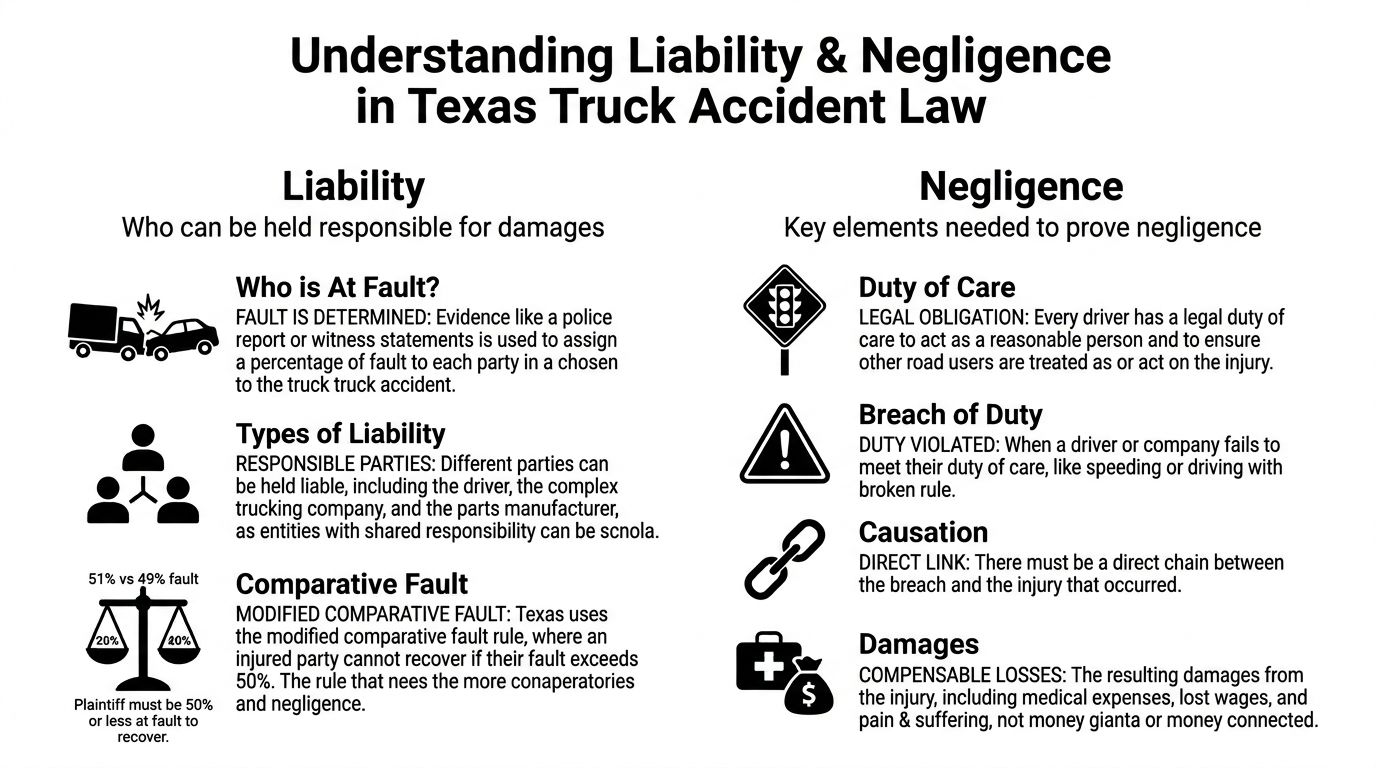
Truck accident cases are built on ordinary legal principles, but the facts are rarely ordinary. Texas law asks a few core questions. Who had a duty to act carefully? Who failed to do that? Did that failure cause the crash? What harm resulted?
What negligence means in a truck crash
Negligence is the failure to use reasonable care under the circumstances. In a truck case, that may involve a driver, a company, or several businesses at once.
Examples include:
- Driver fatigue from unsafe schedules or ignored rest needs
- Distracted driving behind the wheel of a commercial vehicle
- Speeding or following too closely
- Poor maintenance such as worn brakes or tire problems
- Improper loading that makes a trailer unstable
- Negligent hiring or supervision when a company puts an unsafe driver on the road
If you want a plain-English explanation of how fault is shared in Texas injury law, this overview of comparative fault definition is a helpful starting point.
More than one party may be responsible
Truck cases often differ from normal two-car wrecks in this way. Liability may reach beyond the person in the cab.
The potential defendants may include:
| Party | Why they may be liable |
|---|---|
| Truck driver | Unsafe driving, distraction, fatigue, or rule violations |
| Trucking company | Hiring, supervision, scheduling pressure, maintenance failures |
| Maintenance contractor | Poor inspection or repair work |
| Cargo loader or shipper | Unbalanced or unsecured cargo |
| Manufacturer | Defective truck parts or safety systems |
A wreck on I-35 near Austin is a good example. A trailer swings during a lane change, hits an SUV, and causes a chain reaction. The driver may have made the move, but the trailer may also have been loaded badly or maintained poorly. That’s why early investigation matters. If you target only one defendant, you may miss the party with actual financial responsibility.
Liability in a truck case often sits in company records, not just in the crash report.
Texas comparative responsibility
Texas follows a modified comparative responsibility rule. In practical terms, your compensation can be reduced if you were partly at fault, and recovery is barred if you are found more responsible than the other side under Texas law.
That rule gives insurers a strong incentive to shift blame onto you.
Common examples include arguing that you:
- changed lanes too late
- followed too closely
- failed to avoid the truck
- had a pre-existing injury
- made your own injuries worse by delaying treatment
Here’s why that matters. Suppose a San Antonio driver is hit by a commercial truck during a merge dispute. If the evidence shows the truck driver made an unsafe move but the defense persuades a jury that the injured driver also acted carelessly, the value of the claim can drop. If the defense pushes that blame too far and it sticks, recovery can be lost entirely.
That’s one reason trucking companies fight hard over details that seem small. Lane position, timing, statements at the scene, and phone records can become tools in a comparative fault argument.
Why civil claims matter more right now
The practical situation has become more challenging for the public. Injuries in large truck crashes rose by 5% in 2024, while FMCSA safety enforcement cases dropped by 84% in 2025, according to this report on the downward trend in traffic fatalities and the drop in truck safety enforcement. Fewer enforcement actions can mean more responsibility falls on injured people and their lawyers to uncover what went wrong through civil investigation.
If maintenance may be part of your case, even a basic resource like this Preventive Maintenance Checklist for Trucks helps show how routine truck upkeep is supposed to work. The legal point is simple. If basic maintenance steps were skipped, that can support negligence.
How long do you have to file a claim in Texas
Texas personal injury cases are governed by a statute of limitations, which sets a deadline to file suit. Wrongful death claims have deadline rules too.
You should speak with a lawyer as soon as possible after a serious truck crash because evidence problems usually show up long before filing deadlines do. Waiting can weaken witness memory, complicate medical proof, and make record preservation harder.
Calculating the True Value of Your Truck Injury Claim
Individuals often start by asking, "What is my case worth?"” That’s the right question, but it needs to be asked the right way.
A truck accident injury claim is not just a stack of current medical bills. It is the total value of what the crash has cost you and what it is likely to keep costing you.
Economic damages and non-economic damages
Texas injury claims usually include two broad categories of damages. One is concrete. The other is personal.
Here’s a simple breakdown:
| Damage Category | What It Covers |
|---|---|
| Medical expenses | Emergency care, hospital treatment, surgery, follow-up visits, medication, rehabilitation, and future treatment needs |
| Lost income | Missed paychecks, reduced hours, lost earning capacity, and interrupted self-employment income |
| Property losses | Vehicle damage and other out-of-pocket costs tied to the wreck |
| Pain and suffering | Physical pain, limitations, discomfort, and the daily burden of recovery |
| Mental and emotional harm | Anxiety, trauma, sleep disruption, fear of driving, depression, and PTSD |
| Loss of normal life | Inability to parent the same way, enjoy hobbies, travel, exercise, or maintain relationships as before |
If you want a useful framework for thinking through settlement value, this guide on how to calculate a car accident settlement offers a practical starting point that also helps in truck cases.
What people often leave out
Victims often remember the ambulance bill and forget the larger pattern. They count wages already missed, but not reduced future work. They mention surgery, but not the home changes, travel to specialists, interrupted childcare, or the cost of needing help with ordinary tasks.
Insurance companies know that most unrepresented people value claims too narrowly. That’s why early offers often focus on immediate bills and ignore long-term disruption.
A Houston office worker with a serious back injury may return to work eventually, but only with fewer hours, more pain, and limited advancement. A parent with a brain injury may still “look okay” while struggling with concentration, noise sensitivity, and emotional regulation. The loss is real even when it doesn’t show up in a cast.
Psychological harm is part of the claim
Truck wrecks leave many people with more than physical injuries. Psychological injuries like PTSD affect over 20% of survivors, mental health claims after crashes rose by 15%, and victims who fail to document these harms can lose 30% to 50% of their potential settlement value, according to this discussion of common injuries in truck accidents and their long-term effects.
Those numbers matter because insurers often treat emotional harm as secondary unless you prove it carefully.
Document these issues the same way you document physical pain:
- Therapy or counseling records
- Sleep disruption
- Panic while driving or riding
- Flashbacks or nightmares
- Withdrawal from family or social life
- Changes in work performance
- Medication related to anxiety, depression, or trauma
A claim is worth more when it reflects your whole injury, not just the parts visible on an X-ray.
The strategy behind valuation
Valuation is not guesswork. It’s evidence tied to human consequences.
A strong damages presentation usually shows:
- What happened medically
- How long recovery is likely to last
- What daily functions changed
- How work and income were affected
- What treatment and support may be needed in the future
What works is consistency. Your records, your testimony, your family’s observations, and your treatment history should tell the same story.
What hurts value is inconsistency. If medical records say severe pain but your social media shows strenuous activity, the defense will use it. If you stop treatment without explanation, the insurer may say you recovered. If you never report anxiety or driving fear to a provider, the defense may say it wasn’t serious.
This is why the “why” behind each step matters. Going to follow-up visits isn’t just about medical care. It’s about proving duration. Reporting symptoms isn’t complaining. It’s documenting damages. Seeing the right specialist isn’t overreacting. It’s making the future cost of the injury visible.
Navigating the Legal Process Settlement vs Trial
After the claim is opened and evidence starts coming together, the case usually moves in one of two directions. It either resolves in settlement negotiations or it goes into litigation and possibly trial.
For most clients, the process feels less like a straight line and more like a series of pressure points.

How a settlement path usually develops
Take a common scenario. After a freeway crash near Dallas-Fort Worth, the injured driver finishes initial treatment, continues follow-up care, and the lawyer gathers records, wage proof, photographs, and liability evidence. A demand package goes to the insurer. Negotiations begin.
The insurer rarely starts at a fair number. Instead, it often tests your case.
It may argue:
- Your injuries were pre-existing
- Treatment was excessive
- You were partly at fault
- The crash impact was too minor to cause serious harm
- You recovered faster than your doctors suggest
Another issue that can complicate truck cases is hidden information about the truck driver. A NIOSH survey discussion on underreported injuries among long-haul truck drivers highlights how injuries may go unreported due to job security concerns. In litigation, that can matter when fatigue, prior injury, or medical history should have been known to the trucking company but was not properly documented.
What a lawyer is doing during negotiations
Negotiation is not just back-and-forth on numbers. It is a controlled argument about risk.
A Texas personal injury lawyer pushes value by showing the defense what will happen if the case reaches a jury. That may include:
- stronger medical timelines
- witness statements that support your version
- expert review of the crash
- employer records that prove income loss
- evidence that the trucking company failed basic safety responsibilities
When the defense sees a case that is organized, well-documented, and trial-ready, settlement pressure rises.
Some cases settle because the evidence is good. Others settle because the other side believes your lawyer is fully prepared to try them.
A short video can help make that fork in the road feel more concrete.
When trial becomes the right move
Trial is not the goal in every case. Fair compensation is the goal. Sometimes the fastest path to fairness is a negotiated resolution. Sometimes it isn’t.
A case may need trial when:
| Situation | Why settlement may fail |
|---|---|
| Liability is heavily disputed | The defense thinks it can shift blame to you |
| Injuries are severe and long-term | The insurer resists paying future damages fully |
| Corporate conduct looks bad | The company doesn’t want to admit what discovery may show |
| Medical issues are complex | The defense bets a jury will be confused |
Trial has trade-offs. It takes longer. It requires more preparation. It creates uncertainty because juries are made of people, and people can disagree.
But a trial also provides an advantage. Trucking companies know that a polished, documented case can be more dangerous in a courtroom than at a negotiating table. That reality often shapes settlement talks long before opening statements ever happen.
What victims should expect emotionally
The legal process can feel slow when you’re trying to heal. That doesn’t always mean your case is stalled. Serious cases often need time because the value depends on knowing how your recovery unfolds.
After a Houston truck crash, a person may want closure quickly. That’s normal. But closing a case before the full medical picture is clear can transfer future costs from the trucking company to your family. Patience is frustrating. It’s also often protective.
Why a Texas Truck Accident Lawyer is Your Strongest Ally
A truck wreck claim can start going sideways before you leave the hospital.
While you are dealing with pain, missed work, and questions about treatment, the trucking company is often already protecting itself. Its insurer may be taking statements, reviewing electronic records, and looking for a way to frame the crash as driver error, shared fault, or a minor-injury case. That early push matters because the first version of the story often shapes what they offer later.
A Texas truck accident lawyer steps in to stop that process from hardening against you.
Why these cases require more than basic claim handling
Truck cases usually involve more records, more decision-makers, and more opportunities for a company to spread blame. The issue is rarely limited to what happened in the few seconds before impact. A lawyer has to examine what was happening hours, days, and even months earlier. Was the driver pushed to stay on the road too long? Was maintenance delayed? Did the company ignore a pattern of safety problems? Were dispatch decisions part of the chain that led to the crash?
Those questions affect case value. If the evidence shows the company created or tolerated unsafe conditions, settlement pressure changes. If that proof is missed, the insurer gets to argue this was just an unfortunate wreck with limited damages.
Whether you need help after a commercial vehicle crash, a fatal collision, or a catastrophic injury, the legal strategy is the same. Build the case before the other side defines it for you.
What good legal help changes
A lawyer can level the field by:
- Preserving evidence early before records are lost, overwritten, or filtered through the defense
- Controlling communication so adjusters stop using casual calls to pin you to an incomplete account
- Identifying every liable party instead of stopping with the driver and missing the company behind the decisions
- Working with experts when accident reconstruction, medical issues, or future care needs require proof
- Calculating damages fully so the claim reflects future losses, not just current bills
- Preparing for trial so settlement talks happen under real pressure, not on the insurer’s terms
That work changes outcomes in practical ways. I have seen insurers treat a claim one way before records are demanded and very differently after they realize someone is tracing fault through the company, the truck, and the paper trail. Cases get stronger when the other side knows it cannot hide weak safety practices behind a quick payout.
The hesitation many people have
Injured people often wait because they want to avoid conflict, they are unsure whether the case is serious enough, or they assume hiring a lawyer will cost too much.
Insurance companies count on that delay. It gives them time to shape the file, argue that gaps in treatment mean the injury was minor, and push for a number that does not cover future care. Waiting can also make witnesses harder to find and records harder to secure.
Legal help is not about picking a fight for the sake of it. It is about protecting the value of your claim before the defense discounts it. When a lawyer works on a contingency fee, you can get that protection without paying upfront legal fees.
You do not have to sort through this alone while trying to heal. If you were hurt in a truck crash in Houston, Dallas-Fort Worth, Austin, San Antonio, or anywhere in Texas, schedule a free consultation with the Law Office of Bryan Fagan, PLLC. We can review what happened, explain your options under Texas law, and help you take the next step toward financial recovery with clarity and support.