Skip to content
A serious accident can change your life in seconds, but you don't have to face it alone.
You may be reading this while dealing with pain, missed work, car repairs, medical appointments, and calls from an insurance adjuster who wants a statement before you've even had time to think. That's a hard place to be. Most injured people don't start out asking legal questions. They start out asking practical ones. Who's going to pay the bills? Why is the other driver blaming me? What do I need to prove?
In Texas, the answer usually begins with one word. Negligence. That's the legal idea behind most injury claims. It means someone failed to use reasonable care, and that failure caused harm. If you understand how negligence is proven in Texas injury cases, the process starts to feel less mysterious and more manageable.
Take a common example. After a Houston freeway crash, your neck hurts, your SUV is in the shop, and the insurance company says fault is “still under investigation.” You know what happened. The challenge is showing it with evidence that fits the legal rules. That's where many people get stuck.
If your injury happened at home or involved an older family member, practical prevention matters too. Resources like this home safety guide for seniors can help families reduce risks while they focus on recovery.
Early legal guidance can also prevent costly mistakes. If you're unsure about timing, this explanation of when to contact a lawyer after an accident in Texas is a useful place to start.
Your Path to Justice After a Serious Accident
The days after a serious collision often feel scrambled. One minute you're driving to work on I-45 or heading home from school pickup. The next, you're standing on the shoulder with flashing lights behind you, trying to remember what just happened.
Then the second wave hits. Your body stiffens up. A doctor orders treatment. Your employer asks when you'll be back. The other driver's insurer calls and sounds friendly, but their questions are pointed. They want details about speed, lane changes, prior injuries, and whether you “might have contributed” to the crash.
That's why negligence matters so much. It gives the case a structure. Instead of treating your claim like a vague dispute, Texas law asks specific questions about responsibility. Was someone supposed to act carefully? Did they fail? Did that failure cause your injury? What losses did it leave you with?
Practical rule: Injury claims are rarely won by one dramatic piece of proof. They're built by connecting the facts in a clear, believable way.
For many families, that shift is a relief. You don't need to know every legal term on day one. You do need to understand that proving fault is a process. Police reports, photos, witness accounts, medical records, and other evidence can work together like puzzle pieces. Each piece matters because it helps show what happened and why it matters under Texas law.
A truck crash lawyer Houston families trust, a Houston car accident attorney, or a Texas personal injury lawyer will usually look at the same basic question first. What evidence exists today, and what evidence could disappear tomorrow?
The Four Elements of Negligence in Texas Law
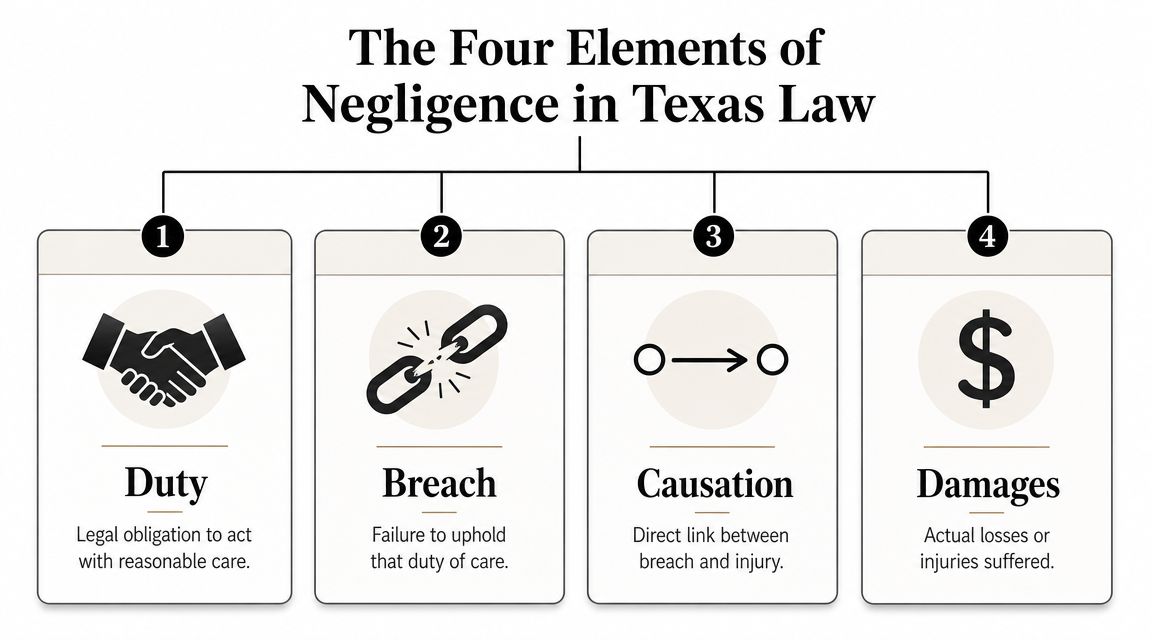
Texas injury cases use a four-part test. The defendant must have owed a duty of care, breached that duty, caused the injury, and produced measurable damages. The causation part includes both actual cause and proximate cause, meaning the injury would not have happened but for the conduct, and the harm had to be a foreseeable result of it, as explained in this discussion of how negligence is proven in a Texas injury case.
Duty means a legal obligation to be careful
Start with duty. In plain language, duty is the rule that says people must act with reasonable care toward others. Drivers must drive safely. Trucking companies must operate responsibly. Property owners must address dangerous conditions they know about or should know about.
A simple way to think about duty is this. Every time someone gets behind the wheel, they're accepting a shared responsibility to follow traffic rules and avoid hurting others. That duty exists before the crash ever happens.
In a Houston rear-end collision, the other driver usually had a duty to keep a safe lookout and maintain control of their vehicle. That part is often straightforward.
Breach means the person failed to meet that duty
A breach happens when someone breaks that obligation. Tailgating, texting, drifting across lanes, ignoring a traffic signal, or driving too fast for conditions can all support a breach argument.
If duty is the promise to drive carefully, breach is the broken promise.
Here's where people often get confused. Bad outcomes alone don't prove breach. A crash by itself doesn't automatically show negligence. You still need facts that show what the other person did or failed to do.
This video gives a helpful overview of how lawyers think about fault and proof in injury cases.
Causation connects the careless act to the injury
Causation is where many claims become more technical. The law doesn't just ask whether someone acted carelessly. It asks whether that carelessness was the cause of the injury.
A helpful distinction:
| Type of causation | Plain-English meaning |
|---|---|
| Actual cause | The injury would not have happened but for the defendant's conduct |
| Proximate cause | The injury was a foreseeable result of that conduct |
Suppose a driver follows too closely on the Katy Freeway and slams into the back of your car. If the crash caused your whiplash, that points to actual cause. If neck and back injuries are the kind of harm you'd expect from that kind of crash, that points to proximate cause.
Damages mean real losses
The last element is damages. This is the harm the collision left behind. It can include physical injury, medical treatment, missed income, pain, and other losses that can be shown through records and testimony.
A strong case tells one consistent story. The driver acted carelessly, the carelessness caused the crash, and the crash caused losses that can be documented.
That's the core of how negligence is proven in Texas injury cases. Not through one magic phrase. Through four linked parts that must all be supported.
Gathering the Evidence to Build Your Case
Knowing the four elements is helpful. Knowing what evidence supports each one is what makes a claim real.
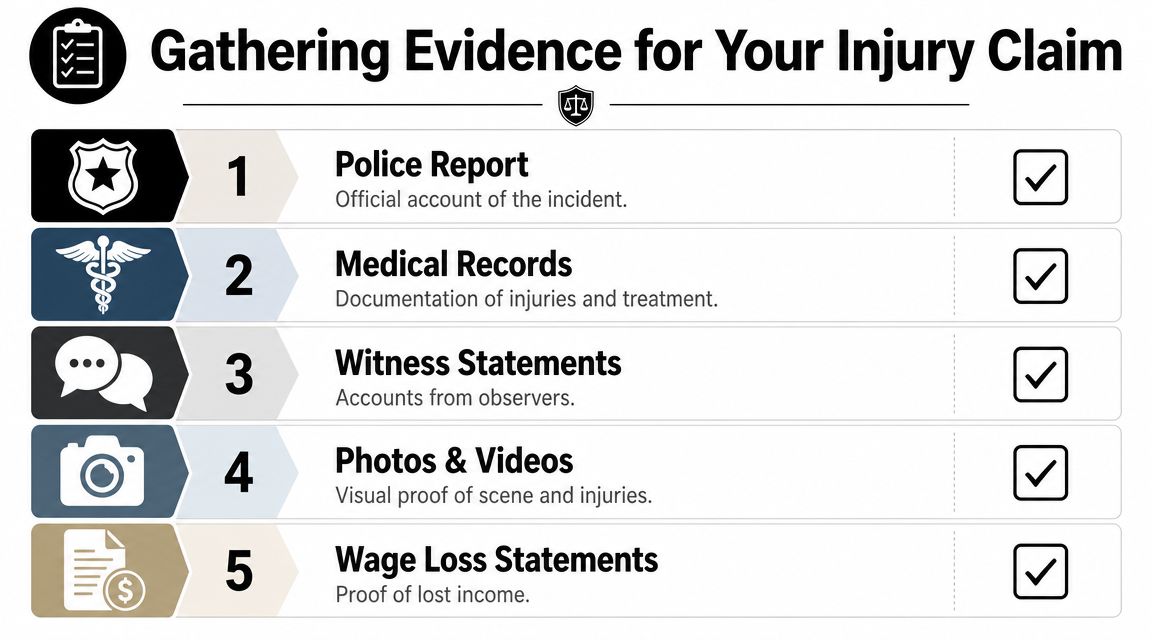
A case is strongest when the proof works from multiple angles. The practical record often includes police reports, witness statements, medical records, scene photos or video, dashcam footage, black-box data, and phone records that together show duty, breach, causation, and damages rather than relying on a single item of evidence. If you want a broader overview, this guide on what evidence is needed for an injury claim in Texas breaks it down further.
What helps prove duty and breach
Some evidence shows what the defendant was supposed to do and how they failed.
- Police report details: The officer's observations, party information, road conditions, and initial description of the crash can help frame the incident.
- Photos from the scene: Skid marks, vehicle positions, traffic signs, debris, and damage patterns often help show what went wrong.
- Witness contact information: Neutral witnesses can confirm lane movement, speed, following distance, or whether a driver appeared distracted.
- Phone records or digital evidence: In some cases, these can help investigate distraction.
In a truck collision, lawyers may also move quickly to preserve company records, onboard data, and inspection materials before they're lost or overwritten.
What helps prove causation
Causation is usually built by showing sequence and connection. The goal is to answer two questions. What happened in the crash, and how did that event lead to your injury?
Useful proof may include:
- Dashcam or surveillance footage: Video can show lane drift, impact angle, or traffic flow.
- Vehicle data: Crash-related data can help reconstruct timing and movement.
- Medical records close in time to the accident: Prompt treatment helps connect symptoms to the event.
- Expert analysis: In more serious cases, reconstruction specialists or medical experts may explain why the injury fits the mechanics of the crash.
If you're organizing documents, tools like a PDF AI legal agent can help you search large records and keep facts in order, especially when a file includes reports, bills, and treatment notes from many providers.
Keep the originals if you can. The torn clothing, damaged helmet, broken child seat, and repair photos may all become part of the story your evidence tells.
What helps prove damages
Damages require proof of what the accident cost you.
A short list of documents to save:
- Medical bills and treatment records that show diagnosis, treatment, and follow-up care.
- Wage loss information from your employer if you missed work.
- Receipts for out-of-pocket costs such as medication, transportation to appointments, or medical equipment.
- A daily symptom journal describing pain, limitations, and missed activities in your own words.
The biggest mistake many people make is waiting too long. Vehicles get repaired. Videos get deleted. Memories fade. A Houston car accident attorney often starts by locking down evidence before the other side shapes the narrative first.
Texas Comparative Negligence and Your Compensation
One of the most important parts of any Texas injury claim is fault allocation. Even when another driver clearly caused the crash, the insurance company may still argue that you share part of the blame.
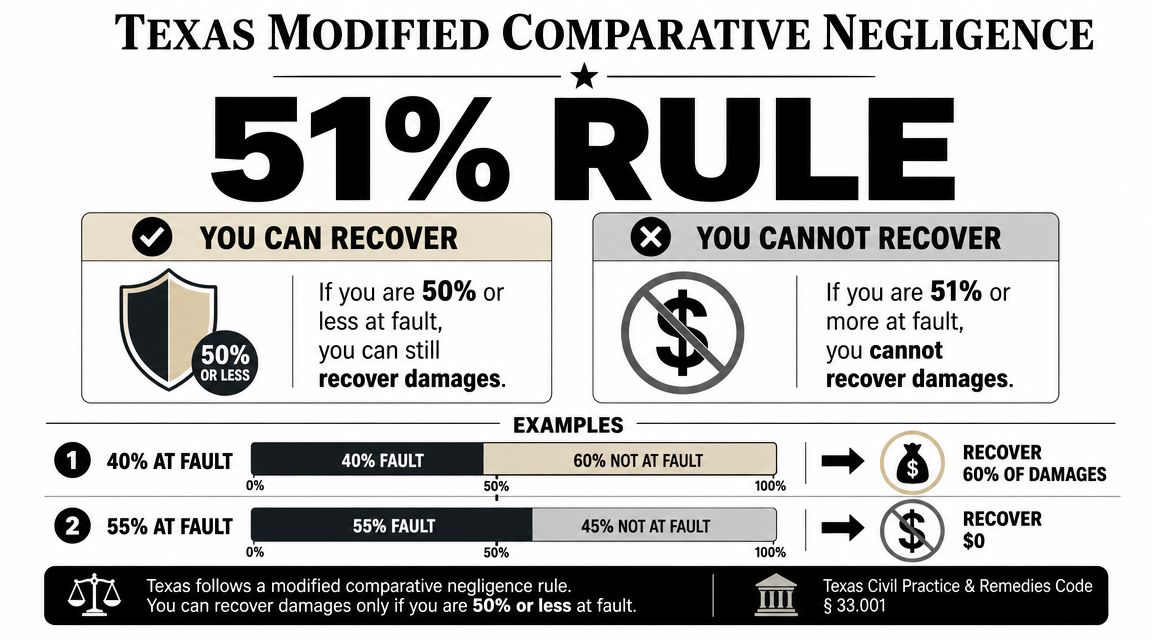
Texas follows a modified comparative negligence rule. If an injured person is 50% or less at fault, they can still recover damages, but the recovery is reduced by that percentage of fault. If the injured person is 51% or more at fault, they recover nothing under Texas Civil Practice and Remedies Code Section 33.001, as explained in this overview of Texas comparative negligence law.
How fault changes a recovery
The easiest way to understand this rule is through the examples built into the rule itself.
| Scenario | Result |
|---|---|
| You prove $100,000 in damages and are assigned 20% fault | You recover $80,000 |
| You are assigned 51% fault | You recover $0 |
That's why comparative fault is such a major battleground. Small shifts in blame can make a large difference. If an adjuster can push your share of responsibility upward, they reduce what the insurer has to pay. If they can push it high enough, they may try to wipe out the claim entirely.
Why insurers focus so hard on your conduct
After a crash, you may hear questions like these:
- “Were you watching the road?”
- “Did you brake suddenly?”
- “Were you driving too fast for conditions?”
- “Why didn't you avoid the collision?”
Those questions are not casual. They're often part of an effort to assign fault to you. That doesn't mean the defense is right. It means fault is being contested.
If you want a plain-language explanation of the rule itself, this guide to comparative fault in Texas is a helpful reference.
When liability is disputed, every photo, witness statement, and treatment record matters more. Comparative negligence turns details into leverage.
A real-world example
After a Houston freeway crash, one driver may admit hitting you from behind but still claim you changed lanes abruptly. In that situation, the case isn't just about whether contact happened. It's about whose choices caused it and how much each person contributed.
That's one reason a Texas personal injury lawyer spends so much time building the facts. In a serious truck wreck or a wrongful death case, the stakes are even higher because fault allocation can shape the entire outcome for the injured person or family.
Common Defenses Used to Deny Injury Claims
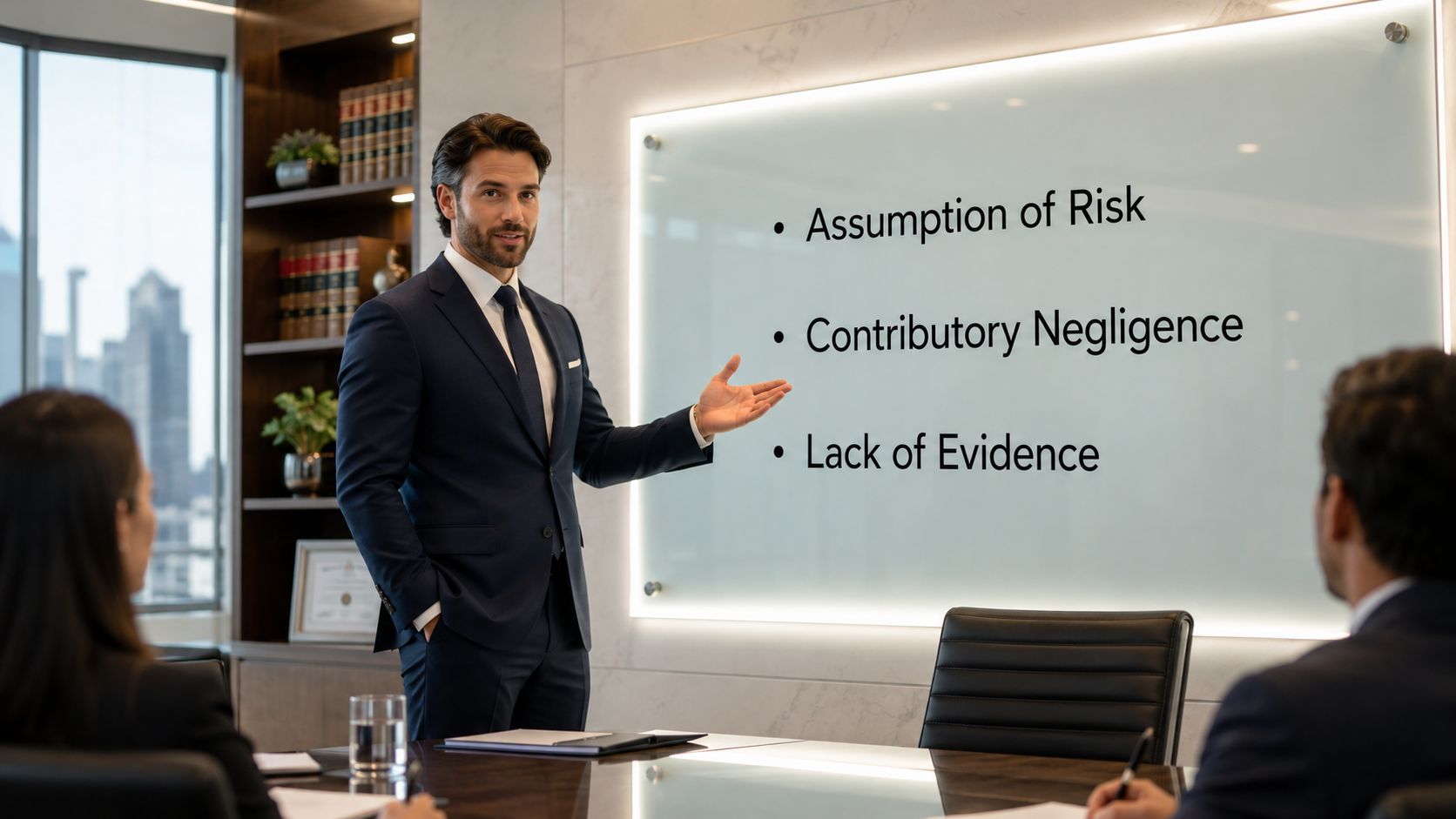
Insurance companies rarely start from the position that your claim should be paid in full without a fight. Most defense strategies are designed to weaken one of the legal links discussed above. If you know the common themes, their arguments become easier to spot.
They may say your injuries were already there
A common defense is that your pain came from a prior condition, not the crash. This issue comes up often with neck, back, and shoulder injuries.
That doesn't end a valid claim. Many injured people had some medical history before the collision. The key question is whether the accident caused new harm or made an existing problem worse. Good medical records and a clear treatment timeline often matter a great deal here.
They may argue you caused the accident
This is the classic blame-shifting defense. The insurer may argue you were inattentive, speeding, improperly changing lanes, or otherwise careless.
That argument ties directly to Texas comparative negligence. A defense lawyer doesn't need to prove you were the only negligent person to help the insurer. They may just try to assign you enough blame to reduce the value of the claim.
They may say the event was unavoidable
Sometimes the defense claims the crash was an accident that no one could have prevented. In plain language, they're arguing that nobody acted negligently.
Physical evidence often becomes decisive. Scene photos, vehicle damage, witness accounts, and electronic data can help show whether the event was unavoidable or whether someone failed to act reasonably.
Insurance companies build defenses early. You should assume they are evaluating your words, your records, and your timing from the beginning.
They may question whether you were really harmed
Another familiar tactic is minimizing damages. The defense may suggest you delayed treatment, overtreated, or are exaggerating how much the injury affected daily life.
That's especially painful for people with serious injuries and for families pursuing a wrongful death lawyer Texas claim after losing a loved one. But the tactic is common. Consistent records, honest testimony, and careful documentation help answer it.
How the Law Office of Bryan Fagan Fights for You
When you're hurt, legal help should make life simpler, not harder. A strong injury team takes the burden of investigation and proof off your shoulders so you can focus on treatment and your family.
That starts with fast action. A lawyer can identify the records that matter, request reports, preserve video, contact witnesses, review medical documentation, and work to secure evidence before it disappears. In serious crash cases, that may include commercial vehicle data, scene analysis, and expert review to clarify how the impact occurred and why the injuries fit the event.
Building the case from the ground up
A good legal strategy doesn't treat your claim like a stack of random paperwork. It builds a connected story from the evidence.
That means showing:
- What duty existed under the circumstances
- What conduct broke that duty
- How the breach caused the injury
- What losses followed and how they changed your life
For a Houston car accident attorney or truck crash lawyer Houston families rely on, the work often includes anticipating defense arguments before they're fully developed. If the insurer is likely to blame you, the lawyer gathers facts that answer that argument early. If the insurer is likely to dispute medical causation, the lawyer focuses on timelines, treatment records, and expert support.
Support for serious injury and wrongful death claims
The same careful approach matters in catastrophic injury and fatal crash cases. Families pursuing claims after losing someone need answers, accountability, and room to grieve. Those cases demand attention to detail and steady communication.
Whether the case involves a passenger vehicle, a commercial truck, or a fatal collision, the goal is the same. Protect the evidence. Present the facts clearly. Push back when the insurer tries to reduce responsibility unfairly.
Recovery takes time. So does building a strong case. But you don't have to figure it all out alone, and you don't have to accept the insurance company's first version of events as final.
If you or your family is dealing with the aftermath of a crash, the Law Office of Bryan Fagan, PLLC is available to help you understand your options and take the next step with confidence. You can schedule a free consultation to discuss your case, your injuries, and the evidence that may support your claim. Recovery is possible, and experienced legal help is available when you're ready.