A serious accident can change your life in seconds — but you don’t have to face it alone. When you're dealing with the aftermath of a collision with a commercial truck, your first thoughts are about survival and safety. What you do in those first few minutes and hours is absolutely critical, not just for your health but for protecting your legal rights down the road.
Your Immediate Actions at the Accident Scene
The moments after a collision with an 18-wheeler on a Texas highway are pure chaos. It's confusing, terrifying, and overwhelming. Having a mental checklist can help you cut through the noise and focus on what truly matters for your well-being and any future personal injury claim.
An accident involving a massive commercial truck is a different beast than a typical car fender-bender. Because of the sheer size and weight disparity, injuries are almost always more severe, and the legal fight that follows is infinitely more complex. While some of the basic steps are similar—we have a guide on what to do after a standard car accident you can review here—a truck crash demands a much higher level of diligence from the very beginning.
To help you stay focused, we've put together a simple checklist summarizing the most important steps to take right after a truck accident.
Post-Accident Safety and Evidence Checklist
This table is your quick-reference guide for the chaotic moments at the scene. These actions are designed to protect both your physical safety and your ability to seek fair compensation later.
| Action | Why It's Critical |
|---|---|
| Move to Safety | Get out of active traffic lanes if possible. Turn on hazard lights to prevent secondary collisions. Your personal safety is the absolute top priority. |
| Call 911 Immediately | This dispatches both medical help and law enforcement. A police report is an essential piece of evidence, and paramedics can identify injuries you may not feel yet. |
| Get Medical Attention | Always let the paramedics check you out. Adrenaline can mask serious injuries. Declining medical care at the scene is a mistake insurance companies love to exploit. |
| Take Photos and Videos | Document everything: vehicle positions, all damage, skid marks, road conditions, and debris. You can't have too many pictures. |
| Identify the Truck & Carrier | Get photos of the truck's license plate, company name, and especially the USDOT number on the side of the cab. This is crucial for identifying the responsible parties. |
| Gather Witness Info | Get names and phone numbers from anyone who saw what happened. Independent witness testimony can be incredibly powerful for your case. |
| Don't Admit Fault | Avoid saying things like "I'm sorry" or "I think I…" Stick to the facts when speaking with the police and others. Let the investigation determine fault. |
Remember, what you do—and don't do—at the scene can have a massive impact on your recovery and your case.
Secure the Scene for Safety
Your first job is to protect yourself and others from more harm. If it's safe to do so, move your vehicle to the shoulder or off the main roadway. Flip on your hazard lights right away to alert oncoming traffic. If you have flares or reflective triangles, now is the time to use them to create a safe zone around the wreckage.
Your health comes first, period. Adrenaline is a powerful chemical that can easily hide severe injuries like concussions or internal bleeding. Never, ever assume you're "fine" just because you can stand up and walk around after a crash.
Calling 911 Is Non-Negotiable
It doesn't matter if the damage seems minor or the truck driver is trying to talk you out of it. Always call 911. This one call accomplishes two vital things at once:
- It gets paramedics on the way. An official medical evaluation at the scene creates a powerful record that links your injuries directly to the accident.
- It brings the police. An officer will create an official crash report, which is a cornerstone of any injury claim. They document the scene, interview witnesses, and record details you might miss in the heat of the moment. The police can also help you understand reporting requirements, like whether the crash qualifies for a mandatory DOT accident report.
This simple infographic gives you a mental checklist to run through during a traumatic event.
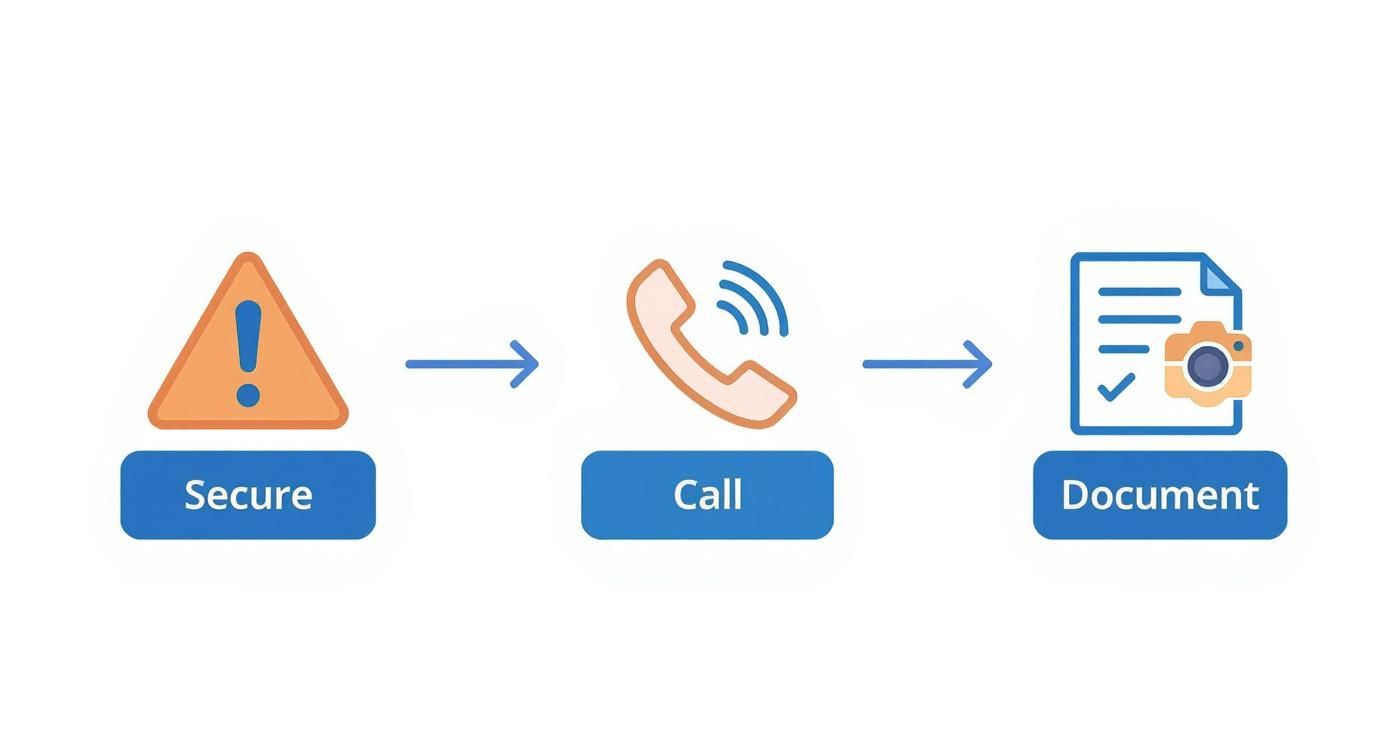
Think of it as Secure, Call, Document—a simple flow to keep you grounded when everything feels out of control.
How to Document the Scene Effectively
If you are physically able to, your smartphone is your best investigative tool. Evidence has a way of disappearing once tow trucks arrive and traffic starts moving again. Take more photos and videos than you think you could possibly need. Get shots from every conceivable angle.
Be sure to capture:
- The final resting positions of all vehicles before anyone moves them.
- Damage to every vehicle involved, showing both close-up details and wider shots that provide context.
- The surrounding scene, including any skid marks on the pavement, debris from the crash, and damage to guardrails or signs.
- Road conditions, like construction zones, weather, and any relevant traffic signs or signals.
- Crucial truck information. Get clear photos of the carrier's name, the truck and trailer license plates, and—most importantly—the USDOT number printed on the truck’s cab. This number is the key to identifying the trucking company.
Your Health Comes First: Getting Medical Care and Documenting Your Injuries

In the chaos right after a truck wreck, your first instinct might be to tell everyone you're okay. Adrenaline is pumping, and it's a powerful painkiller. It can completely mask the signs of a serious, even life-threatening, injury.
This is why getting a full medical evaluation right away is the most critical thing you can do—not just for your health, but for any future legal claim.
Even if you think you just have a few scrapes and bruises, some of the worst injuries are invisible at first. For example, that dull headache you feel after a collision on I-45 in Houston could be the first sign of a traumatic brain injury. That slight soreness in your stomach might be internal bleeding. These are chances you can't afford to take.
When you go to the emergency room or your family doctor immediately, you create an official, time-stamped record. This document is the cornerstone of your case, linking your injuries directly to the accident. It makes it extremely difficult for the trucking company's insurance adjuster to later claim you got hurt somewhere else.
The Danger of Injuries That Show Up Late
Many of the most severe injuries common in truck accidents don't reveal themselves for hours, or sometimes even days. "Feeling fine" right after the crash is a dangerous gamble.
Here are a few common delayed-onset injuries we see all the time:
- Whiplash and Soft Tissue Damage: Your neck and back might feel okay at the scene, but by the next morning, the pain from damaged muscles and ligaments can be unbearable.
- Concussions and Traumatic Brain Injuries (TBIs): Symptoms like confusion, memory problems, dizziness, or sensitivity to light often creep in slowly over the next day or two.
- Internal Bleeding: Organ damage can lead to a slow bleed that only becomes a critical emergency after a significant delay.
- Psychological Trauma: The emotional fallout—like PTSD, anxiety, and a new fear of driving—often surfaces long after the physical wounds have started to heal.
Putting off medical treatment doesn't just put your health at risk; it hands the insurance company a powerful argument to use against you. They will absolutely argue that if you were really hurt, you would have seen a doctor immediately.
Your recovery is a marathon, not a sprint. The records you start keeping from day one are the proof you'll need to show the full, true impact this accident has had on every part of your life.
Start Your Own Personal Injury Journal
Beyond the official medical files, one of the most powerful tools you have is a simple daily journal. This is your story. It fills in the gaps that medical charts can't, providing a human account of your day-to-day life and struggles after the wreck.
Your journal is where you track everything. For your attorney, this becomes an invaluable resource for calculating the total value of your claim, especially for things like pain and suffering.
Here’s what you should be writing down:
- Daily Pain Levels: Rate your pain on a scale of 1 to 10. Note any new symptoms, no matter how small they seem.
- Doctor Visits: Log every single appointment—doctors, specialists, physical therapy, consultations.
- All Your Expenses: Keep a folder for every bill, receipt, co-pay, and prescription. Even track your mileage driving to and from appointments.
- Missed Work: Document every hour or day you're unable to work because of your injuries.
- How Your Life Has Changed: This is crucial. Write down how the injuries stop you from living your normal life. Can you no longer pick up your kids, mow the lawn, or enjoy your weekend hobbies?
This detailed log turns abstract legal terms like "pain and suffering" into concrete, undeniable evidence. It shows the real cost of the accident—not just in dollars and cents, but in the quality of your life. This is the kind of meticulous proof needed to demand fair compensation for everything you've been through.
Who Is Liable for a Texas Trucking Accident?

After a devastating collision with an 18-wheeler, one of the first questions you may ask is, "Who is actually responsible for this?" Unlike a typical car crash, a commercial truck accident isn't that simple. It almost always involves a tangled web of potential liability that goes far beyond just the person behind the wheel.
It’s a mistake to think it’s just about the driver. Multiple individuals and corporations could share the blame, which is why these cases demand a deep and immediate investigation to unravel the truth.
In Texas, your case is built on the legal principle of negligence. To hold someone liable, your attorney must prove they had a legal duty to act safely, that they breached that duty, and that this failure directly caused your injuries. For example, every truck driver has a duty to follow traffic laws. If one was texting while driving down a Houston freeway and caused a wreck, that’s a clear case of negligence.
But the responsibility rarely stops there. A proper investigation has to look higher up the corporate ladder to uncover every single factor that contributed to the crash.
The Chain of Responsibility in a Truck Crash
Pinpointing every single party that played a role in the accident is absolutely critical. Why? Because it’s the only way to secure the full and fair compensation you need to rebuild your life. A single truck crash can have multiple causes, which means there can be multiple defendants.
An experienced truck crash lawyer in Houston will dig into the actions of several key players:
- The Truck Driver: Was the driver fatigued from being pushed too hard? Were they distracted, intoxicated, or speeding? Did they violate the federal Hours of Service rules that strictly limit their time behind the wheel?
- The Trucking Company (Motor Carrier): Did the company put profits over people by cutting corners on safety? They can be held directly liable for negligent hiring (like putting a driver with a terrible record on the road), providing inadequate training, or pressuring drivers to meet dangerous, unrealistic deadlines.
- The Cargo Shipper or Loader: Was the truck's cargo overloaded, unbalanced, or improperly secured? It only takes one sudden shift in weight for a driver to lose complete control of an 80,000-pound rig.
- The Maintenance Company: If a third-party shop was responsible for inspections and repairs, did their shoddy work—like failing to fix faulty brakes—lead to the crash?
- The Vehicle or Parts Manufacturer: Sometimes, the problem lies with the truck itself. A sudden tire blowout or a catastrophic brake system failure could point directly to a manufacturing defect, making the manufacturer liable for the resulting harm.
One of the biggest factors we look at is the quality of a company's fleet safety management. A company with a robust safety program is trying to prevent accidents. A weak or nonexistent one is often powerful evidence of a carrier's negligence.
How Texas Law Divides Blame: Understanding Comparative Responsibility
Texas operates under a legal doctrine called proportionate responsibility, which you might also hear called modified comparative fault. This rule is designed for situations where more than one person—including you, the victim—is partially to blame for an accident.
Under this system, you can still recover damages as long as a jury finds you to be 50% or less at fault for the crash.
Your final compensation award, however, will be reduced by your exact percentage of responsibility. So, if you were awarded $100,000 but found to be 10% at fault, your recovery would be cut by 10%, leaving you with $90,000.
Here’s the critical part: If you are found to be 51% or more at fault, you are completely barred from recovering any compensation under Texas law. This is exactly why trucking companies and their insurance adjusters fight so aggressively to shift even a tiny sliver of blame onto you.
The Role of Federal Regulations
The entire trucking industry is governed by a strict and complex set of federal rules called the Federal Motor Carrier Safety Regulations (FMCSA). These regulations cover everything from driver qualifications and mandatory drug testing to vehicle maintenance schedules and how cargo must be secured.
Proving that a driver or their trucking company violated one of these FMCSA rules is a powerful tool for establishing negligence. For instance, if our investigation uncovers that the driver blew past their legal driving limits and their logbooks were faked to cover it up, that is rock-solid evidence we can use to hold both the driver and their employer accountable.
The grim reality is that large truck crashes remain a massive safety problem. The National Safety Council reports that 5,472 people died in large-truck crashes in 2023. Even more shocking, 70% of those fatalities were occupants of other vehicles, just like you.
Because liability is so complex and the stakes are so high, you need a legal team that truly understands the trucking industry and knows exactly how to uncover every responsible party. Our attorneys are ready to launch that comprehensive investigation to ensure everyone who contributed to your injuries is held accountable.
How to Handle Insurance Company Communications
It won't take long. Within a day or two of the crash, sometimes just a few hours, your phone is going to ring. On the other end will be a very polite, professional-sounding insurance adjuster from the trucking company. Their job is to sound like they're on your side, but their real goal is to protect their company's profits by paying you as little as they can get away with.
This first conversation is a pivotal moment. What you say—and, just as importantly, what you don’t say—can have a huge impact on your ability to get fair compensation for your injuries and everything you’ve lost.
Never forget: the adjuster is not your friend. They are highly trained negotiators, skilled at finding any piece of information they can use to weaken or flat-out deny your claim. They'll try to get you to admit you were partly at fault, downplay how hurt you are, or corner you into a recorded statement before you've even had a chance to process what happened.
Why You Should Never Give a Recorded Statement
The adjuster will almost certainly ask you to give a recorded statement about the accident. They’ll probably frame it as a routine step, something to “speed up the process.” You should always, without exception, politely say no.
These recorded statements are traps, plain and simple. Adjusters know how to ask leading or confusing questions designed to get you to say something that undermines your case. For example, they might ask, “You were feeling okay at the scene, right?” A simple “yes” can be twisted later to argue your injuries weren't that serious or that they must have happened after the crash.
Your best response is straightforward and firm: "I am not comfortable giving a recorded statement at this time. My attorney will be in touch with you." This protects your rights without creating a fight.
Once you have a lawyer, they will handle every single communication with the insurance company. This ensures your words can never be used against you.
The Danger of a Quick Settlement Offer
Another classic tactic is to dangle a quick, lowball settlement check in front of you, sometimes within the first week. They might offer a few thousand dollars to cover your immediate car repairs and a couple of doctor's visits. When you’re out of work and the bills are piling up, that money can seem like a lifeline.
But accepting that offer is almost always a catastrophic mistake. The moment you cash that check, you sign away your right to seek any further compensation for this accident—forever.
It’s a trap for a reason. It can take weeks, or even months, to understand the true extent of your injuries. What feels like minor back pain today could turn into a condition requiring major surgery down the road. A "mild" concussion could lead to long-term cognitive problems. That quick settlement won't cover any of it.
Communicating with Insurance Adjusters Do's and Don'ts
Navigating that initial call with the adjuster is tricky. You don’t want to be rude, but you absolutely must protect your rights. Here’s a simple guide to help you handle that conversation.
| Do | Don't |
|---|---|
| Get the adjuster's name, title, and company. | Agree to a recorded statement. |
| Provide only basic facts: your name and contact info. | Discuss your injuries or medical condition in detail. |
| Be polite but firm about your boundaries. | Speculate on who was at fault or how the crash happened. |
| State that your attorney will be in contact. | Accept a settlement offer on the spot. |
| End the call if you feel pressured or uncomfortable. | Give them your Social Security number or financial information. |
Ultimately, the safest move is to let an experienced attorney handle these conversations from the very beginning. It removes the risk of saying something that could damage your case.
The Critical Importance of a Spoliation Letter
Trucking companies are required by federal law to hold onto a mountain of data, but not forever. Key evidence like the driver’s logbooks, the truck’s “black box” data recorder, and recent maintenance records can all be legally destroyed after a certain amount of time. This is the very evidence that could prove your case.
This is exactly why one of the first things a truck accident attorney does is send a spoliation letter. This is a formal legal demand sent directly to the trucking company, ordering them to preserve all potential evidence related to your crash.
This letter essentially stops the clock and makes it illegal for them to destroy critical information, such as:
- Driver’s Logs and Hours-of-Service (HOS) data to check for driver fatigue.
- Black Box/Event Data Recorder (EDR) information showing the truck’s speed, braking, and other actions right before impact.
- Maintenance and inspection records for the truck and its trailer.
- The driver’s qualification file, including their driving history and any past incidents.
Without a spoliation letter, this crucial proof can disappear, making it incredibly difficult to prove the trucking company was negligent. This is a perfect example of why contacting a truck crash lawyer in Houston immediately is so vital. It’s not just about knowing what to do after a truck accident; it’s about acting fast to protect the proof you need to win.
While you're dealing with the trucking company's insurer, don't forget about your own policy. It might contain benefits you're entitled to. You can learn more about how uninsured and underinsured motorist claims work in our detailed guide, as these policies can be a critical source of recovery if the truck's insurance isn't enough to cover your damages.
How Long Do You Have to File a Claim in Texas?
After a traumatic truck wreck, all you want is time to heal. The last thing you should be worrying about is a legal countdown, but in Texas, the clock starts ticking the second that crash happens. Taking swift action is one of the single most important things you can do to protect your right to fair compensation.
This isn't just about getting ahead of the insurance company or making sure evidence doesn't disappear—it’s about a non-negotiable legal deadline baked into state law. If you miss this window, you could lose your chance to seek justice forever, no matter how clear-cut your case might be.
Understanding the Texas Statute of Limitations
The Texas law that sets this deadline is called the statute of limitations. For the vast majority of truck accident claims, you have just two years from the date of the crash to file a formal lawsuit in court.
Two years might sound like plenty of time, but it can vanish in the blink of an eye when you're juggling surgeries, physical therapy, and the immense stress of recovery.
Let's put it in real-world terms. After a Houston freeway crash on July 1, 2023, you must file your lawsuit by July 1, 2025. If you try to file it on July 2, 2025, the court will almost certainly throw your case out. You'll be permanently barred from recovering a single penny for your injuries.
The statute of limitations is an unforgiving, absolute deadline. Waiting until the last minute is a dangerous gamble that can leave you with no legal recourse to hold the negligent parties accountable.
Why Acting Early Gives You the Upper Hand
While your lawsuit must be filed within that two-year period, the real work of building a powerful case starts on day one. Waiting to call an attorney puts your entire claim at a serious disadvantage.
Bringing a legal team on board right away gives you several crucial advantages:
- Immediate Investigation: It allows your attorney to launch a deep investigation, bringing in accident reconstruction experts and securing physical evidence before it’s lost for good.
- Evidence Preservation: Your lawyer can fire off a spoliation letter to the trucking company, a legal notice that forces them to preserve critical records like driver's logs and the truck's "black box" data.
- Reliable Witness Testimony: People's memories fade fast. An early investigation lets your team find and interview witnesses while their recollections are still fresh and accurate.
- Building a Stronger Case: A detailed, well-supported claim built over many months is infinitely more powerful than one scrambled together as the deadline closes in. This thorough preparation often results in a much better settlement offer, sometimes without ever having to step into a courtroom.
Don't Let Time Run Out on Your Recovery
The point of this deadline isn't to add more pressure—it's to give you the knowledge you need to take control. Understanding the rules is the first step. The absolute best way to protect yourself is to speak with an experienced Texas personal injury lawyer long before the statute of limitations even becomes a worry.
When you contact a lawyer soon after the accident, they can take over the legal heavy lifting while you focus on what truly matters: your physical and emotional recovery. It's the best way to ensure every piece of evidence is locked down, every deadline is met, and your case is positioned for success from the very beginning. Your future is too important to leave to chance.
How a Texas Truck Accident Lawyer Can Help You Heal
Trying to piece your life back together after a serious truck accident while juggling the complexities of the legal system is a weight no one should carry alone. The physical pain, the emotional toll, and the endless stream of medical bills can feel completely suffocating. This is exactly where an experienced legal team comes in—to take that burden off your shoulders so you can focus on the one thing that truly matters: your recovery.
Make no mistake, from the moment the crash happens, the trucking company and its massive insurance carrier are already working against you. They dispatch their own investigators, adjusters, and lawyers to the scene with one goal in mind: protecting their profits by minimizing or outright denying your claim. You need a dedicated advocate in your corner to level the playing field.
Launching an Immediate and Thorough Investigation
The second you hire a Texas personal injury lawyer, a full-blown investigation kicks into gear. Time is absolutely critical here because vital evidence has a bad habit of disappearing. We move fast to preserve everything needed to build a rock-solid case for you.
Our first moves usually involve:
- Sending a Spoliation Letter: This is a formal legal demand sent directly to the trucking company, ordering them to preserve crucial evidence. This includes the truck driver's logbooks, the truck's "black box" data, drug and alcohol test results, and all maintenance records.
- Hiring Accident Reconstruction Experts: These are specialists—often former law enforcement officers—who can scientifically analyze the crash scene, vehicle damage, and other physical evidence to piece together exactly how the accident happened and who was at fault.
- Interviewing Witnesses: We track down and speak with anyone who saw the crash while their memories are still sharp, locking in testimony that could make or break your case down the road.
This aggressive, proactive approach ensures that the proof needed to hold every negligent party accountable is secured before it can be conveniently lost or destroyed.
Calculating the Full Scope of Your Damages
One of the trickiest parts of any personal injury claim is figuring out the true, long-term cost of your injuries. You can bet that any quick settlement offer dangled by an insurance adjuster won't come close to covering the future impact on your life.
Our team collaborates with medical and financial experts to calculate the total value of your claim, which must account for:
- Current and Future Medical Expenses: This covers everything from the initial ambulance ride and ER bills to future surgeries, physical therapy, medication, and any lifelong care you might require.
- Lost Earning Capacity: If your injuries keep you from returning to your job or limit your ability to work in the future, we calculate the total income you will lose over the course of your working life.
- Pain and Suffering: We help put a number on the non-economic damages—the physical pain, the mental anguish, and the loss of your ability to enjoy life as you once did.
You only get one shot to secure the compensation you need to rebuild your life. A skilled attorney makes sure your final settlement or verdict covers every single loss—past, present, and future.
Fighting for Your Fair Recovery
With a thoroughly investigated case and carefully documented damages, your lawyer will take over all communications and negotiations with the powerful insurance companies. We know their playbook, and we will aggressively shut down any lowball offers or attempts to unfairly blame you for the crash.
While most cases settle out of court, we prepare every single one as if it’s going to trial. This shows the other side that we're serious and ready to fight all the way.
Knowing when to get a lawyer involved is a critical decision. For more on this, you can read our guide on when to hire a personal injury lawyer to better understand how early legal help can protect you. Our team is ready to stand with you, handle the legal heavy lifting, and fight for the justice you deserve, so you can focus on getting better.
Common Questions After a Texas Truck Accident
When you're dealing with the fallout from a commercial truck wreck, your mind is probably racing with a thousand questions. It's completely normal to feel overwhelmed and unsure of what to do next. Here are some straightforward answers to the questions we hear most often from families across Texas.
What if I Was Partially at Fault for the Accident?
This is a huge worry for a lot of people we talk to. The good news is, even if you think you might share some of the blame, you can likely still recover compensation.
Texas operates under a legal rule called "proportionate responsibility." In plain English, this means you can file a claim and win, as long as you aren't found to be 51% or more responsible for the crash.
Your final compensation will just be reduced by your percentage of fault. For example, if a jury decides you were 10% at fault, your total award would be reduced by that 10%. A big part of our job as experienced Houston car accident attorneys is to build a rock-solid case that minimizes any fault assigned to you and protects your right to a full recovery.
How Much Does It Cost to Hire a Truck Accident Attorney?
It costs you absolutely nothing out of your own pocket to get started. Our firm, like many personal injury firms, works on a contingency fee basis.
What does that mean for you? We only get paid if we win your case. Our fee is a percentage of the final settlement or verdict we secure for you. You will never see a bill from us, and you won't have to worry about legal fees while you're focused on getting better.
What Types of Compensation Can I Receive?
In Texas, the law allows you to seek compensation—legally known as "damages"—for the full scope of your losses. It’s not just about the medical bills. These damages are typically broken down into a few key categories:
- Economic Damages: These are your tangible, out-of-pocket financial losses. Think of all current and future medical bills, lost wages from being unable to work, and the cost to repair or replace your vehicle.
- Non-Economic Damages: This is compensation for the very real, but less tangible, human cost of the wreck. It covers things like your physical pain and suffering, mental anguish, permanent disfigurement or impairment, and the loss of your ability to enjoy your life as you once did.
- Wrongful Death Damages: If the worst has happened and you've lost a family member, a wrongful death lawyer in Texas can help you seek justice. This type of claim addresses the unique losses your family has suffered, such as lost companionship, guidance, and financial support.
A wreck involving a commercial truck can turn your world upside down in an instant—but you don't have to navigate the aftermath alone. Recovery is possible, and legal help is available. The legal team at The Law Office of Bryan Fagan, PLLC is here to give you the clear answers and determined representation you need.
Your recovery is what matters most, and we're here to help fight for it. Schedule your free, no-obligation consultation today by visiting us at https://texaspersonalinjury.net and take the first step toward rebuilding your life.