A serious accident can change your life in seconds, but you don’t have to face the aftermath alone.
If you’re reading this, you may be dealing with pain, medical bills, missed work, and constant calls from an insurance adjuster who wants a statement before you’ve had time to breathe. That’s where a personal injury demand letter matters. It’s often the first formal step in asking for compensation after a crash, fall, or other injury-causing event in Texas.
A good demand letter does more than ask for money. It tells your story in a way an insurance company has to take seriously. It lays out what happened, why the other party is responsible, how you were hurt, what your treatment has involved, and what your losses look like in real dollars. In many cases, that letter opens the door to settlement without a lawsuit.
After a Houston freeway crash, for example, an injured driver may know the other motorist caused the wreck. But knowing that and proving it are two different things. A strong letter bridges that gap. It turns scattered records, bills, photographs, and wage information into a clear claim.
Your First Step Toward Justice After a Texas Accident
A demand letter gives you structure when everything else feels scattered.
One day you’re driving to work, picking up your kids, or heading home on I-10. The next day you’re in physical therapy, trying to understand medical jargon, and wondering how you’ll cover rent while you’re out of work. Many injured people feel pressure to settle fast just to get relief.
That’s usually when mistakes happen.
A sample demand letter personal injury format can help, but only if it’s used the right way. A generic template won’t know whether your case involves a rear-end collision in Houston, a truck wreck near Dallas, or an uninsured driver in San Antonio. Texas cases need Texas thinking.
A demand letter is often your first real chance to take control. It can:
- Set out the facts clearly so the insurance company can’t pretend it doesn’t understand the claim
- Show liability with documents instead of emotion
- Tie your injuries to the accident through records and treatment history
- Push negotiations forward before litigation becomes necessary
A rushed letter usually reads like a complaint. A strong letter reads like a case the insurer could lose in court.
That difference matters.
If you’re still in the early days after a crash, start with the basics. This guide on what to do after car accident is a good first step before you draft anything. The stronger your file is at the beginning, the stronger your demand usually becomes later.
Gathering Your Evidence Before You Write
A demand letter is only as strong as the proof behind it.
Before you write a single paragraph, gather the records that support every part of your claim. If something isn’t documented, the adjuster will often treat it as if it doesn’t exist.
What to collect first
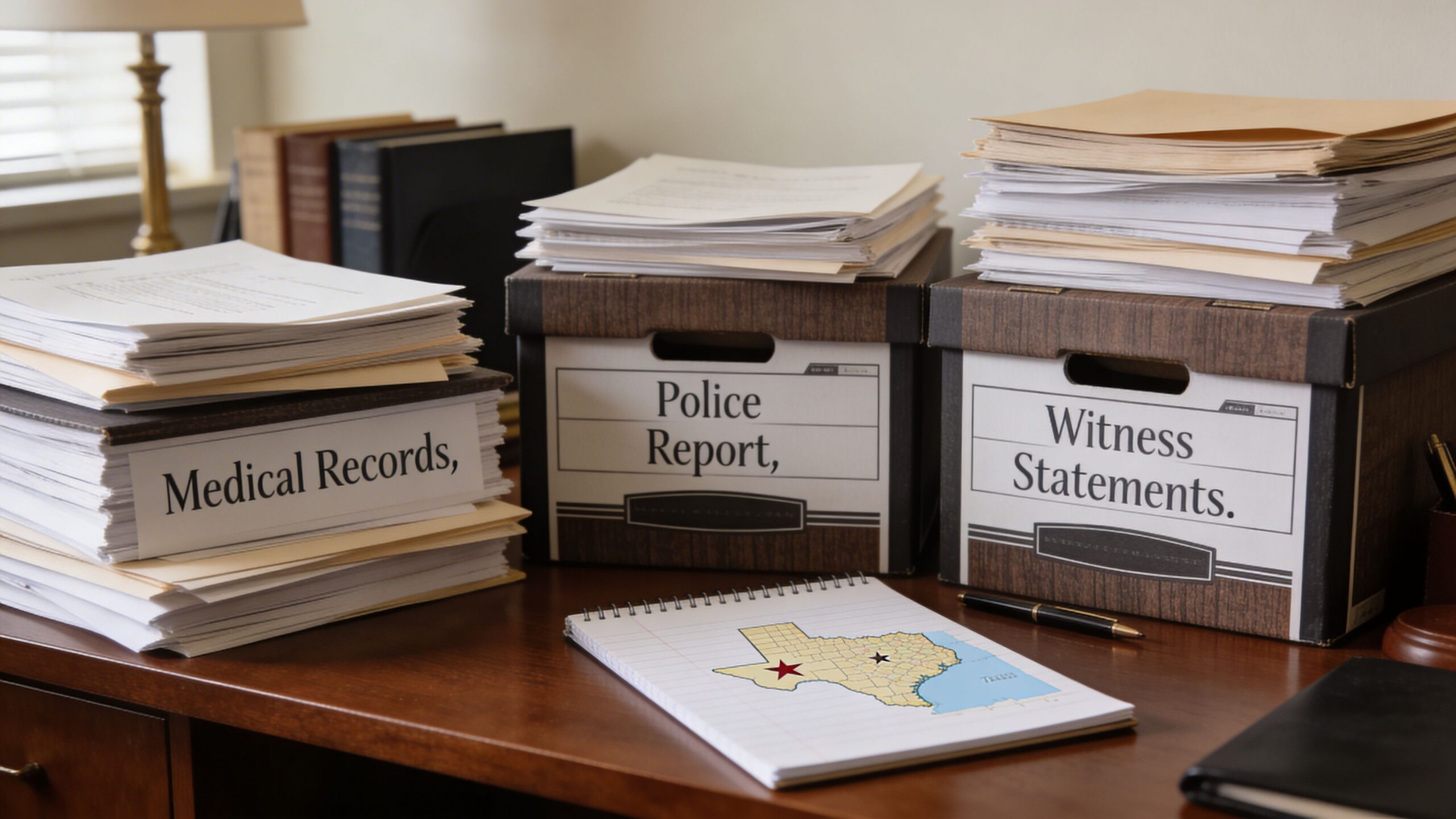
Start with the core documents:
- Police report. This gives the basic facts, identifies drivers and witnesses, and may note who was cited.
- Medical records and bills. Get everything from the emergency room to follow-up visits, imaging, prescriptions, and physical therapy.
- Photos. Scene photos, vehicle damage, visible injuries, and road conditions can all matter.
- Lost income proof. Pay stubs, employer letters, tax records, or other wage documentation help show what the injury cost you financially.
- Insurance information. You need both the at-fault driver’s coverage details and your own policy documents.
If you haven’t reviewed the crash report yet, this guide on how to read police accident report can help you spot important details before you draft your letter.
Why each document matters
Insurance companies look for gaps.
If your letter says you missed work, they’ll want proof. If you say your back pain started after the collision, they’ll compare that statement to your first medical visit. If your version of events differs from the report, they’ll use that against you.
That’s why organization matters as much as content. Put your records in date order. Match bills to treatment. Keep a simple timeline of symptoms, appointments, and work restrictions.
Practical rule: If you mention a fact in your demand letter, attach the document that proves it whenever possible.
Texas law you need to understand
Texas injury claims turn on fault and negligence. In plain English, that means you must show another party failed to use reasonable care and caused your injuries.
Texas also uses comparative responsibility. If you share part of the blame, your recovery can be reduced. If a driver in a Houston collision claims you were partly responsible because of your lane change or speed, that issue can affect settlement value. Your demand letter should not ignore that risk. It should address the facts carefully and support your version with records, photos, and witness statements.
Texas also has a statute of limitations for most personal injury claims. Waiting too long can weaken your negotiating position and, in some cases, your right to pursue the case at all. That’s one reason people often speak with a Texas personal injury lawyer early, even if they hope to resolve the claim without filing suit.
Don’t overlook UM and UIM coverage
One issue generic templates miss is uninsured and underinsured motorist coverage.
Over 14% of Texas drivers are uninsured, which means your own UM/UIM coverage may be critical after a crash. A demand letter to your own insurer works differently from one sent to the at-fault driver’s carrier, especially in places like Houston and Dallas, as noted by Mighty’s discussion of personal injury demand letter strategy.
That matters in real life. If the other driver has little or no coverage, the letter must often include policy details, proof of underinsurance, and a tighter presentation of your damages.
How to Structure Your Texas Personal Injury Demand Letter
A strong letter is organized, factual, and hard to dismiss.
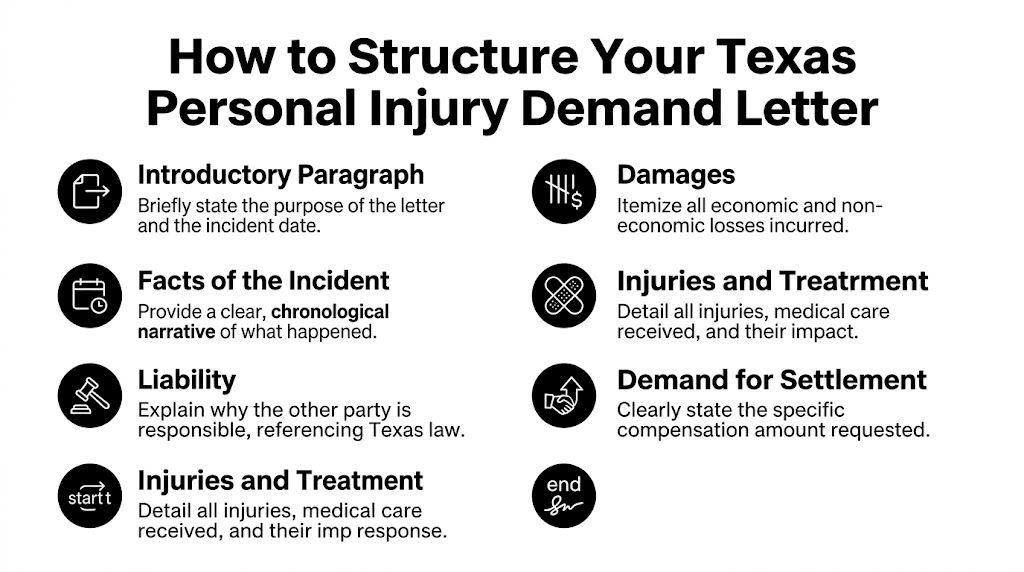
The most effective letters follow a clear sequence. Establish liability with facts and police reports, detail injuries and treatment chronologically, itemize economic and non-economic damages, and present a specific monetary demand with a response deadline. Following that structure increases pre-litigation resolution rates to over 70%, according to McCready Law’s explanation of demand letter methodology.
Start with the basic case information
Open with the date, claim number, names of the parties, and the purpose of the letter.
Keep it short. You’re identifying the claim, not arguing it yet.
A simple opening usually includes:
- Your identifying information and, if represented, your lawyer’s contact information
- The claim reference used by the insurance company
- The accident date and location
- A direct statement that the letter is a settlement demand arising from the injury event
State the facts in chronological order
Self-written letters often falter here. People jump between the collision, their pain, what the adjuster said, and how angry they are.
Don’t do that.
Write the incident in order. What happened first, what the other party did, what happened on impact, and what occurred immediately after. Use plain language. If the police report supports your account, say so. If there were witnesses, mention them. If there are photos, refer to them.
A rear-end crash example might say the other driver failed to control speed and struck your vehicle from behind while traffic was slowing. That’s cleaner and stronger than an emotional retelling.
Explain liability under Texas negligence principles
This section connects the facts to responsibility.
You don’t need a law review article. You do need to show why the other side is legally at fault. In Texas, that usually means identifying the careless conduct. Failing to yield, speeding, following too closely, drifting into another lane, driving distracted, or violating a traffic signal are common examples.
If comparative responsibility may come up, be careful. Don’t volunteer fault unnecessarily. Address the issue only with support. A calm, evidence-based explanation works better than a defensive one.
Adjusters respond to proof, not outrage. A professional tone can increase your credibility more than a dramatic one ever will.
Lay out injuries and treatment like a timeline
This part should read like a medical story backed by records.
Use dates and providers. Start with the first treatment after the incident and move forward in order. Include diagnoses, imaging, referrals, therapy, injections, surgeries, restrictions, and ongoing symptoms where supported.
A useful format looks like this:
| Part of the letter | What to include |
|---|---|
| Initial treatment | Emergency room visit, urgent care, ambulance, first complaints |
| Follow-up care | Orthopedic visits, chiropractor, physical therapy, pain management |
| Diagnostic findings | MRI, CT, X-ray, physician diagnoses |
| Current status | Ongoing pain, work limits, future treatment recommendations |
If you want to compare your draft to a more detailed model, this annotated demand letter attorney sample is useful because it shows how lawyers separate narrative from evidence and damages.
Itemize your damages clearly
Itemizing damages clearly makes the claim value tangible.
Break damages into categories. Medical expenses, lost wages, future care, property loss, and other out-of-pocket costs should be listed separately. Pain and suffering belongs in its own discussion rather than being blended into a total without explanation.
Short, organized presentation helps. A messy paragraph full of numbers usually hurts more than it helps.
Make a specific demand and set a deadline
Close with a precise settlement demand. Then give a reasonable deadline for response.
The number should come from your records, your treatment history, the seriousness of the injury, and the risks in the case. It should not be pulled from a generic internet example. If the amount looks unsupported, the insurer will treat the whole letter as inflated.
End with a firm statement that you expect a written response by the deadline and that the enclosed materials support your demand.
Sample Demand Letter for a Texas Car Accident
A sample is often easier to use than a checklist. Below is a straightforward example for a Texas motor vehicle case. You can adapt it to a car wreck, truck crash, or similar claim.
Sample only: Replace every bracketed item with facts from your own case and attach the records referenced in the letter.
[Your Name]
[Your Address]
[City, State, ZIP]
[Date]
Claims Adjuster
[Insurance Company Name]
[Insurance Company Address]
Re: Demand for Settlement
Claim Number: [Claim Number]
Date of Loss: [Date of Accident]
Insured: [At-Fault Driver’s Name]
Dear [Adjuster Name],
I am submitting this demand for settlement arising out of the motor vehicle collision that occurred on [Date of Accident] at [Location] in Texas.
Your insured, [At-Fault Driver’s Name], caused this collision by [brief factual description, such as failing to control speed, running a red light, or failing to yield]. The crash report, witness information, and photographs support liability. A copy of the police report is enclosed as part of this demand package.
Immediately after the collision, I experienced [list symptoms]. I sought medical treatment beginning on [date] with [provider name]. Since that time, I have treated with [list providers in order], and my diagnoses have included [list diagnoses supported by records]. Copies of my medical records and billing statements are attached.
As a result of this collision, I have incurred the following losses:
- Medical expenses. [Amount from records]
- Lost wages. [Amount from employer or wage proof]
- Future medical care. [Amount if supported by physician recommendations]
- Property damage or other out-of-pocket losses. [Amount if applicable]
In addition to these financial losses, I have experienced physical pain, disruption of daily activities, and limitations affecting my work and personal life.
Based on the enclosed records, bills, and supporting evidence, I hereby demand the sum of [specific dollar amount] to resolve this claim. Please respond in writing within 30 days of receipt of this letter.
If you need additional documentation to evaluate this demand, please let me know promptly.
Sincerely,
[Your Name]
This format works because it’s clean. It doesn’t argue every point. It gives the adjuster the facts, the treatment history, the losses, and the number needed to begin serious negotiations.
Calculating Your Demand for Full and Fair Compensation
The hardest part of a sample demand letter personal injury case is often the final number.
Many people either ask for too little because they’re afraid of sounding unreasonable, or ask for too much without support. Both mistakes can weaken the claim.

Economic damages come first
Start with the losses you can document.
These usually include medical bills, wage loss, future medical recommendations, and any other out-of-pocket expenses tied to the injury. Use records, invoices, payroll documents, and provider opinions where available.
If you need a more detailed walkthrough, this guide on how to calculate car accident settlement can help you think through the categories before you put a number in your letter.
Non-economic damages require reasoning
Pain, suffering, physical impairment, and day-to-day disruption are real losses, but they’re harder to measure.
One common method is the multiplier method, using a range of 1.5 to 5 times economic damages depending on the seriousness of the injury, according to the verified methodology discussed earlier in this article. That’s not a magic formula, and it shouldn’t replace case-specific judgment. Still, it helps explain why a claim with significant treatment, lasting pain, or surgery may justify a much higher demand than one involving short-term soreness.
Consider this simple approach:
- Milder injury cases may support a lower multiplier
- Long treatment periods often justify more
- Surgery, disability, or future care usually increase the value discussion
- Weak liability or gaps in treatment can reduce it
Your demand should reflect both what you’ve already lost and what the injury is likely to cost you going forward.
A real example shows why detail matters. In a documented 2022 truck accident case, a demand letter itemized damages totaling $4,016,586, including $465,459 in past medical bills, $1,763,855 in future lost earning capacity, and $890,000 for pain and suffering, as described in Miller & Zois’s sample demand letter discussion. The lesson isn’t that every case is enormous. It’s that careful calculation can uncover losses people would otherwise miss.
A quick explainer may help if you’re weighing categories of damages before making a demand:
Don’t forget future losses
Some injuries heal quickly. Others don’t.
If your doctor has recommended future treatment, work restrictions, surgery, or continued therapy, your demand should account for that. A settlement usually ends the claim. If you leave future losses out, you usually don’t get a second chance later.
Common Mistakes That Can Weaken Your Personal Injury Claim
Most weak demand letters fail for predictable reasons.
The problem usually isn’t a lack of effort. It’s that injured people are trying to negotiate while still recovering, still gathering records, and still figuring out what the case is worth.

Statistics show that 60% of demand letters written without a lawyer fail to settle, often because of vague incident descriptions or poor damages calculations, and those mistakes can lower offers by 35%. In contrast, attorney-drafted letters have a 90% success rate in high-volume markets like Houston and Dallas, according to SMS Trial’s guide to demand letters and personal injury claims.
The errors that show up most often
- Sending the letter too early. If you haven’t reached a stable point in treatment, you may not know the full value of the claim.
- Using anger instead of proof. A harsh tone doesn’t make a weak file stronger.
- Leaving out attachments. If the records aren’t there, the adjuster can downplay the claim.
- Making an unrealistic demand. If the number has no clear support, the insurer may discount everything else in the letter.
- Admitting fault carelessly. Casual phrases like “I may have been distracted” can do real damage in a Texas comparative responsibility dispute.
What works better
A better letter is calm, specific, and documented.
Some people use legal drafting tools or attorney-reviewed resources to organize a first version. Others ask a Texas personal injury lawyer to prepare the demand once treatment records are complete. The right choice depends on the complexity of the injury, the amount of insurance coverage, and whether liability is clear.
When to Partner With a Texas Personal Injury Lawyer
Some claims are manageable with a well-prepared demand package. Others need immediate legal help.
If your case involves a catastrophic injury, a disputed fault argument, a commercial vehicle, a denied UM/UIM claim, or the death of a loved one, it’s smart to talk with counsel early. That includes cases where you may need a Houston car accident attorney, a truck crash lawyer Houston families can turn to after a serious collision, or a wrongful death lawyer Texas families can consult after a fatal crash.
Recent Texas law changes add another reason. Texas tort reform amendments updated in 2025 have placed stricter limits on non-economic damages for certain injuries and require clear and convincing evidence of egregious negligence, which can make a lowball offer harder to challenge without a stronger legal strategy, as discussed in AllLaw’s sample demand letter overview.
If you’re deciding whether to hire counsel, this article on Top Factors That Influence How Clients Choose A Law Firm offers a practical checklist for evaluating communication, experience, and fit.
In real practice, legal help becomes especially important when insurers dispute causation, push blame onto you, or ignore future losses. Firms such as the Law Office of Bryan Fagan, PLLC handle Texas injury claims involving car wrecks, truck accidents, wrongful death, catastrophic injury, and uninsured motorist disputes.
Recovery is possible. You don’t have to sort through this alone, and you don’t have to guess what your case is worth.
If you were hurt in a crash or your family is grieving a fatal accident, Law Office of Bryan Fagan, PLLC can help you understand your options. Whether you need guidance after a car wreck, help with a truck collision claim, support in a wrongful death case, or advice about catastrophic injuries and uninsured motorist coverage, you can schedule a free consultation to talk through what happened and what comes next. Legal help is available, and a path forward is possible.