A serious accident can change your life in seconds—but you don’t have to face the aftermath alone. One minute everything is normal, and the next you're left with injuries, mounting bills, and a hundred confusing questions about what comes next. One of the biggest questions is often about blame. In Texas, the legal rule for dividing responsibility is called comparative fault, and it means that even if you were partially to blame for the accident, you can often still recover money for your injuries.
Your Guide to Understanding Fault After a Texas Accident

When you're trying to heal, the last thing you need is a dense legal textbook. We created this guide to give you clear, straightforward answers about a critical concept in Texas personal injury law known officially as proportionate responsibility. We’ll break this rule down in plain English so you know exactly how fault is determined and what it means for your ability to get the compensation you need to move forward.
The core idea is both simple and fair: a minor mistake on your part shouldn't stop you from holding the other, more responsible party accountable for the harm they caused. You have rights, and understanding them is the first step toward protecting your future.
Why This Rule Matters for You
Understanding proportionate responsibility is your first line of defense against insurance company tactics. You can bet the other driver's insurance company will do everything it can to shift blame onto you. They'll look for any excuse—arguing you were going a few miles over the speed limit, didn't swerve fast enough, or were momentarily distracted—to reduce what they have to pay or deny your claim entirely.
Knowing how the law actually works empowers you to fight back. Here’s what you need to know right from the start:
- Texas is not an all-or-nothing state. Unlike outdated laws, being found partially at fault doesn't automatically bar you from recovering damages.
- Your percentage of fault is key. The amount of money you can receive is directly reduced by your assigned percentage of responsibility.
- There is a strict cutoff. If you are found to be more than 50% responsible, you cannot recover anything. This makes fighting for every single percentage point absolutely essential.
Quick Guide to Comparative Fault in Texas
To help you see how this works at a glance, we've put together a simple table. This chart summarizes the core concepts of Texas's proportionate responsibility system, giving you a fast, easy-to-understand overview of what matters most for your claim.
| Concept | What It Means for You |
|---|---|
| Proportionate Responsibility | This is the official Texas term for comparative fault. A jury or judge assigns a percentage of blame to everyone involved in an accident. |
| The 51% Bar Rule | You can only recover money if your share of the fault is 50% or less. If you are found 51% or more to blame, you get nothing. |
| Reduced Damages | Your final compensation award will be reduced by your percentage of fault. If you are 10% at fault, your award is cut by 10%. |
| Protecting Your Claim | You must actively fight against unfair blame. Every percentage point the other side pins on you directly lowers your recovery and threatens your right to compensation. |
Think of it like a pie. The total damages are the whole pie, but your final slice gets smaller based on how much of the "fault" pie you're assigned.
This guide will walk you through each of these points with real-world examples, like what happens after a Houston car accident, to make these legal ideas easy to grasp.
Our goal at The Law Office of Bryan Fagan, PLLC, is to be your trusted guide. We believe that with clear information and strong legal support, you can navigate this process with confidence.
We are here to help you understand your rights and fight for the full and fair compensation you are owed. Recovery is possible, and you don't have to face this alone. For a free, no-obligation consultation with an experienced Texas personal injury lawyer, please contact us today. We're ready to listen and give you the clear answers you deserve.
What Is the Legal Definition of Comparative Fault?
When you're trying to heal after a serious accident, the last thing you need is a bunch of confusing legal jargon. So, let’s break down the idea of comparative fault in plain English. It's simply a legal rule used to divide blame when more than one person's carelessness causes an accident.
Think of it this way: accidents are rarely one person's fault. Imagine two people are rushing and accidentally knock over a fragile store display. It wouldn't make sense to force just one person to pay for all the damage. A fair solution would be for each person to pay for their share of the mess they helped create. Texas personal injury law uses that same basic logic for accidents.
In Texas, the official legal term for this concept is "proportionate responsibility." The name says it all—each person involved is held financially responsible only for their specific percentage of the blame.
Getting a handle on this concept is one of the most important first steps you can take to protect your right to compensation. It gives you the power to push back when insurance companies try to unfairly shift the blame onto you.
From Unfair to Fair: A Brief History
This way of assigning blame is a much more just system than the old, harsh rule that once governed injury claims. For over a century, many courts used a doctrine called "contributory negligence," which first came about in an 1824 case. This system was incredibly strict and all-or-nothing. It meant that if you were found even 1% to blame for your own accident, you were completely barred from recovering a single penny.
Lawmakers eventually saw how deeply unfair this was and started looking for a better way. The big shift began in 1908 when the U.S. Congress passed the Federal Employer's Liability Act, which created a comparative system for railroad workers. This groundbreaking change allowed injured workers to recover damages that were simply reduced by their share of fault, instead of being left with nothing. You can read more about the history and current status of negligence laws on MedicalMalpracticeLawyers.com.
How Proportionate Responsibility Works in Your Case
Texas law gets it: accidents are rarely black and white. Most of the time, multiple factors contributed to what happened. Under our state’s system, your financial recovery is simply reduced by whatever percentage of fault a jury assigns to you.
Let’s say you were in a wreck on a Houston freeway. A jury looks at the evidence and decides the other driver was 90% at fault for making an illegal lane change, but that you were 10% at fault for driving a couple of miles over the speed limit.
- You can still hold the other driver accountable for their 90% share of the harm they caused.
- Your total compensation award would just be reduced by your 10% share.
- You would not be unfairly shut out from getting help, which is exactly what would have happened under the old, all-or-nothing system.
This balanced approach makes sure that the person who was most responsible for causing the accident bears the biggest part of the financial cost. This is absolutely critical in complex cases involving a catastrophic injury or a wrongful death claim, where every dollar of compensation is vital to a family’s ability to move forward.
How Texas's 51% Bar Rule Affects Your Injury Claim
This is the single most important rule for any Texas personal injury claim. Our state uses a system called modified comparative fault, which includes what’s known as the “51% Bar Rule.” It might sound technical, but the idea behind it is simple—and it is absolutely critical to the outcome of your case.
Here’s what it means: you can recover financial compensation for your injuries as long as a jury finds you are 50% or less to blame for the accident. But if that same jury decides you were 51% or more at fault, you are legally blocked from recovering a single penny.
That one percentage point is everything. It can be the difference between getting the money you need to put your life back together and walking away with nothing.
The Make-or-Break Threshold
This all-or-nothing cutoff at 51% makes the Texas system incredibly high-stakes. The world of injury law is generally split between two frameworks: pure comparative negligence and modified comparative fault.
Some states follow a "pure" model, where an injured person can still get some compensation even if they were 99% to blame. Texas is stricter. We use a "modified" approach, which the law here officially calls proportionate responsibility. This system is designed specifically to prevent people who are mostly at fault from collecting money. You can find more details about these different legal frameworks at MWL-Law.com.
The 51% Bar Rule isn't just a legal theory; it's the battlefield where your right to compensation is won or lost. The insurance company has one primary goal: to push your share of the blame over that 50% line.
Because of this harsh rule, fighting to minimize your assigned percentage of fault becomes the most important part of protecting your claim.
Real-World Examples of the 51% Bar Rule
Let's see how this plays out in real life. Imagine you were badly hurt in a multi-car pileup on I-45 in Houston. After everything, your total damages—medical bills, lost income, and pain and suffering—add up to $200,000.
Here’s how the 51% rule would apply to your recovery:
- Scenario 1: You are found 20% at fault. The other drivers are held 80% responsible. Your $200,000 award is reduced by your 20% of the blame, so you can recover $160,000.
- Scenario 2: You are found 50% at fault. The other driver is also found 50% responsible. You are right on the edge. Your award is cut by half, and you can recover $100,000.
- Scenario 3: You are found 51% at fault. The other driver is found 49% responsible. Because you crossed that 51% line, you are completely barred from recovering anything. You get $0.
As you can see, a tiny shift in blame can have a devastating financial impact. This is exactly why insurance adjusters will nitpick every detail of your accident.
They’ll argue you were distracted, driving a little too fast, or didn’t react quickly enough—anything to pile more fault onto you. It’s a standard tactic, whether you were in a straightforward car wreck or a complex truck crash involving a commercial vehicle. An experienced Houston car accident attorney knows these arguments are coming and knows how to build a powerful case to protect you.
Calculating Your Compensation with Comparative Fault
Legal theories can seem abstract, but this is where proportionate responsibility hits home. It’s time to translate the law into dollars and cents.
Understanding how fault percentages impact your final financial recovery is one of the most powerful pieces of knowledge you can have. It shows you exactly what’s at stake and why fighting to minimize any blame placed on you is so critical.
The math itself is surprisingly simple. You start with the total value of your damages—everything from medical bills and lost wages to pain and suffering. That total is then reduced by whatever percentage of fault is assigned to you.
Real-World Damage Calculation Examples
Let's walk through a clear example. Imagine you were hurt in a serious crash on a Houston freeway. After adding up all your losses, your total damages are calculated to be $100,000.
Here’s how different findings of fault would directly impact the money you could actually receive:
- You are found 10% at fault: Your $100,000 award is reduced by 10% ($10,000). You would be able to recover $90,000.
- You are found 30% at fault: Your $100,000 award is reduced by 30% ($30,000). Your potential recovery drops to $70,000.
- You are found 50% at fault: Your $100,000 award is reduced by 50% ($50,000). You can still recover $50,000.
- You are found 51% at fault: Because you’ve crossed that critical threshold, your recovery becomes $0. You get nothing.
These numbers make it crystal clear: every single percentage point matters. A tiny shift in the blame game can mean a difference of tens of thousands of dollars, or even losing your right to compensation entirely.
Visualizing the 51% Cliff
The financial cliff created by Texas's 51% Bar Rule is dramatic and absolute. It’s not a gradual slope; it’s a hard cutoff.
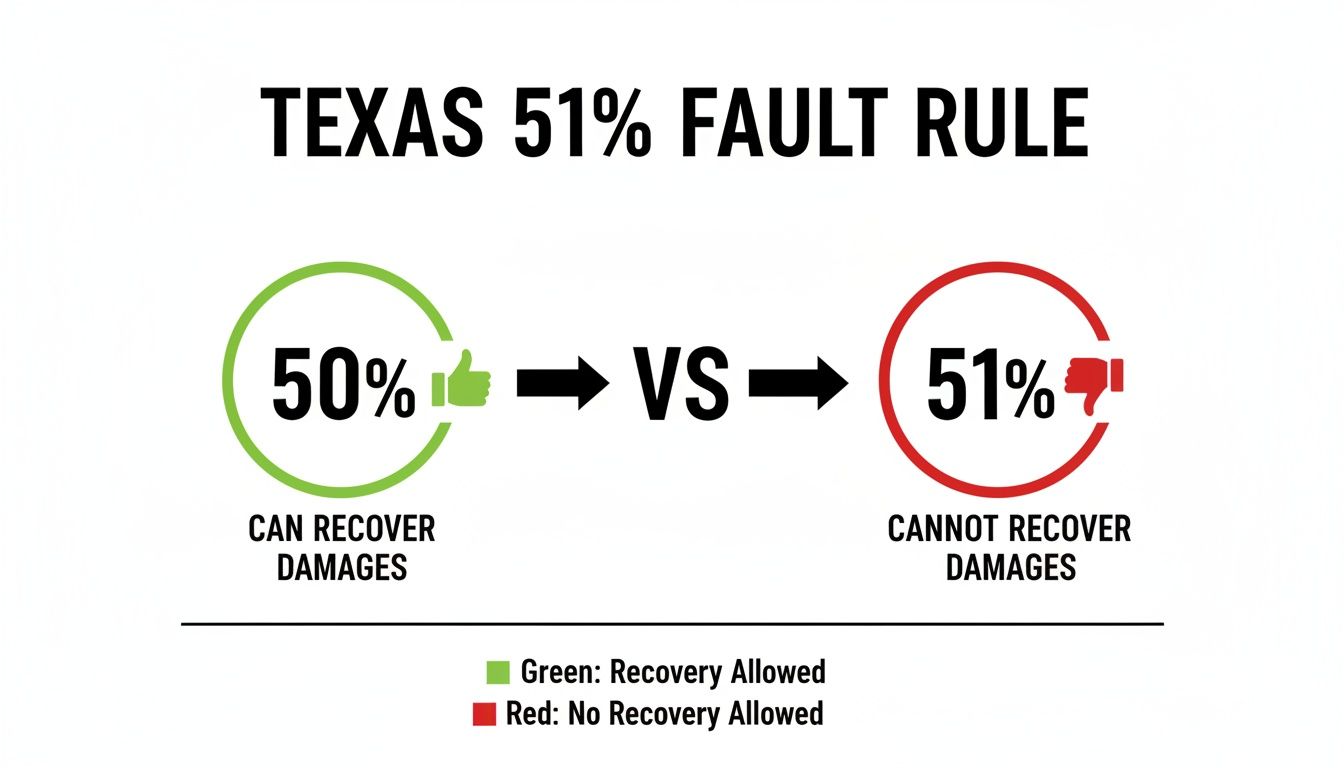
As you can see, the difference between being found 50% at fault and 51% at fault is the entire value of your claim. This is why insurance companies will fight so hard to push that percentage just one point over the line.
What Happens with Multiple At-Fault Parties?
Accidents are rarely simple. Multi-car pile-ups or crashes involving commercial trucks often have several parties who share some of the blame. When this happens, the same proportionate responsibility rules apply, but things can get a bit more complicated.
A jury will be asked to assign a percentage of fault to every single person involved in the incident, including you.
Your ability to recover damages depends on your percentage of fault compared to the combined fault of everyone else. As long as your fault is 50% or less, you can still seek compensation from the other at-fault parties.
For instance, say you are found 20% at fault, while two other drivers are each found 40% at fault. You can recover damages from both of them, though your total award will still be reduced by your 20% share.
This is where another important legal concept comes into play: joint and several liability. It governs how you can collect damages when multiple people are responsible. You can learn more about joint and several liability in our detailed article to see how it works in these complex, multi-party cases.
How Insurance Companies Use Comparative Fault Against You
After a serious accident, you might expect the other driver's insurance company to do the right thing. Unfortunately, that’s a dangerous assumption to make.
It's vital to remember that insurance companies are for-profit businesses. Their adjusters are highly trained professionals whose main job is to protect the company's bottom line by paying you as little as possible.
The most powerful tool they have for this is Texas’s proportionate responsibility law. They will turn the idea of shared blame into a weapon, hunting for any reason—no matter how small—to push a percentage of fault onto you. Their goal is to make you doubt the strength of your own case, feel responsible for the crash, and ultimately accept a quick, lowball settlement.
Common Tactics Adjusters Use to Shift Blame
Insurance adjusters are experts at finding fault where there isn't any. They will pick apart every single detail of your accident, looking for minor issues they can blow out of proportion to argue you share the blame.
Here are just a few of the common arguments a Texas personal injury lawyer sees them use to pin a percentage of fault on you:
- Claiming you were distracted by the radio or a passenger for a split second before the crash.
- Arguing you were going just 1 or 2 MPH over the speed limit.
- Suggesting you didn't hit your brakes fast enough to avoid the collision.
- Twisting a simple, polite statement you made at the scene, like "I'm so sorry this happened," into an admission of guilt.
Every one of these arguments is designed to chip away at your claim's value. By pinning even 10% or 20% of the fault on you, they can save their company thousands of dollars. And if they can convince a jury that you were more than 50% responsible, they walk away without paying you a dime.
What to Do After an Accident: Never Give a Recorded Statement Alone
Within days of your accident, you can expect a call from the other driver's insurance adjuster. They’ll likely sound friendly and concerned, but when they ask for a recorded statement about what happened, it’s a strategic move to gather evidence they can use against you.
A recorded statement is not a casual chat. It is a formal interview where the adjuster will ask tricky, leading questions designed to get you to say something—anything—that implies you were partly at fault. Once your words are on tape, they are almost impossible to take back.
It is absolutely critical that you politely refuse to give a recorded statement until you have spoken with an experienced personal injury lawyer. Your attorney will handle all communications with the insurance company, shielding you from these manipulative tactics. If you're wondering how to handle these tricky calls, our guide on how to deal with insurance adjusters offers valuable tips.
How a Lawyer Fights Back to Protect Your Compensation

It’s disheartening to realize the other driver’s insurance company will try to use comparative fault to blame you for your own injuries. But you don't have to face this fight alone. An experienced Texas personal injury lawyer becomes your strongest advocate, ready to dismantle the insurer’s arguments and aggressively defend your right to fair compensation.
We don’t just react to the insurance company; we get ahead of them. Our entire strategy is built on one goal: keeping your share of fault as low as possible—ideally at 0%—to maximize your recovery and make sure you stay clear of Texas’s 51% fault bar.
Building a Case to Prove the Other Party's Negligence
The moment you hire our firm, we kick off our own independent investigation into the accident. We know the first story the insurance company hears is rarely the whole story. Our job is to dig for the truth and leave no stone unturned.
This investigation almost always includes:
- Securing the Official Police Report: We get the official crash report to analyze the responding officer’s initial findings, diagrams, and written narrative.
- Gathering Visual Evidence: We act fast to find and preserve critical video evidence from nearby traffic cameras, business security systems, or dashcams that can show exactly what the other driver did.
- Interviewing Eyewitnesses: We track down anyone who saw the crash and get their statements. This testimony can back up your side of the story and poke holes in the other driver’s claims.
Gathering this initial evidence is a race against the clock. Video gets deleted, and people’s memories fade. A lawyer mastering client intake and onboarding is a crucial first step, as it allows us to meticulously collect every detail needed to counter a comparative fault defense.
Using Experts to Establish the Facts
In many serious accidents, especially those involving a devastating truck accident or a tragic wrongful death, police reports and witness accounts aren't enough. The other side will still try to muddy the waters and create a "he said, she said" situation to confuse a jury.
This is where we bring in the experts. Accident reconstruction specialists use science to piece together the story of the crash.
An accident reconstructionist can analyze everything from vehicle damage and skid marks to debris fields. Using this physical evidence, they create a scientifically sound model of the collision. Their expert testimony can definitively prove things like the other driver’s speed, their angle of impact, or their failure to yield, leaving the insurance company with very little room to argue.
This kind of expert analysis is incredibly powerful. It cuts through the confusion and presents a clear, factual narrative showing who was truly negligent. It’s a direct counter to the adjuster’s attempts to blame you and gives us a much stronger negotiating position.
If you want to learn more about what a personal injury lawyer does to protect their clients, this is a perfect example. By building an ironclad case based on hard facts, not just opinions, we give you the best possible shot at securing the justice and full compensation you deserve.
How Long Do You Have to File a Claim in Texas?
Texas has a strict legal deadline for filing lawsuits, known as the statute of limitations. For nearly all personal injury cases, you have just two years from the date of the accident to file your claim.
This is a hard deadline. If you miss that two-year window, the court will almost certainly refuse to hear your case, and you will lose your right to seek compensation forever. It's crucial to contact an attorney quickly to protect your rights and preserve important evidence before it disappears.
What If the Police Report Says I Was Partially at Fault?
Don't panic. A police report is just the officer's first take on what happened, often put together at a chaotic accident scene. It is not the final word on who is legally responsible.
Police reports can have mistakes or leave out critical information. An experienced Texas personal injury lawyer will launch a much more thorough investigation. We often uncover evidence—like security camera footage or new witness testimony—that tells a completely different story and can dramatically reduce or even eliminate any fault the report tries to place on you.
Can I Still File a Claim If I Received a Ticket?
Yes, absolutely. Getting a traffic ticket after a crash does not stop you from filing a personal injury claim to recover money for your injuries.
A ticket is for a traffic violation, which is a separate legal issue from who is civilly liable for causing the accident. Your attorney can still build a strong case showing the other driver's carelessness was the main reason you got hurt. Never let a ticket discourage you from fighting for the compensation you deserve.
Do not assume a police report or a traffic ticket is the end of your case. Think of them as the starting point of the investigation, not the final conclusion on who is responsible for your injuries.
What If Multiple People Caused My Accident?
In complicated crashes with more than one at-fault driver, the same rule of proportionate responsibility applies. A jury will be asked to assign a percentage of blame to every person involved, including you. We see this often in major highway pile-ups or claims a truck crash lawyer Houston would handle.
Your ability to get paid depends on your percentage of fault compared to the combined fault of everyone else. As long as your share of the blame is 50% or less, you can still recover damages. These multi-party cases, which are common in devastating wrongful death lawyer Texas claims, demand a high level of legal skill to make sure fault is assigned fairly.
A serious accident can leave you feeling overwhelmed and unsure where to turn. You don't have to figure this out alone. The team at The Law Office of Bryan Fagan, PLLC is here to listen, answer your questions, and explain your rights in plain English. We believe that recovery is possible and that legal help is available to you.
We invite you to schedule a free, no-strings-attached consultation to talk about your case. Let us help you understand your options and take the first step toward getting your life back. Contact us today by calling (877) 221-5125 or by visiting our website at https://texaspersonalinjury.net.