Skip to content
A serious accident can change your life in seconds, but you don't have to face it alone.
If you're reading this, you may be sitting at home with pain that won't let up, a wrecked car in the driveway, missed work, and an insurance adjuster already asking questions. That's a brutal place to be. It's also the moment when the right evidence can protect your future.
When people ask what evidence is needed for injury claim Texas cases, my answer is simple. You need proof that tells a clear story. Who had a duty to act safely. How they failed. How that failure caused your injuries. And what those injuries have cost you physically, financially, and personally. In Texas, the key legal elements are duty, breach, causation, and damages, and the most persuasive proof usually includes medical records, police or incident reports, photos or video, witness statements, and financial records such as pay stubs and medical bills, as explained in this Texas injury claim evidence overview.
Your Guide to Building a Strong Texas Injury Claim
A Houston driver gets rear-ended on the way home, feels rattled, and tells herself she will deal with it tomorrow. By the next week, the bruises have changed, the cars are in the shop, the witness has stopped answering calls, and the insurance company is already shaping the story. That is how valid claims get weakened.
Start protecting your case immediately. Evidence is how you keep control of what happened, what it did to your body, and what it has cost you to recover.
A strong Texas injury claim is a story backed by proof. Every record you keep helps establish one of four legal points:
- Duty. The other person had a responsibility to act with reasonable care.
- Breach. They failed to act safely.
- Causation. Their actions led to your injuries.
- Damages. You suffered physical, financial, and personal losses.
If your evidence does not help prove fault, connect the crash to your injuries, or show what the injury has taken from you, it belongs lower on your priority list.
Why early evidence changes the outcome
Insurance companies do not pay based on sympathy. They pay based on documentation. A person who gets prompt medical care, preserves photos, tracks expenses, and requests the crash report has a far better position than someone who relies on memory and verbal explanations.
That is not paperwork for its own sake. It is the foundation of your recovery story.
For many Texas claims, one of the first anchors is the official report. If you have not requested it yet, learn how to get your Texas crash report after an accident and keep a copy with the rest of your records.
Your job right now
Act like your future claim depends on what you save today, because it does.
Keep every photo. Save every discharge paper, prescription receipt, towing invoice, and text message about the wreck. Write down what you remember while it is still clear. If pain shows up later, note when it started and how it affects your work, sleep, and daily routine. Insurers often attack causation first. A gap between the incident and treatment gives them room to argue the injury came from something else.
You do not need to build the whole case tonight. You do need to preserve the building blocks.
The First 48 Hours Critical Evidence to Collect
The first two days matter because some of the most valuable proof is easiest to lose. Skid marks fade. vehicles get repaired. Witnesses stop answering unknown numbers. Your own memory gets less precise with each passing day.
If you're physically able, treat these first hours as a preservation window.
A quick visual checklist can help you focus on what matters most.
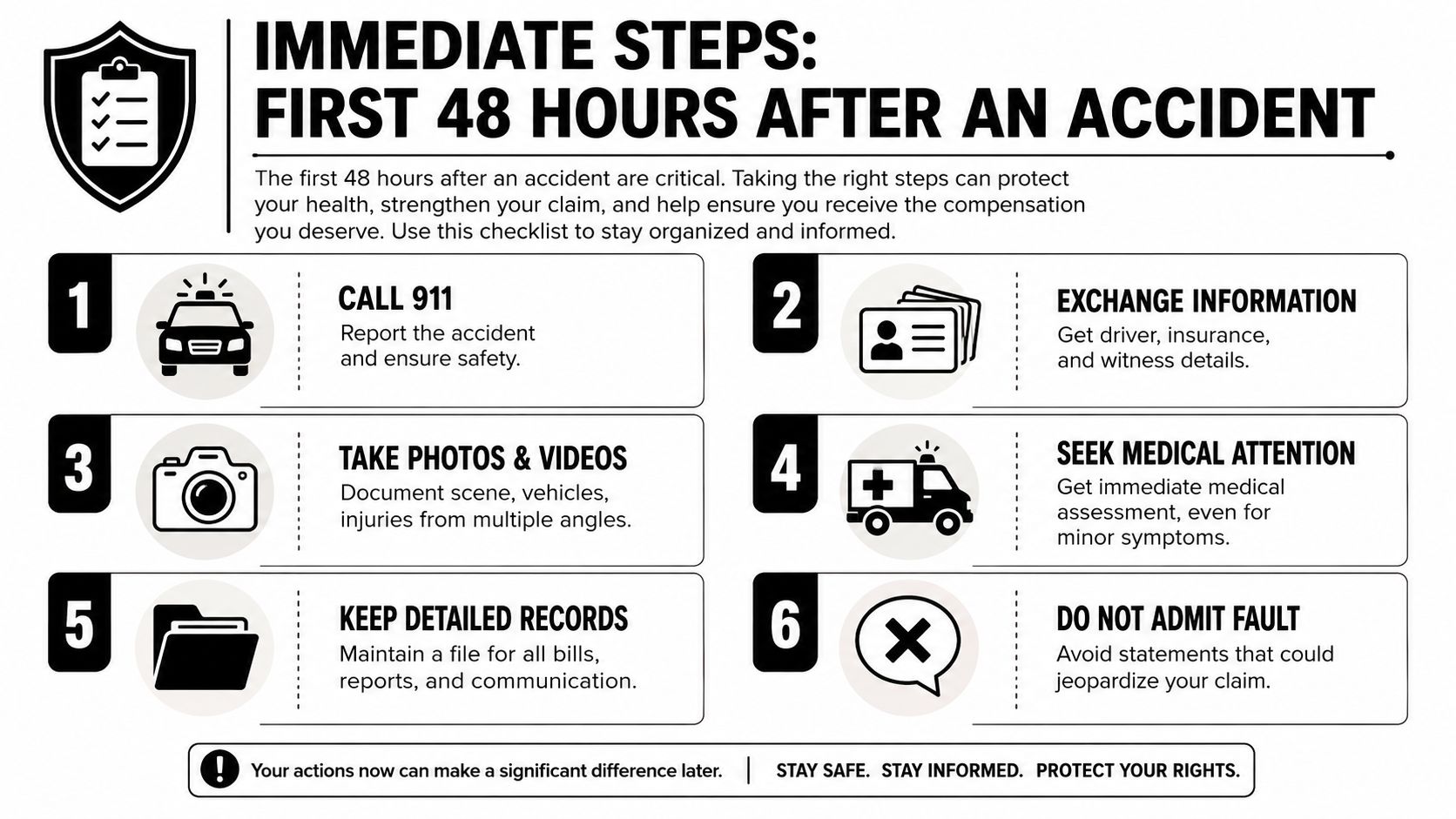
What to gather at the scene
Start with what your phone can capture.
- Photos of the full scene. Get wide shots of the roadway, lanes, traffic lights, debris, weather, and anything that shows how the crash happened.
- Photos of each vehicle. Take front, rear, side, and close-up damage images.
- Visible injuries. Bruising, swelling, cuts, burns, and torn clothing matter.
- Contact information. Get names, phone numbers, insurance details, and plate information.
- Witness details. If someone saw what happened, get their contact information before they leave.
After a crash on I-45 in Houston, a neutral witness can be the difference between a denied claim and a paid one. If the other driver later changes their story, that witness may be the person who confirms the lane change, sudden stop, or phone use that caused the wreck.
Why the police report matters
A police report often becomes the first neutral document in the file. It may identify the parties, location, road conditions, vehicle positions, officer observations, and whether any citation was issued. That doesn't end the case, but it gives your lawyer and the insurer a starting point anchored to the day of the crash.
If you need help understanding how to obtain and use that report, review this guide on a Texas crash report.
Say as little as necessary at the scene. Be respectful, be truthful, and don't guess about speed, fault, or injuries.
Here's the other immediate priority. Get medical care. Even if you think you're “mostly okay,” pain from soft tissue injuries, head trauma, and internal problems can show up later.
A short video explanation can also help you remember the first moves that protect your case.
What not to do in the first 48 hours
A lot of cases get damaged by avoidable mistakes.
| Mistake | Why it hurts your claim |
|---|---|
| Admitting fault | You may say something inaccurate before the facts are clear |
| Delaying treatment | The insurer may argue you weren't really injured |
| Failing to identify witnesses | Independent support can disappear quickly |
| Repairing the vehicle too fast | Damage photos and crash-related evidence may be lost |
Proving Your Injuries with Medical Evidence
A week after the crash, the adjuster calls and sounds friendly. Then the questions start. Why did you wait to see a specialist. Why do the records mention shoulder pain first, then headaches later. Why did you miss therapy. Those are not casual questions. They are looking for a way to disconnect your injuries from the accident.
Medical evidence is how you keep control of that story.
Scene photos and witness names help show how the accident happened. Your medical file shows what the accident changed in your body, your daily life, and your recovery. In Texas, that link is everything. You need records that connect the event, the symptoms, the diagnosis, the treatment, and the lasting effects in a clear timeline.
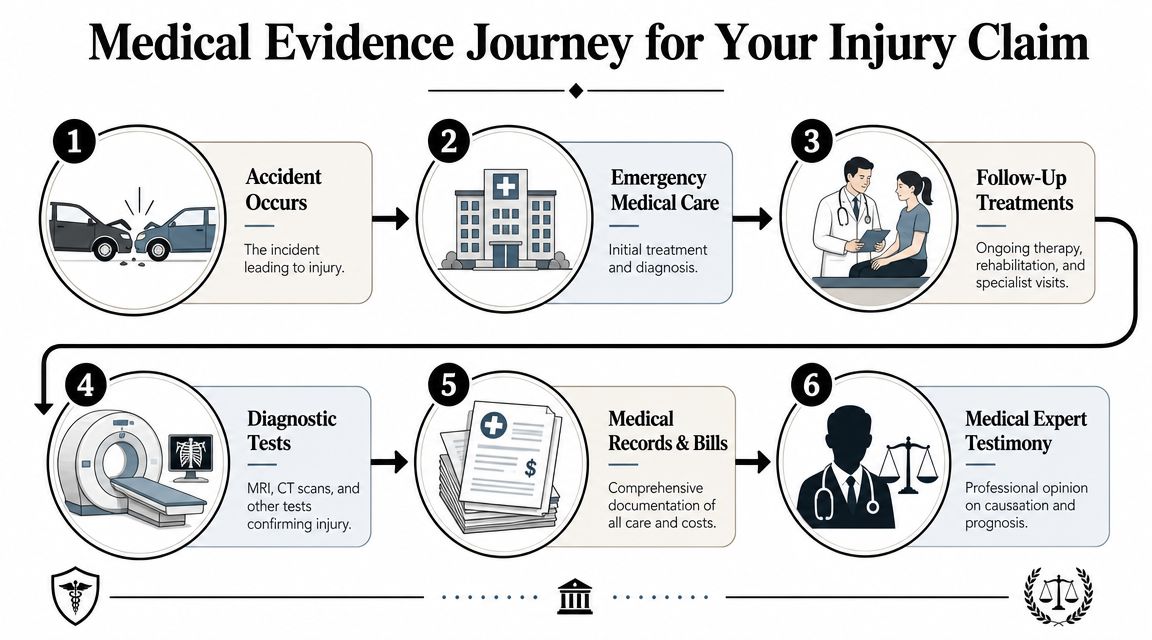
What a strong medical file looks like
A persuasive medical file develops step by step, and each step answers a different defense argument.
Emergency room or urgent care records
These records put your first complaints close to the date of the accident. They help show you did not invent symptoms later.Diagnostic testing
X-rays, MRIs, CT scans, and other imaging can confirm fractures, disc problems, head injuries, and other trauma that may not be obvious from pain complaints alone.Follow-up treatment notes
Visits with your primary doctor, orthopedist, neurologist, pain specialist, or physical therapist show whether symptoms improved, stayed the same, or got worse over time.Medication records and treatment plans
Prescriptions, injections, referrals, work restrictions, and home exercise instructions show the practical effect of the injury on your routine and your ability to function.
That sequence does more than fill a chart. It builds proof of causation and damages. If the insurer argues your condition came from age, a prior injury, or something unrelated, a clear treatment timeline gives your lawyer the records needed to push back.
What you should do starting now
Tell every doctor exactly what hurts and exactly how it affects you. Be specific. Mention pain, numbness, dizziness, headaches, weakness, sleep problems, anxiety while driving, trouble lifting, missed work tasks, and anything else that changed after the accident.
Consistency matters. If your back still hurts, say so at the next visit. If the pain moved, got worse, or started causing new limitations, report that too. If it is not in the chart, expect the insurance company to argue it was never a real problem.
Follow the treatment plan as closely as you can. Keep appointments. Fill prescriptions. Attend therapy. If cost, transportation, or work makes that hard, tell the provider and tell your lawyer. A missed visit with no explanation gives the defense an argument. A documented obstacle is different.
If your doctors are still deciding whether you have healed as much as you are likely to heal, read about maximum medical improvement and how it affects settlement decisions.
The insurer's perspective: If you disappear from treatment for weeks and then return describing severe symptoms, they will argue the injury was minor, resolved, or came from something else.
Common medical evidence mistakes
Some errors weaken a case fast.
- Skipping follow-up care. Gaps in treatment make it easier to argue that your injury was temporary or unrelated.
- Underreporting symptoms. Patients often try to be tough or optimistic. That hurts claims. Your records should reflect the full picture.
- Ignoring referrals. If a doctor recommends imaging, a specialist, or therapy, follow through when possible.
- Treating only once. One visit may prove you were hurt. It rarely proves how long the injury lasted or how seriously it disrupted your life.
Serious injury cases rise or fall on this paper trail. Long-term pain, mobility limits, brain injury symptoms, and future treatment needs must be documented carefully and consistently. Done right, your medical evidence does not just prove you went to the doctor. It shows, piece by piece, what this accident took from you and what it will take to put your life back together.
Documenting the Financial Toll of Your Accident
A week after the crash, the adjuster asks for proof of your losses. You know you missed work. You know you paid for prescriptions, rides to appointments, and help around the house. If those costs are not documented, the insurer will treat them as if they never happened.
Money losses are part of your recovery story. They show what this accident has cost you in real terms, and they help connect the other driver's carelessness to the disruption in your daily life.

The records that put real numbers behind your claim
Start one file today. Digital is fine. Paper is fine. What matters is consistency.
Save every document tied to the accident, including medical bills, pharmacy receipts, therapy invoices, mileage or transportation costs, parking receipts, repair estimates, rental car charges, and any invoice for medical equipment or household help you needed because of your injuries. If you miss work, keep pay stubs, time sheets, tax records if you are self-employed, and a short employer statement showing the dates you missed, your usual pay, and whether you had to work reduced hours or lighter duty.
These records do more than total up expenses. They show the insurer that your losses are concrete, traceable, and harder to argue away.
| Type of loss | Useful proof |
|---|---|
| Past medical care | Bills, receipts, treatment statements |
| Lost income | Pay stubs, employer confirmation, missed-time records |
| Vehicle damage | Repair estimates, photos, valuation documents |
| Future care concerns | Ongoing treatment records and physician recommendations |
How these records shape case value
Every receipt fills in a piece of the picture. A pharmacy receipt supports your treatment. A wage statement shows the injury affected your paycheck. A repair estimate helps tie the force of the crash to the losses that followed.
That is how you build damages. Texas law allows recovery for financial losses tied to the accident, often called special damages in a Texas injury case. Your job is to make those losses easy to prove.
Some documents also matter because of how they are signed, sent, or verified. Employer wage letters, repair authorizations, and certain insurance forms carry more weight when they are complete and properly documented. If you want a practical overview of what gives paperwork legal force, review SendItFax's insights on binding documents.
Do not overlook the smaller expenses
Insurers love to dismiss scattered costs. Do not let them.
Co-pays, bandages, over-the-counter medication, rideshare trips to treatment, child care during appointments, and parking fees can add up fast. Save them. If you paid out of pocket because of this injury, put it in the file.
Keep a plain, honest loss log
Use a notebook or your phone and update it every few days. Record missed work, canceled jobs, reduced hours, and tasks you had to pay someone else to handle. If your injury made you hire lawn care, cleaning help, or extra child care, write down the date, amount, and reason.
Do the same for daily disruption. Short entries are enough. “Could not drive to physical therapy, paid for ride.” “Missed half day of work because of back spasms.” “Needed help lifting groceries.” Those notes help tie your financial losses to the way the injury changed your routine.
This is not busywork. It is how you take control of the proof.
How Texas Laws Impact Your Evidence Strategy
The crash happened fast. The blame fight starts even faster.
In Texas, evidence is how you keep control of your story. Every photo, record, and signed document helps answer two questions that decide injury claims. Who caused this wreck? How much did it cost you physically, financially, and personally?
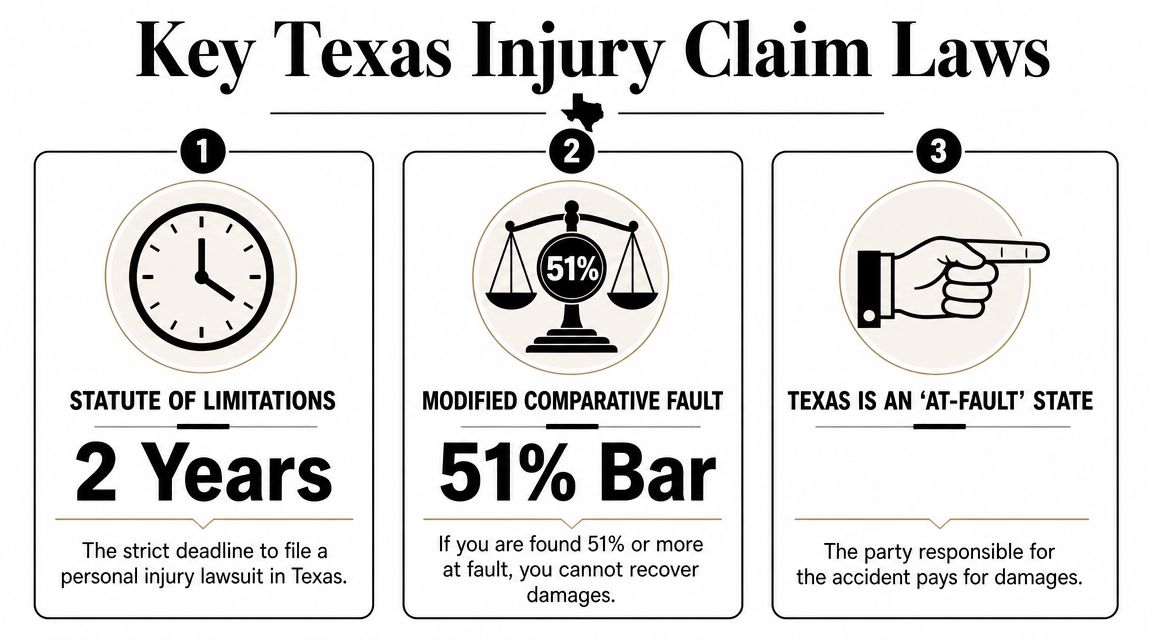
Texas law also rewards people who act early. There is a deadline to file a personal injury lawsuit, and waiting puts evidence at risk long before that deadline arrives. Skid marks fade. video gets overwritten. Witnesses stop answering unknown numbers. Medical gaps give the insurer something to attack.
The fault rule you need to take seriously
Texas uses a modified comparative fault system. That means your compensation can be reduced if you share blame, and you can lose the right to recover if the other side pushes your percentage of fault too high.
That is why evidence collection is not just about proving the other driver did something wrong. It is also about blocking blame-shifting before it takes hold.
Get and preserve proof that answers the common defense arguments:
- Scene photos that show lane position, vehicle damage, traffic signs, debris, and sight lines
- Witness names and contact information before people disappear
- The police report number so your lawyer or insurer can get it quickly
- Prompt medical records that connect the crash to your symptoms
- Written communication from the other driver, insurer, or business involved
Each item strengthens a different part of your case. Together, they make it harder for an adjuster to argue that you caused the crash, exaggerated your injuries, or failed to limit the damage.
Why document quality matters under Texas law
A good claim file is organized, consistent, and signed correctly.
Texas injury cases often turn on paperwork people rush through. Recorded statements, medical authorizations, settlement releases, repair forms, and wage verification letters can all affect what you can prove later. Sloppy or incomplete documents create openings the insurer will use. Before you sign anything, review SendItFax's insights on binding documents. You need to know what carries legal weight and what rights you may be giving up.
Do not hand the insurance company broad access to your records without understanding the scope. Do not guess on forms. Do not sign a statement “just to keep things moving.”
A Texas example
After an intersection collision, the other driver says you were distracted and entered too late on a yellow light. You say the other driver ran red.
Now the case becomes a proof problem.
If you collected timestamped photos, got a witness name, sought treatment right away, and kept your records in order, you have building blocks that support your version of events and your damages. If you also avoided careless paperwork, you have given the insurer fewer ways to twist the facts.
That is the right evidence strategy in Texas. Build the file early. Build it carefully. Build it so your recovery story is backed by proof, not just memory.
Advanced Evidence Your Attorney Can Secure for You
A driver swears you caused the crash. The police report is incomplete. The store camera across the street deletes footage every few days. That is when a lawyer's investigation matters most.
Serious Texas injury claims are often won with evidence you cannot get on your own. This material does more than fill a file. It helps prove who acted carelessly, how the collision happened, and why your losses trace back to this event instead of something else.
What your lawyer may preserve and obtain
One of the first jobs is sending a spoliation letter. That is a formal demand to preserve evidence before it is erased, overwritten, repaired, or discarded. In the right case, that step protects the building blocks of your recovery story.
Your attorney may pursue:
- Vehicle electronic data. This can show speed, braking, steering input, seat belt use, and timing around impact.
- Cell phone records. These records can support a distracted driving claim if the other driver was calling, texting, or using data at the wrong time.
- Surveillance video. Footage from stores, restaurants, apartment complexes, traffic cameras, or nearby homes can capture the crash or what happened seconds before it.
- Trucking company records. In commercial vehicle cases, driver qualification files, hours-of-service logs, maintenance records, inspection reports, dispatch communications, and onboard data can reveal rule violations and unsafe company practices.
- 911 recordings and dispatch logs. These records can pin down timing, location, road conditions, and early statements from the people involved.
This evidence is powerful because it is harder for an insurance company to brush aside. A witness may forget. A driver may change the story. Electronic records and preserved footage often do not.
Why speed matters
Many of these records have a short shelf life.
Video gets deleted in the ordinary course of business. Trucking companies rotate documents. Vehicles get repaired, sold, or salvaged. Phones are replaced. If no one acts quickly, proof that could support your claim disappears before you even know it existed.
That is why early legal help is not an overreaction in a severe injury case. It is a practical move to protect evidence before the other side controls the narrative.
A lawyer may also bring in the right professionals to explain what the records mean. Accident reconstruction experts can use vehicle damage, scene measurements, and electronic data to show how the wreck unfolded. Medical experts can connect the force of the crash to the injuries you are treating. Those opinions help turn raw information into a clear case for negligence and damages under Texas law.
The Law Office of Bryan Fagan, PLLC handles investigation and evidence preservation for Texas motor vehicle injury claims, including car, truck, catastrophic injury, and wrongful death matters.
You Are Not Alone Let Us Help You Recover
You've already got enough on your shoulders. Healing is hard enough without trying to chase records, argue with adjusters, and decode Texas liability rules on your own.
A strong claim needs more than a stack of papers. It needs a clear theory of fault, a medical timeline that proves causation, and records that show exactly how the accident changed your life. That's true whether you need a Houston car accident attorney after a freeway wreck, a truck crash lawyer Houston families can call after a commercial collision, or a wrongful death lawyer Texas families trust after the unthinkable.
What you should do today
If you're still in the early stage after a crash, focus on these moves:
- Get medical care and follow through with treatment.
- Save every document tied to the accident.
- Preserve photos, video, and witness information before they disappear.
- Be careful with insurers and don't give broad statements or sign forms casually.
- Talk to a lawyer early if the injuries are serious, fault is disputed, or a loved one was killed.
Recovery is possible, and legal help can make the path clearer.
You do not have to carry the legal burden alone. The right evidence can tell your story with force and credibility. The right legal help can turn that evidence into action.
If you were hurt in a crash or lost someone you love, contact the Law Office of Bryan Fagan, PLLC for a free consultation. You can speak with a Texas personal injury lawyer about your rights, your evidence, and your next steps in plain English. You've been through enough. Let an experienced legal team handle the fight while you focus on recovery.