
A serious accident can change your life in seconds, but you don’t have to face it alone.
A lot of people end up on this page in the same position. The crash happened. Maybe it was a rear-end collision on a Houston freeway, a side-impact crash in Dallas, or a hard hit at a busy San Antonio intersection. At first, you felt shaken and sore. Then the deeper pain started. Your lower back tightened. Your neck stopped turning normally. Pain began traveling into your arm or down your leg.
That pattern matters. A herniated disc from car accident trauma often doesn’t look dramatic in the first hour, but it can disrupt your work, sleep, driving, childcare, and recovery for months. It can also create a legal problem if the injury isn’t documented the right way from the beginning.
Your Life After a Crash Navigating a Herniated Disc Injury
After a Houston freeway crash, a person might go home thinking they only have “whiplash” or a strain. A few days later, they can’t sit comfortably at a desk. A week later, pain starts shooting down one leg. By then, the insurance company is already looking for a way to say the problem came from something else.
That’s why these cases need calm, early action.

A herniated disc injury isn’t just a medical term. It can mean trouble getting out of bed, trouble lifting your child, trouble getting through a workday, and real fear about whether the pain will become permanent. If your doctors start talking about injections, specialist referrals, or surgery, the stress gets even heavier.
What people usually worry about first
Most clients focus on the same practical questions:
- Will this get better: Some disc injuries improve with conservative care, while others keep pressing on nerves and cause lasting problems.
- How do I pay for treatment: Imaging, specialist visits, therapy, and possible procedures can become expensive quickly.
- What if symptoms showed up later: That delay is common, but insurers often try to use it against you.
- Do I need a lawyer now: If there’s serious pain, radiating symptoms, missed work, or pushback from an insurer, legal guidance usually helps early.
The strongest claims usually start with the strongest medical paper trail.
If your treatment eventually includes a procedure, practical home planning matters too. For readers preparing for mobility limits, pain flare-ups, or basic equipment needs, this guide on recovering from surgery at home is a useful starting point.
What Texas law gives you the right to pursue
If another driver caused the crash, Texas law may allow you to seek compensation for medical care, lost income, pain and suffering, physical impairment, and future treatment needs. The key is proving both fault and causation. In other words, showing who caused the crash and showing how that crash caused this spinal injury.
That second part is where many valid claims get challenged. Not because the injury isn’t real, but because the documentation wasn’t built carefully enough from day one.
How a Car Accident Causes a Herniated Disc
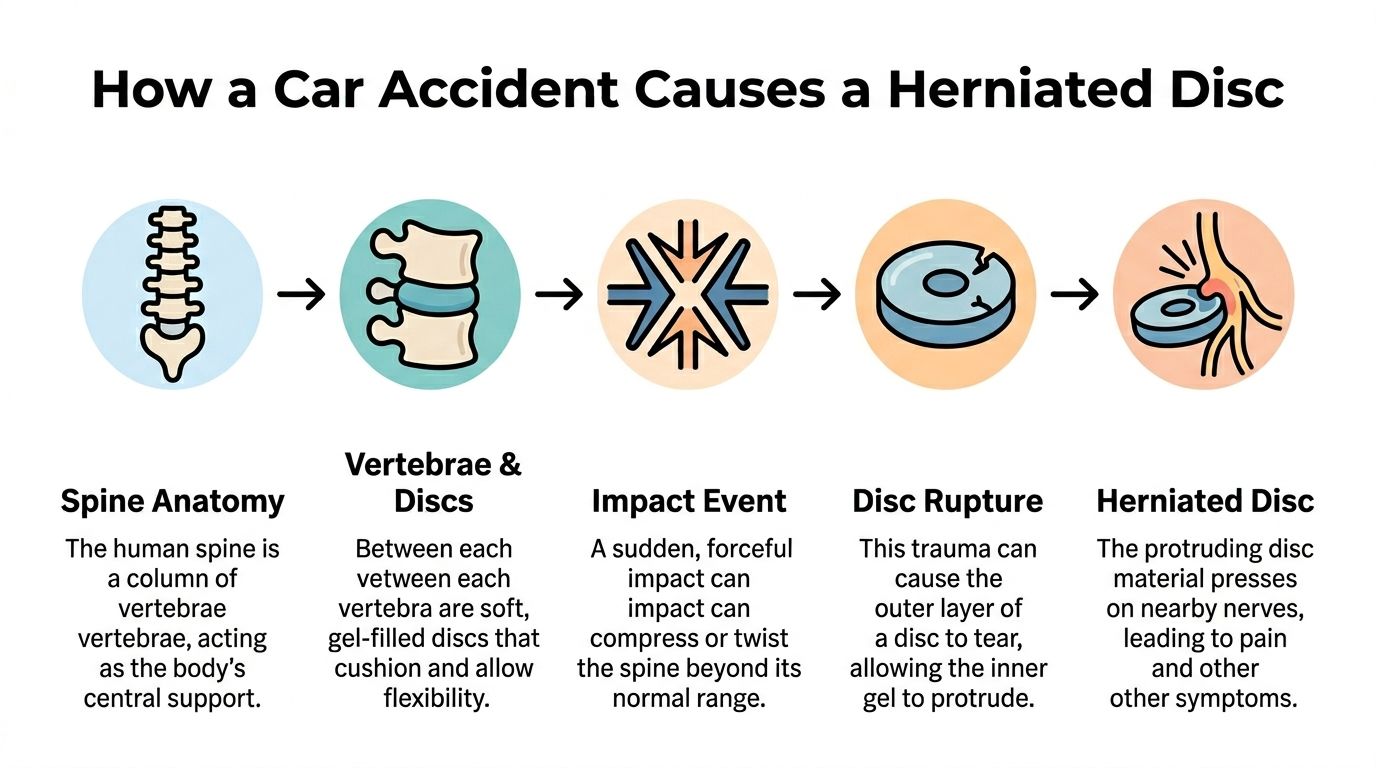
Your spine is a stack of bones called vertebrae. Between those bones sit discs that act like cushions. They help absorb force and allow movement.
A simple way to picture a disc is a jelly donut. The outside is the annulus fibrosus, a tougher outer ring. The inside is the nucleus pulposus, a softer, gel-like center.
What the crash force does to the disc
When a car is hit, your body doesn’t stop moving just because the vehicle does. Your neck, back, and torso absorb the force. If that force bends, twists, compresses, or snaps the spine beyond what the disc can tolerate, the outer layer can tear. Then the inner material pushes outward and irritates or compresses nearby nerves.
According to this discussion of crash-related disc trauma, car crashes account for nearly 39% of all spinal cord injuries in the United States, and lumbar disc herniations occur in up to 35% of people with moderate to severe spinal trauma from these collisions. That same source explains the basic mechanism clearly: the annulus fibrosus tears, the nucleus pulposus pushes out, and the disc can press on spinal nerves, often at L4-L5 or L5-S1.
Different wrecks load the spine in different ways
Not every collision injures the spine the same way.
A rear-end crash often creates a fast whip motion in the neck and back. A side-impact crash can twist the body unnaturally. A head-on collision can drive heavy compressive force through the lumbar spine.
Here’s what that looks like in real life:
- Rear-end collision: Your head and torso snap backward and forward. Cervical discs often take the stress.
- T-bone or side-impact crash: The spine may rotate while also absorbing a sideways jolt.
- Head-on crash: The body folds forward against restraints, and the lower back can absorb major compression.
Why these injuries are often misunderstood
A person can walk away from the scene and still have a serious disc injury. Vehicle damage doesn’t always tell the full story. The body can take force in a way the bumper does not.
That’s one reason insurers like to minimize these claims. They may point to low property damage, delayed pain, or a prior complaint of back soreness. But the medical reality is more complicated than that.
If you’re dealing with spinal pain after a wreck, this overview of car accident back injuries can help you understand how these injuries fit into a broader claim.
A disc injury claim gets stronger when the mechanics of the crash match the symptoms, the imaging, and the treatment timeline.
Symptoms and Diagnosis of a Herniated Disc
Some people feel immediate pain. Others feel stiffness first, then notice the nerve symptoms later. What matters is not guessing. It’s getting the right evaluation and making sure your complaints are documented precisely.

Common symptoms that should not be brushed off
A herniated disc can cause local pain, nerve pain, or both. The location of the disc often shapes the symptoms.
Watch for signs like these:
- Neck or low back pain: Deep, persistent pain that doesn’t settle down after the first few days.
- Radiating pain: Pain moving into an arm, hand, buttock, or leg.
- Numbness or tingling: Pins-and-needles sensations can suggest nerve irritation.
- Weakness: Trouble gripping, lifting, climbing stairs, or pushing off one leg.
- Pain with sitting or bending: Some disc injuries worsen when pressure increases on the spine.
If pain is traveling down the leg, people often call it sciatica. If it travels from the neck into the arm, doctors may describe it as radiculopathy. For readers trying to understand overlapping nerve symptoms, Understanding Scoliosis And Sciatica gives helpful background in plain language.
Why the ER visit may not be enough
Emergency rooms are designed to rule out immediate emergencies. They are not always designed to complete a full soft-tissue spine workup on the first visit.
That creates a common problem. A crash victim gets checked for fractures, receives pain medication, maybe gets discharged with rest instructions, and assumes the worst has been ruled out. But X-rays cannot detect either bulging or herniated discs, as noted in this explanation of bulging disc vs. herniated disc after a car accident. That same source notes that the distinction between the two can significantly affect claim value, and that cases involving long-term impairment or permanent disability often exceed $100,000 when there is proper diagnostic evidence.
Bulging disc vs herniated disc
These terms are often used loosely, but they are not the same thing.
| Condition | General idea | Why it matters legally |
|---|---|---|
| Bulging disc | The disc extends outward more broadly | It may still be painful, but insurers often argue it is less severe |
| Herniated disc | The outer layer tears and inner material pushes out | It more strongly supports a traumatic nerve-compression claim |
A lawyer can’t diagnose this. Your imaging and specialist records do. But from a case value standpoint, precision matters.
What to ask your doctor about
If symptoms continue, ask direct questions:
- Do I need an MRI or CT scan: Soft-tissue injuries usually require advanced imaging.
- Should I see a spine specialist: Orthopedists, neurologists, neurosurgeons, or pain specialists may help define the injury.
- Are my symptoms consistent with nerve involvement: That language matters in the chart.
- What restrictions should I follow: Work restrictions and activity limits help show the injury’s impact.
Later in the process, this kind of treatment record becomes part of the proof. Resources on motor vehicle accident injuries treatment can help you understand the treatment path and why consistency matters.
A short visual overview can also help you recognize symptoms and treatment issues people often overlook.
If your pain is spreading, your leg is going numb, or your hand feels weak, don’t settle for “it’s just soreness” without proper imaging.
How to Prove the Accident Caused Your Herniated Disc
The legal fight in these cases is often not whether you’re hurting. It’s whether the insurer can get away with saying the crash didn’t cause it.
That’s the central issue. Insurance adjusters regularly argue that a disc problem was degenerative, pre-existing, or unrelated. They know many people have old aches, normal wear in the spine, or delayed symptoms after a wreck. They use that gap to create doubt.
The paper trail that wins these cases
A strong claim tells one consistent story from the date of the collision forward. That story is built from records, not from frustration.
The most useful proof usually includes:
- Early medical evaluation: Get checked promptly, even if symptoms seem manageable at first.
- Consistent symptom reporting: Tell every provider where the pain is, when it started, and whether it travels into an arm or leg.
- Mechanism of injury documentation: The chart should reflect how your body moved in the crash, such as whipping forward, twisting, or being hit from the side.
- Follow-up care: Missed appointments and long treatment gaps give insurers arguments they don’t deserve.
- Objective testing: Imaging and specialist findings carry weight because they don’t depend only on your description.
Delayed symptoms are common, but they must be documented correctly
This often weakens many valid claims.
As explained in this piece on delayed herniated disc symptoms after a crash, delayed symptom onset creates a documentation gap that insurance companies actively exploit. The same source notes that adrenaline masks pain immediately post-accident, and that for Texas claims, baseline imaging and a medical timeline tied to the crash mechanics can help counter insurer denials.
If your symptoms showed up later, that does not mean your case is weak. It means your timeline has to be built carefully.
What to do if pain appeared days later
If the timeline is delayed, take these steps immediately:
- Return to a doctor right away and clearly say the pain began after the crash, even if it worsened over several days.
- Describe the progression. Don’t just say “my back hurts.” Say it started as stiffness, then became shooting pain down the leg.
- Keep your reports consistent across urgent care, your primary doctor, physical therapy, and specialists.
- Avoid self-diagnosing online and then repeating inaccurate terms in your records.
- Save proof of disruption like missed work, canceled travel, or difficulty with routine tasks.
Practical rule: The more specific your timeline, the harder it is for an insurer to call your injury vague or unrelated.
The pre-existing condition defense
Texas law does not let a negligent driver escape responsibility just because you had prior wear and tear or an earlier back complaint. If a crash aggravated a vulnerable spine, that aggravation can still be compensable.
But you need records that show the difference between your pre-crash condition and your post-crash condition. That can mean comparing old and new symptoms, old and new treatment intensity, or old and new functional limits.
A real-world example helps. After a Dallas commuter crash, a driver may have had occasional low back soreness before the wreck but no leg numbness, no MRI findings on file, no specialist care, and no missed work. After the collision, the same person has radiating pain, an MRI-confirmed disc injury, physical restrictions, and time away from the job. That change matters.
When expert analysis helps
In disputed cases, the details of vehicle damage, crash angle, occupant movement, and force transfer can become important. That’s where outside analysis may support causation. If the insurer is denying the mechanics of the injury, an accident reconstruction expert witness may help connect the crash dynamics to the medical findings.
The goal isn’t to make the case sound dramatic. It’s to make it clear, documented, and difficult to distort.
What Is Your Herniated Disc Claim Worth in Texas
This is the question almost everyone asks, and the honest answer is that value depends on the facts. A mild injury that improves with conservative care is different from a case involving nerve damage, surgery, permanent restrictions, or ongoing pain.
Still, there are useful guideposts.
According to average settlement data for herniated discs after car accidents, average settlements range from $30,000 to over $250,000. That same source states that mild cases may settle for $50,000 to $150,000, while severe cases requiring surgery can range from $100,000 to $300,000 or more. It also notes that treatment costs alone can average $20,000 to $100,000+.
Those numbers are not guarantees. They are a reminder that this injury can carry serious financial weight.
What drives case value
Texas injury claims usually involve two broad categories of damages.
First are economic damages. These are the financial losses you can track on paper.
Second are non-economic damages. These cover the human impact that doesn’t show up neatly on a bill.
Here is a practical breakdown:
| Type of Damage | What It Covers | Example |
|---|---|---|
| Medical expenses | Past and future care related to the injury | ER visit, MRI, specialist visits, physical therapy, injections, surgery |
| Lost wages | Income missed while you recover | Time away from an hourly job, salary loss during medical leave |
| Loss of earning capacity | Reduced ability to earn in the future | A worker can return, but only with restrictions or reduced hours |
| Pain and suffering | Physical pain and day-to-day discomfort | Ongoing low back pain, nerve pain, painful sleep |
| Mental anguish | Emotional impact of the injury | Anxiety about driving, fear of surgery, frustration from chronic pain |
| Physical impairment | Loss of normal physical function | Trouble lifting, standing, bending, driving long distances |
| Loss of enjoyment of life | Reduced ability to do normal activities | You can’t coach your kid’s team, exercise, garden, or travel comfortably |
Why similar injuries can have very different outcomes
Two people can both have a lumbar herniation and still have very different claims.
One person may improve with therapy and return to normal work. Another may need injections, lose overtime pay, stop lifting at work, and struggle for months with sleep and driving. The MRI may look similar, but its practical impact is not.
That’s why quick online calculators usually mislead people. They don’t measure how this injury changed your routine, your job, your family role, or your future treatment needs.
The issue of future damages
Future losses are often the most undervalued part of a disc case.
If your doctor believes you’ll need continued treatment, work restrictions, pain management, or surgery later, your claim should reflect that. Settling too early can leave you paying for future care out of your own pocket.
This is especially important if you’re hearing terms like “ongoing radicular pain,” “surgical consult,” “permanent restrictions,” or “maximum medical improvement” before you feel recovered.
The right settlement amount is not just about what you’ve already spent. It’s also about what this injury is likely to cost you next.
Navigating the Legal Process for Your Injury Claim
A disc injury claim is often lost in small moments. A recorded statement. A casual remark to the adjuster. A rushed settlement before the MRI results are fully understood.
Texas law gives you a path to recover, but you need to protect that path early.

What not to do with the insurance company
The other driver’s insurer is not there to coach you through your case. Their job is to limit what they pay.
Avoid these common mistakes:
- Don’t give a recorded statement without legal advice. Adjusters often ask questions designed to lock you into incomplete answers.
- Don’t minimize your symptoms by trying to sound tough or polite.
- Don’t sign broad medical releases that let the insurer dig through unrelated records.
- Don’t accept a quick check before you know whether the injury will require advanced treatment.
A common example is the person who says, “I’m probably okay, just sore,” in the first week. Later, the insurer points to that statement and tries to use it against them after the MRI shows a real injury.
Texas fault law matters
Texas follows a fault-based system for car accidents. That means the driver who caused the crash is financially responsible for the damage that followed.
Texas also uses modified comparative responsibility. If you were partly at fault, your compensation can be reduced by your percentage of responsibility. If you are found more responsible than the other side under Texas law, you can be barred from recovery.
That’s one reason the details matter so much in disputed crashes. Liability problems can reduce otherwise valid injury claims.
How long do you have to file a claim in Texas
In most Texas personal injury cases, the statute of limitations is two years from the date of the injury. In a wrongful death case, the deadline is generally two years from the date of death.
There can be exceptions depending on the facts, the parties involved, and notice requirements. Waiting is risky. Evidence gets harder to collect, and treatment gaps get easier for insurers to exploit.
If the crash involved a commercial vehicle, a family may also need guidance from a truck crash lawyer Houston residents can trust. If the collision turned fatal, a wrongful death lawyer Texas families rely on can help preserve evidence and protect the claim before key deadlines pass.
Why future care has to be part of the claim
Whiplash-related disc injuries are not always short-term. According to whiplash disc injury statistics, 25% of whiplash victims develop herniated discs. That same source states that 39% show disc degeneration 5 to 10 years after trauma, and those patients require surgery twice as often as controls, typically 8 years earlier. That long-term risk is one reason a rushed settlement can be so costly.
What a lawyer does
A good Texas personal injury lawyer does more than send letters.
A lawyer can help by:
- gathering crash reports, photos, and witness information
- organizing medical records into a clear timeline
- pushing back when an adjuster claims the injury was pre-existing
- identifying future losses before a settlement is discussed
- preparing the case for litigation if the insurer won’t act reasonably
If your crash involved a passenger car, commercial truck, or fatal injury, you may need guidance from a Texas personal injury lawyer, a Houston car accident attorney, or related counsel handling catastrophic injury and wrongful death claims.
You Don’t Have to Face This Alone We Can Help
A herniated disc from car accident trauma can disrupt almost every part of your life. The pain may be constant. The diagnosis may take time. The insurance company may act like your delayed symptoms are suspicious, your MRI doesn’t matter, or your treatment is excessive.
That doesn’t mean they’re right.
What usually works in these cases is straightforward. Get evaluated early. Tell your doctors exactly what you feel. Follow through with treatment. Keep your records organized. Don’t let an insurance adjuster shape your story before your medical picture is clear.
What usually does not work is waiting too long, guessing instead of documenting, or accepting a fast settlement because you hope the pain will fade. Sometimes it does. Sometimes it gets worse. You need room to make decisions based on medical facts, not pressure.
If you’re in Houston, Dallas, Austin, San Antonio, or a nearby Texas community, legal help can make the process more manageable. The right lawyer can deal with the insurer, build the proof, and focus on the future costs and limitations that many people overlook in the early weeks after a crash.
Recovery is possible. So is accountability.
You don’t need to know everything today. You just need to take the next smart step and protect both your health and your rights.
If you’re dealing with serious back or neck pain after a collision, the Law Office of Bryan Fagan, PLLC can help you understand your options and protect your claim. Whether you need a Texas personal injury lawyer, a Houston car accident attorney, help after a commercial vehicle wreck, or guidance for a catastrophic injury or wrongful death case, the firm offers a free consultation to discuss what happened, what your case may involve, and what to do next. You don’t pay upfront fees, and you don’t have to handle the insurance company alone.