Skip to content
A serious accident can change your life in seconds, but you don't have to face it alone.
If you're reading this after a crash in Houston, a truck collision near Dallas, a rideshare accident in Austin, or a fatal wreck that left your family searching for answers, you're probably dealing with more than pain. You may be juggling medical appointments, missed work, calls from insurance adjusters, and the fear that one wrong move could hurt your case.
That fear is understandable. In Texas, winning a personal injury case usually isn't about one dramatic moment in court. It's about making smart decisions early, protecting key evidence, and understanding how Texas fault rules can change the outcome of your claim. The core question behind how to win a personal injury case in Texas is often this: how do I protect my future, pay for treatment, and avoid getting blamed for something that wasn't my fault?
The answer starts with a clear plan.
Your Guide to Justice After a Texas Accident
After an injury, “winning” means different things to different families. For one person, it means getting enough compensation to cover surgery, follow-up care, and time away from work. For another, it means holding a careless driver accountable after a loved one's death. If you're speaking with a Texas personal injury lawyer, those are the kinds of goals that matter most.
Texas personal injury claims are built on practical proof. You need to show what happened, why it happened, how your injuries connect to the event, and how those injuries changed your life. That sounds simple until an insurer starts arguing that your pain came from a prior condition, your treatment was delayed, or you were partly to blame.
A strong claim tells one consistent story from day one. The crash happened this way, the injury followed, and the losses are documented.
That's why early choices matter so much. The photos you take at the scene, the urgent care visit you make that evening, and the words you use when speaking to an adjuster can all affect the value of your case later.
Here's what often works in real Texas cases:
- Fast medical attention: Records created right after the accident help connect the crash to the injury.
- Clear documentation: Photos, names, reports, and work records help prevent blame-shifting.
- Careful communication: Short, accurate statements protect you better than guesses or apologies.
- Early legal advice: Serious cases often need a strategy before evidence fades.
What usually doesn't work is waiting, assuming the insurance company will “do the right thing,” or treating a serious injury like a minor inconvenience until symptoms get worse.
A Houston car crash attorney, a truck crash lawyer Houston families can call after a commercial collision, or a wrongful death lawyer Texas families trust after a fatal crash all look at the same basic question first: can we prove fault and damages with reliable evidence?
You can. But the clock starts immediately.
The First 48 Hours Protecting Your Rights and Your Health
The first two days after a wreck can shape your case for months. Evidence disappears fast. Skid marks fade. Vehicles get repaired. Witnesses stop answering unknown numbers. Your own memory gets less precise with time.
After a freeway collision, your first job is safety. Your second job is documentation.
What to do at the scene
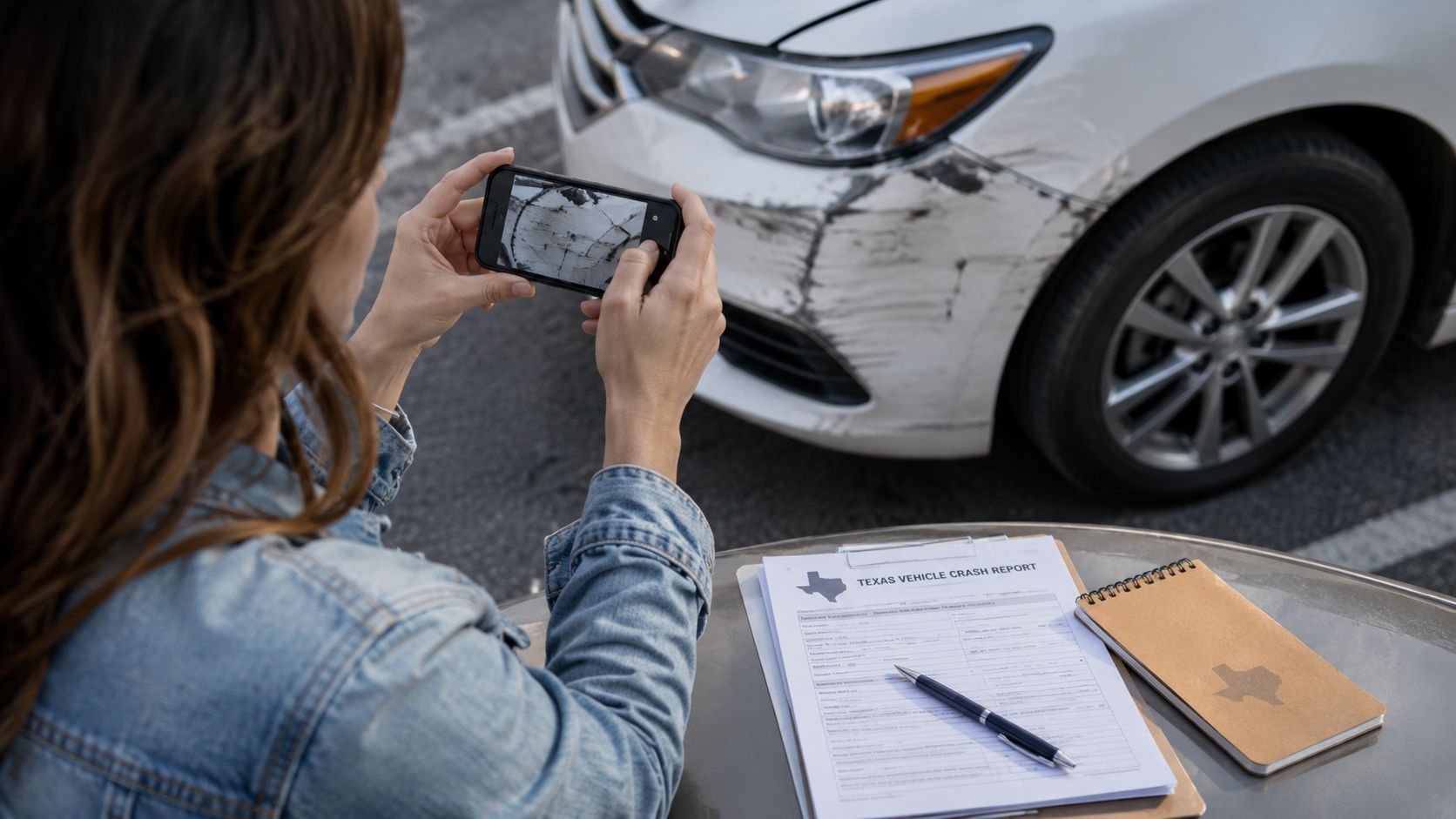
If you're physically able, gather the basics before leaving:
- Photograph the whole scene: Get wide shots, close-ups of damage, road signs, lane markings, debris, and visible injuries.
- Identify witnesses: Ask for names and contact details. A neutral witness can matter when the other driver changes their story.
- Cooperate with police: A report creates an early record of what happened.
- Keep your words simple: Stick to facts. Don't speculate about speed, fault, or whether you're “okay.”
Texas injury claims are strongest when they are built around liability, causation, and damages, with records that start immediately. That means preserving scene evidence, seeking prompt medical care, and tying symptoms to contemporaneous records, as explained in this guide on building the proof pillars of a Texas injury case.
A common mistake happens after a Houston I-45 truck crash or a neighborhood rear-end collision. The injured person declines ambulance care, goes home, and hopes the pain will pass. Then the stiffness turns into severe neck pain, a shoulder injury, or headaches the next morning. The defense later argues the injury wasn't serious, or wasn't caused by the crash.
Why medical care matters immediately
Prompt treatment protects your health first. It also creates a timeline no adjuster can easily ignore.
Even if you think you only have soft tissue pain, start documenting symptoms early. Basic self-care may help while you wait for formal treatment, and resources explaining the R.I.C.E. method for muscle pain can be useful for short-term relief after minor strain. But home care is not a substitute for medical evaluation after a crash.
Practical rule: If a symptom affects movement, sleep, work, driving, or concentration, it belongs in a medical record.
What not to do in the first 48 hours
Some mistakes are easy to avoid once you know what insurers look for.
| Situation | Better move |
|---|---|
| The adjuster asks for a recorded statement | Politely decline until you've had advice |
| You feel sore but “not injured enough” for a doctor | Get evaluated anyway |
| You want to post about the crash online | Don't post photos or commentary |
| You threw receipts and discharge papers in a bag | Start one organized file now |
If you need a more detailed checklist, review what to do immediately after an accident in Texas. That kind of step-by-step guidance can keep a stressful day from becoming a long-term legal problem.
Understanding Texas Fault Laws and Why They Matter
Many believe that a personal injury case turns on whether they were injured. In Texas, the harder fight is often about fault.
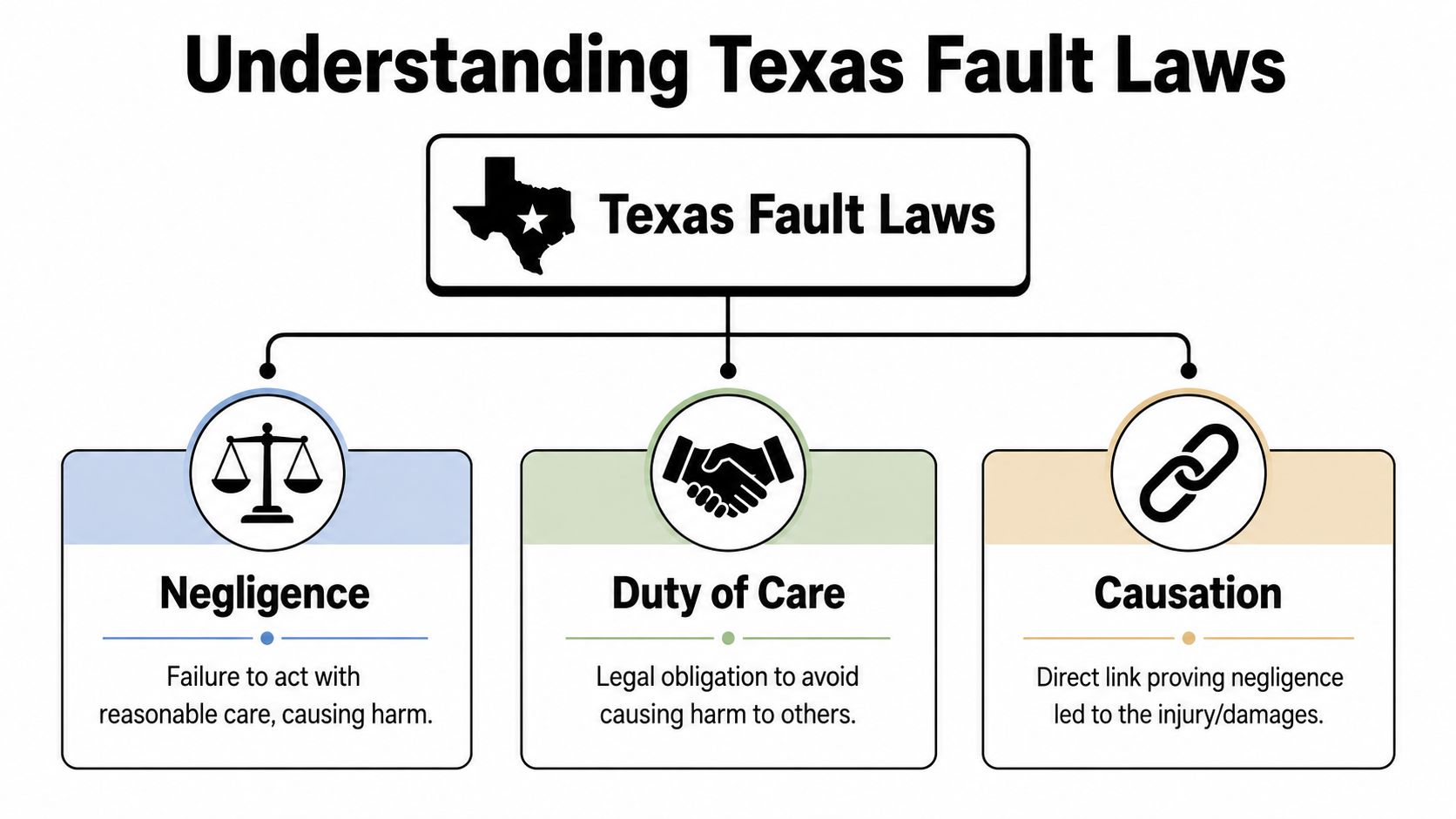
A case usually starts with proving negligence and causation because Texas uses a fault-based system. Most personal injury claims also must be filed within 2 years of the injury date under Texas Civil Practice and Remedies Code § 16.003, and if the injured person is found 51% or more at fault, they recover nothing, as discussed in this overview of Texas negligence, causation, and filing deadlines.
What negligence means in plain English
Negligence is carelessness that causes harm. In a traffic case, that may involve speeding, an unsafe lane change, distracted driving, following too closely, or failing to yield. Duty of care means people on Texas roads must act with reasonable caution. Causation means the careless act led to your injuries.
Those ideas sound technical, but they come up in ordinary situations every day.
Take a Dallas lane-change crash. Driver A says Driver B drifted into the lane without checking mirrors. Driver B says Driver A was speeding in a blind spot. Both drivers may point to vehicle position, impact location, dashcam footage, or witness statements. If the defense persuades a jury or insurer that you carried too much blame, your recovery can shrink or disappear.
For a closer look at how this rule works, review this explanation of comparative fault in Texas injury cases.
Why the 51 percent rule changes everything
Texas uses a form of modified comparative negligence. That means fault can be divided. But the line matters.
If you're found mostly responsible, your case may fail even if you were seriously hurt. That's why insurers often focus on behavior that sounds minor at first:
- Phone use allegations
- Claims that you were speeding
- Arguments about lane position
- Statements taken out of context
- Gaps in treatment that weaken causation
Here's the practical impact. If liability is clear, settlement talks usually center on damages. If liability is contested, the entire case can become a fight over percentages of fault.
This short video gives a helpful visual introduction to fault and injury claims in Texas.
What families should remember
You don't need to speak like a lawyer to protect your rights. You do need to understand that fault is not a side issue. It is often the issue.
In many Texas claims, the battle is not “Were you hurt?” It's “Can the defense shift enough blame onto you to reduce or bar recovery?”
That's why the strongest cases are consistent from the beginning. The scene evidence, the report, the medical records, and your own account should fit together.
How to Build an Unbeatable Evidence File
A strong evidence file does more than show you were hurt. It has to answer the defense before the defense asks the question.
In Texas injury cases, that matters because small facts often get used to argue big percentages of fault. A blurry photo, a missing follow-up visit, or an inconsistent timeline can give the insurer room to argue that you caused more of the event than you did, or that your injuries came from something else. I tell clients to build the file as if a skeptical adjuster, defense lawyer, and juror will all read it later. Because they might.
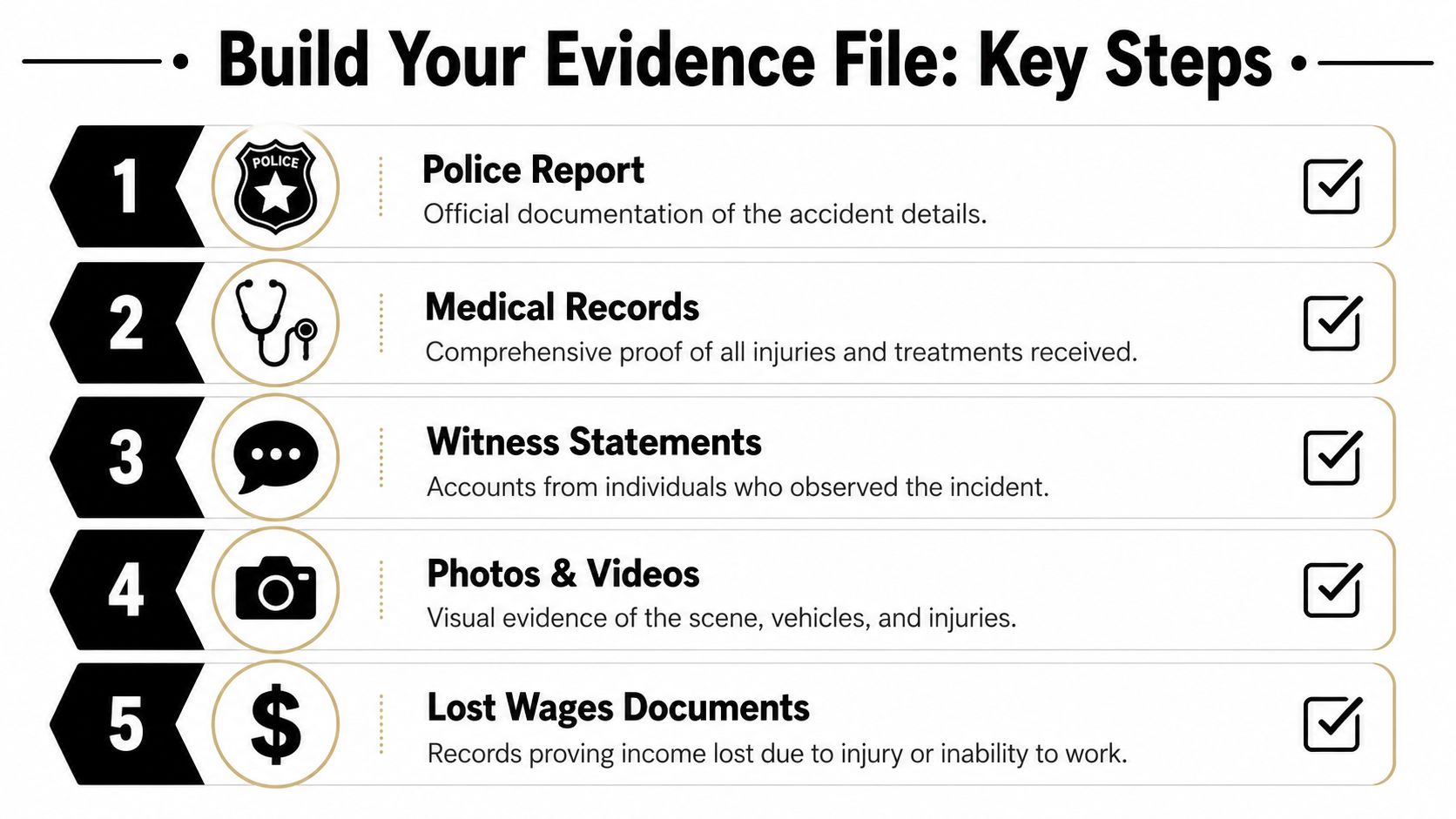
Build the file around proof problems, not paperwork
A pile of documents is not the same as a persuasive case file. The goal is to connect four points clearly: what happened, who caused it, what injuries followed, and how those injuries changed your daily life.
Organize your records in separate folders with dates on everything:
- Scene and vehicle evidence: crash report, photos, video, dashcam footage, tow records, repair estimates, black box data if available
- Medical evidence: ambulance records, ER records, imaging, prescriptions, specialist visits, therapy notes, work restrictions
- Income evidence: pay stubs, tax records, employer letters, missed shifts, invoices if you are self-employed
- Daily impact evidence: calendar entries, pain journal, canceled activities, home assistance, sleep problems, missed family responsibilities
Dates matter. If your treatment starts late, stops for a while, or changes providers often, the defense may argue the injury was not serious or was caused by something unrelated.
What makes evidence persuasive in a Texas case
The best files are consistent.
Your photos should fit the crash report. Your medical records should fit your account of pain and limitations. Your work records should fit the restrictions your doctor gave you. When those pieces line up, it becomes harder for the other side to push blame onto you or minimize the claim.
A good pain journal helps if it stays specific and practical. Write down what you could not do, what movements caused pain, what medication you took, and what changed at work or at home. “Needed help getting out of bed” carries more weight than “rough day.”
Common defense arguments and the proof that answers them
| Defense argument | Evidence that helps answer it |
|---|---|
| “Your injuries are exaggerated” | Prompt treatment records, imaging, specialist notes, therapy records |
| “The impact was too minor to cause this” | Vehicle photos, repair records, body position details, early symptom reports |
| “You were partly at fault” | Scene photos, witness statements, dashcam footage, vehicle data, 911 call records |
| “You healed quickly” | Ongoing treatment notes, work restrictions, journal entries, testimony from people who see your daily limits |
Notice the pattern. Good evidence does not just prove damages. It protects liability too. In a Texas case, that can be the difference between a reduced recovery and a barred one if the defense succeeds in shifting too much blame.
Do not overlook witnesses and technical proof
People often focus on medical bills and miss other proof that can carry a case.
A neutral witness who saw the other driver drift across a lane can matter more than pages of argument later. A supervisor who confirms missed work and changed duties can support lost wages. A spouse, friend, or adult child can describe the before-and-after reality in a way records alone cannot.
Some cases need more technical support. Fatal cases, disputed cause-of-death cases, and claims involving delayed medical decline may require a closer look at autopsy findings and causation. In that setting, information about a forensic pathologist for negligence cases can help families understand one part of the proof.
Act before evidence disappears
Some of the best evidence is temporary.
Skid marks fade. Surveillance video gets overwritten. Commercial vehicles may have electronic data that is lost if nobody asks for it quickly. Cell phone records, maintenance logs, and incident reports are easier to preserve early than to recover months later.
That is one reason serious cases are built from the start with trial standards in mind. A clear, dated, organized file gives your lawyer more room to push back when the insurer tries to recast the facts.
Good evidence makes your story easier to verify and harder to distort.
Navigating Negotiations with Insurance Companies
Two weeks after a wreck, the adjuster calls while you are still in pain, missing work, and trying to figure out treatment. The tone is polite. The questions are not casual. The company is testing fault, looking for gaps in your medical story, and measuring how cheaply it might close the claim.
That matters even more in Texas because negotiation is tied to fault allocation. If the insurer can push enough blame onto you, the value of the case drops. If they can push it past the 51% bar, the claim can fail altogether. Settlement talks are not just about dollars. They are often a fight over the story of how the accident happened.
The adjuster is evaluating your case, not helping you value it.
What to say and what to avoid
Keep your responses brief, accurate, and limited to what you know.
Useful statements sound like this: “I am still receiving medical care.” “I am not prepared to discuss fault.” “My injuries and losses are still being evaluated.” Those answers protect you better than estimates about speed, healing time, or whether you “could have avoided” the crash.
A few mistakes cause real damage:
- Giving a recorded statement too soon: Small guesses can become admissions in the claim file.
- Accepting broad medical releases: The insurer may search for old records to argue your pain came from a prior condition, not this wreck.
- Talking settlement before treatment is clear: Once you sign a release, the claim is over, even if your condition gets worse.
- Using casual language: “I'm okay” and “maybe I was partly at fault” are the kinds of phrases adjusters quote later.
I regularly see insurers use ordinary, polite conversation to build a comparative fault argument. In Texas, that is a serious threat, not a technical detail.
The first offer usually reflects the insurer's strategy
Early offers often come before the full medical picture is known. That is not accidental. The company may be betting that financial pressure will get you to settle before future care, lost earning capacity, or lasting pain can be documented.
A fair negotiation starts with timing. If liability is still disputed, treatment is ongoing, or the carrier has not confirmed all available coverage, the case is usually not ready to resolve. Waiting is frustrating. It also prevents the insurer from buying peace at a discount.
Look beyond the at-fault driver's policy
Serious injury cases often run into an insurance limit problem. Texas minimum policies can be far too small for a major injury. That means the negotiation is not only about proving harm. It is also about identifying every policy that may apply.
Sometimes there is more than one source of coverage. A driver may have a personal policy and be working at the time of the crash. A commercial vehicle claim may involve a company policy. Your own UM or UIM coverage may also matter, and timing can affect those claims, as explained in this guide to Texas UM and UIM claim issues.
This is one of the biggest practical differences between a small claim and a serious one. You can prove substantial harm and still recover less than the case is worth if the insurance search is incomplete.
A stronger negotiation posture
Insurance companies pay more attention when the demand is backed by organized proof and a theory of the case they would struggle to defeat in court. That usually includes:
- A clear liability position tied to the Texas fault rules.
- Medical records that connect the wreck to the injuries.
- wage loss proof that matches the time missed and work limits.
- A careful account of future treatment needs based on records and doctor input, not guesswork.
- Confirmation that all applicable insurance has been identified.
A careful settlement strategy protects your recovery and your legal position. The goal is not to sound aggressive. The goal is to keep the insurer from defining the facts before your evidence does.
You Don't Have to Face This Alone Your Path to Justice
By the time claimants seek legal counsel, they've often realized the claim is more complicated than it first appeared. The pain didn't fade. The bills grew. The adjuster started pushing. Fault became disputed. Or the loss was so severe that the family couldn't carry the process alone.
That's where legal counsel changes the situation. A lawyer's role isn't just to file paperwork. It's to turn medical records, witness accounts, scene proof, income loss, and insurance issues into one coherent case that can survive scrutiny.
Historically, about 90% to 95% of personal injury lawsuits settle before trial, and when cases do go to trial, plaintiff success is roughly 50% to 60%. One Texas summary also reported a median verdict of $12,281 and an average of $826,892, showing how headline verdicts can be misleading and why strong preparation for negotiation often matters more than chasing a courtroom showdown, according to this discussion of Texas settlements and verdicts.
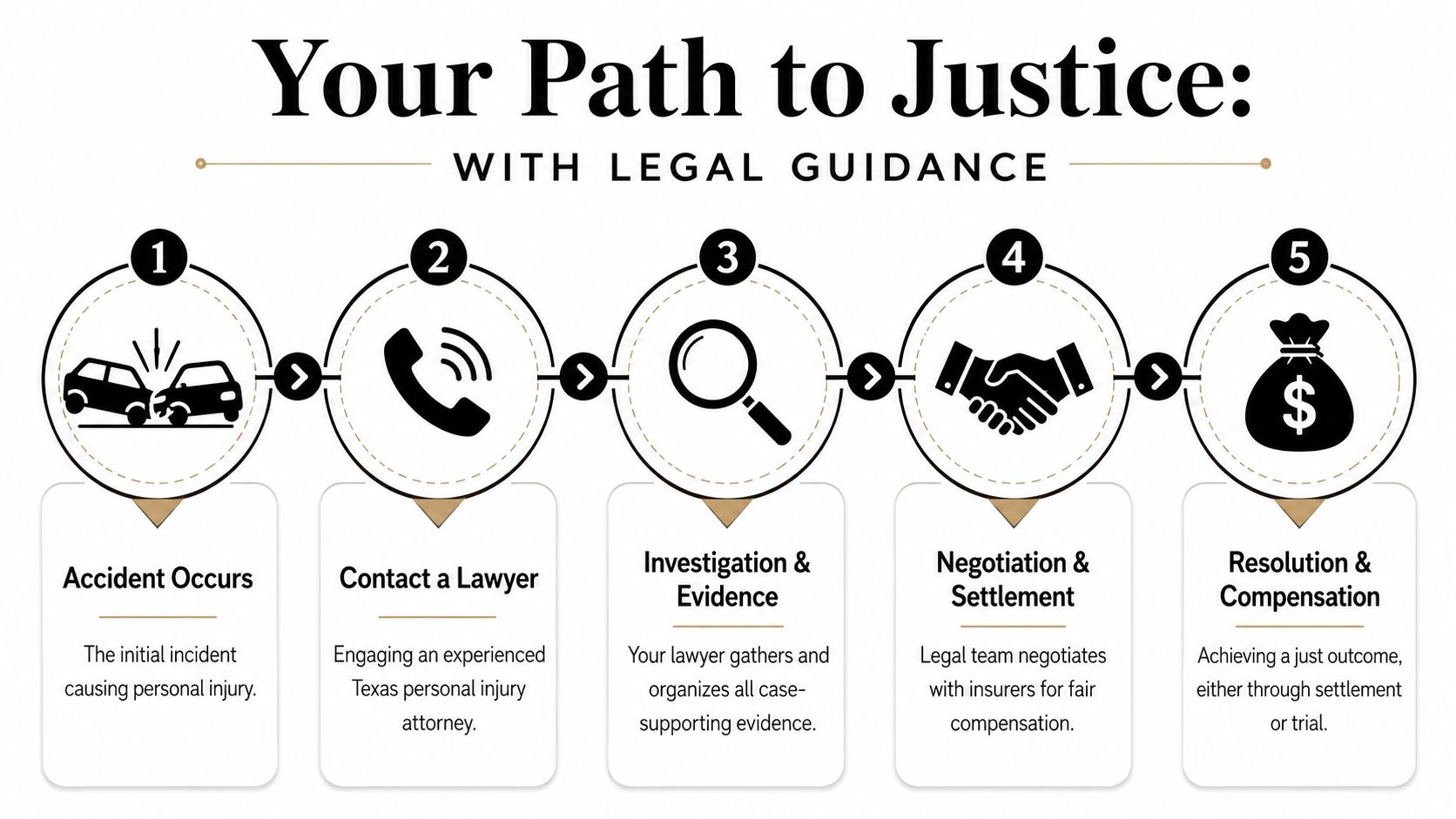
What a lawyer actually helps you do
A good legal strategy makes the case easier to prove and harder to undervalue.
That often includes:
- Preserving evidence early: before video is lost, vehicles are repaired, or witnesses disappear
- Managing communication: so insurers get the information they're entitled to, but not careless admissions
- Valuing the case realistically: based on records, treatment, work loss, and long-term effects
- Spotting hidden issues: including fault disputes, low policy limits, and UM/UIM problems
- Preparing for suit if needed: because the plaintiff's position often strengthens when the defense sees the case is organized and trial-ready
Some clients need a Houston car accident attorney after a chain-reaction freeway wreck. Others need a wrongful death lawyer Texas families can trust to handle a fatal case with care. Others need help after a company vehicle crash, a motorcycle wreck, or a collision with an uninsured driver.
What the process usually feels like
Many injured people worry that hiring counsel means an automatic march into a courtroom. Usually, it doesn't.
Most strong cases are resolved because the file is prepared well enough to force serious negotiation. That doesn't mean every claim settles easily. It means preparation creates options. If the insurer won't be reasonable, a lawsuit may become necessary. If the proof is strong, settlement may happen before trial.
If you're trying to choose counsel, this guide on how to choose the best personal injury lawyer in Texas can help you ask practical questions about experience, communication, and case handling.
A good lawyer doesn't just argue your case. They reduce your risk of making expensive mistakes while you're trying to heal.
The Law Office of Bryan Fagan, PLLC handles Texas injury matters involving car accidents, truck collisions, wrongful death claims, and other serious injury cases. For many families, that kind of support means someone else can take over the paperwork, evidence collection, and insurer pressure while they focus on treatment and recovery.
If you've been searching for how to win a personal injury case in Texas, the answer is not one trick or one perfect sentence. It's early care, careful evidence, smart handling of fault issues, disciplined negotiations, and legal guidance when consequences are substantial.
Recovery is possible. Help is available. And you do not have to figure this out alone.
If you were hurt in a crash or lost a loved one because of someone else's carelessness, contact Law Office of Bryan Fagan, PLLC to schedule a free consultation. You can talk with a Texas personal injury lawyer about your rights, your next steps, and what your case may require, with no obligation. Whether you need a Houston car accident attorney, help with a truck collision, guidance on a UM/UIM dispute, or support from a wrongful death lawyer Texas families can trust, legal help is available and recovery can begin with one call.