A serious accident can change your life in seconds, but you don't have to face it alone.
If you're reading this after a wreck on I-10, a fender-bender in a Dallas parking lot, or a hard rear-end crash on your way home, you probably want two things right now. You want to know what to do next, and you want to make sure one bad moment doesn't turn into a bigger legal and financial problem.
This guide on what to do after a car accident texas step by step is written from the practical side of Texas personal injury law. The checklist matters, but the order matters too. What helps at the scene isn't always what helps your claim later. And two issues get missed far too often: crashes involving an uninsured driver, and injuries that don't show up until hours or days later.
Your Immediate Priorities at the Accident Scene
The first few minutes after a crash are chaotic. Your job is to slow things down and handle them in the right order.
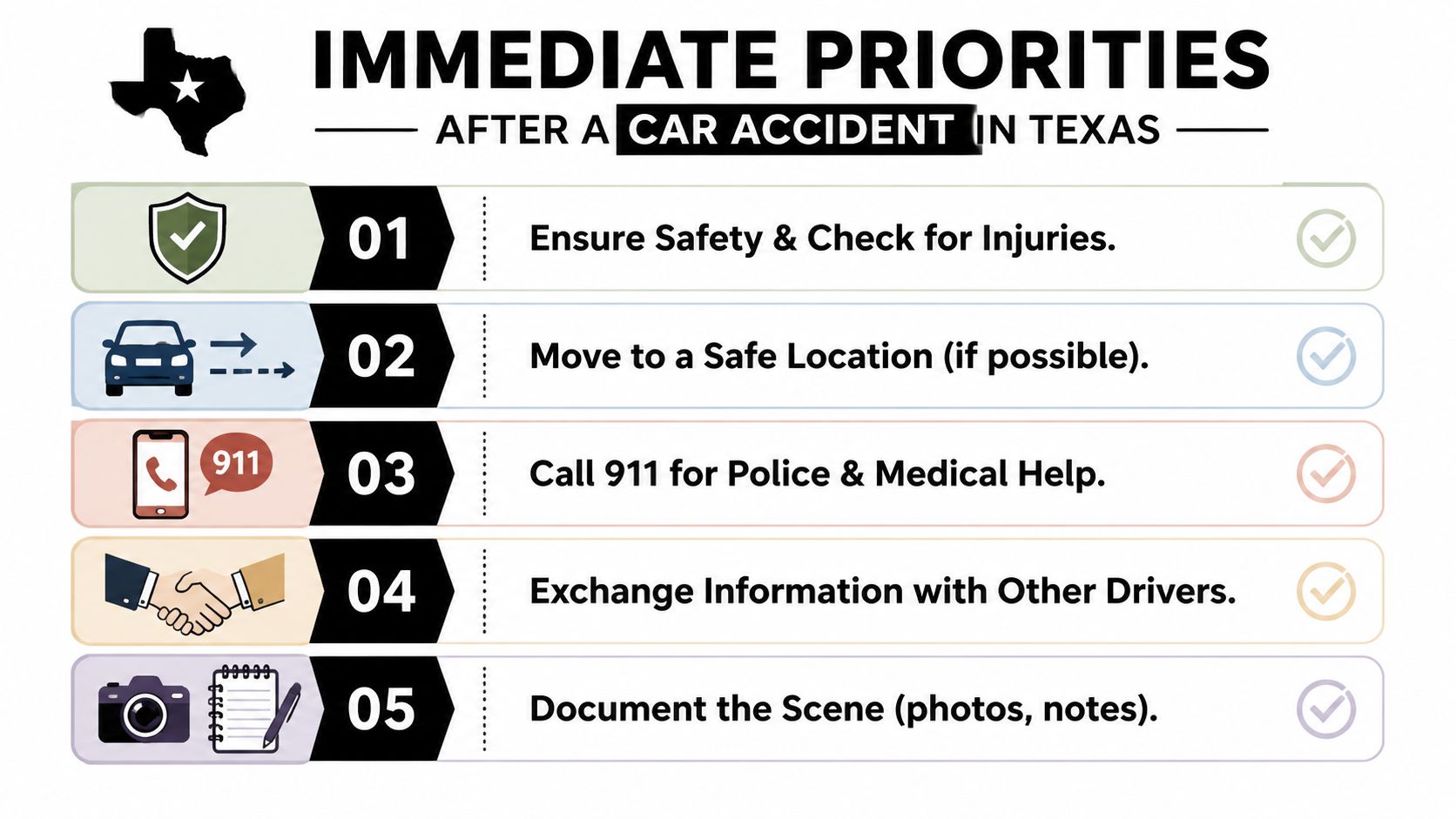
Under Texas law, you must stop immediately and remain at the scene. You must then check for injuries and call 911 if anyone is hurt. Texas also requires reporting to law enforcement if the crash causes injury, death, or property damage of more than $1,000 to any one person's property, according to this Texas crash reporting guide.
Start with safety, not blame
If your vehicle can be moved without making things worse, get out of active traffic. That can mean pulling onto a shoulder after a Houston freeway collision or moving to the edge of a parking lot after a low-speed impact. If someone is seriously hurt, don't create more risk by trying to force movement before emergency responders arrive.
Use this mental checklist:
- Stop your vehicle and stay there
- Check yourself and others for injuries
- Call 911 if anyone may be hurt
- Move to a safer location if it can be done safely
- Wait for law enforcement when reporting is required
Practical rule: A calm, simple 911 call is better than trying to sort out fault at the roadside.
A lot of people make the same mistake here. They start apologizing, arguing, or guessing about what happened. Don't. The scene isn't the place to debate who had the green light or whether someone “came out of nowhere.”
Why the police report matters
When law enforcement responds, the crash moves from a private dispute to an event with an official record. That record often becomes one of the first documents insurance adjusters review. Texas guidance also notes that the police crash report is often obtained through TxDOT's Crash Records Information System, which makes it a practical milestone in the claim process.
That matters in real life. After a pile-up, details blur fast. Drivers leave, witnesses disappear, and cars get repaired. The report doesn't prove every issue by itself, but it can anchor the claim before memories shift.
What works and what doesn't
A few roadside choices can protect you immediately:
- Do work with the facts. Give your location, identify the vehicles involved, and report visible injuries.
- Don't downplay pain. If your neck, back, head, or chest hurts, say so.
- Do keep the scene intact when possible. If a vehicle must be moved for safety, take quick photos first if you can.
- Don't leave because the crash “seems minor.” That can create both legal trouble and claim problems later.
If you remember nothing else, remember this: secure safety first, make the required report, and resist the urge to explain away the crash before you know the full picture.
How to Document Everything to Protect Your Claim
Once everyone is safe, your phone becomes one of the most useful tools you have.
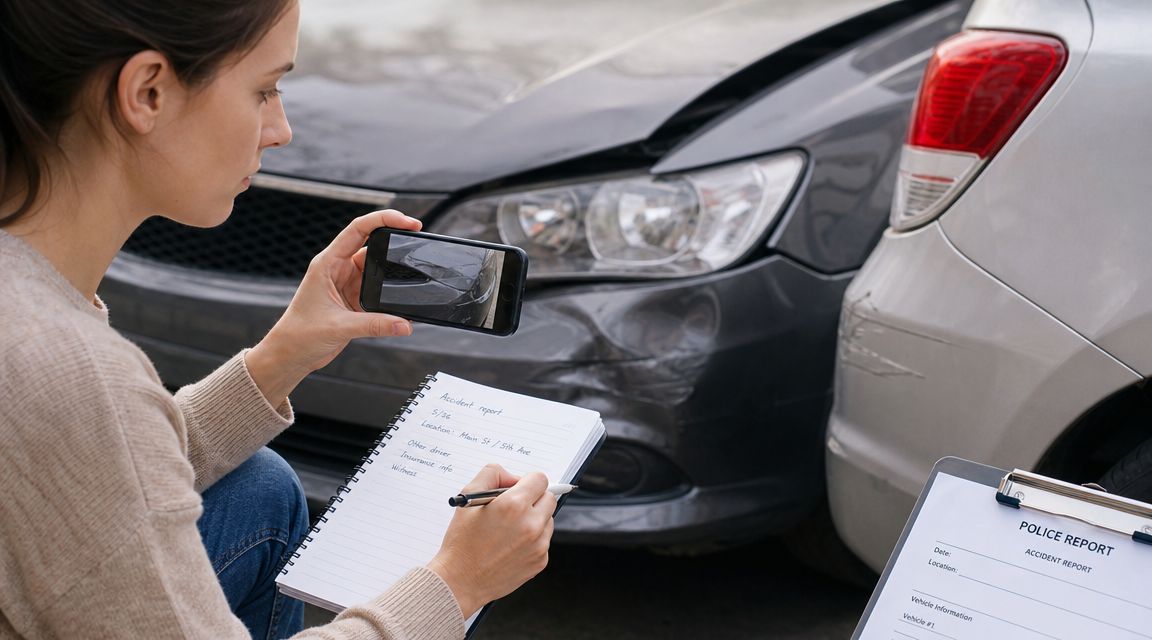
Texas consumer guidance puts documentation in the core post-crash sequence: exchange information, document the scene with photos or video and witness contacts, then notify your insurer. That same guidance warns against giving a recorded statement too early or speculating about fault because insurers can later use those statements to dispute liability, as explained by the Texas Department of Insurance.
Turn a chaotic scene into usable evidence
Take more photos than you think you need. Start wide, then move closer.
After a Houston freeway crash, for example, the other driver may later claim you changed lanes suddenly. Good scene photos can show lane position, debris, damage patterns, skid marks, traffic signs, and the general layout before tow trucks erase the story.
Focus on these:
- Vehicle positions: Capture all cars from multiple angles before they're moved, if safe.
- Damage details: Photograph each impact point, broken glass, deployed airbags, and interior damage.
- Road conditions: Include traffic lights, stop signs, lane markings, weather, standing water, or construction.
- Human evidence: Photograph visible injuries if appropriate, and save torn clothing or damaged personal items.
- Witness details: Get names and contact information from anyone who saw the crash.
Get the right information from the other driver
At minimum, collect the other driver's name, contact information, insurance information, and driver's license details. If they're angry or evasive, don't argue. Wait for police if they're responding and let the report capture identifying details.
If the other car appears to have mechanical problems, don't guess at what failed. Still, details like leaking fluids, warning lights, or obvious front-end issues can become relevant later. If you're trying to better understand car symptoms after a crash, that kind of reference can help you describe what you observed without making unsupported conclusions.
The best evidence is usually ordinary evidence. Clear photos, exact times, witness names, and accurate notes beat dramatic opinions every time.
Keep one file from day one
Claims get weaker when documents scatter across texts, emails, glove-box papers, and camera rolls. Put everything in one place as early as possible.
A simple evidence file should include:
| Item | Why it matters |
|---|---|
| Photos and videos | They preserve damage, road layout, and scene conditions |
| Witness contacts | They help when stories later conflict |
| Tow and repair paperwork | They show what happened after the wreck |
| Medical receipts and notes | They connect treatment to the crash |
| Crash report details | They help organize the claim timeline |
If you need help making sense of the official report once it becomes available, this guide on how to read a Texas police accident report can help you spot key sections and common issues.
Why Seeking Medical Care Is a Non-Negotiable Step
A lot of injured drivers say the same thing after a crash: “I felt okay at first.”
That's exactly why this step matters. Symptoms like whiplash, headaches, dizziness, and internal bleeding may appear hours or days after a crash, and victims who skip immediate care can face an insurer's argument that the injury wasn't serious or wasn't caused by the wreck, according to this Texas delayed-injury discussion.

Adrenaline hides a lot
After a rear-end collision in traffic, your body may be flooded with stress chemicals. You may stand up, talk clearly, and even drive home. That doesn't mean you escaped injury.
Soft-tissue injuries, concussions, spinal pain, and internal problems often don't announce themselves at the roadside. By the next morning, your range of motion may shrink, your headache may worsen, or numbness may start in your arm or leg.
What works is getting evaluated promptly and following through. What doesn't work is waiting to “see if it goes away” while creating a gap in treatment that the insurance company can point to later.
Know when same-day care makes sense
Go to the ER or seek urgent same-day care if you have symptoms such as:
- Head injury signs: headache, dizziness, confusion, or vomiting
- Neck or back pain: especially if it worsens or limits movement
- Abdominal or chest pain: these can point to serious internal issues
- Numbness or weakness: especially in the arms or legs
- Any worsening symptoms: even if the crash first seemed minor
Medical reality: Feeling “fine” at the scene doesn't rule out injury.
Keep every record. That includes discharge paperwork, imaging orders, prescriptions, work restrictions, follow-up instructions, and pharmacy receipts. A clear treatment timeline often helps prove that the crash caused the injury and that the injury affected your daily life.
This video gives a useful overview of why medical follow-up matters after a wreck:
Don't make your medical record harder to read
Be accurate with your providers. Tell them when the crash happened, where you hurt, what symptoms started immediately, and what changed later. If your pain gets worse over the next few days, return for reevaluation so the record reflects that progression.
Insurance companies often challenge delayed-onset injuries in low-speed and rear-end collisions. Prompt care won't guarantee an easy claim, but skipping care often makes a hard case harder.
Navigating Insurance Calls and Texas State Reporting
The administrative side of a crash starts quickly. Sometimes it starts before you've had time to process what happened.
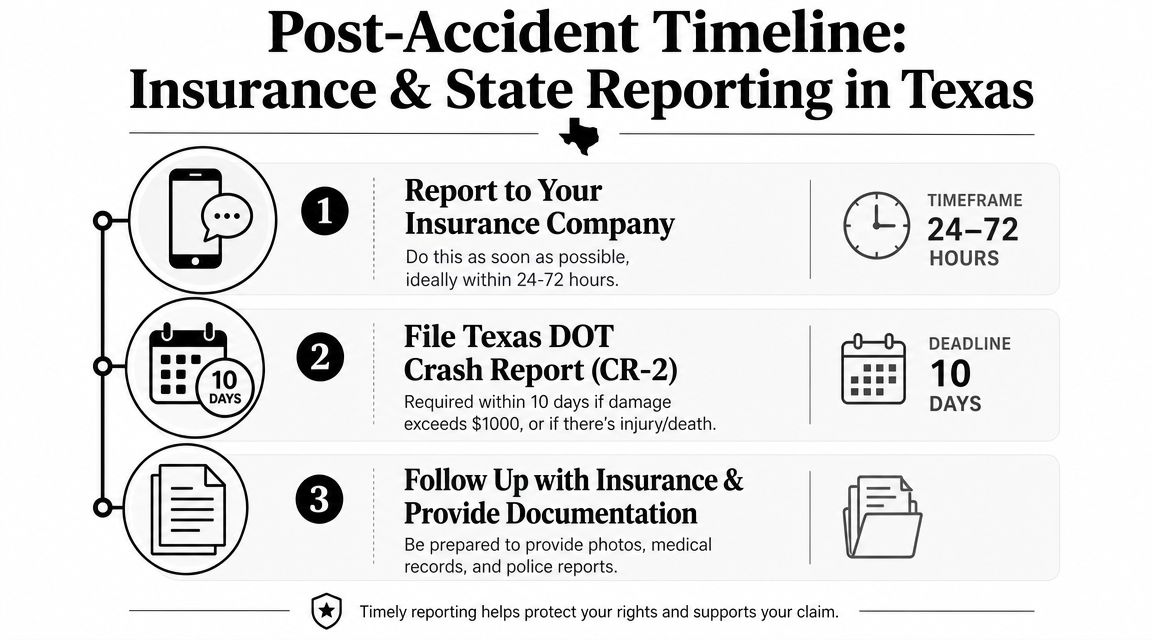
If a crash in Texas is minor and there is no police report, drivers may need to file a Driver's Crash Report, Form CR-2, within 10 days if the collision involves injury, a fatality, or property damage of $1,000 or more. The first 10 days are also critical for notifying your insurer and documenting the scene, as explained in this Texas crash paperwork overview.
What to tell your insurance company
Report the crash promptly. Stick to the basics. Give the date, time, location, vehicles involved, and whether police responded.
Don't turn that first notice call into a full narrative. You usually don't know the full extent of your injuries, the repair issues, or what every witness will say.
A safe approach looks like this:
- State the essentials: when and where the crash happened, who was involved, and where the car is now.
- Mention injuries carefully: say you are being evaluated or treated if that's true.
- Ask what they need: get the claim number and the adjuster's contact information.
- Avoid speculation: don't guess about speed, blame, or medical prognosis.
If you want a more detailed breakdown before speaking with an adjuster, this page on what to say to insurance after an accident is a practical place to start.
What not to say on an early call
The phrases that hurt claims are usually casual ones.
“I'm fine.”
“It was probably my fault.”
“I didn't see them.”
“My car doesn't look that damaged.”
Each of those can be pulled into a later liability or injury dispute. You can be polite without volunteering conclusions. If the other driver's insurer asks for a recorded statement early, slow down before agreeing.
A recorded statement given too early can lock you into facts you later learn were incomplete or wrong.
The paperwork trap people miss
If law enforcement doesn't create the report, many drivers assume there's nothing else to do besides open an insurance claim. That's where problems start.
Check whether a CR-2 filing applies to your situation. Keep copies of anything you submit. Save your police incident number if officers responded. And make sure the information you give your insurer matches the basic facts you documented at the scene.
This is also where uninsured driver issues begin to surface. If the other motorist can't produce valid coverage, or if you later learn the policy is insufficient, your own policy may become the center of the claim.
Understanding Your Legal Rights and Critical Deadlines
The practical steps after a crash connect directly to legal rules. If you understand those rules early, your decisions make more sense.
Texas injury claims usually turn on fault and negligence. In plain English, that means asking whether another driver failed to use reasonable care and caused the collision. Running a red light, following too closely, drifting out of a lane, or backing into a moving vehicle in a crowded lot are all common examples.
Fault, negligence, and comparative responsibility
Not every case is clean. A driver may be mostly at fault, while the other driver may still have made a mistake. Texas follows a modified comparative responsibility system. In practical terms, your own share of fault can affect whether you recover compensation and how much you can pursue.
That's one reason scene evidence matters so much. In a Dallas parking lot crash, one driver may say you were speeding through the aisle while you say they backed out without looking. In a multi-vehicle wreck on I-10, each insurer may try to push blame downstream. The facts rarely organize themselves.
A short way to think about it:
| Legal concept | What it means in real life |
|---|---|
| Negligence | A driver didn't act with reasonable care |
| Fault dispute | The parties disagree about who caused the crash |
| Comparative responsibility | Your own actions may be examined too |
| Damages | The losses tied to the crash, such as medical bills, lost wages, and pain and suffering |
Deadlines can change the value of a case
Texas accident victims also need to know the statute of limitations, which is the deadline for filing a lawsuit. Missing that deadline can mean losing the right to pursue the case in court.
That doesn't mean you should wait until the deadline is close. Waiting creates practical problems first. Witnesses become harder to locate. Photos get deleted. Vehicles are repaired or sold. Medical records become harder to connect to the crash if treatment is inconsistent.
Insurance companies work from files. Strong cases usually have a clean timeline, consistent records, and early preservation of evidence.
Uninsured and underinsured driver claims need a different approach
Many basic crash guides don't explain how different a UM/UIM claim can be. That gap matters because about 14% of U.S. motorists were uninsured in 2022, according to this discussion of uninsured and underinsured motorist issues.
If the at-fault driver has no insurance, or not enough insurance, the claim may shift to your own policy. That changes the order of operations. Notice requirements, proof issues, and policy language suddenly matter much more.
What tends to work in these cases:
- Preserve proof of the other driver's lack of coverage if you can get it through the report or claim communications.
- Review your UM/UIM coverage early before giving broad statements or signing authorizations.
- Treat your own insurer seriously because even though it's your carrier, it still evaluates the claim through a legal and financial lens.
This is also where other complicated cases branch off. A drunk-driving wreck may involve punitive issues. A commercial vehicle crash may bring in a company, layered insurance policies, and electronic evidence. A fatal collision may become a wrongful death claim, which families should discuss with a wrongful death lawyer Texas residents trust. Catastrophic injuries and truck wrecks often require a truck crash lawyer Houston families can call early because evidence can disappear fast.
If your injuries are significant, or your family is dealing with a death, legal advice should happen sooner rather than later.
When to Call a Texas Car Accident Lawyer for Help
A lawyer is not necessary for every Texas crash. But early legal help can make a real difference when the facts are messy, the injuries are more serious than they first seemed, or insurance coverage is already becoming a problem.
I usually tell people to pay attention to what the case is becoming, not just how the crash happened. A rear-end collision on I-10 can look straightforward at the scene and still turn into a fight a week later if the other driver changes stories, your neck pain gets worse, or you learn the at-fault driver has no insurance. In those situations, delay helps the insurance company more than it helps you.
Signs you shouldn't handle the case alone
Call a lawyer if any of these are true:
- Your injuries are affecting daily life: you missed work, need follow-up care, cannot lift normally, or the pain showed up days later and is getting worse
- Fault is disputed: the other driver is blaming you, changing their account, or the report does not clearly resolve who caused the crash
- Insurance coverage is uncertain: the at-fault driver may be uninsured or underinsured, which can shift the case into a UM/UIM claim under your own policy
- A business or commercial vehicle was involved: delivery vans, company trucks, and rideshare cases often involve multiple policies and added evidence issues
- A family member died: surviving relatives should get legal advice promptly before key deadlines and evidence problems develop
The delayed-injury issue matters more than many people realize. Insurance adjusters often argue that if you did not complain enough on day one, the injury must not be related to the crash. A lawyer helps connect the timeline, the medical records, and the practical reality that adrenaline often hides symptoms for hours or days.
What that help looks like in practice
In a serious freeway collision, legal work often starts with preserving evidence, reviewing the crash report for errors, identifying all available insurance, and organizing medical proof in a way that shows how the injury developed over time. In a Dallas parking lot crash, the focus may be different. Surveillance footage can disappear, witness memories fade fast, and low-speed impact arguments often lead insurers to downplay real injuries.
Uninsured-driver cases need special attention. Once the claim shifts toward your own UM/UIM coverage, your insurer is no longer just processing paperwork. It is evaluating whether to pay, how much to pay, and whether it can challenge causation, treatment, or the value of your losses. That is often the point where experienced legal help saves a claim from being boxed into a smaller number than it deserves.
The Law Office of Bryan Fagan, PLLC handles Texas motor vehicle injury matters involving car wrecks, truck crashes, catastrophic injuries, uninsured motorist disputes, and wrongful death cases. It helps to speak with an attorney who can assess liability issues, insurance problems, and injury documentation early, before recorded statements and claim notes start shaping the case against you.
If you are unsure about timing, this guide on when to hire a personal injury lawyer in Texas can help you evaluate whether your case has reached that point.
Getting legal advice early does not mean you are filing suit right away. It means you are protecting evidence, preserving options, and avoiding preventable mistakes while the claim is still taking shape.