Skip to content
A serious accident can change your life in seconds, but you don't have to face it alone.
If you're searching for the average car accident settlement texas victims receive, you're probably dealing with more than curiosity. You may be staring at medical bills, missing work, arguing with an adjuster, and wondering how you're supposed to get back to normal. That question is understandable. It feels like a way to measure what your case might be worth.
The problem is that a single “average” can hide more than it reveals. A sore neck after a rear-end collision is not valued the same way as a spinal injury from a highway truck crash. A claim with clear liability is different from one where the insurer tries to shift blame. A case with strong documentation usually moves very differently from one with treatment gaps and missing evidence.
What matters most is not whether your case looks average. What matters is what builds value under Texas law, what can reduce it, and what you can do now to protect your recovery.
You Are More Than a Statistic Understanding Your Settlement
You are driving home after a crash. Your shoulder is tightening up, your phone keeps buzzing with insurance calls, and the first question in your mind is simple: what is this case worth?
A statewide average will not answer that question well. As noted earlier, one published source gave a Texas bodily injury average, but that figure bundles together very different claims. A short course of physical therapy after a low-speed collision does not belong in the same bucket as a case involving surgery, permanent pain, or months away from work.

The better way to value a Texas car accident claim is to ask what is driving the number in your case.
Start with the losses tied directly to the wreck. Medical bills matter. So do future treatment recommendations, missed paychecks, limits on the kind of work you can still do, and the day-to-day pain the injury has caused. Liability matters too. A case with clear fault, prompt treatment, and complete records usually has a stronger settlement position than a case with treatment gaps or a dispute over who caused the crash.
I tell clients to focus on proof, not averages.
Two drivers can leave the same intersection with very different claims. One may need a few follow-up visits and return to work quickly. Another may need imaging, injections, surgery, rehab, and help at home for months. Both were in a "car accident." Their financial recovery will look very different because the harm is different.
Some costs are obvious right away. Others show up later. Car repairs are one example. If your vehicle suffered mechanical damage, a realistic repair estimate can help show how serious the impact was. Even a basic reference point like a Haltom City engine repair cost guide shows how fast collision-related expenses can grow before you even get to medical treatment.
It also helps to understand the legal categories behind the claim. If you want a plain-English explanation of the out-of-pocket losses that often anchor a settlement demand, review this guide to special damages in a personal injury claim.
What changes settlement value in real life?
- Injury severity and recovery time
- Whether doctors expect future care
- The amount of income you lost
- How strong the evidence is on fault
- Whether the insurance company claims you share blame
- How much insurance coverage is available
- How well your records document what the crash changed
An honest case evaluation starts there. Your claim is not a math shortcut. It is a record of what this wreck cost you, and what it will keep costing if you do not recover full compensation.
The Building Blocks of Your Texas Settlement
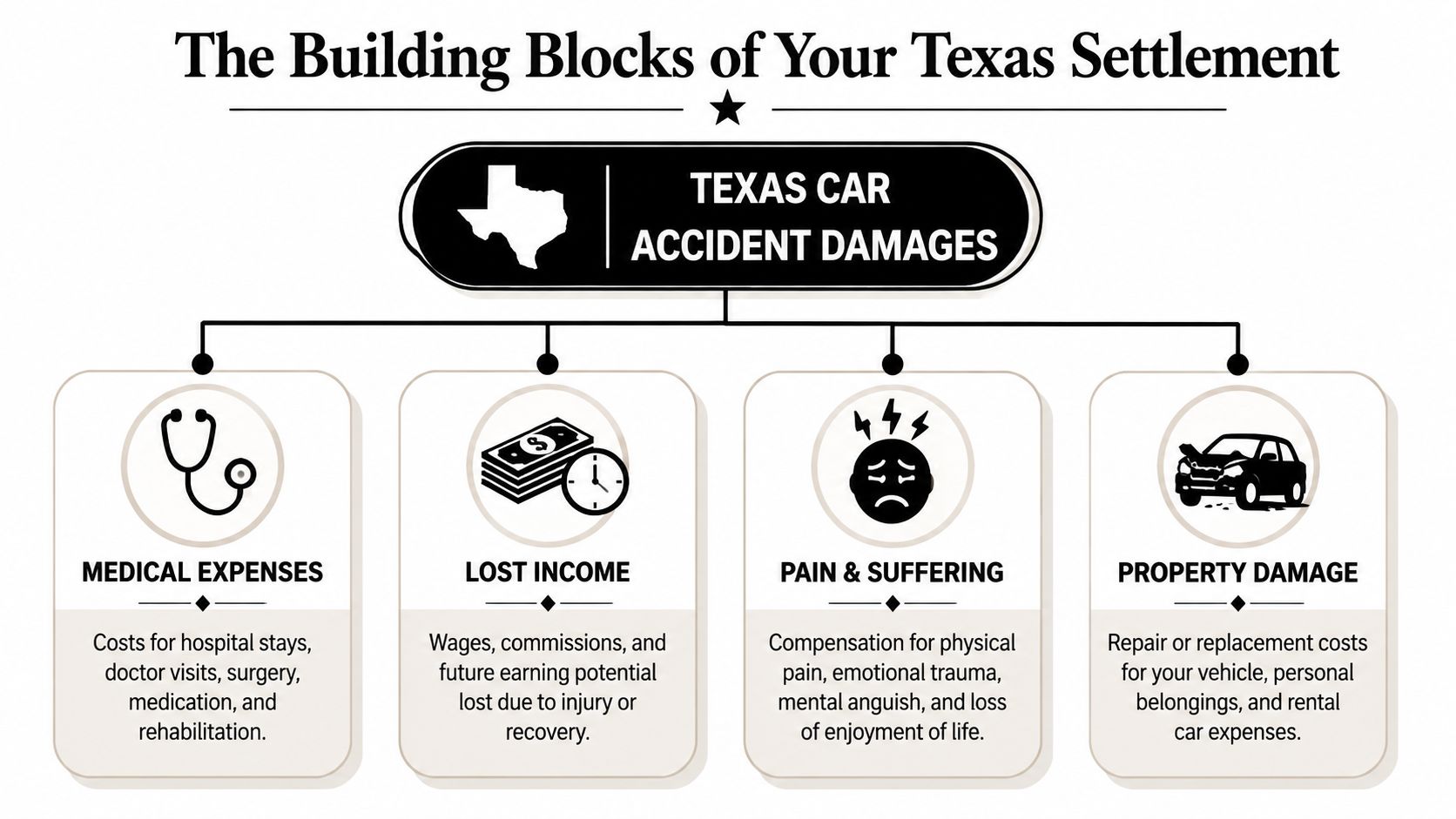
Settlements are built from damages, the legal term for what the crash took from you. That includes the bills you can count, the income you missed, and the day-to-day harm that does not show up on an invoice. If you want to understand what your case may be worth, start there instead of chasing a single “average” number.
Economic damages
Economic damages are the out-of-pocket losses tied to the wreck. These are usually the foundation of a settlement demand because they can be backed up with records.
Common examples include:
- Medical care: Ambulance charges, emergency room treatment, imaging, surgery, prescriptions, follow-up visits, physical therapy, and projected future care.
- Lost wages: Income you missed while recovering or attending treatment.
- Reduced earning capacity: Losses tied to long-term work limits if the injury affects what you can do for a living.
- Property damage: Vehicle repairs, replacement value if the car is totaled, rental costs, and damaged personal items.
Property damage often matters more than people expect. A hard-impact crash can leave you dealing with towing fees, storage bills, rental expenses, and repair estimates before the full medical picture is even clear. If your vehicle suffered mechanical damage after the collision, a practical reference like this Haltom City engine repair cost guide helps show how quickly those costs can rise.
Non-economic damages
Non-economic damages cover the human impact of the crash. They are harder to measure, but they are still part of a valid Texas injury claim.
These losses often include:
- Physical pain
- Emotional distress
- Mental anguish
- Scarring or disfigurement
- Loss of enjoyment of daily life
- Loss of normal routines and independence
This category is where two cases with similar medical bills can separate. A shoulder injury that heals in eight weeks is different from a back injury that keeps you from sleeping well, picking up your child, driving long distances, or returning to the same job. For a clearer explanation of how these categories are evaluated, review this guide to economic and non-economic damages in Texas injury claims.
The short video below gives a useful overview of how settlement value is often discussed in injury cases.
What strengthens a settlement demand
Insurance companies do not pay based on sympathy. They pay based on exposure, documentation, and risk.
A stronger claim usually includes prompt medical attention, consistent follow-up care, clear physician recommendations, solid proof of lost income, and photos or records that connect the wreck to your losses. Gaps in treatment, missed appointments, and incomplete records give the adjuster room to argue that you healed quickly, were not badly hurt, or had some other cause for your symptoms.
I tell clients to document life as it is now, not just the first week after the crash. Keep receipts. Save prescriptions. Track missed work. Write down what you cannot do, what hurts, and what help you need at home. Those details often make the difference between a low offer and a demand that reflects the full cost of the collision.
How Texas Laws Shape Your Financial Recovery
A strong injury claim can still lose value fast if Texas law cuts into it. Settlement value is not just about how badly you were hurt. It also depends on fault, deadlines, and how much insurance is available.
Fault and comparative responsibility
Texas uses a modified comparative fault rule. If you share part of the blame, your compensation is reduced by that percentage. If you are more than 50% responsible, you cannot recover damages. If you want the rule explained in plain English, review this Texas modified comparative fault overview.
Insurance adjusters use this rule every day.
In an intersection crash, the other driver may run the light, but the insurer may still argue you were speeding or looking at your phone. In a trucking case, the carrier may admit its driver made a bad move but still claim you failed to react soon enough. Every percentage point matters because it directly lowers what you can recover.
That is why liability proof carries real financial weight. Police reports help, but they are only part of the picture. Photos, witness statements, vehicle data, scene evidence, and prompt treatment often decide whether fault stays where it belongs.
Deadlines matter
Texas law gives injured people a limited window to file many car accident lawsuits. Miss that deadline, and even a valid claim can be barred.
Waiting also creates practical problems long before a lawsuit deadline becomes the issue. Witnesses forget details. Security footage gets deleted. Skid marks fade. Vehicles are repaired or sold. In serious cases, those losses can change the value of the case because key proof of fault or injury is gone.
Early case review helps you protect evidence and make informed decisions while the facts are still fresh.
Insurance policy limits often control the real-world outcome
Here is the hard truth. A case can be worth more than the insurance available to pay it.
Texas drivers are required to carry liability insurance, but minimum limits may be far too low for a crash involving surgery, a long recovery, or permanent impairment. That creates a gap between the full value of the harm and the money on the table. In practice, policy limits often shape settlement strategy as much as medical records do.
A careful review should look at every possible source of coverage, including the at-fault driver's policy, your uninsured or underinsured motorist coverage, and any policy tied to an employer, commercial vehicle, or other responsible party.
Do not assume the other driver's insurance will cover everything. In many serious crashes, the central question is not whether the claim has value. It is where the money will come from.
Settlement Examples What Different Injuries Can Mean
Two people can walk away from similar wrecks with very different cases. One misses three days of work and finishes physical therapy in a month. The other needs surgery, cannot return to the same job, and still hurts a year later. That is why a single “average settlement” number does not tell you much about your own claim.
A better question is this: what did the crash cost you, and what will it continue to cost you?
Typical Texas Car Accident Settlement Ranges by Injury Severity
| Injury Severity | Common Injuries | Typical Settlement Pattern |
|---|---|---|
| Minor | Sprains, bruising, mild soft tissue injuries | Often lower-value claims if treatment is short and recovery is complete |
| Moderate | Broken bones, herniated discs, injuries needing surgery | Usually higher because medical bills, lost income, and recovery time increase |
| Severe or catastrophic | Spinal injuries, traumatic brain injuries, amputations, fatal injuries | Often the highest-value claims because future care, permanent limits, and major income loss are involved |
Minor injuries
A low-speed rear-end collision in Fort Worth may cause neck pain, headaches, stiffness, and a few weeks of physical therapy. Those cases still deserve attention. People miss work, pay copays, cancel plans, and deal with pain that disrupts sleep and daily routines.
These claims usually rise or fall on basic proof. Helpful facts include:
- prompt medical care
- consistent follow-up treatment
- photos showing vehicle damage and visible injuries
- a clear timeline from the crash to the first symptoms
What hurts a minor injury case is a long treatment gap, especially if the insurance adjuster argues the pain came from something else. I see that issue often. People try to push through because they have jobs, kids, and bills. Then the insurer uses that delay to discount a very real injury.
Moderate injuries
Moderate injury cases usually involve more than a few appointments. A Houston freeway crash that causes a fractured wrist, a torn shoulder, or a herniated disc can lead to imaging, specialist visits, injections, surgery, rehabilitation, and months of missed income.
The value changes because the losses change. The medical bills are higher. The recovery lasts longer. The injury often interferes with work, driving, lifting, sleep, and family responsibilities in ways that are easy to describe but harder to live through.
These are also the cases where future treatment becomes a real point of dispute. Insurance companies often accept the ambulance bill and the emergency room records. They push back on what comes next, especially if your doctor recommends surgery or ongoing pain management. Good case preparation means tying those recommendations to the crash with clear records and doctor opinions.
Severe and fatal cases
Catastrophic injuries belong in a different category because the consequences are different. A spinal cord injury, traumatic brain injury, amputation, or fatal crash can change a family's finances for years. The claim may involve long-term care, home modifications, loss of earning capacity, daily assistance, and serious pain and mental suffering.
In fatal cases, surviving family members may have claims tied to the loss of financial support, companionship, and the services their loved one provided at home. Those cases require careful proof and patience. They also require room for grief. Families are often being asked for documents and decisions at the same time they are trying to get through the worst weeks of their lives.
Some of the highest-value cases also involve more than one liable party. A wreck with an 18-wheeler, delivery vehicle, or company truck may require a broader investigation into the driver, the employer, maintenance records, and available insurance. This guide on commercial truck accident response gives useful context on why early evidence matters so much in truck-related collisions.
The practical takeaway is simple. Injury labels matter, but they do not decide a case by themselves. What drives settlement value in Texas is how the injury shows up in records, bills, work loss, future care, and daily life.
Your Roadmap From Crash to Compensation
You leave the crash scene thinking the hard part is over. Then the calls start, the bills show up, your car is in the shop, and you are supposed to know what your case is worth before your treatment is even finished.
That is why a step-by-step approach matters. A Texas claim usually gets stronger or weaker based on what happens in the first few days and weeks.
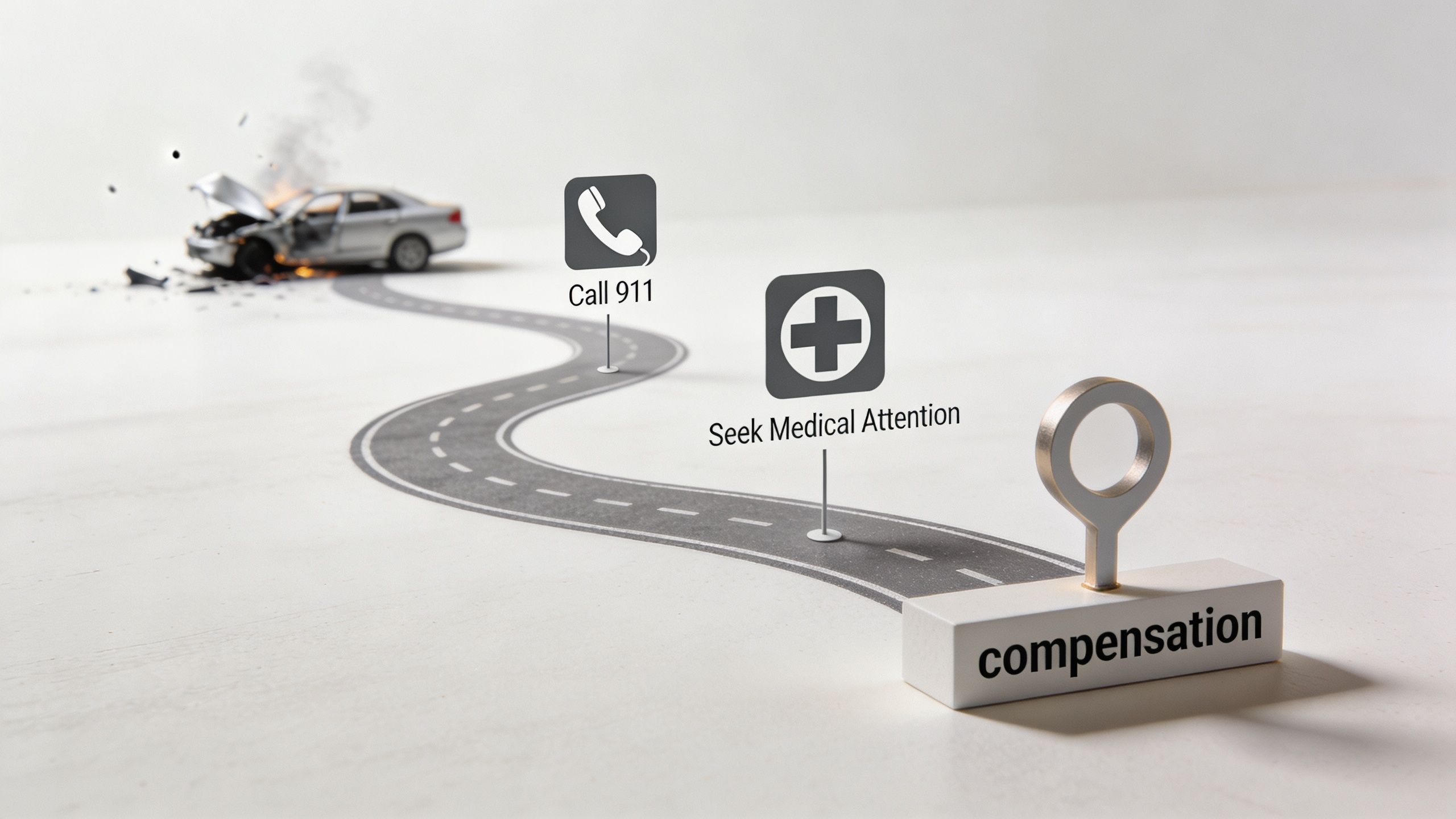
At the scene and in the first days
Start by protecting your health and the proof your claim will depend on later. Settlement value in Texas is not built from a generic average. It is built from records, timing, and the quality of the evidence tied to your injuries.
- Call 911 and get medical care. Adrenaline can hide serious injuries. Early treatment also creates the first medical record connecting the crash to your condition.
- Photograph everything you can safely capture. Get vehicle damage, skid marks, debris, road conditions, traffic signs, and visible injuries.
- Exchange the right information. Names, phone numbers, insurance details, plate numbers, and witness contact information all matter.
- Watch what you say. Stay courteous, but do not guess about speed, fault, or what caused the wreck.
- Report the crash and keep copies. Save the crash report number, tow paperwork, discharge papers, prescriptions, and repair estimates.
- Follow through with care. Missed appointments and long gaps in treatment often become insurer talking points.
Commercial vehicle crashes need extra attention. Driver logs, company records, maintenance issues, and electronic data may matter. This guide on commercial truck accident response offers useful practical context on why preserving information early matters in truck-related collisions.
Dealing with insurance companies
Insurance adjusters often call before the full picture is clear. They may sound helpful. Their job is still to control the payout.
Three early trouble spots come up again and again:
- Recorded statements. A tired, medicated, or incomplete answer can be used against you later.
- Broad medical authorizations. You may be asked to sign releases that reach far beyond the injuries caused by this crash.
- Quick settlement offers. These offers often arrive before future treatment, time off work, or lasting pain can be measured.
Keep your communication short and factual. Do not volunteer opinions. Do not estimate your injuries. If you are still treating, say so.
How the claim usually develops
Once the immediate emergency settles down, the case usually moves through a series of practical stages. Each one affects value for a different reason.
- Investigation. This includes the crash report, photos, witness accounts, vehicle damage, and any available video.
- Medical and financial review. Records, bills, work loss, and doctor opinions help show what the crash has cost you so far and what it may cost later.
- Demand package. The injured person or lawyer sends the insurer a documented claim that explains liability, injuries, and damages.
- Negotiation. The insurer may dispute fault, argue that treatment was excessive, or say your condition was preexisting.
- Filing suit if needed. Some cases do not move until a lawsuit forces deadlines, testimony, and a more serious evaluation.
This is also the point where many injured Texans decide whether to handle the claim alone or get legal help. One option people consider is the Law Office of Bryan Fagan, PLLC, which handles Texas injury claims involving car accidents, truck wrecks, catastrophic injuries, and wrongful death matters on a contingency-fee basis.
The practical goal is simple. Protect the evidence, document the losses, and avoid settling before you can see the full cost of the crash.
You Don't Have to Face the Insurance Companies Alone
A week after a crash, many Texans are still in pain, missing work, and trying to sort out car repairs. Then the adjuster calls and asks for a recorded statement, broad medical releases, and a quick answer about settlement. That timing is not accidental. Insurance companies know early pressure can produce cheap resolutions before the full value of a claim is documented.
A lawyer changes the balance of that conversation. The point is not to chase an "average" settlement number. The point is to identify what your case is really made of, prove it, and push back when the insurer leaves out parts of the loss.
What a lawyer changes
Good representation often affects the result in specific, practical ways:
- Protecting your words: Adjusters listen for comments they can use to minimize injury or increase your share of fault.
- Building the value story: Records, bills, lost income documents, treatment timelines, and doctor opinions need to fit together clearly.
- Handling Texas fault disputes: If the insurer says you caused part of the wreck, your recovery can shrink. Strong advocacy focuses on the facts that matter.
- Looking for every available policy: Some cases involve more than one source of coverage, especially in commercial, rideshare, or multi-vehicle crashes.
- Timing the demand correctly: Settling too early can leave out future treatment, lasting limitations, or income loss that has not fully developed yet.
I have seen good cases lose value because the injured person was honest but unprepared, or because the insurer treated an unfinished medical picture as a finished one. That is a fixable problem when the claim is organized early.
That help matters in a straightforward rear-end crash and in harder cases involving serious injuries, disputed liability, uninsured drivers, or a death claim. The legal work changes with the facts, but the goal stays the same. Present the full loss, supported by evidence, and do not let the insurer define the case on its own terms.
Recovery is possible
You do not need to know the final value of your claim right away. You do need to avoid decisions that weaken it.
Get medical care. Keep your records in one place. Follow treatment instructions. If an insurer asks for a recorded statement or broad authorization forms, slow down and understand the risk before agreeing. If the crash left you with significant injuries or financial strain, speak with counsel before signing anything.
Law Office of Bryan Fagan, PLLC handles Texas injury claims involving car accidents, truck wrecks, catastrophic injuries, and wrongful death matters on a contingency-fee basis. Legal help can reduce pressure, protect the claim, and give you room to focus on healing.
You are not just dealing with paperwork. You are dealing with the cost of someone else's negligence. Recovery is possible, and you do not have to handle the insurance company by yourself.