Skip to content
A serious accident can change your life in seconds, but you don't have to face it alone.
If you're searching how much can i get for pain and suffering texas, you're probably not asking a theoretical question. You're asking because life got expensive, painful, and uncertain very fast. After a Houston freeway crash, for example, a person may leave the scene thinking they're lucky to be alive, then wake up the next morning unable to turn their neck, pick up their child, or focus at work.
That's when the stress starts. Medical appointments stack up. Insurance adjusters call before you even understand your injuries. Family members ask what the case is worth, and you don't have a clear answer yet.
Texas law does allow injured people to seek compensation for more than hospital bills and lost wages. The law recognizes the human impact of an injury too. That includes the pain, anxiety, disruption, and loss of normal life that often follow a wreck, fall, or other serious event caused by someone else's negligence.
A Texas personal injury lawyer looks at both sides of that damage. One side is financial. The other is personal. Both matter.
Your Life Changed in an Instant Now What
A common scene after a crash is this. You're sitting on the shoulder of the road, adrenaline still high, telling yourself you'll be fine. Then the next few days tell a different story. Your back tightens. Sleep gets worse. Work becomes harder. Driving suddenly makes you nervous.
That's where many injury claims begin. Not in a courtroom, but in the quiet realization that your life no longer feels normal.
After a Houston freeway collision, I often see the same pattern. The person tries to push through it. They wait to get checked out. They assume the insurer will “do the right thing.” Then the adjuster treats the claim like a billing exercise and ignores the part that hurts most, which is what the injury took from everyday life.
Practical rule: If your routine changed because of the accident, that change may be part of your claim.
Texas personal injury law calls that pain and suffering, but the phrase can sound smaller than what you're dealing with. It can include ongoing pain, emotional distress, fear, loss of mobility, embarrassment from scarring, and the inability to do things you used to do without thinking.
What to do in the first days
Before worrying about settlement value, protect the claim itself.
- Get medical care quickly: Prompt treatment helps your health first. It also creates records that connect your symptoms to the accident.
- Follow your treatment plan: Missed visits give insurers an opening to argue that you weren't badly hurt.
- Document the day-to-day impact: Write down what hurts, what you can't do, and how your sleep, mood, and routine changed.
- Be careful with insurance calls: Adjusters are gathering information that may reduce the value of your claim.
- Review a practical post-crash checklist: This guide on what to do after a car accident in Texas covers the immediate steps that matter most.
Texas is a fault-based state. That means the person who caused the accident is generally responsible for the harm that followed. To recover compensation, you need to show negligence, damages, and a connection between the crash and your injuries. You also need to act before the statute of limitations runs out, because waiting too long can destroy an otherwise valid claim.
What Pain and Suffering Actually Means in Texas
Pain and suffering is the part of a case that doesn't come with a receipt.
Texas law treats these losses as noneconomic damages. In ordinary negligence cases like car wrecks, truck crashes, motorcycle collisions, and pedestrian injury claims, there usually isn't a statutory cap on pain and suffering. The amount is usually decided from the evidence, including how severe the injury is, whether it's permanent, and how much it affects daily life, as explained in this discussion of noneconomic damages under Texas law.

What falls under pain and suffering
A jury or insurer may consider several kinds of nonfinancial harm:
- Physical pain: The neck pain, headaches, back spasms, nerve symptoms, or chronic discomfort that continue after the accident.
- Mental anguish: Anxiety, fear, irritability, depression, and the emotional strain that often follows trauma.
- Loss of enjoyment of life: Missing activities that used to be part of who you are. That might mean sports, family outings, hobbies, or walking without pain.
- Disfigurement: Visible scarring or permanent physical changes that affect confidence and daily interactions.
- Physical impairment: Limits on movement, lifting, standing, driving, sleeping, or working.
What this looks like in real life
This part of a claim is often easier to understand with ordinary examples.
If you can't sit through your child's school event because your back locks up, that matters. If you avoid freeways after a wreck because driving now triggers panic, that matters too. If your spouse has to help you dress, cook, or get in and out of bed, that says something about the seriousness of the injury.
Pain and suffering is not “extra money.” It's the legal system's way of recognizing that an injury can damage a person's life in ways a billing statement never shows.
For many people, this is the most misunderstood part of the case. Insurance companies often focus on the visible expenses because they're easy to count. But the law allows your claim to reflect the harder truth, which is that some losses are lived, not invoiced.
How Insurance Companies and Juries Calculate Compensation
The desire for a specific number is common. That's understandable. But there isn't one fixed Texas formula that tells you exactly what pain and suffering is worth in every case.
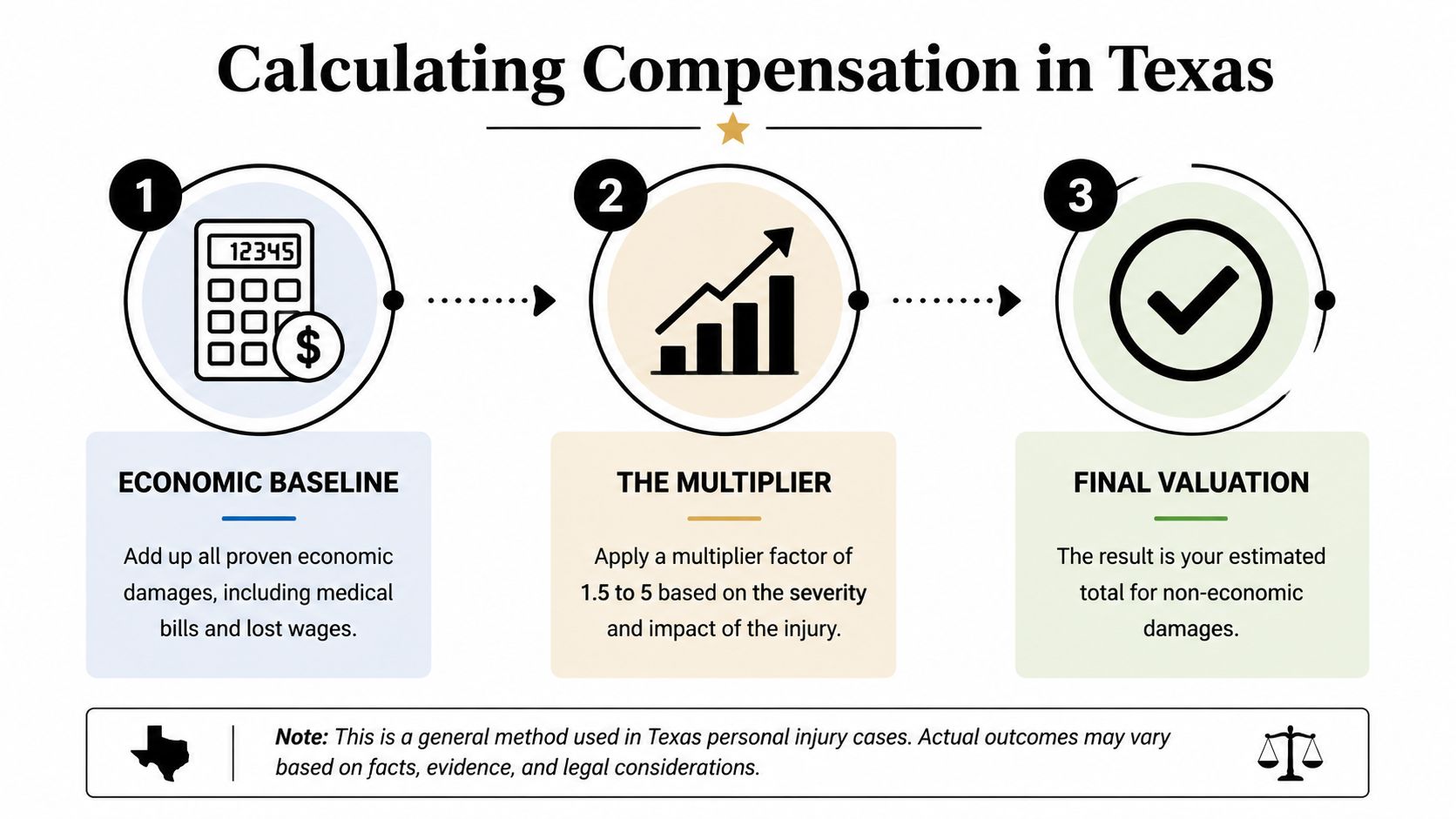
The approach used most often is the multiplier method. In Texas, it remains the most widely used way to estimate pain and suffering damages, with multipliers typically ranging from 1.5 to 5 times economic damages, depending on injury severity, according to this Texas pain and suffering overview.
The multiplier method in plain English
Here's the basic idea.
Add up economic damages
These are the measurable losses such as medical bills, prescriptions, therapy costs, and lost wages.Choose a multiplier
The multiplier reflects how serious and lasting the injury is. Lower-end cases tend to involve shorter recovery and less disruption. Higher-end cases usually involve surgery, permanent limitations, or major life impact.Estimate pain and suffering
You multiply the economic losses by the selected number to reach a pain and suffering figure.
The source above gives a concrete example. A person with $24,000 in economic damages may receive $84,000 in pain and suffering using a 3.5 multiplier.
Why the same bills can lead to different outcomes
Two people can have similar medical expenses and still end up with very different claim values.
One person may recover steadily and return to work with few lasting symptoms. Another may develop chronic pain, sleep problems, or a permanent physical restriction that changes daily life. On paper, the bills may look close. In reality, the suffering is not.
That's why evidence matters so much. Medical records, doctor opinions, photographs, treatment history, and your own account of how life changed all help support the number.
Quick takeaway: The multiplier doesn't drive the case by itself. The facts drive the multiplier.
What about the per diem method
Some lawyers and insurers also talk about a per diem approach. That method assigns a daily value to your pain and applies it over the period of recovery. It can be useful in some negotiations, especially when the timeline is clear.
But in practice, I see the multiplier method come up more often because it ties the value to documented losses and injury severity. If you want a fuller explanation of these categories, this page on pain and suffering damages in Texas claims is a helpful starting point.
Key Factors That Increase or Decrease Your Settlement Value
Settlement value rises or falls based on proof. Not just how badly you feel, but how clearly you can show what happened, what treatment you needed, and how the injury changed your life.

A claims adjuster will study records for weaknesses. A jury will look for consistency. Strong cases usually don't depend on one dramatic fact. They're built from many smaller facts that all point in the same direction.
What tends to increase value
Some facts make a case easier to prove and harder to minimize.
- Severe or lasting injuries: Surgery, permanent restrictions, disfigurement, or long recovery usually support higher non-economic value.
- Consistent treatment: Regular follow-up care shows that the symptoms were serious enough to require continuing attention.
- Clear liability: If the other driver plainly caused the crash, the defense has less room to shift blame.
- Strong daily-life evidence: A pain journal, work records, photos, and witness statements can make your losses more real.
- Credible medical support: Doctors who clearly connect the crash to your symptoms help remove doubt.
One practical tool many clients find useful is tracking symptoms in a structured way. Even something simple like reporting TMJ pain levels on a daily scale can help you describe pain consistently over time, especially when jaw injury, headaches, or facial tension are part of the case.
What tends to reduce value
Some mistakes hurt otherwise valid claims.
The biggest one is inconsistency. If someone says they're in severe pain but stops treatment early, skips therapy, or has long gaps in care, the insurer will argue the injury wasn't that serious.
Another major issue is shared fault. Texas follows a modified comparative fault rule. If you are found 51% or more responsible, you recover nothing. If your share of fault is lower, your recovery is reduced accordingly, as discussed in this explanation of Texas comparative fault and settlement outcomes.
Here's a practical breakdown:
- Posting too much online: Social media photos can be taken out of context and used against you.
- Downplaying symptoms at appointments: Medical records are often the backbone of a case.
- Ignoring mental health effects: Anxiety, sleep loss, and trauma often matter, but only if they're documented.
- Waiting too long for legal guidance: Delay can mean lost evidence, missing witnesses, and a weaker position.
For a clearer look at how these losses fit together, this page on economic vs. non-economic damages can help.
A short video can also help make these issues more concrete:
Real-World Texas Pain and Suffering Settlement Examples
General numbers can be misleading if you don't know what kind of case they describe. A short-treatment rear-end collision and a life-changing commercial truck crash do not belong in the same mental bucket.
Still, broad examples help. In Texas, the median personal injury settlement is $12,281, while the average verdict is $826,892. For catastrophic car accident injuries, settlements average $1,167,808, and one documented case involved $1 million in economic damages and a $4 million pain and suffering award, for a total of $5 million, according to these Texas personal injury figures and examples.
Illustrative Texas Pain and Suffering Scenarios
| Accident Scenario | Economic Damages (Medical/Wages) | Injury Severity & Impact | Typical Multiplier | Estimated Pain & Suffering Range |
|---|---|---|---|---|
| Rear-end crash with short recovery | Qualitatively modest | Soft-tissue symptoms, limited treatment, temporary disruption | Lower end | Often more modest |
| Houston freeway collision with surgery | $24,000 | Broken wrist, surgery, missed work, extended recovery | 3.5 | $84,000 |
| Commercial truck crash with permanent disability | $1,000,000 | Permanent disability, major life impact, long-term losses | 4 | $4,000,000 |
How to read examples like this
These examples are useful because they show scale, not because they predict your exact result.
A person with a temporary injury may still have a valid claim, but the case usually depends on clear treatment, credible complaints, and proof that the injury disrupted normal life. On the other hand, catastrophic injury cases carry much larger numbers because the suffering is deeper, longer, and easier to document through surgeries, permanent limitations, and future care needs.
A Dallas driver with whiplash after a low-speed impact may settle very differently from a family hit by an 18-wheeler on I-10. The first case may turn on treatment gaps and proof quality. The second may involve permanent impairment, loss of independence, and major future harm.
The right question usually isn't “What do these cases pay?” It's “What facts in my case make the number go up or down?”
That's also why families in fatal accident cases should think beyond the crash itself. A wrongful death lawyer Texas families consult will look closely at the emotional and relational losses tied to the death, not just the final medical bills. In catastrophic wrecks, a truck crash lawyer Houston families call often has to build the case around life-care evidence, permanent limitations, and the full human cost of the injury.
Critical Legal Rules That Can Limit Your Recovery
A strong injury case can still lose value fast if it runs into a legal limit. At this stage, many online articles oversimplify the answer.

Comparative responsibility can shrink or block recovery
Texas uses a modified comparative responsibility system. If the injured person is found 51% or more responsible, recovery is barred. If the person is less at fault, the award is reduced by that share of fault, as summarized in this discussion of Texas pain and suffering limits and fault rules.
This matters in everyday cases. A driver may have been injured badly, but if the defense persuades a jury that the driver was mostly responsible, the value of the case may collapse.
For that reason, fault evidence matters almost as much as medical evidence. Police reports, photos, witness statements, vehicle damage, and scene investigation can change the outcome.
Not every case type is treated the same
Many ordinary negligence cases, including most car and truck accident claims, don't have a general statutory cap on pain and suffering. But some categories are different.
Medical malpractice claims are a major exception. In Texas, noneconomic damages in those cases are often capped at $250,000 against a single doctor and up to $500,000 against institutions. Claims against government entities can also have lower limits, according to the same source.
That distinction is critical. A private vehicle crash and a medical negligence claim may involve severe injury in both situations, but the legal ceiling can be very different.
Don't forget the filing deadline
The statute of limitations can also control the case. In most Texas personal injury matters, waiting too long to file can end your right to recover. Some cases involve notice requirements or facts that need immediate investigation. That's one reason an injured person should speak with a Houston car accident attorney or other qualified counsel early rather than after the insurer has already framed the case.
How to Protect Your Rights and Maximize Your Claim
The cases that hold value usually have one thing in common. The injured person treated the claim seriously from the beginning.
Steps that help
- Start medical care and stay consistent: Gaps in treatment create doubt. Consistency creates proof.
- Keep a simple injury journal: Note pain, missed activities, sleep problems, and emotional changes.
- Save every record: Bills, work notes, prescriptions, imaging, discharge papers, and photos all matter.
- Don't give casual statements to the insurer: Short, harmless-seeming comments can be used to minimize the claim.
- Stay off social media when possible: Insurers look for anything they can reframe.
- Get legal advice early: A law firm can gather evidence, communicate with the carrier, and evaluate whether settlement talks are realistic or whether litigation may be needed.
If emotional symptoms are part of your recovery, outside support may matter too. Resources such as expert Vernon therapists for ICBC claims show the kind of counseling support people often seek after traumatic collisions, even though the legal system and insurance rules differ by location. What matters in Texas is that emotional harm is real and should be documented when it's part of the injury picture.
The Law Office of Bryan Fagan, PLLC handles Texas personal injury matters involving car crashes, truck wrecks, wrongful death claims, and catastrophic injuries. In a serious case, a lawyer's job includes preserving evidence, dealing with adjusters, valuing both economic and non-economic losses, and preparing the claim for negotiation or trial.
Recovery is possible. Clear answers are possible too.
If you were hurt in a crash or lost a loved one because someone else acted carelessly, Law Office of Bryan Fagan, PLLC can help you understand what your case may involve and what steps to take next. A free consultation can help you evaluate fault, damages, deadlines, and whether your pain and suffering claim is being undervalued. You don't have to sort through insurance pressure and legal uncertainty alone. Legal help is available, and there is a path forward.