Skip to content
A serious accident can change your life in seconds, but you don't have to face it alone.
You may be reading this after a Houston freeway crash, a Dallas intersection collision, or a wreck on the way home from work. Your body hurts. Bills are starting to arrive. An insurance adjuster keeps calling. You're trying to figure out treatment, missed work, car repairs, and one urgent legal question: how long after a car accident can you claim injury in Texas?
That question's importance is often underestimated. Many injured Texans assume they can wait until treatment ends or until the insurance company makes a fair offer. In real life, that delay can put your case at risk. While you focus on getting through the day, the legal clock may already be running.
Pain can also linger in ways that aren't obvious right away. If you're dealing with ongoing symptoms, this infographic about chronic pain offers a helpful overview of how pain can affect daily life after an injury.
A Serious Accident Can Change Your Life
After a Houston freeway crash, a lot of people do the same thing at first. They get medical care, report the wreck, and try to cooperate with the insurance process. That seems reasonable. But confusion often starts when the insurer asks for more records, delays a decision, or suggests there's still plenty of time to work things out.
What makes these cases so stressful
Texas injury law includes several moving parts. You may hear terms like fault, negligence, comparative responsibility, and statute of limitations. In plain English, those ideas usually come down to four questions:
- Who caused the crash
- Whether that person acted carelessly
- Whether you may share part of the blame
- How long you have to protect your right to recover compensation
Texas follows a fault-based system. That means the person who caused the crash may be responsible for the harm that followed. To recover compensation, an injured person usually needs to show negligence, meaning the other driver failed to use reasonable care.
Where readers often get confused
Many people mix up an insurance claim with a lawsuit. They aren't the same thing. You may be able to open an insurance claim quickly, but that alone doesn't always protect your rights in court.
Practical rule: The date that matters most is often not the date the insurer responds. It's the legal filing deadline set by Texas law.
Comparative responsibility can also affect a case. If the other side argues you were partly at fault, that can change how the claim is evaluated. That's one reason careful documentation matters from the start, especially in serious car, truck, and wrongful death cases.
If your injuries involve a commercial vehicle, a truck crash lawyer Houston case may require early investigation. If a family member died in a collision, a wrongful death lawyer Texas claim raises separate issues about timing, proof, and damages.
Understanding Filing Deadlines in Texas
A crash happens on the way home from work. You report it to the insurer, treatment starts, and weeks pass in phone calls, paperwork, and appointments. While all of that is going on, the legal clock usually keeps running.
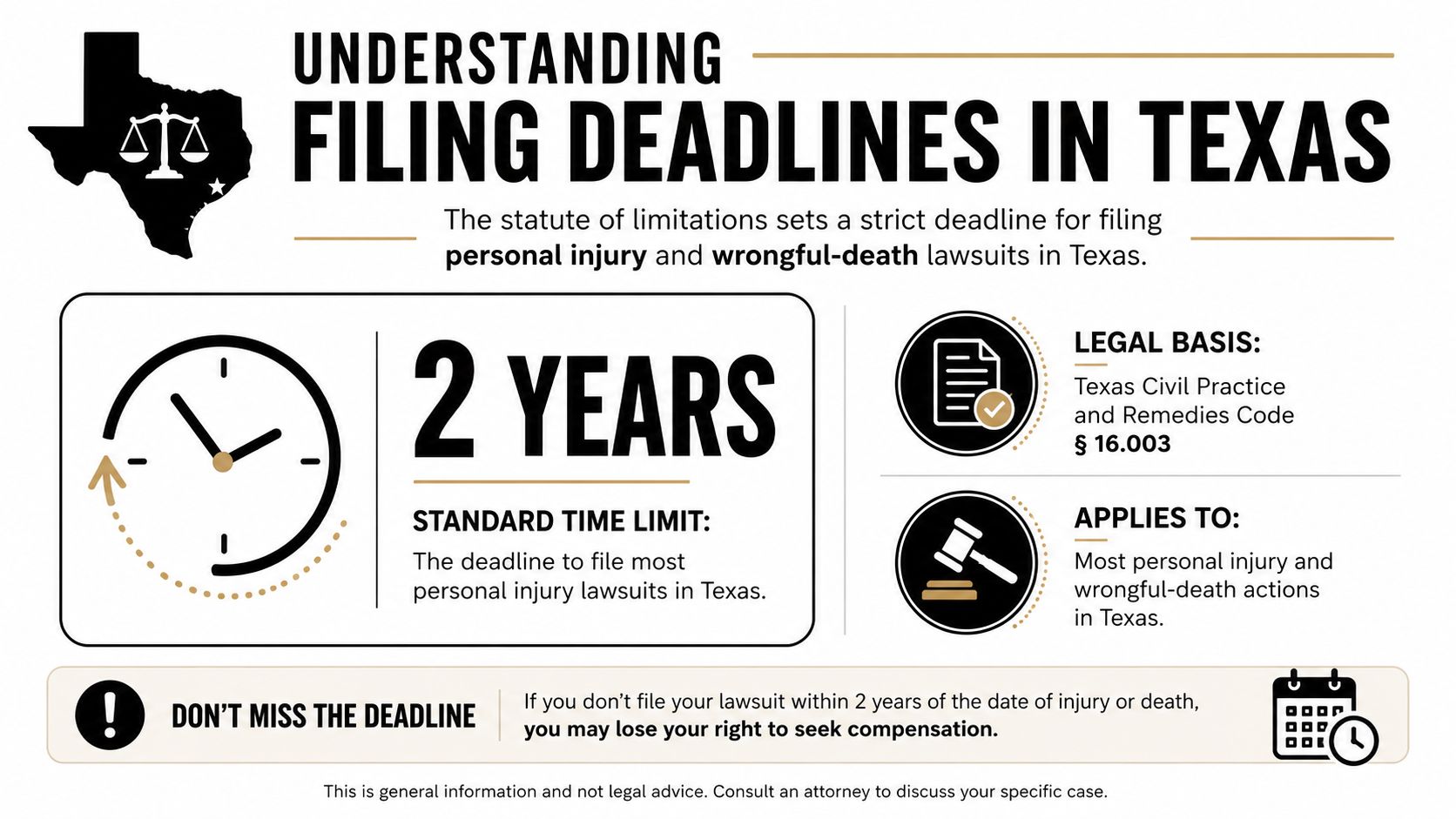
Texas gives most injured people two years to file a lawsuit after a car accident. The rule comes from Texas Civil Practice and Remedies Code § 16.003. A helpful overview of the Texas car accident statute of limitations explains the same basic deadline.
What the two-year rule means
For many Texas car wreck cases, the countdown starts on the date of the crash. A lawsuit filed after that deadline can be barred, even if the injuries are serious and fault seems clear.
A calendar works as a good comparison here. Once the date is set, you count forward two years. If the crash happened on January 15, 2024, the filing deadline is usually January 15, 2026.
That same rule often applies whether the injured person was a driver, passenger, pedestrian, or bicyclist. Related claims may involve different rules, though, which is why lawyers often separate an ordinary injury deadline from less common timing issues such as a statute of repose in Texas injury cases.
Why readers get tripped up
The biggest point of confusion is simple. Insurance negotiations do not pause the two-year lawsuit deadline.
That matters in real life. A Dallas driver may spend months sending records to the adjuster. A Houston passenger may be told the carrier is still "reviewing liability." A San Antonio family may wait for one more settlement call. None of those discussions automatically extends the court filing deadline under Texas law.
What happens if you miss it
Texas courts usually enforce filing deadlines strictly. If a case is filed late, the other side can ask the court to dismiss it before the court ever reaches questions about fault, medical treatment, or damages.
A strong claim can be lost because of timing alone.
A quick deadline example
| Crash date | Filing deadline |
|---|---|
| January 15, 2024 | January 15, 2026 |
That date is often the first thing a Texas injury lawyer checks. Before settlement strategy. Before expert reports. Before trial planning. Because if the petition is not filed on time, insurance talks rarely matter.
Exceptions and Tolling Rules
Exceptions matter because the general rule does not fit every injury claim. Texas law calls these pause rules tolling, and the main Texas statute is Texas Civil Practice and Remedies Code § 16.001.
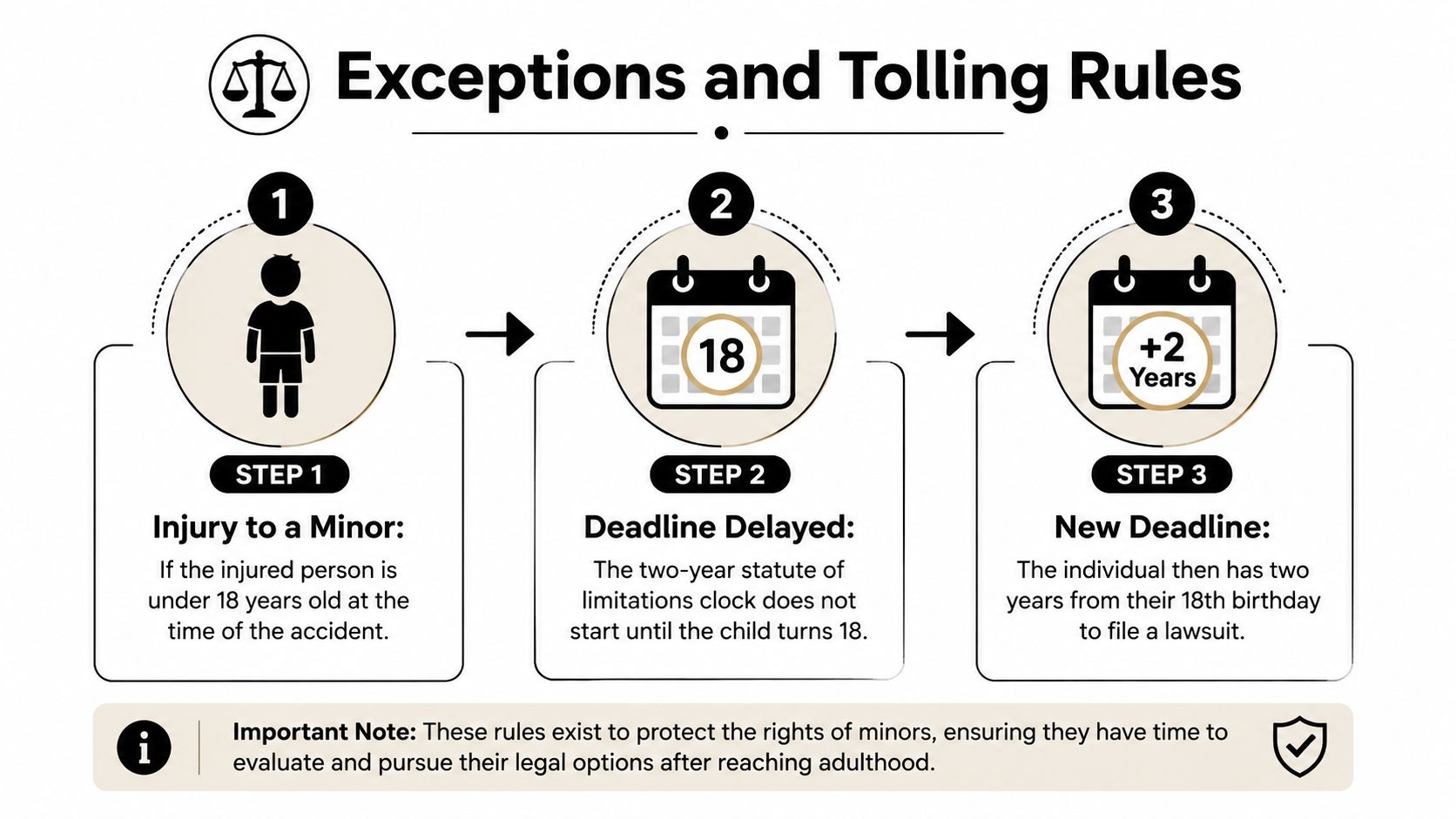
A good way to understand tolling is to picture the legal clock as a stopwatch that has not started yet for certain injured people. For someone who was under 18 when the crash happened, the two-year limitations period is usually postponed until adulthood. For a person who was of unsound mind at the time of injury, the clock may be delayed until that legal disability ends.
That can change the filing date by years.
When the deadline may be delayed
For a child injured in a Texas car wreck, the child's own injury claim usually does not expire two years after the crash date. It usually begins running when the child turns 18. So if a 10-year-old is hurt in a collision, the child's deadline is often measured from the 18th birthday, not from the date of impact.
The same statute can protect an injured adult who was legally incapacitated when the accident occurred. In that situation, the court focuses on when the person regained legal capacity. General explanations of these tolling rules appear in this overview of Texas personal injury statute of limitations exceptions.
A Texas example that trips up families
Suppose a child is injured in a Fort Worth crash on March 1, 2024. The child's claim may remain timely well beyond March 1, 2026 because § 16.001 can delay the start of the limitations period until age 18.
But parents need to slow down here and separate the child's claim from the parents' claim.
That distinction causes real confusion. A parent may assume every expense tied to the child follows the child's longer deadline. Usually, it does not. Claims for medical bills incurred while the child is still a minor are often treated as the parents' claim, and those claims commonly remain tied to the standard two-year deadline running from the wreck date, as noted in this discussion of Texas injury deadlines and tolling rules.
Here is the practical takeaway. A child may have extra time for the child's own injury claim, while the parents may have much less time to recover medical expenses they are legally responsible for paying.
Other uncommon tolling situations
Texas law may also pause the deadline in narrower circumstances, such as when a defendant is absent from the state for a qualifying period. These cases are fact-specific and usually require proof that fits the statute closely. Courts do not apply tolling just because a defendant is hard to deal with, hard to serve, or involved in long insurance discussions.
That last point matters. Insurance negotiations still do not stop the two-year deadline. Tolling is a legal exception created by statute, not a courtesy created by an adjuster.
If you are sorting out whether a deadline was paused, also make sure you are not mixing up tolling with a different concept called repose. This explanation of how a statute of repose differs from an injury filing deadline helps separate those rules.
Insurance Versus Court Deadlines
A common Texas accident scenario goes like this: the injured driver reports the crash, sends medical records to the adjuster, waits for updates, and assumes the claim is progressing. Then the two-year lawsuit deadline arrives unnoticed in the background. If no lawsuit was filed in time, the insurance conversation does not save the case.

The side-by-side difference
Insurance deadlines and court deadlines do different jobs.
Your insurance policy may set its own notice and claim rules for benefits under your own coverage, such as personal injury protection or uninsured/underinsured motorist coverage. Those rules come from the contract. The lawsuit deadline for an injury claim against the at-fault driver comes from Texas law, usually Tex. Civ. Prac. & Rem. Code § 16.003.
A simple way to view it is this:
| Type of deadline | What it controls |
|---|---|
| Insurance policy deadline | Notice and claims under your own policy, based on the contract language |
| Court filing deadline | Your lawsuit against the at-fault party, usually governed by Texas law |
Those clocks can run at the same time. One does not replace the other.
Why settlement talks create danger
Insurance negotiations do not pause the two-year deadline. Texas lawyers see this misunderstanding often. An adjuster may ask for more records, say the claim is under review, or mention that settlement authority is still pending. None of those statements extends the court's filing deadline.
This point gets missed in many general guides, but it matters in real cases. The legal deadline keeps running even while the claim file looks active.
Here is the practical risk. A Harris County driver might spend months discussing treatment updates with the other driver's insurer. A Dallas family might wait for a final offer after surgery records arrive. A Bexar County adjuster might keep asking for one more document. In each example, the calendar still moves toward the filing cutoff.
If an adjuster says the claim is being evaluated, that is not an agreement to extend your time to sue.
Prompt reporting still matters for coverage reasons. This guide on how long to report an accident to insurance explains that part of the process. But reporting a claim is not the same thing as filing a lawsuit, and settlement discussions are not tolling.
Practical Steps to Preserve Your Claim
The strongest legal deadline in the world won't help if key evidence disappears. After a crash, small decisions can affect how clearly you can prove injury, fault, and losses later.
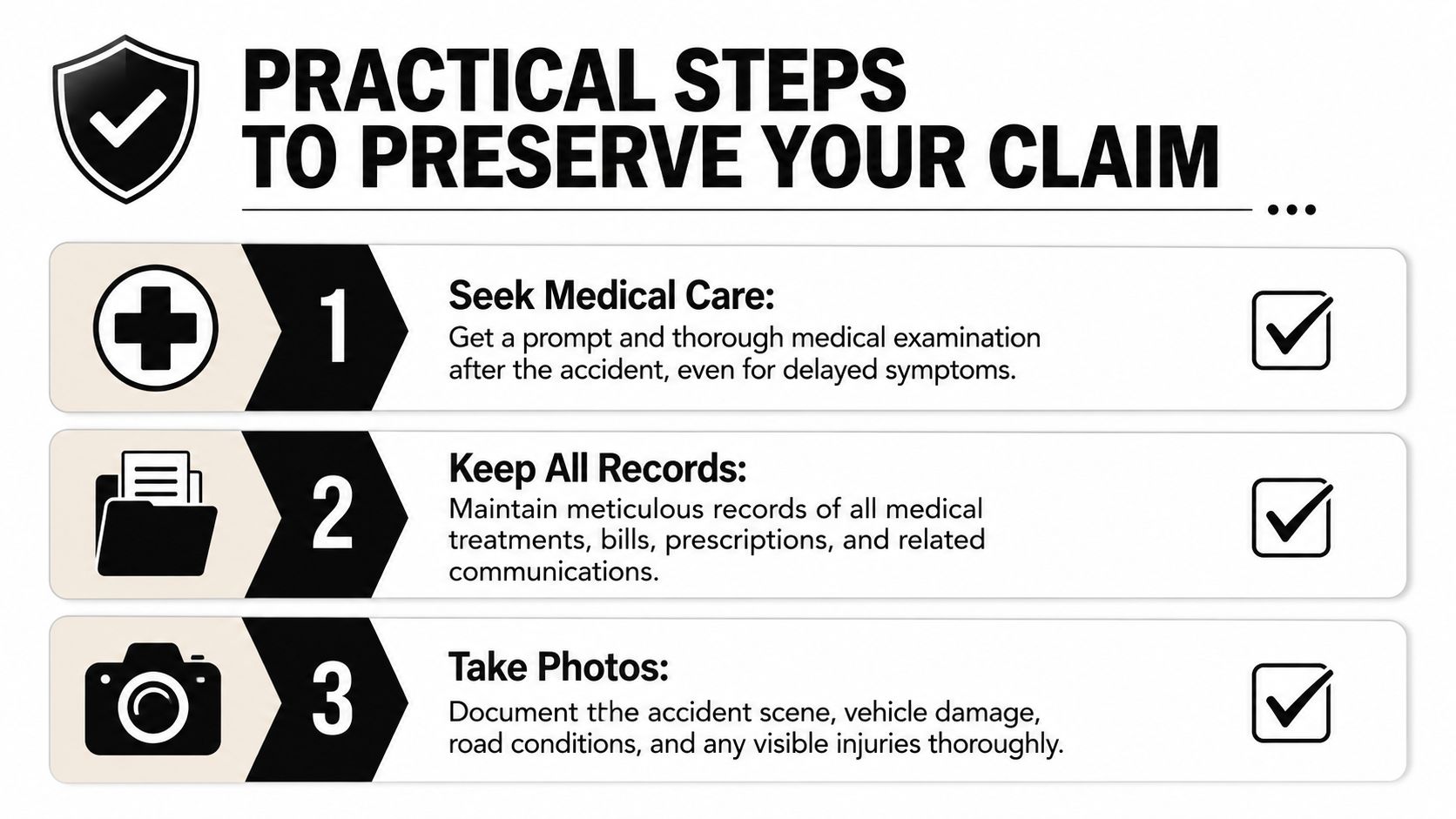
Start with medical care
Get checked promptly, even if symptoms seem manageable. Some injuries show up more clearly after the shock wears off. Early treatment also creates records that connect the crash to your condition.
Keep every discharge paper, imaging result, prescription note, therapy record, and invoice. If pain changes over time, write that down too.
Build your file early
A good claim file usually includes more than a police report. Try to gather:
- Photos of the scene: vehicle damage, road conditions, skid marks, debris, and visible injuries
- Names and contact details: witnesses, responding officers, towing companies, and insurers
- Medical records and bills: urgent care, emergency room, specialists, therapy, and medications
- Work impact records: missed shifts, reduced duties, or employer communications about time away
This guide to what evidence is needed for an injury claim in Texas is useful if you're trying to organize proof while recovering.
Be careful with insurers
You should report the crash, but be thoughtful in what you say. Don't guess about speed, distance, or fault. Don't downplay symptoms just because adrenaline is masking them. And don't sign a release before you understand the full scope of your injuries.
A recorded statement can sound harmless in the moment. Later, the insurer may compare every word against your records.
This short video gives a practical overview of what injured people should keep in mind after a wreck:
When to call a lawyer
Call early if the injuries are serious, a truck was involved, fault is disputed, or a family member died. A lawyer can help secure evidence before it fades, communicate with insurers, and watch deadlines while you focus on treatment.
The Law Office of Bryan Fagan, PLLC handles Texas motor vehicle injury matters, including car, truck, catastrophic injury, and wrongful death claims, on a no-fee-unless-we-win basis.
Real-Life Texas Accident Examples
After a Houston freeway crash, one injured driver did something simple but important. She got follow-up care, saved every medical record, and spoke with counsel well before the filing deadline. That gave her legal team time to review the police report, gather photos, and prepare the case while treatment was still ongoing. She didn't have to wait for the insurance company to decide when her rights mattered.
Houston example
The lesson from that kind of case is practical. Filing pressure feels lower when the legal deadline is still far away, but that's exactly when evidence is easiest to collect. Witness memories are fresher. Vehicle photos are available. Medical history is easier to organize. A Houston car accident attorney can use that time to build a clearer story of negligence and damages.
Dallas example
A different pattern shows up in Dallas cases. An injured person keeps negotiating with the adjuster, sends records more than once, hears that the file is under review, and expects a settlement offer soon. Then the deadline passes. At that point, the insurer has little reason to pay fairly if the lawsuit right has already been lost.
Insurance conversations can continue right up to the edge of a filing deadline. Your legal rights may not.
That same problem can affect families handling fatal crash cases. A wrongful death lawyer Texas claim often involves grief, funeral issues, and family responsibilities all at once. Delay is understandable. But from a legal standpoint, delay can still be costly.
For catastrophic collisions, including commercial vehicle wrecks, the same principle applies. Early action gives your legal team room to investigate fault, preserve records, and respond if the other side tries to shift blame under Texas comparative responsibility rules.
Reclaim Your Life With Expert Legal Support
A car accident claim has two tracks. One is your physical recovery. The other is the legal deadline. They often move at different speeds, and that mismatch is where people get hurt twice. You may still be treating, still talking with an adjuster, and still waiting for answers while the Texas filing clock keeps running.
That is why clear legal advice matters. A Texas personal injury lawyer can line up the key dates, check whether any narrow exception may apply, and prepare a case before Tex. Civ. Prac. & Rem. Code § 16.003 closes the door. Insurance negotiations do not pause that two year deadline. As noted earlier, that point gets missed in many accident guides, but it can decide whether you still have a claim at all.
You do not have to figure this out alone while trying to heal.
If you need answers about an injury claim, car wreck lawsuit, catastrophic injury case, or wrongful death matter, contact Law Office of Bryan Fagan, PLLC to schedule a free consultation. You can use the firm's online contact options or call the office directly to discuss your case. There is no fee unless they win, and you can get straightforward guidance on what to do next from a Texas personal injury lawyer.