Skip to content
A serious accident can change your life in seconds, but you don't have to face it alone.
You may be reading this from your kitchen table, with an ice pack nearby, a phone full of insurance messages, and bills already showing up. The question feels urgent because it is. How much is my car accident case worth texas? You want a number. You also want honesty.
The honest answer is that there isn't a single Texas settlement calculator that can tell you exactly what your case is worth on day one. A fair value comes from evidence, not guesswork. Your medical records, missed work, photos, diagnosis, recovery timeline, and the facts of how the crash happened all shape the result.
After a Houston freeway crash, one person may walk away with soreness that improves in a few weeks. Another may deal with a herniated disc, nerve pain, and months of treatment. Two crashes can look similar at the scene and lead to very different case values later. That's why broad averages only tell part of the story.
Your Life Changed in an Instant Now What?
The first days after a wreck are usually a blur. You may be trying to get your car repaired, explain your absence to work, help your kids feel safe again, and answer calls from an insurance adjuster who sounds helpful but is already building a file.

Many people seek a quick online estimate during this time. That is understandable, but most automated tools overlook what matters. They do not account for whether your pain prevented you from sleeping, whether your back injury worsened after the crash, or whether the other driver was clearly at fault.
Start with what can be proved
A Texas car accident claim gains value when the losses are documented in a way that makes sense to an insurance company, a mediator, or a jury. That means:
- Medical treatment records that connect your injuries to the wreck
- Evidence from the scene such as photos, witness names, and the crash report
- Proof of wage loss if you missed work or had to change duties
- A clear timeline showing what your life looked like before and after the collision
Practical rule: The value of a case usually rises when the story is clear, consistent, and backed by records.
A rear-end crash in Dallas traffic might seem straightforward. But if the injured driver waits weeks to see a doctor, skips follow-up care, and posts online about weekend activities, the insurer may argue the injury wasn't serious. The opposite is also true. Prompt treatment, steady follow-up, and careful documentation give your case structure.
The goal is a fair number, not a fast number
A fast offer can feel like relief. Sometimes it's just a discount dressed up as closure. Before you can judge whether an offer is fair, you need to understand what Texas law allows you to claim and how insurers put a dollar figure on pain and suffering.
The Three Building Blocks of Your Texas Car Accident Settlement
Most Texas car accident cases are built from three categories of damages. Once you understand these, settlement numbers start to make more sense.
Averages can be misleading if you don't know what they include. Texas personal injury data shows a sharp gap between average and median outcomes. The average is $826,892, while the median is $12,281, and for motor vehicle crashes specifically the median award is $16,000, according to Texas settlement data discussed here. Big catastrophic cases pull averages upward, which is why your own facts matter more than any headline number.
Economic damages
These are the losses you can usually prove with bills, invoices, pay records, or repair estimates.
Think about a San Antonio commuter who is taken from the scene by ambulance, misses work, pays for prescriptions, and needs follow-up imaging. Those are economic damages. They often include:
- Medical expenses for emergency care, specialists, therapy, prescriptions, and related treatment
- Lost income from missed work, reduced hours, or changed job duties
- Property loss such as vehicle damage and related costs
If you want a simple breakdown of these categories, this explanation of economic vs non-economic damages is a useful starting point.
Non-economic damages
These losses are real, but they don't come with a receipt. This is the human side of the claim.
A shoulder injury may stop a parent from lifting a child. A concussion may leave someone sensitive to light, exhausted, and irritable. A back injury may make driving, sleeping, and sitting through work meetings miserable. Those losses often fall into non-economic damages, including pain, emotional distress, and loss of enjoyment of normal life.
The strongest pain and suffering claims don't rely on dramatic language. They rely on details that show how daily life changed.
Punitive damages
Punitive damages are different. They aren't meant to compensate you for ordinary losses. They're meant to punish especially harmful conduct.
In car accident cases, these usually come up only when the behavior was extreme, such as a particularly reckless set of facts. They are not part of most claims, so they shouldn't be the center of your expectations.
A practical takeaway helps here. Most injured people should focus first on proving the full scope of their economic and non-economic harm. That's where the essential work happens, and that's where cases are won or undervalued.
The Formula How Your Case Value Is Actually Calculated
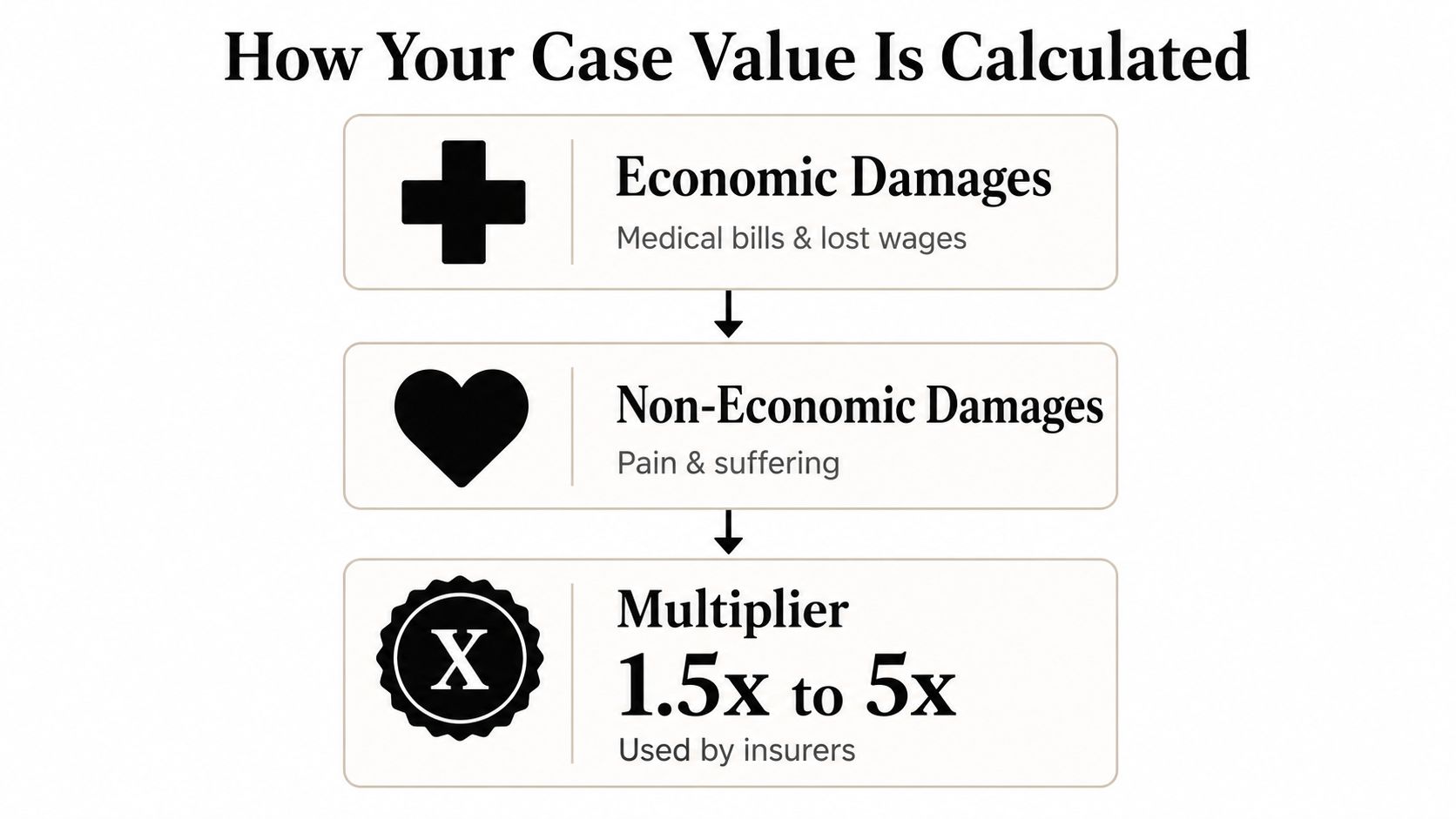
Insurance companies and lawyers often start with a method that feels less mysterious once you see it on paper. In many Texas car accident cases, they total the special damages like medical bills and lost income, then apply a multiplier to estimate pain and suffering. Reported Texas guidance describes a multiplier range of 1.5 to 5, with minor soft tissue cases often falling around 1.5 to 2, and catastrophic brain or spinal injuries pushing 4 to 5 or higher, as outlined in this discussion of how Texas car accident settlements are calculated.
Think of the multiplier like a pressure setting
The base of the claim is the measurable loss. Then the multiplier reflects how serious and disruptive the injury is.
If your injuries are limited, improve quickly, and don't interfere much with daily life, the multiplier tends to stay lower. If the crash caused lasting pain, invasive treatment, a long recovery, or major disruption to work and family life, the multiplier usually rises.
Here are the kinds of facts that can push it up:
- Objective findings such as imaging or specialist diagnosis
- Consistent treatment over time instead of long gaps
- Clear liability showing the other driver caused the crash
- Daily impact like sleep loss, driving anxiety, missed family activities, or inability to do your job normally
What actually persuades adjusters
Adjusters do not increase value because someone says they are suffering. They increase value when the file shows why the suffering is credible.
A useful habit is keeping a short pain journal. Note your sleep problems, limits on driving, missed events, bad days after therapy, and what movements trigger pain. Pair that with your medical records. If your doctor recommends therapy or specialist care, follow through if you can.
If you're still sorting out treatment options, resources about pain relief treatment options can help you understand the kinds of care people often explore after collision-related injuries.
A simple settlement calculator can be helpful, but only if you understand what goes into it. This overview of how to calculate a car accident settlement shows the framework. The key difference comes from how well the facts support a higher multiplier.
A strong case file answers two questions at once. What did this crash cost you, and how deeply did it change your day-to-day life?
Key Factors That Raise or Lower Your Settlement Amount
Some facts act like levers. They don't guarantee a result, but they can push a case value up or down in a major way.

Fault is the first lever
Texas uses modified comparative responsibility. If your share of fault goes too high, your claim can collapse. Even below that point, your recovery can be reduced based on your share of responsibility.
That means liability evidence matters early. Skid marks, vehicle damage, dashcam footage, black-box data in some cases, witness statements, and the wording of the crash report all shape negotiations. A Houston car accident attorney will usually focus on this immediately because weak liability can drag down the whole case, even when the injury is significant.
A common example is a left-turn collision in Austin. One driver says the light was yellow and safe. The other says the turn was reckless. The injury may be serious, but if fault is muddy, the insurer may use that uncertainty to reduce the offer.
Medical proof changes the conversation
Not all treatment records carry the same weight. Emergency room records matter. So do orthopedist notes, imaging results, therapy progress reports, and referrals to specialists.
What doesn't work well is treating only once, then trying to fill in the gaps later. When there are long breaks in care, insurers often argue one of two things. Either you weren't badly hurt, or something else caused the ongoing pain.
Future care is where many people lose money. A key gap in many settlement calculations is the failure to quantify long-term treatment needs. One analysis notes that a herniated disc can lead to 20+ years of therapy and potentially over $200,000 in future damages that adjusters may ignore in early offers, as discussed in this review of future medical expenses in injury settlements.
For clients with severe trauma, transfer costs can become part of the larger medical picture. If a crash involved emergency transport over a long distance, this Med Jets air ambulance pricing guide is a helpful resource for understanding what those services involve.
Credibility can lift or sink a claim
Insurance adjusters look for inconsistencies. So do defense lawyers. If you tell your doctor your pain is an eight out of ten but post videos of heavy lifting, the defense will use that.
What helps instead:
- Be accurate with doctors about your symptoms and limitations
- Follow treatment advice unless there is a real reason you can't
- Avoid exaggeration because modest, specific descriptions are more believable
- Keep records organized in one place, whether that's Evernote, a notes app, or a physical folder
Later in the case, educational material can help you understand how lawyers evaluate these issues in practice.
Insurance limits and vehicle type matter too
A serious injury case can still face practical limits if the at-fault driver has little insurance. That often happens in ordinary passenger vehicle cases, and it also comes up in rideshare and delivery crashes.
Commercial cases can be different because companies may have larger policies and more evidence to review. A truck collision, for example, can involve company records, maintenance issues, and driver logs. That can increase complexity, but it can also uncover proof that strengthens the claim. For people injured in commercial vehicle wrecks, a truck crash lawyer Houston case often requires a faster investigation than a routine two-car crash.
Sample Texas Car Accident Settlement Ranges
This is the aspect of greatest interest. The key is to use ranges carefully, not as guarantees.
Industry data cited in Texas reporting places minor injury settlements such as whiplash or sprains around $10,000 to $30,000, moderate cases such as fractures or herniated discs around $45,000 to $200,000, and severe injuries like traumatic brain or spinal cord damage at over $500,000 and into the multi-millions in some cases, according to this overview of the average car accident settlement in Texas.
Example Texas Car Accident Settlement Ranges by Injury Severity
| Injury Tier | Common Injuries | Example Settlement Range |
|---|---|---|
| Minor | Whiplash, sprains, short-term soft tissue injuries | $10,000 to $30,000 |
| Moderate | Fractures, herniated discs, longer therapy-based recovery | $45,000 to $200,000 |
| Severe | Traumatic brain injury, spinal cord damage, permanent disability | Over $500,000 and into the multi-millions |
What those ranges can look like in real life
A rear-end crash on a Dallas tollway may cause neck strain, several weeks of treatment, and time away from work. That kind of claim may fall within the minor range if the symptoms resolve and liability is clear.
A side-impact collision in Houston might leave someone with a fractured wrist or herniated disc, require imaging and therapy, and affect work for months. That starts to look more like a moderate case.
The highest-value cases usually involve permanent impairment, loss of independence, profound pain, or death. When a family loses someone in a fatal wreck, the legal analysis changes significantly. In those situations, a wrongful death lawyer Texas claim focuses not only on financial loss but also on the full human impact of what was taken.
Settlement ranges are reference points. The real value comes from how clearly you can prove the injury, the disruption, and the other driver's responsibility.
Your Checklist to Preserve Your Case's Value After an Accident
The hours and weeks after a crash can either protect your claim or weaken it. Small decisions matter.

Do these things early
- Get medical care quickly. Tell the provider every symptom, even if it seems minor at first. Neck pain, headaches, numbness, and dizziness can evolve.
- Take photos. Capture vehicle damage, bruising, road conditions, debris, and anything else that helps explain the crash.
- Get witness information. A neutral witness can make a disputed case much stronger.
- Report the collision. A police report isn't perfect, but it often becomes a key part of the file.
- Notify your insurer carefully. Basic notice is usually necessary. Detailed recorded statements to the other driver's insurer are a different issue.
Avoid these common mistakes
- Don't downplay your pain just to seem tough
- Don't skip follow-up visits if you're still hurting
- Don't sign broad medical releases without understanding what you're giving away
- Don't accept the first offer just because bills are piling up
- Don't post casually online about physical activity or travel while the claim is active
For people recovering from collision injuries, information about physical therapy for motor vehicle accidents can help you understand how rehab often fits into the bigger recovery process.
Keep one running file
Use your phone or a notebook. Save every bill, receipt, appointment summary, work note, and photo. Make a simple list of bad days, missed family events, sleep problems, and tasks you couldn't do.
After a Fort Worth crash, that file may become the difference between a vague claim and a persuasive one. It helps your lawyer, but it also helps you remember what happened when months have passed and details start to blur.
You Don't Have to Face This Alone Legal Help Is Available
A Texas car accident case is rarely just about the crash itself. It's about what happened after. The pain, the missed work, the strain on your family, the treatment decisions, and the pressure from insurance companies all affect value.
The good news is that the process is not random. Case value usually comes down to documented losses, credible medical proof, clear liability, and a full accounting of how the injury changed your life. When those pieces are handled well, you are in a much stronger position.
Texas law also gives you deadlines. In most car accident cases, the statute of limitations is two years from the crash. Waiting too long can make evidence harder to find and can put your claim at risk. If you were hurt in a wreck involving a commercial vehicle, uninsured driver, or a fatal crash, getting legal advice early is even more important.
A skilled Texas personal injury lawyer can help gather records, calculate damages, push back on low offers, and present the part of the claim that insurers often minimize most aggressively, which is your pain and future loss. If you're dealing with a serious crash in Houston, working with a Houston car accident attorney can also help preserve local evidence quickly. And if the case involves a death, a wrongful death lawyer Texas claim deserves careful handling from the start.
Recovery is possible. You don't have to know every rule before asking for help. You just need clear information, steady guidance, and someone who knows how Texas accident claims really work.
If you have questions about what your claim may be worth, Law Office of Bryan Fagan, PLLC offers free consultations for injured Texans and families after serious crashes. You can speak with a team that handles car accidents, commercial vehicle wrecks, catastrophic injury claims, and wrongful death cases across Texas. There are no upfront fees, and you pay nothing unless the firm wins for you.