Skip to content
Most Texas car accident settlements take 3 to 18 months, but a straightforward case with minor injuries and clear fault may resolve in 3 to 6 months, while serious or disputed cases can take 12 to 36 months or longer. If you're hurt, out of work, and waiting on bills to pile up, that range can feel frustratingly wide.
A serious accident can change your life in seconds, but you don't have to face it alone.
If you're reading this, you may be sitting at home with a sore neck, a stack of medical papers, and an insurance adjuster already calling. You want one clear answer: how long does a car accident settlement take? The honest answer is that the timeline depends on your injuries, your treatment, who caused the crash, and whether the insurance company decides to cooperate.
That uncertainty is hard. After a Houston freeway crash, for example, many people assume the claim should settle quickly because the damage seems obvious. Then treatment continues, new symptoms show up, or the insurer starts questioning fault. What felt like a short process becomes a long one.
Still, the timeline isn't random. A settlement usually moves through a set of stages, and each stage has a purpose. When you understand those stages, you can make better decisions, avoid common mistakes, and know when patience protects your claim and when it's time to push back.
Your First Question After an Accident
The first days after a crash are often a blur. You're trying to get your car moved, find medical care, answer family questions, and decide whether you should even talk to the insurance company. On top of that, you're wondering how you'll pay for treatment if the claim drags on.
That stress is normal. It also makes people vulnerable to quick settlement pressure.
Why the timeline feels so uncertain
Insurance claims move more slowly than is often anticipated because money usually comes at the end of documentation, not at the beginning of the injury. Before anyone can fairly value a case, they need to understand what happened, who was at fault, how badly you were hurt, and whether you will need more care.
In Texas, fault matters. Texas follows a fault-based system, which means the person who caused the crash is generally responsible for the harm that follows. Negligence is the legal concept behind that rule. In plain English, negligence means a driver failed to use reasonable care, such as texting behind the wheel, following too closely, or running a red light.
Texas also uses comparative responsibility. If the insurance company argues that you partly caused the wreck, that can reduce what you recover. That issue alone can slow a case because both sides may fight over witness statements, vehicle damage, and medical records.
Practical rule: The faster answer isn't always the better answer. A quick settlement can leave you paying later for care the insurer refused to consider.
What you should do right away
The steps you take early can affect both the value and timing of your claim.
- Get medical care: Prompt treatment helps protect your health and connects your injuries to the crash.
- Save every record: Keep discharge papers, prescriptions, bills, imaging reports, and work notes.
- Be careful with adjusters: You can report the crash, but don't guess about your injuries or accept blame.
- Learn the first steps: This guide on what to do after a car accident in Texas can help you stay organized.
If you've lost a loved one, the emotional weight is even greater. Families speaking with a wrongful death lawyer Texas often ask the same question about timing, because grief doesn't pause the legal and financial fallout.
The Six Key Stages of a Car Accident Settlement
Some parts of the process happen quickly. Others take time because they should.
A broad overview helps you breathe a little easier.
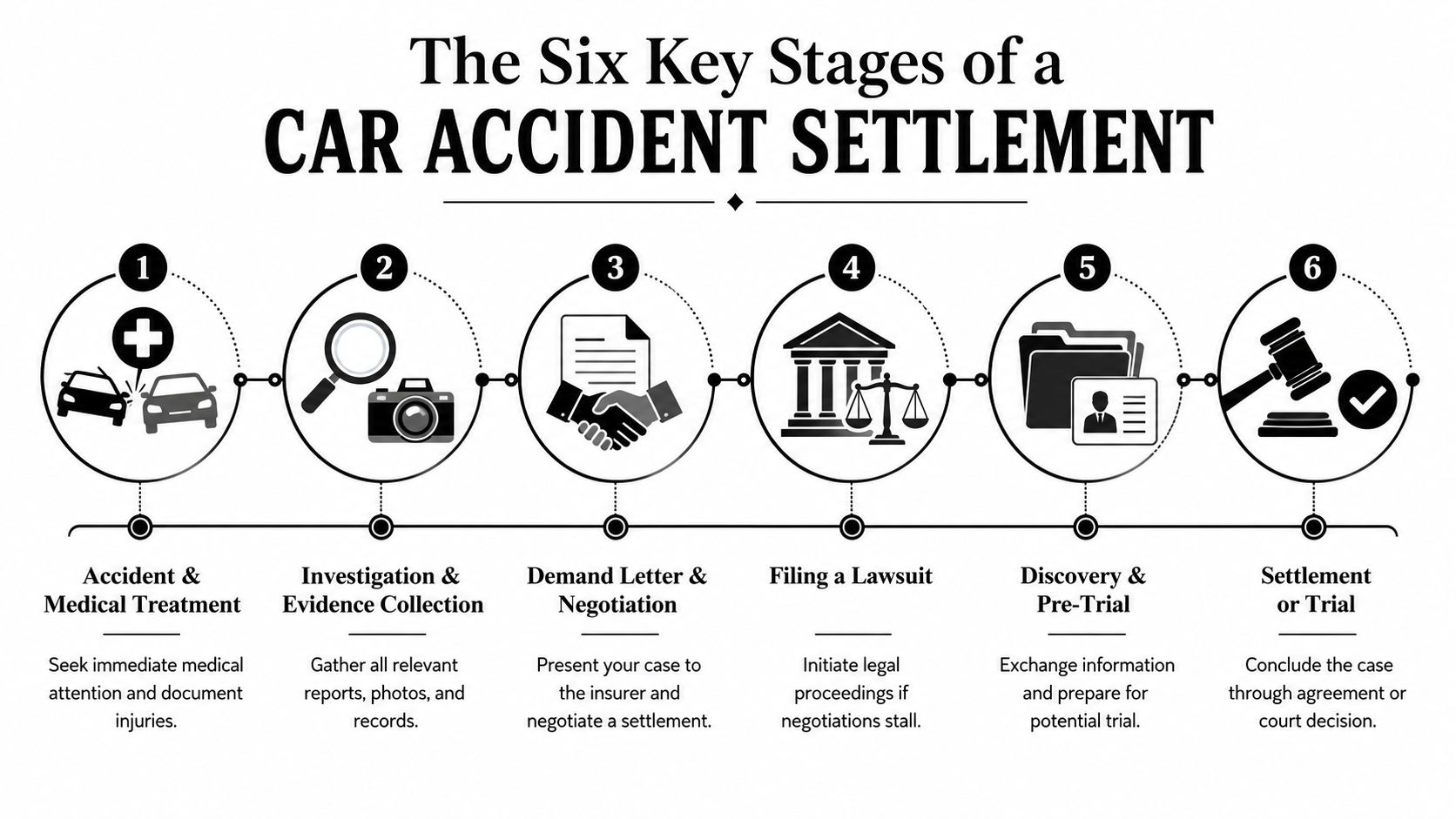
According to this Texas settlement timeline overview, a straightforward car accident settlement with clear liability and minor injuries typically resolves within 3 to 6 months, the average timeframe for most claims falls between 3 and 18 months, and disputed or serious cases often extend to 12 to 36 months or longer.
Stage one and stage two
Medical treatment comes first. Your health drives the case. If you settle before doctors understand your condition, the claim may not reflect the true cost of your recovery.
Investigation starts early. This includes the crash report, photographs, witness statements, vehicle damage, and your medical records. If the other driver disputes fault, this stage becomes more important.
After a Dallas intersection crash, for example, a driver may say you turned too late. Your phone records, dashcam footage, scene photos, and the pattern of impact may tell a different story.
For a fuller walkthrough, this page on the Texas personal injury claim process shows how these early steps fit together.
A Texas Personal Injury Lawyer handles representation for injury victims across Texas on a no-fee-unless-we-win basis.
Stage three and stage four
Maximum medical improvement, or MMI, often becomes the turning point. That's the stage where your condition has stabilized enough for your doctors to give a clearer opinion about future care, restrictions, and lasting effects. It doesn't always mean you're fully healed. It means the medical picture is clearer.
The demand letter follows. Once treatment records and evidence are organized, your lawyer sends a settlement demand to the insurer. This package usually explains liability, injuries, medical care, lost income, pain, and future needs.
A strong demand letter isn't just a number on paper. It's the story of how the crash changed your life, backed by records the insurer can't easily ignore.
Later in the process, insurer response times matter. Some Texas sources note that insurance companies usually respond to a settlement demand letter within 30 to 90 days when claims are moving through pre-suit negotiation, but the actual pace depends on cooperation, documentation, and dispute level.
Stage five and stage six
At this point, many people assume the case should wrap up fast. Sometimes it does. Sometimes it doesn't.
Negotiation can be short or drawn out. The insurer may accept responsibility but argue your treatment was excessive. Or it may make a low opening offer and wait to see whether you are desperate enough to take it.
Resolution happens in one of two ways. You either settle, or you file suit. If the insurer won't negotiate fairly, litigation may be the only path that protects the value of your claim. That step matters in car cases, but also in catastrophic injuries, commercial vehicle cases, and wrongful death claims.
If your crash involved a semi, delivery van, or company vehicle, a truck crash lawyer Houston may need to deal with multiple insurers, company records, and a more aggressive defense from the start.
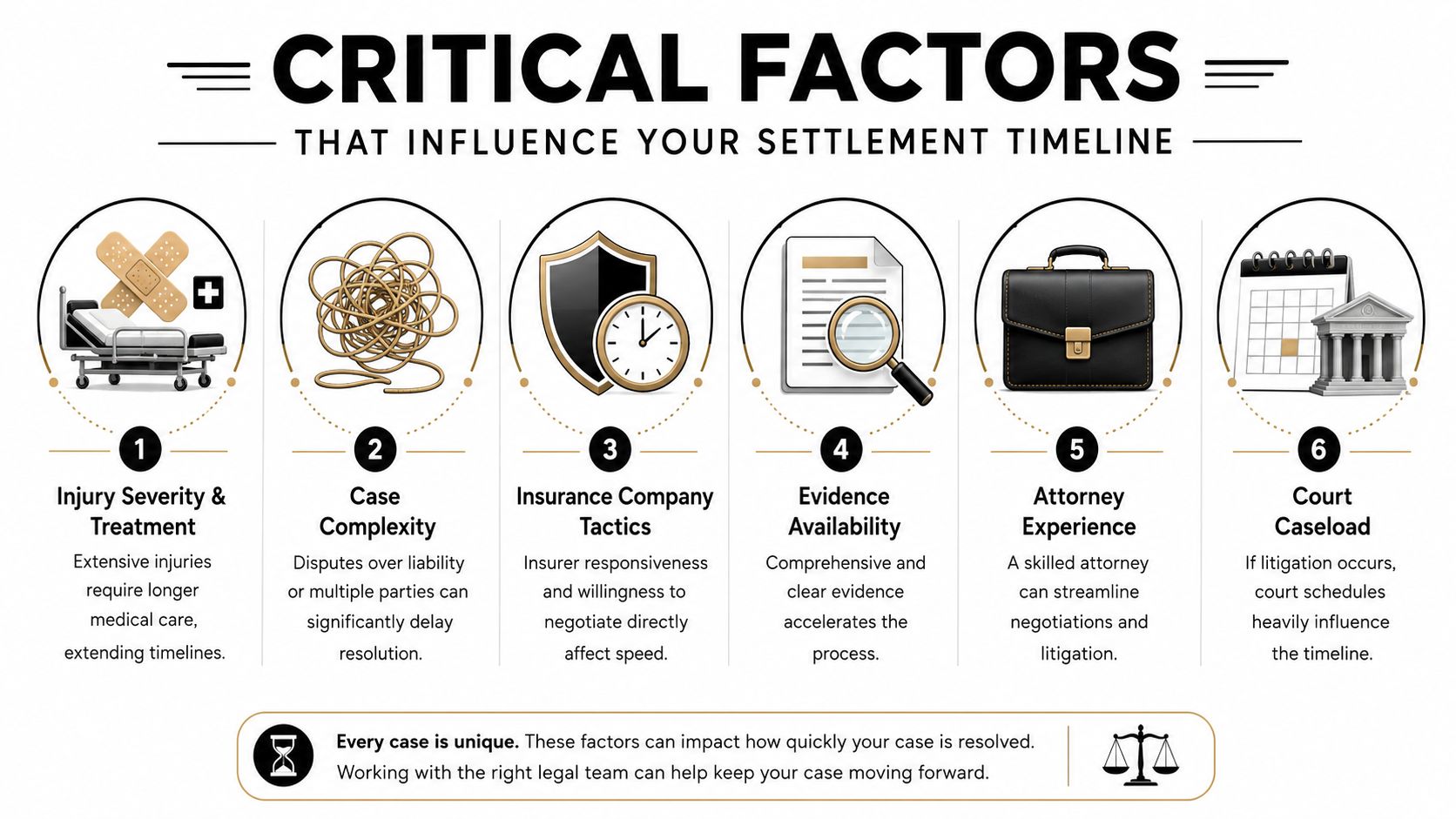
Critical Factors That Influence Your Settlement Timeline
Two people can get rear-ended on the same day and finish their cases months apart. The reason usually isn't luck. It's a mix of medical, legal, and strategic factors.
Injury severity and the MMI trap
One of the biggest reasons a case slows down is ongoing treatment. According to this discussion of the MMI trap, victims often wait months or years for settlement because they haven't finished treatment, and insurers increasingly demand MMI before negotiating, stretching cases that might settle in 3 to 6 months to over a year.
That can feel unfair when you're the one in pain. But there is a logic behind it. If no one knows whether you'll need another procedure, more therapy, or long-term restrictions at work, it's hard to value the claim accurately.
A Houston car accident attorney will often tell clients that waiting can protect them, but waiting without a strategy can also hurt them. The key is knowing whether your case needs more medical clarity or whether the insurer is actively using delay as a tactic.
Fault disputes and comparative responsibility
Texas comparative responsibility rules give insurers an advantage. If they can shift part of the blame to you, they may reduce the amount they offer or drag out negotiations while they build that argument.
Here are common examples:
- Intersection crashes: One driver says the light was yellow, the other says it was red.
- Lane-change wrecks: Both drivers blame each other for entering the lane first.
- Multi-vehicle collisions: Each insurer tries to place the chain reaction on someone else.
- Uninsured motorist claims: Your own insurer may still challenge fault or damages.
If the adjuster starts asking repeated questions about what you "could have done differently," they may be building a comparative responsibility defense.
Insurance tactics and practical bottlenecks
Some delays are ordinary. Others are strategic.
- Slow responses: The adjuster may take longer than expected to review records or return calls.
- Extra document requests: Some insurers ask for more records than the claim truly requires.
- Low first offers: An insurer may test whether financial pressure will push you into settling too early.
- Multiple parties: Commercial carriers, umbrella policies, and employer involvement all add layers.
A serious crash in Austin can also involve a second timeline problem: your own recovery may be moving one direction while the paperwork moves another. Medical offices can be slow to send records. Employers can be slow to verify missed work. These aren't dramatic issues, but they matter.
What you can control
You can't control a court schedule or an adjuster's attitude. You can control preparation.
- Follow treatment consistently: Gaps in care often invite disputes.
- Keep a simple file: Save bills, mileage, prescriptions, photos, and work correspondence.
- Respond promptly: If your lawyer or doctor needs something, quick replies help.
- Call for help early: Delay often starts when people try to manage a serious claim alone.
Realistic Timelines for Different Texas Accident Scenarios
The easiest way to understand how long a car accident settlement takes is to compare real-world situations. The same legal rules apply, but the timeline changes with the facts.
According to Texas car settlement data discussed here, the average settlement for a nonfatal car accident injury in Texas is approximately $20,000, most settlements range between $15,000 and $30,000, simple cases with minor injuries often settle in 6 to 12 months, and complex cases involving serious injuries or disputed fault frequently take 2 to 3 years or more to resolve.
Three common examples
After a Houston freeway rear-end crash, a driver with soft tissue injuries may treat for a short period, gather records, and resolve the claim without filing suit. Fault is obvious, the records are clean, and the insurer doesn't have much room to argue.
After an Austin T-bone collision, the timeline often gets longer. Surgery, extended therapy, and questions about future limitations make it harder to place a fair value on the claim before treatment develops.
A commercial vehicle case can take the longest. If an I-10 truck crash causes catastrophic injuries, several parties may be involved. The trucking company, its insurer, the driver, and other carriers may all investigate at once. That kind of case can move into litigation even when the harm is clear.
Estimated settlement timelines by accident type
| Accident Scenario | Key Factors | Estimated Timeline |
|---|---|---|
| Minor rear-end crash in a Dallas suburb | Clear fault, short treatment, limited dispute | 3 to 6 months |
| Typical injury case with ongoing treatment | Continued care, record gathering, active negotiation | 6 to 12 months |
| Intersection crash with fault dispute | Comparative responsibility issues, more investigation | 9 to 18 months |
| Serious injury case involving surgery | Longer recovery, higher damages, future care questions | 12 months or more |
| Houston truck or commercial vehicle crash | Multiple parties, company investigation, complex insurance issues | 2 to 3 years or more |
The timeline isn't a measure of whether your case is strong. Often, the most serious cases take the longest because the stakes are higher and the harm is harder to fully document.
Where families and injured drivers often misjudge the process
Many people compare their case to a friend's case and assume the same timeline should apply. That usually creates frustration. A friend may have had a minor crash, no surgery, no fault dispute, and no lien issues. Your case may involve all four.
The same is true in fatal crash cases. Families working with a wrongful death lawyer Texas are not just proving bills. They may be dealing with grief, estate issues, multiple relatives, and harder liability questions.
If you're trying to estimate your own timeline, look at the facts, not just the type of vehicle. A pickup crash can be simple. A sedan crash can become complex. The details control the clock.
Understanding Your Legal Deadlines in Texas
A settlement timeline is flexible. Your legal deadline is not.

According to this explanation of Texas Civil Practice and Remedies Code Section 16.003, the statute of limitations for filing a Texas personal injury lawsuit is exactly two years from the date of the accident, and missing that deadline permanently bars recovery.
Why this deadline matters so much
Many people think filing an insurance claim is enough. It isn't. The two-year deadline applies to filing a lawsuit. If settlement talks drag on and no lawsuit is filed in time, you can lose your bargaining power completely.
That matters even if the adjuster sounds friendly. Insurance companies know the calendar. If you wait too long, they may have little reason to offer fair value.
A lawyer also watches for more than one deadline. Evidence can disappear early. Vehicle data may be lost. Witnesses move away. Medical providers purge records. The legal filing deadline is the final cutoff, but practical deadlines begin much sooner.
Fault, negligence, and filing strategy
Texas personal injury law transitions from abstract to practical here.
- Fault: Who caused the crash?
- Negligence: What careless act led to it?
- Comparative responsibility: Will the insurer try to put some blame on you?
- Damages: What did the crash cost you physically, emotionally, and financially?
Those questions shape both settlement strategy and the decision to file suit. Some cases should stay in pre-suit negotiation for a while. Others need to be filed sooner to preserve pressure and protect your rights.
If you want a simple explanation of the deadline, this page on the Texas car accident statute of limitations is a helpful starting point.
Waiting to call a lawyer doesn't make a claim simpler. It usually gives the other side a head start.
From Agreement to Payment How You Get Your Money
Signing a settlement agreement feels like the finish line. It usually isn't the day you receive your money.
There's an often-unanticipated final delay that occurs after a case settles. According to this explanation of the payment clearance gap, there is often a 2 to 6 week delay between signing the release and receiving funds because the insurer issues the check, the lawyer's escrow account must clear it, and liens are then paid before the client receives their share.
What happens after you say yes
The process usually looks like this:
- You sign the release: This closes the claim against the party paying the settlement.
- The insurer sends the check: That doesn't usually go straight into your pocket.
- The funds go into a lawyer trust or escrow account: The check must clear.
- Liens are resolved: Medical providers, health insurers, or government claims may need to be paid.
- Your net funds are disbursed: Then you receive your portion.
Some Texas sources note that insurers often issue payment within 2 to 6 weeks, but clients may not have funds in hand for about 60 days if lien resolution slows the final disbursement. That's especially common when government-related claims are involved.
Why this part confuses so many people
People hear "settled" and reasonably think "paid." In practice, those are different moments.
After a San Antonio crash, for example, a client may sign papers and expect the money by the weekend. Then the office explains that the settlement check has to arrive, clear, and be processed before medical balances are addressed. That gap can feel painful when rent, treatment, or family expenses can't wait.
Ask one simple question after settlement: "What still has to happen before the money reaches me?" A clear answer reduces stress and prevents surprise.
When to call a lawyer
You should consider legal help early if:
- Your injuries are serious: Ongoing care changes case value and timing.
- The insurer disputes fault: Comparative responsibility can shrink your recovery.
- A truck or company vehicle was involved: These claims often become more complex quickly.
- You've lost a loved one: A family may need a wrongful death claim, not just an insurance conversation.
- You feel pressured to settle: Pressure usually means the insurer thinks your claim may be worth more than the first offer.
A Car Accident Lawyer in Texas provides representation for drivers and passengers injured in Texas car accidents. That may be useful if you're trying to understand whether your case should stay in negotiation or move toward suit.
If you're asking how long your own case may take, the best next step is to talk through the facts with someone who handles Texas injury claims every day. Law Office of Bryan Fagan, PLLC offers free consultations for injured Texans and families dealing with car crashes, truck wrecks, catastrophic injuries, and wrongful death claims. You don't have to guess your way through insurance delays, legal deadlines, or settlement decisions alone. Recovery is possible, and legal help is available when you're ready.