A serious accident can change your life in seconds—but you don’t have to face it alone. When someone else’s carelessness in Texas turns your world upside down, the law gives you the right to demand compensation for your losses. This compensation, legally known as "damages," is the first step toward putting the pieces of your life back together. But to get the full and fair recovery you deserve, you first need to understand what you're fighting for.
Understanding Your Right to Compensation After a Texas Accident
Imagine you’re driving home on a Houston freeway when a distracted driver runs a red light and T-bones your car. You’re rushed to the hospital with serious injuries—a broken leg, a concussion, and severe whiplash. Life as you knew it has come to a screeching halt, and the path forward feels uncertain.
At The Law Office of Bryan Fagan, PLLC, we’ve seen how quickly an accident can change everything. The good news is that Texas personal injury law allows you to pursue two main types of damages: economic and non-economic. These are designed to cover everything from the mountain of medical bills to the wages you’ve lost because you can’t work. For a broader view of accident trends, you can explore personal injury statistics.
The core difference is simple: economic damages cover the tangible, out-of-pocket costs you can prove with a paper trail. Non-economic damages compensate you for the human, personal suffering that doesn’t come with a receipt. One covers your wallet; the other covers your well-being.
This infographic gives you a quick visual of how these two categories break down.
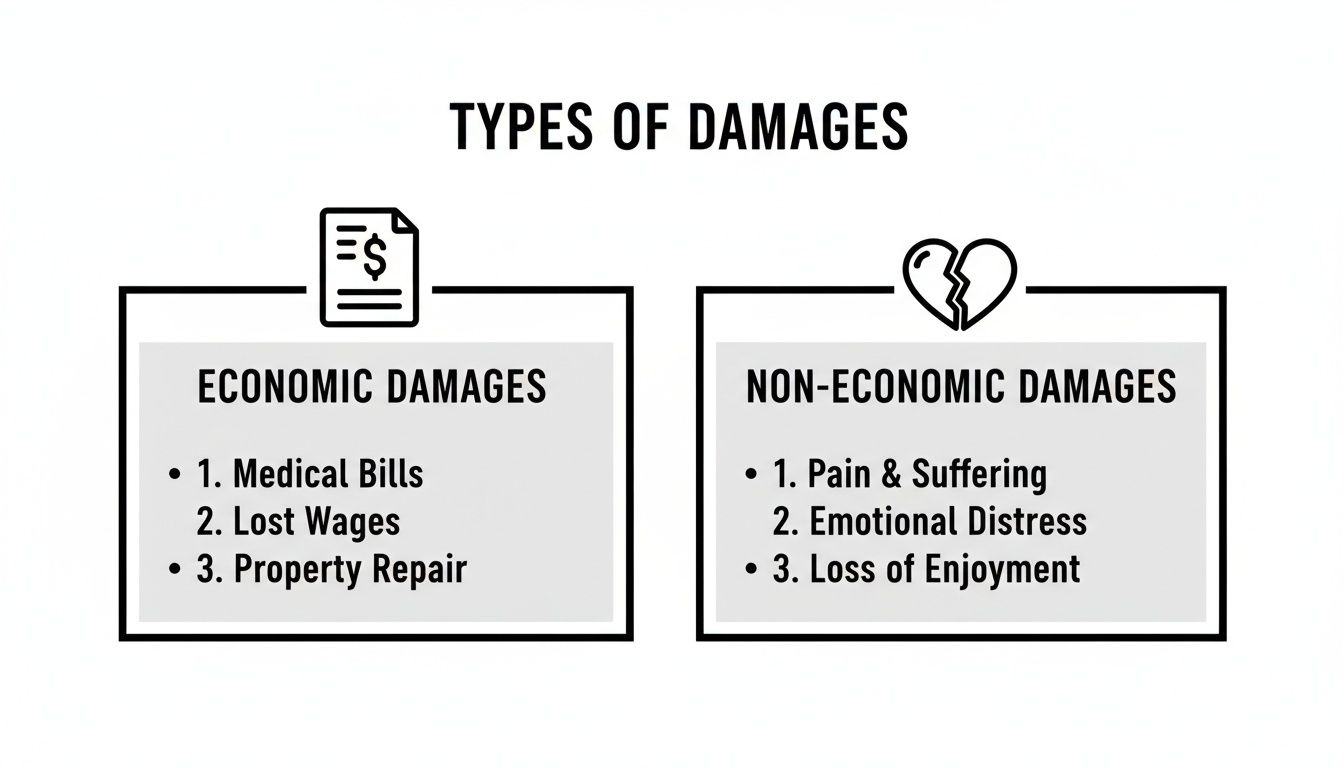
As you can see, one side is about calculable financial losses, while the other is about the very real, but less tangible, impact on your life.
Economic vs Non-Economic Damages At a Glance
To make it even clearer, this table provides a side-by-side comparison of the two main types of compensation. It's a quick way to understand what each category covers and how they differ.
| Comparison Point | Economic Damages (Tangible Losses) | Non-Economic Damages (Intangible Losses) |
|---|---|---|
| Core Purpose | To reimburse you for specific, calculable financial losses. | To compensate you for the human cost of the injury, like pain and suffering. |
| Examples | Medical bills, lost wages, future lost earnings, property damage. | Pain, mental anguish, disfigurement, loss of enjoyment of life. |
| How It's Proven | With receipts, invoices, pay stubs, and expert financial projections. | Through personal testimony, medical records, and witness statements. |
Both types of damages are critical for a full and fair recovery. Without accounting for both the financial and the personal toll of an injury, you risk being left with an incomplete settlement that doesn't truly cover what you've lost.
Calculating Your Economic Damages: The Tangible Costs of an Injury
Economic damages are the financial bedrock of any personal injury claim. These aren't abstract numbers; they represent every single dollar you've lost—or will lose—because someone else was negligent. Our first job as your legal team is to build a rock-solid case to recover every penny.
Think of it this way: if you have a paper trail for a cost that only exists because of the accident, it’s almost certainly an economic damage. These are the real, measurable expenses that put immense financial pressure on you and your family when you're already going through enough.
Documenting Your Medical Expenses
For most people, medical costs are the largest and most important part of their economic damages. It's absolutely essential to track every single expense, no matter how small it seems, from the moment the accident happens.
These costs go way beyond the initial ER bill. Your claim must account for everything:
- Emergency Services: This includes the ambulance ride and the initial treatment you received at the hospital.
- Hospital Stays and Surgeries: Any time you spent as an inpatient or any procedures you needed.
- Ongoing Therapies: This covers physical, occupational, and other rehabilitative therapy sessions needed for your recovery.
- Prescription Medications: Every single medication prescribed to treat your injuries.
- Future Medical Needs: This is a critical part of your claim. If your injury is going to require long-term care, more surgeries down the road, or permanent medical equipment, we work with medical experts to project those costs for the rest of your life. A key part of this is understanding when you've reached a stable point in your recovery, and you can learn more about what is maximum medical improvement to see how that affects your claim.
When we're tallying up economic damages, we have to consider all medical expenses you've incurred. Sometimes, information from medical service FAQs, like these understanding wound care financial FAQs, can help clarify some of these tangible costs.
Recovering Lost Income and Future Earnings
If your injuries have kept you out of work, those lost wages are a direct economic damage. We’ll use your pay stubs, employment records, and tax returns to calculate exactly how much income you've been denied.
Real-world example: After a Houston freeway crash, a construction worker is hurt when his company truck is rear-ended. His injuries are severe enough that he can't go back to his physically demanding job. His claim wouldn't just include the wages he lost while recovering; it would also include his loss of future earning capacity.
This is an incredibly important distinction. If your injuries permanently limit your ability to do your job or force you into a career that pays less, you have the right to be compensated for that lifetime of diminished income. To prove this, a Houston car accident attorney will often bring in economists and vocational experts. They analyze your career trajectory and project the total financial hit you'll take over your expected working life.
Valuing Non-Economic Damages: The Human Cost of Your Suffering
While economic damages add up your financial losses, non-economic damages tackle something far more profound: the human cost of an accident. These are the losses that don't show up on a spreadsheet but can change your life forever. They are just as real, and just as deserving of compensation, as any medical bill you receive.
In Texas, the law is clear—your suffering has value. It gives juries the power to assign a monetary figure to the pain, the trauma, and the emotional distress you've been forced to endure because of someone else’s negligence. This is a critical piece of the puzzle in achieving true justice.

Proving Your Personal Suffering
So, how do you put a price on suffering? It's not easy, but an experienced Texas personal injury lawyer knows how to build a compelling narrative that shows a jury the true, devastating extent of your losses. We use powerful evidence to paint a clear picture of how the accident has impacted your life, including:
- Personal Testimony: Your own story, told in your own words. This is often the most powerful evidence of what you have truly lost.
- Journals and Diaries: Keeping a record of your daily struggles—the pain, the anxiety, the physical limitations—provides an undeniable, real-time account of your suffering.
- Statements from Loved Ones: Testimony from your family and friends can illustrate how your injuries have changed you. They see firsthand how you can no longer participate in the activities you once loved.
- Expert Evaluations: Psychologists and other medical experts can offer professional opinions that validate the depth of your mental anguish and emotional trauma.
These damages get to the very heart of what you’ve lost: the daily torment of chronic pain, the depression that comes from losing your independence, or the unbearable grief in a wrongful death case. The non-economic portion of a claim can often be 1.5 to 5 times the total medical costs. While some states cap these awards, Texas law allows juries to realistically value your suffering—a crucial protection for victims of the severe truck crashes plaguing our highways.
Real-World Impact of Non-Economic Losses
Example: Imagine a young mother in Houston who suffers a severe back injury in a wreck caused by a drunk driver. Her economic damages will cover her surgery bills and physical therapy costs. But what about the fact that she can no longer pick up her toddler, play with her kids at the park, or even sit through a movie without agonizing pain? That is her loss of enjoyment of life, and it is a profound, compensable loss.
This is exactly why non-economic damages are so essential. They acknowledge the full human cost of an injury. A skilled attorney will help you understand the different ways to prove these losses, and you can learn more about how to calculate pain and suffering damages in our detailed guide.
How a Texas Personal Injury Lawyer Maximizes Your Claim
Getting the compensation you deserve after a serious accident is about much more than just adding up your expenses. It takes a strategic, compassionate legal approach to prove the full extent of everything you've lost—both the tangible financial costs and the intangible personal suffering. An experienced Texas personal injury lawyer is your strongest ally in this fight, making sure insurance companies don't get away with undervaluing your claim.
At The Law Office of Bryan Fagan, PLLC, our first move is always to launch a thorough investigation into what happened. We track down police reports, interview witnesses, and work quickly to preserve critical evidence. This groundwork builds an undeniable case against the at-fault party and is absolutely essential for proving their negligence.

Building a Powerful Case for Maximum Compensation
To get you the maximum possible compensation, we meticulously document every single loss. We bring in medical and financial experts who can provide powerful, convincing testimony about the long-term costs of your injuries. By working with them, we can project your future medical needs and lost earning capacity, turning abstract future losses into solid, recoverable figures.
Our strategy is comprehensive and includes:
- Expert Consultation: We partner with life care planners, economists, and vocational specialists to prove the full financial fallout from your injury.
- Compelling Evidence: We guide you in documenting your pain and suffering through journals and statements from family and friends, painting a clear, human picture of your non-economic damages.
- Strategic Negotiation: We know the tactics insurance adjusters use to reduce payouts. We take over all communications, shielding you from their pressure tactics and lowball offers, allowing you to focus on your recovery.
We pull all this evidence together into a powerful argument for compensation. A critical step in this process involves creating a formal request for payment, which you can learn more about by reading up on writing a demand letter for personal injury. While we always aim to secure a fair settlement out of court, our Houston car accident attorneys are always prepared to take your case to trial if that's what it takes to get you justice.
How Long Do You Have to File a Claim in Texas?
It's crucial to understand that personal injury cases in Texas are time-sensitive. The law that sets this deadline is called the statute of limitations, and for most personal injury claims, it is just two years from the date of the accident. If you miss that deadline, you lose your right to sue—forever.
Insurance companies will also try to use a Texas law called modified comparative responsibility (or the 51% rule) against you. This rule states you can only recover damages if you are found to be 50% or less at fault for the accident. Your total compensation is then cut by whatever percentage of fault is assigned to you. For instance, if you're awarded $100,000 but found 10% responsible, you will only receive $90,000. This is why having a skilled legal team on your side is non-negotiable. A wrongful death lawyer Texas will aggressively fight back against these tactics, working tirelessly to prove the other party’s negligence and protect your right to the full compensation your family deserves.
Special Considerations in Catastrophic Injury and Wrongful Death Claims
When a crash is so severe that it leaves someone with a life-altering injury or tragically takes a loved one, the conversation about damages shifts entirely. These cases, known as catastrophic injury and wrongful death claims, demand a much deeper and more compassionate approach to calculating both economic and non-economic losses. The Law Office of Bryan Fagan is prepared to provide the strength and expert guidance your family needs during these unimaginable times.
Damages in a Texas Wrongful Death Claim
Here in Texas, when a loved one dies because of someone else’s negligence, surviving family members have the right to file a wrongful death claim. This isn't just about money; it’s a legal action seeking accountability and compensation for the immense personal void that can never be filled.
The damages are meant to address the full scope of what the family has lost:
- Loss of Companionship and Society: This is for the lost love, comfort, partnership, and guidance that the person provided.
- Mental Anguish: This compensates for the profound grief, sorrow, and emotional pain the family is forced to endure.
- Loss of Inheritance: This accounts for the financial support and assets the deceased would have accumulated and passed on over their lifetime.
Navigating a wrongful death claim means facing the profound emotional toll on the survivors. While legal action is one part of the process, it's also important to support those who are grieving. Sometimes, small gestures like thoughtful sympathy gifts for the loss of a mother can offer a moment of comfort.
Valuing a Catastrophic Injury Claim
A catastrophic injury—like a severe traumatic brain injury, paralysis, or extensive burns—changes a person's life forever. The damages awarded must reflect a lifetime of necessary medical care, lost dreams, and missed opportunities.
Real-world example: Imagine a family whose primary breadwinner is paralyzed after a horrific truck crash. Their economic damages claim has to cover lifelong medical care, future surgeries, 24/7 in-home nursing assistance, and extensive modifications to their home and vehicle. The non-economic damages would then address the permanent loss of their quality of life and the fact that they can never work or enjoy their old hobbies again.
A skilled truck crash lawyer Houston will bring in life care planners and economists to build a detailed, concrete projection of these future needs. We make sure your claim accounts for every single dollar needed to provide security and dignity for the rest of your or your loved one's life.
Practical Advice: What to Do After an Accident
After a serious accident, the clock starts ticking immediately. The steps you take in the first few hours and days can make or break your ability to recover the full compensation you deserve. It's not just about money; it's about protecting your future and your family.
Acting fast and making smart choices is the best way to safeguard your rights. This isn't just legal advice; it's a practical roadmap to help you build the strongest possible claim right from the start.
Your Immediate Post-Accident Checklist
Your health and your legal claim are the two biggest priorities. Follow these steps to protect both.
- Get Medical Attention Now: Your well-being is everything. Even if you think you're okay, see a doctor. Adrenaline can easily mask serious issues like concussions or internal bleeding that won't show symptoms for hours or even days. This visit also creates an official medical record that directly links your injuries to the accident—a piece of evidence that is absolutely vital.
- Preserve Every Piece of Evidence: Use your phone to take pictures and videos of everything—the accident scene from all angles, the damage to all vehicles, your injuries, and even road conditions like skid marks or debris. If anyone saw what happened, get their name and phone number. This evidence can disappear fast, and it’s often what proves who was at fault.
- Document Everything: Start a journal right away. Write down every single detail you can remember about the crash itself. Then, track your daily pain levels, every doctor's appointment, and how your injuries are impacting your day-to-day life. Keep a dedicated folder for every bill, receipt, and pay stub. You can't prove a loss if you don't have a record of it.
How to Handle Insurance Companies
While that checklist is a great start, the next actions are non-negotiable. Getting these wrong can completely derail your case and cost you dearly.
Crucial Advice: Do not talk to the other driver's insurance adjuster before you've spoken with a lawyer. Their job is to pay you as little as possible. They are trained to get you to accept a low offer or to twist your words into a statement that damages your claim. Just politely decline to speak and tell them your attorney will be in touch.
When you are ready, when to call a lawyer is one of the most important decisions you can make. The sooner you have an experienced advocate on your side, the better protected you will be. An experienced Texas personal injury lawyer will handle all communications with the insurance company, manage all legal deadlines, and fight for the justice you're owed.
Common Questions About Injury Damages in Texas
When you're trying to recover from an injury, the last thing you want is to be bogged down by confusing legal jargon. We get it. Below, we've answered some of the questions we hear most often from our clients about economic and non-economic damages, giving you the straightforward information you need to understand your rights.

How Does the Texas Comparative Fault Rule Affect My Damages?
Texas operates under what’s called a “modified comparative fault” rule, sometimes known as the 51% bar rule. In simple terms, this means you can still recover damages even if you were partially to blame for the accident, as long as you weren't 51% or more at fault.
But there's a catch: your final compensation will be reduced by whatever percentage of fault is assigned to you. For instance, if a jury awards you $100,000 but finds you were 10% responsible, your award drops to $90,000. This is precisely why having a skilled Houston car accident attorney is so critical—we build a powerful case to minimize any blame unfairly pointed your way.
Are There Caps on Non-Economic Damages in Texas Injury Cases?
For the vast majority of personal injury cases, like those stemming from car or truck accidents, the answer is no. Texas does not place a cap on non-economic damages. Juries are given the discretion to award an amount they deem fair and just, based on the evidence of your pain, suffering, and emotional trauma.
The main exception to this rule is in medical malpractice claims, which are governed by specific statutory caps. This is a crucial distinction, as it means victims of negligent drivers on Texas roads can seek full, uncapped compensation for the very real and personal impact an accident has had on their lives.
What if the Driver Who Hit Me Is Uninsured?
This is an incredibly stressful but unfortunately common scenario. If the at-fault driver has no insurance—or not enough to cover the full extent of your damages—you can turn to your own insurance policy for help. This is where your Uninsured/Underinsured Motorist (UM/UIM) coverage comes into play.
This is an essential part of your auto policy, designed specifically to protect you in these situations. An experienced truck crash lawyer Houston can guide you through the process of filing a UM/UIM claim with your own insurance company to recover both your economic and non-economic losses, up to your policy's limits.
You have been through enough. Recovery is possible, and legal help is available. Let our experienced and compassionate legal team take on the fight for you, so you can focus on healing. At The Law Office of Bryan Fagan, PLLC, we are ready to build the strongest possible case to secure the justice and compensation you and your family deserve. Schedule your free, no-obligation consultation today by visiting us at https://texaspersonalinjury.net. We are here to offer clarity, trust, and hope.