Skip to content
A serious accident can change your life in seconds, but you don't have to face it alone.
If you're searching for what happens after filing an injury claim in Texas, you're probably dealing with pain, bills, missed work, and a lot of uncertainty. It's common to be unsure whether you're in a simple insurance process, headed toward a lawsuit, or somehow both at once. That confusion is normal.
In Texas, an injury case usually moves along two parallel tracks. One is the insurance claim, where the adjuster investigates and negotiates. The other is the lawsuit track, which may become necessary if the insurer delays, denies, or refuses to offer fair compensation. Knowing the difference helps you make better decisions early, especially after a Houston freeway crash, a serious truck wreck, or a fatal collision that may require a wrongful death lawyer Texas families can trust.
Your Claim Is Filed Now What?
Once the claim is opened, the insurance company starts looking at it from its own angle. The adjuster wants to know what happened, who caused it, how badly you were hurt, and what the company might have to pay. That doesn't mean the insurer is your enemy in every case, but it does mean you should be careful from the start.
The timeline can be very different from case to case. Some claims settle in a matter of months, while cases that go to trial may take several years, and the usual sequence is evidence gathering, demand, negotiation, suit if needed, discovery, and trial if necessary, as noted by Team Justice's overview of the Texas personal injury process. Filing a lawsuit doesn't end the case. It begins a more formal stage that can change the outcome in a meaningful way.
What you should expect right away
During the first few weeks, expect calls, emails, paperwork, and requests for information. The adjuster may ask for a recorded statement early. Be polite, but don't assume that “just telling your side” is risk-free.
A basic overview like My Policy Quote for auto insurance can help you understand the standard insurance reporting process, but an injury claim usually needs more caution than a property-damage-only case.
A fast response helps your claim. A rushed statement can hurt it.
The First 30 Days The Insurer's Investigation
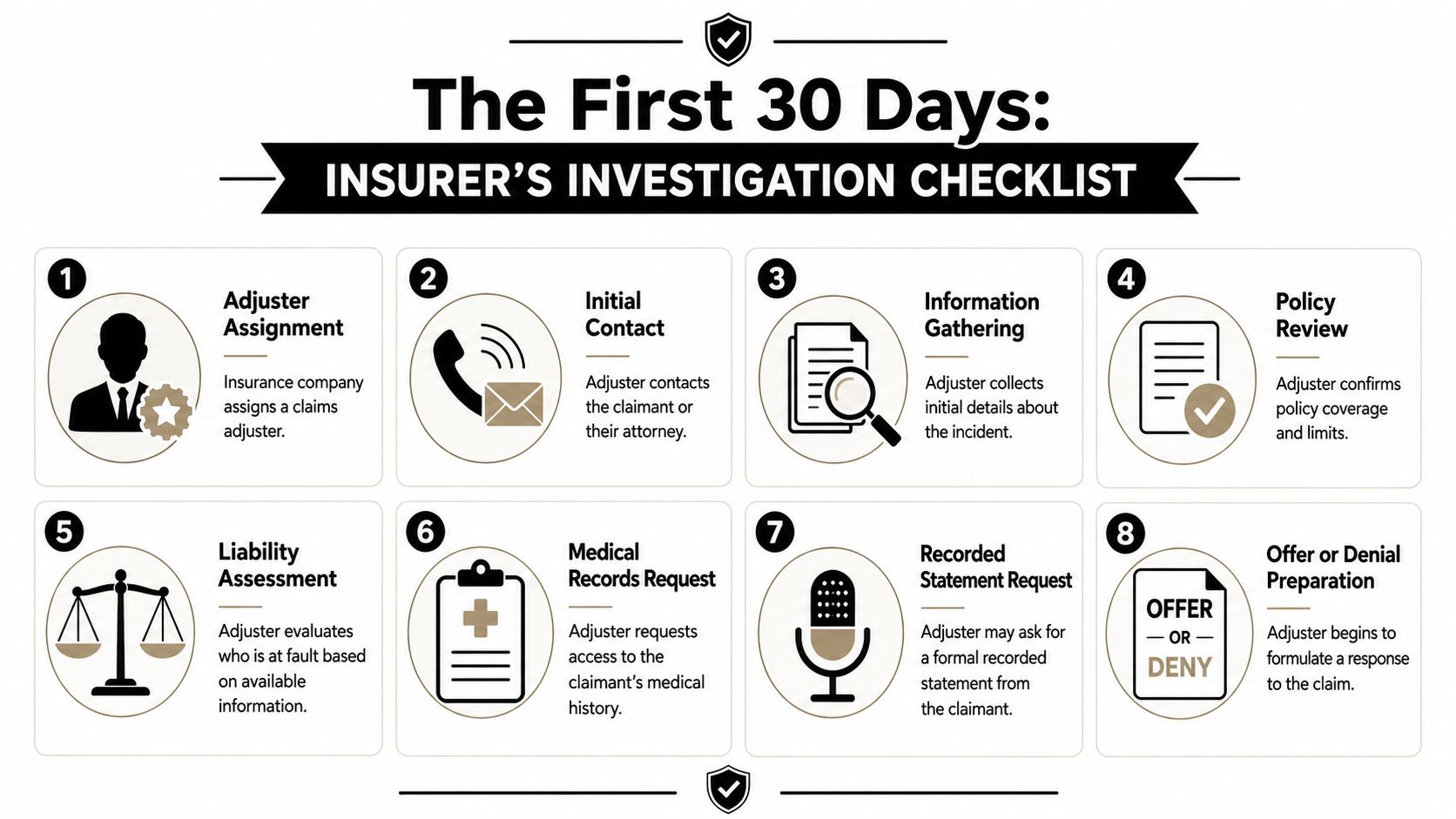
The first month matters because the insurer is building its file before you've had much time to recover. The adjuster may sound friendly, but their role is to evaluate exposure and protect the company's money. That affects what they ask for, what they focus on, and what they may leave out.
What the adjuster is doing
Most insurer investigations follow a familiar pattern:
- Assigning the claim to an adjuster who becomes the main point of contact.
- Reviewing coverage to see what policy applies and what defenses may exist.
- Collecting early records such as photos, crash reports, and repair information.
- Assessing liability by comparing each driver's version of events.
- Requesting medical authorizations that may reach farther than necessary.
- Asking for a recorded statement before the medical picture is clear.
- Preparing an early position that may lead to a low offer or denial.
The company is also watching for gaps. Gaps in treatment, gaps in documentation, and gaps between what you say and what the records show.
What you should do during the same window
Your job is different. You need to protect your health and create a clean, consistent record.
A few practical steps help:
- Get medical care promptly: Early treatment connects the injury to the accident and gives doctors a chance to document symptoms before the insurer argues they came from something else.
- Keep your appointments: If you stop care without explanation, the insurer may say you healed quickly or weren't seriously hurt.
- Save everything: Hold onto discharge papers, prescriptions, invoices, work notes, and mileage records.
- Slow down before speaking: If the adjuster wants a recorded statement, get legal advice first. Statements given too early often become ammunition later.
If you're not sure how to handle those calls, this guide on what not to say to an insurance adjuster in Texas is worth reading before you respond.
Practical rule: The insurance company starts evaluating your credibility immediately. Consistency matters from day one.
Why this phase shapes the whole case
Early investigation doesn't just affect whether you get an offer. It shapes the story the insurer tells itself about your case. If the file starts with incomplete records, vague symptoms, or a harmful statement, your lawyer has to spend time correcting that frame.
That's one reason many people call a Texas personal injury lawyer early, even before settlement talks begin. In serious cases, especially those involving a commercial vehicle or disputed fault, early mistakes can become expensive later.
Building Your Case While You Heal
While the insurer is collecting information, you should be building proof. This part of the case is less dramatic than a courtroom scene, but it often matters more. Good cases are built in ordinary moments: doctor visits, pharmacy receipts, missed shifts, follow-up appointments, and notes about how your injury changes daily life.
After a truck crash on I-45, for example, a client may remember the ambulance ride and the emergency room visit. What often gets forgotten is the next month. Trouble sleeping. Missing a child's school event. Needing help getting dressed. Taking a different route because driving now causes panic. Those details can become important evidence later.
The records that help most
Your medical file is the backbone of the injury claim, but it isn't the whole picture. Useful proof often includes:
- Treatment records: Emergency care, specialist visits, imaging, therapy, and medication history.
- Expense records: Bills, co-pays, pharmacy costs, and out-of-pocket purchases tied to recovery.
- Work loss proof: Pay stubs, employer notes, and documentation of reduced hours or job changes.
- Personal notes: A simple journal of pain levels, physical limits, and missed activities.
A journal doesn't need to be dramatic. It needs to be honest. “Couldn't lift groceries today” is often more believable and more useful than broad claims that say very little.
Why following treatment matters
Insurance adjusters often look for any excuse to argue that your condition isn't serious or isn't related to the crash. When a person misses treatment without explanation, the insurer may say the injury resolved, the person didn't think it was important, or something else caused the ongoing symptoms.
That doesn't mean you must follow every recommendation blindly. It means you should communicate with your doctors, ask questions, and make sure your records show your actual recovery.
For readers trying to understand the rehabilitation side of post-collision recovery, this article on Boston physical therapy for car accidents gives a helpful look at how therapy can fit into an injury case. The legal value in Texas comes from the same basic principle. Consistent treatment creates a clearer record.
The strongest file usually isn't the loudest one. It's the one with steady medical care, clean documentation, and a believable timeline.
Fault and responsibility still matter
Texas injury cases are fault-based. That means your claim depends on showing another party acted negligently and that the negligence caused your injuries. In many vehicle cases, that may involve speeding, distraction, unsafe lane changes, failure to yield, or poor company safety practices.
Texas also uses comparative responsibility. If the defense can show you share some fault, that can reduce what you recover. That's another reason detailed evidence matters. It helps your lawyer answer blame-shifting with documents instead of guesswork.
The Demand Letter and The Art of Negotiation
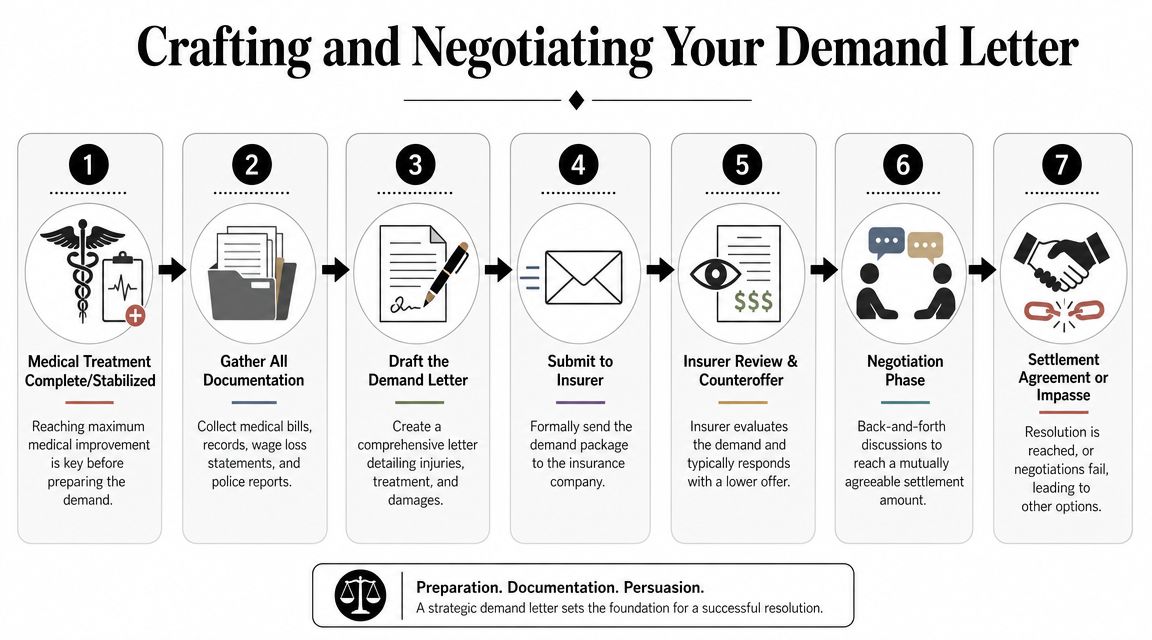
Once treatment becomes clearer and the evidence is organized, the case often enters a more deliberate stage. Your lawyer prepares a demand letter. A demand letter transforms a claim from a loose collection of bills and complaints into a structured argument for compensation.
A strong demand package tells a story the adjuster can't easily dismiss. It explains how the crash happened, why the insured is legally responsible, what your doctors found, how the injury disrupted your work and daily life, and why the requested amount is justified.
What goes into a serious demand
A real demand letter is usually built around evidence, not emotion alone. It often includes:
- Liability proof: Crash reports, photographs, witness information, and any supporting records.
- Medical support: Records, bills, diagnosis history, and the course of treatment.
- Income loss evidence: Employer verification and records showing missed work or reduced earning ability.
- Human impact: A clear explanation of pain, limitations, and the effect on normal life.
If you want to see how these packages are structured, this sample demand letter for personal injury can make the format easier to understand.
Why negotiation often feels frustrating
Most adjusters do not pay the demand amount just because it was requested. They may push back on fault, challenge treatment, question whether care was necessary, or argue that symptoms were minor. This back-and-forth is normal.
A Houston car accident claim often reaches a turning point here. If the insurer responds reasonably, the case may settle. If the insurer keeps discounting clear evidence, filing suit may become the only practical way forward.
That isn't a failure. It's strategy.
A lawsuit is often what finally forces the insurer to value the case based on evidence instead of assumption.
What works and what doesn't
Some approaches tend to help during negotiation:
| Approach | Why it helps |
|---|---|
| Waiting until the medical picture is clearer | It reduces the risk of settling before the full harm is known |
| Sending organized proof | It gives the adjuster fewer excuses to delay or minimize |
| Presenting the claim as trial-ready | It signals that low offers won't end the case |
Other approaches often hurt:
| Mistake | Why it causes problems |
|---|---|
| Settling too early | You may sign away rights before future needs are known |
| Using inflated or inconsistent claims | The adjuster may stop taking the file seriously |
| Ignoring the lawsuit deadline while negotiating | You can lose leverage, or worse, lose the claim altogether |
A Houston car accident attorney or truck crash lawyer Houston victims rely on can add real value. Good negotiation isn't about making the loudest demand. It's about showing the insurer what the case will look like if a jury eventually sees it.
When to File a Lawsuit The Statute of Limitations
There's a point in some cases when negotiation has done all it can do. The insurer won't move, liability is disputed, or the offer does not reflect the harm. At that point, filing a lawsuit may be the right step.
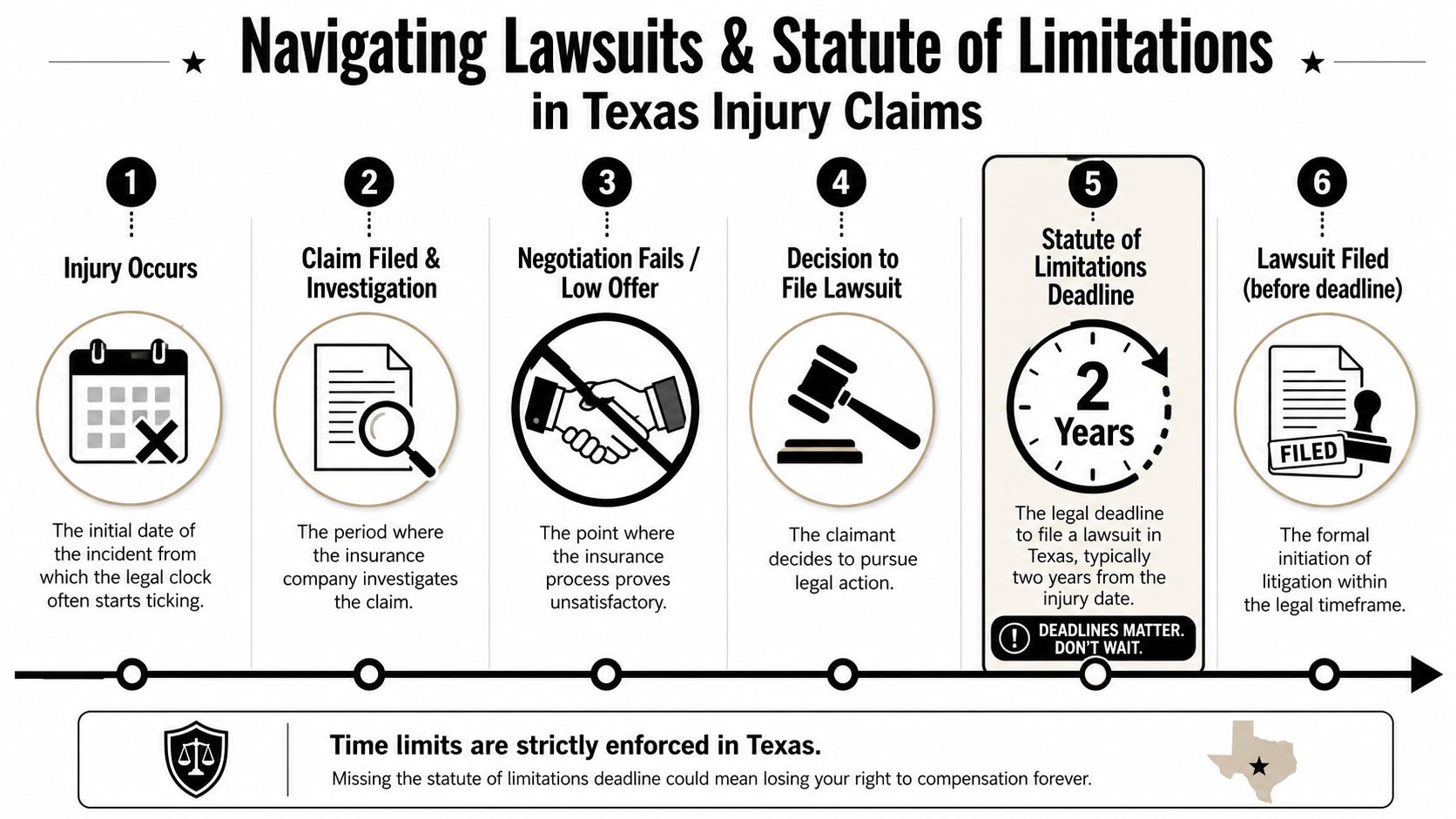
In Texas, timing matters. Most personal injury lawsuits must be filed within 2 years, and workplace injury claims have separate administrative deadlines. Injured employees generally must report the injury to the employer within 30 days and generally submit DWC Form-041 within 1 year to protect benefits, as explained in this Texas injury filing overview. If those deadlines are missed, recovery options can shrink or disappear.
What filing a lawsuit actually does
Filing suit means your lawyer drafts and files a petition in court before the legal deadline expires. That changes the case in several ways:
- The insurer no longer controls the pace alone
- The defendant must formally respond
- Court rules begin to govern evidence exchange
- Your lawyer gains stronger tools to prove fault and damages
For a closer look at those deadlines, see this page on the Texas personal injury statute of limitations.
A short video can also help make the timing issue easier to grasp:
Insurance claim versus lawsuit
These two tracks often overlap, but they aren't the same thing.
| Insurance claim | Lawsuit |
|---|---|
| Handled mainly by adjusters | Handled under court rules |
| Focuses on voluntary settlement | Creates formal deadlines and obligations |
| Can stall if the insurer chooses | Forces the case into a legal process |
| Limited by what the insurer will share | Opens the door to discovery |
The biggest mistake I see is waiting too long because settlement talks seem promising. A polite adjuster is not an extension of the filing deadline. If the deadline passes, the courthouse may be closed to the claim even if negotiations were active.
The Litigation Journey Discovery Mediation and Trial
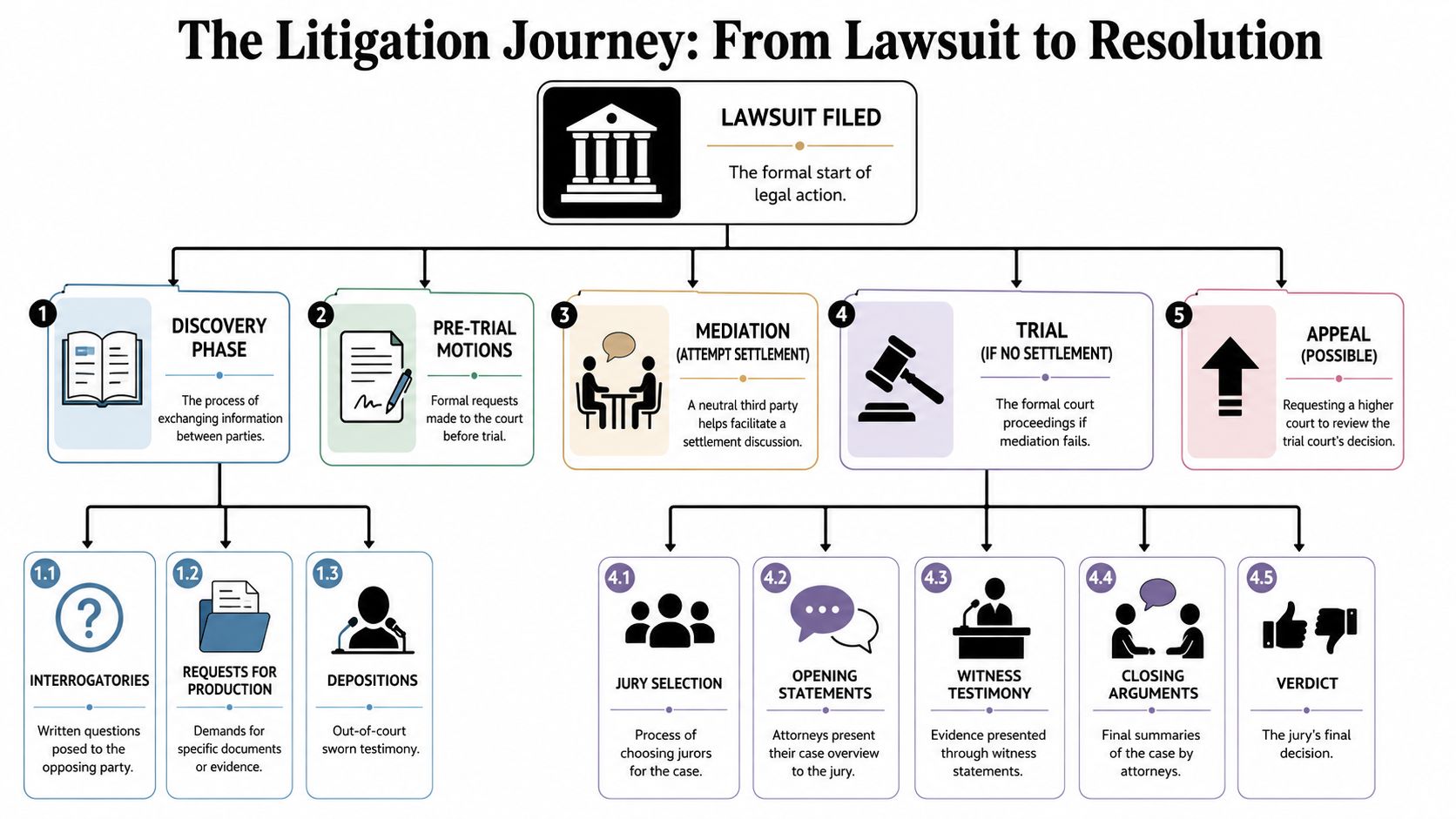
Once the lawsuit is filed, many clients expect an immediate court date. That usually isn't how it works. Litigation is a sequence of structured steps, and each one serves a purpose. In Texas, the case usually moves through service of process, the defendant's answer, and then discovery, and discovery is the phase that often changes settlement value the most because both sides exchange admissible evidence such as medical records, crash reports, depositions, and interrogatory answers, as described by Cal Mundell Law's explanation of the Texas personal injury process.
Discovery is where the case gets tested
Discovery is the formal exchange of information. In this phase, claims must be backed up with proof. It's also when weak defenses often start to crack.
Common discovery tools include:
- Interrogatories: Written questions the other side must answer.
- Requests for production: Demands for documents such as photos, maintenance records, logs, employment files, or insurance materials.
- Depositions: Sworn testimony taken outside the courtroom.
- Medical evidence exchange: Records and opinions used to prove injury, treatment, and future impact.
In a trucking case, discovery may reveal company records that weren't available during the insurance phase. In a wrongful death case, it may expose conflicting witness versions or incomplete internal investigations. In a catastrophic injury claim, it can help show the long-term impact with more precision.
Why most cases still resolve before trial
Filing suit doesn't mean a trial is guaranteed. In fact, many cases settle after discovery because both sides finally see the strengths and weaknesses clearly. That's one reason a Texas personal injury lawyer prepares every case as if it may be tried. Trial readiness often leads to more advantageous settlements.
Mediation is also a major turning point. A neutral mediator works with both sides to see whether the case can be resolved without trial. Many Texas courts expect parties to attempt mediation before a jury trial date arrives.
Discovery gives each side less room to hide behind assumptions. That alone can move settlement talks forward.
Texas rules that can affect litigation at any stage
Texas-specific rules demonstrate their importance in a very practical way.
Texas follows a form of comparative fault. If the defense can persuade a jury that you share responsibility, that affects recovery. In a rear-end crash, for instance, the defense might still argue sudden braking, defective lights, or distracted driving by the injured person. Whether that argument works often depends on the evidence gathered in discovery.
Claims involving public vehicles or city agencies bring another layer of complexity. A case against a private driver and a case against a government entity may look similar on the road, but they don't move the same way in law. Notice rules, procedural defenses, and timing can change the path quickly.
A practical legal team has to connect all of that. Medical proof, fault arguments, deadlines, witness credibility, and venue strategy all feed into the same question: what will happen if this case is presented to a judge or jury?
What trial actually means for you
If mediation fails, the case may go to trial. Trial is where lawyers present witnesses, records, expert opinions, and argument to a judge or jury. It's more formal, more demanding, and less predictable than settlement.
That said, trial also creates accountability. Some insurers only become realistic when they see that the injured person is prepared to testify, the doctors are credible, and the documents support the claim. For some families, especially after a fatal crash, trial is not just about compensation. It's also about being heard.
For Texans evaluating legal help, the Law Office of Bryan Fagan, PLLC is one option for handling car wreck, truck collision, wrongful death, and serious injury litigation across the state.
Critical Texas Rules That Can Change Your Case
Some cases look straightforward until a Texas rule changes the analysis. These rules don't just affect court filings. They can change bargaining power, strategy, and whether a claim survives at all.
Comparative responsibility can reduce recovery
Texas uses a modified comparative responsibility system. In plain English, that means fault can be shared. If the other side proves you were partly responsible, your recovery can be reduced. If the facts suggest a disputed lane change, distracted driving, or a failure to react, that issue may come up in negotiations long before trial.
This matters in everyday cases. After a Houston intersection crash, the insurer may argue both drivers made mistakes. After a commercial vehicle collision, the defense may try to shift blame onto the injured driver to reduce exposure.
Special timing rules can create traps
Texas-focused sources note that ordinary personal injury lawsuits usually have a 2-year limit, but claims against government entities can require written notice in as little as 6 months, minors may have tolling until age 18, and the discovery rule can delay the clock when injuries were not immediately apparent, as discussed in this Texas legal deadline guide.
That means the right legal question isn't always just “Was the claim filed?” Sometimes it's “Was the right notice given, to the right party, on time?”
Negligence still drives the whole case
No matter how technical the process feels, the core issue is still negligence. You must show that another person, company, or entity failed to use reasonable care and caused real harm. That may involve a distracted driver, an unsafe truck operation, a dangerous roadway condition, or a fatal collision requiring a wrongful death lawyer Texas families can call for answers.
Deadlines preserve your right to sue. Evidence is what makes the case worth bringing.
You Are Not Alone We Can Help
An injury claim can feel impersonal once forms, adjusters, and deadlines take over. But your case is still about your health, your income, your family, and your future. Clear advice matters, especially when you're trying to recover and make careful decisions at the same time.
If you're dealing with a car wreck, a commercial truck collision, a catastrophic injury, or the loss of a loved one, legal guidance can make the process more manageable. Recovery is possible, and help is available.
If you have questions about what happens after filing an injury claim in Texas, the Law Office of Bryan Fagan, PLLC offers a free consultation so you can understand your options, protect important deadlines, and decide what to do next with confidence.