Skip to content
A serious accident can change your life in seconds, but you don't have to face it alone.
If you're reading this after a Houston freeway crash, a truck collision on I-10, or a fatal wreck that turned your family upside down, you're probably dealing with more than pain. You're dealing with medical bills, missed work, calls from insurance adjusters, and a question that feels impossible to answer under pressure: should you settle, or should you go to trial?
That decision matters because it affects your time, your stress level, your financial recovery, and your family's future. Some cases should settle. Some should be prepared for court from day one. In many Texas injury claims, the answer is more strategic than people expect. A strong case often settles because the lawyer is ready to try it.
A good Texas personal injury lawyer should help you understand both paths in plain English. That includes how fault works, what negligence means, how comparative responsibility can reduce recovery, and why deadlines like the statute of limitations can shape your options. It also means discussing candidly what strategies are effective in actual circumstances, not just what sounds tough.
A Serious Accident Can Change Your Life in Seconds
After a serious wreck, victims typically don't start by thinking about litigation strategy. They think about the ER bill, the totaled vehicle, the next missed paycheck, and whether they'll ever feel normal again. That's especially true after a violent car crash, a commercial truck collision, or the loss of a loved one in a wrongful death case.
Texas law gives injured people the right to seek compensation when someone else's negligence caused harm. In simple terms, negligence means a person or company failed to use reasonable care. That might be a distracted driver, a trucking company that cut corners, or a property owner who ignored a dangerous condition.
What clients usually need first
Before the settlement-versus-trial question even becomes urgent, most families need a few basic things:
- Medical stability: Follow treatment, keep records, and don't ignore new symptoms.
- Financial clarity: Track missed work, out-of-pocket costs, and insurance correspondence.
- Legal direction: Get advice before giving detailed statements to the other side.
- A realistic plan: Know whether your claim is likely to resolve through negotiation or whether litigation may be necessary.
Practical rule: The best early decision is usually not “settle or trial.” It's “protect the case before the insurance company defines it for you.”
A lot of injured Texans worry that hiring a lawyer means signing up for a long courtroom fight. That isn't how most cases work. But it is true that if the insurer doesn't take your injuries seriously, your case may need pressure. That pressure comes from evidence, deadlines, expert preparation, and a legal team that can prove it's ready to put the case in front of a jury if necessary.
If you're comparing settlement vs trial in a Texas personal injury case, the goal isn't to pick the most aggressive-sounding option. The goal is to choose the path that gives you the best recoverable result with the least unnecessary risk.
The Two Paths to Justice An Overview of Settlement and Trial
A settlement is a negotiated agreement. You and the at-fault party's insurer, or sometimes multiple parties, agree on a payment amount and resolve the claim without asking a jury to decide it. A settlement gives you a defined result. In exchange, you usually give up the right to continue pursuing that claim.
A trial is different. The case goes into court, evidence is presented, witnesses testify, and a judge or jury decides fault and damages. That process is public, formal, and less predictable.
What usually happens in Texas injury cases
In practice, settlement is the normal path. National research summarized by Justia notes that only about 3% of all tort matters result in a jury trial, while roughly 95% of personal injury cases settle before trial according to Justia's settlement-versus-trial overview.
That should reassure you. Most injured Texans won't need to sit through a full trial to recover compensation. Still, a case often settles fairly only when the other side believes trial is a real possibility.
If you want a plain-English explanation of what happens after a lawsuit is filed, this guide on what litigation lawyers do in injury cases helps explain the court process without legal jargon.
Settlement and trial serve different purposes
Settlement works best when both sides can value the case realistically. Trial becomes more important when they can't. That may happen when:
- Liability is disputed: The insurer says you caused the crash.
- Injuries are minimized: The adjuster argues you weren't hurt as badly as your doctors say.
- Future losses are contested: Ongoing care, lost earning ability, or permanent impairment are in dispute.
- The carrier delays: The company drags out the process hoping you'll accept less.
One helpful resource is The Texas Personal Injury Settlement Process, which explains what to expect from demand through settlement or trial.
Going to court and being ready for court aren't the same thing. In many strong cases, real trial preparation is what opens the door to serious settlement talks.
Settlement vs Trial A Head-to-Head Comparison for Your Claim
When families compare settlement vs trial for a personal injury claim in Texas, they're usually weighing several concerns at once. They want fair compensation, but they also want closure. They want accountability, but they also need to know how long the process could take and how much uncertainty they can handle.
Here's a side-by-side look at the practical trade-offs.
| Factor | Settlement | Trial |
|---|---|---|
| Control over outcome | You choose whether to accept the agreement | A jury or judge decides the outcome |
| Timeline | Often resolves sooner | Usually takes longer because of court scheduling, discovery, and testimony |
| Costs and case burden | Usually less intensive than full trial preparation | Requires more preparation, more witnesses, and more litigation expense |
| Privacy | Often more private than a courtroom proceeding | Court filings and proceedings are generally public |
| Certainty of recovery | Agreed amount provides predictability | Outcome is uncertain, including the possibility of losing |
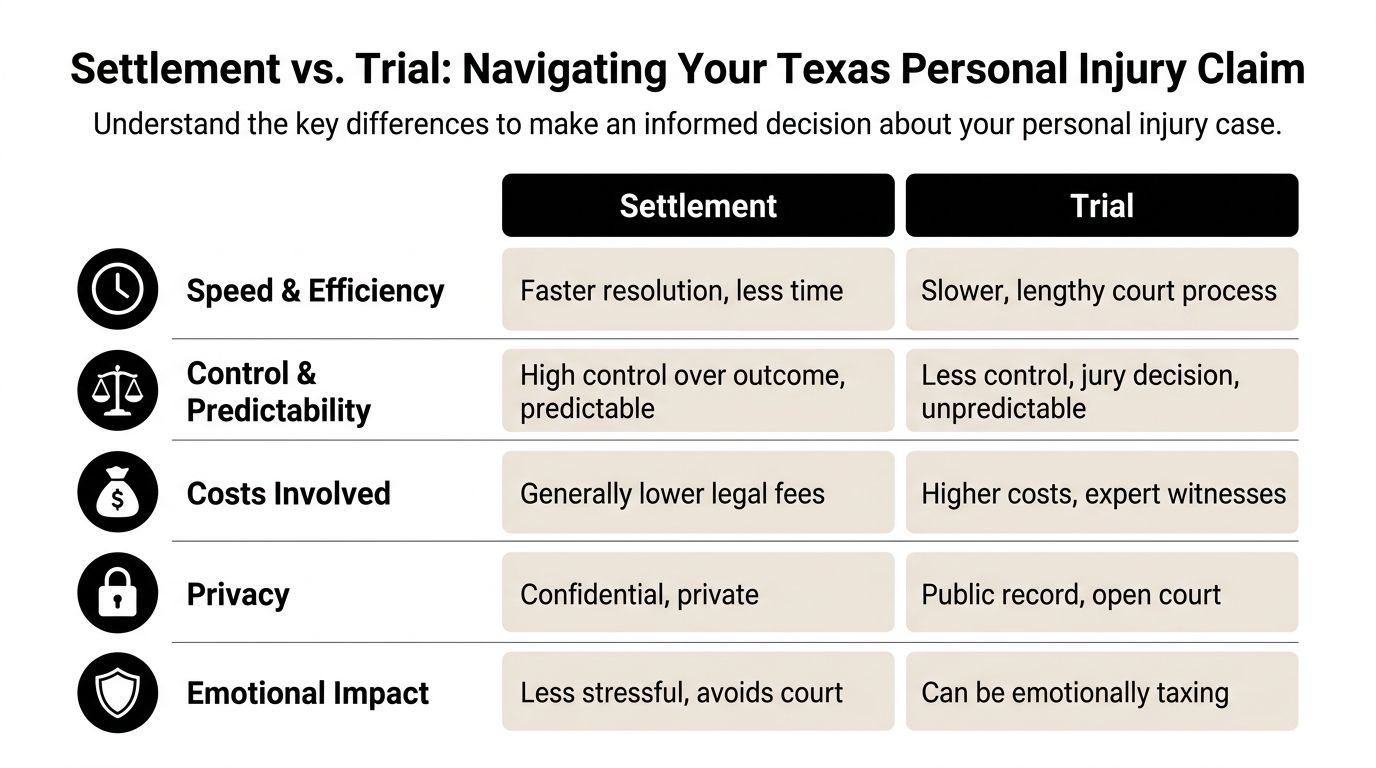
Control matters more than people think
In a settlement, you keep decision-making power. You can reject a low offer. You can demand additional terms. You can decide that guaranteed money now is better for your family than gambling on a verdict later.
At trial, control shifts. Your lawyer presents the strongest case possible, but jurors bring their own views, life experience, and reactions to witnesses. That doesn't mean trial is bad. It means trial carries a different kind of risk.
Take a Houston freeway crash involving a commercial truck. If the trucking company clearly caused the collision and the medical proof is strong, the insurer may settle once it sees the case is organized and ready. If the company insists your injuries are minor or claims you changed lanes unsafely, trial pressure may be the only way to move negotiations.
Time and emotional cost
Settlement is usually easier on injured people and families. It avoids testimony, cross-examination, and the stress of waiting for a verdict. For someone recovering from surgery or grieving a loved one, that matters.
Trial takes stamina. You may need to sit through depositions, medical examinations requested by the defense, pretrial hearings, and the courtroom process itself.
Consider these real-world concerns:
- If you need funds sooner: Settlement may better support immediate medical and household needs.
- If the insurer won't be reasonable: Trial preparation may be necessary to strengthen your position.
- If public accountability matters to you: Some clients prefer a jury to hear what happened.
- If privacy matters more: Settlement often keeps details more contained.
Some clients don't want a fight. Others don't want to be pushed around. A smart strategy respects both concerns.
Certainty versus upside
A settlement gives certainty. A trial offers possibility. Sometimes that possibility is important, especially in severe injury or wrongful death claims where the defense refuses to acknowledge the full scope of loss.
But bigger isn't always better if it isn't collectible. That's one of the most overlooked parts of the settlement vs trial personal injury Texas conversation. If the insurance policy is limited and the defendant has no meaningful assets, a large verdict on paper may not translate into money in hand.
That's why experienced lawyers evaluate not only what a case could be worth, but what can be recovered.
Key Texas Laws That Shape Your Decision
Texas law doesn't just affect what you can recover. It affects how risk should be evaluated when deciding between settlement and trial.
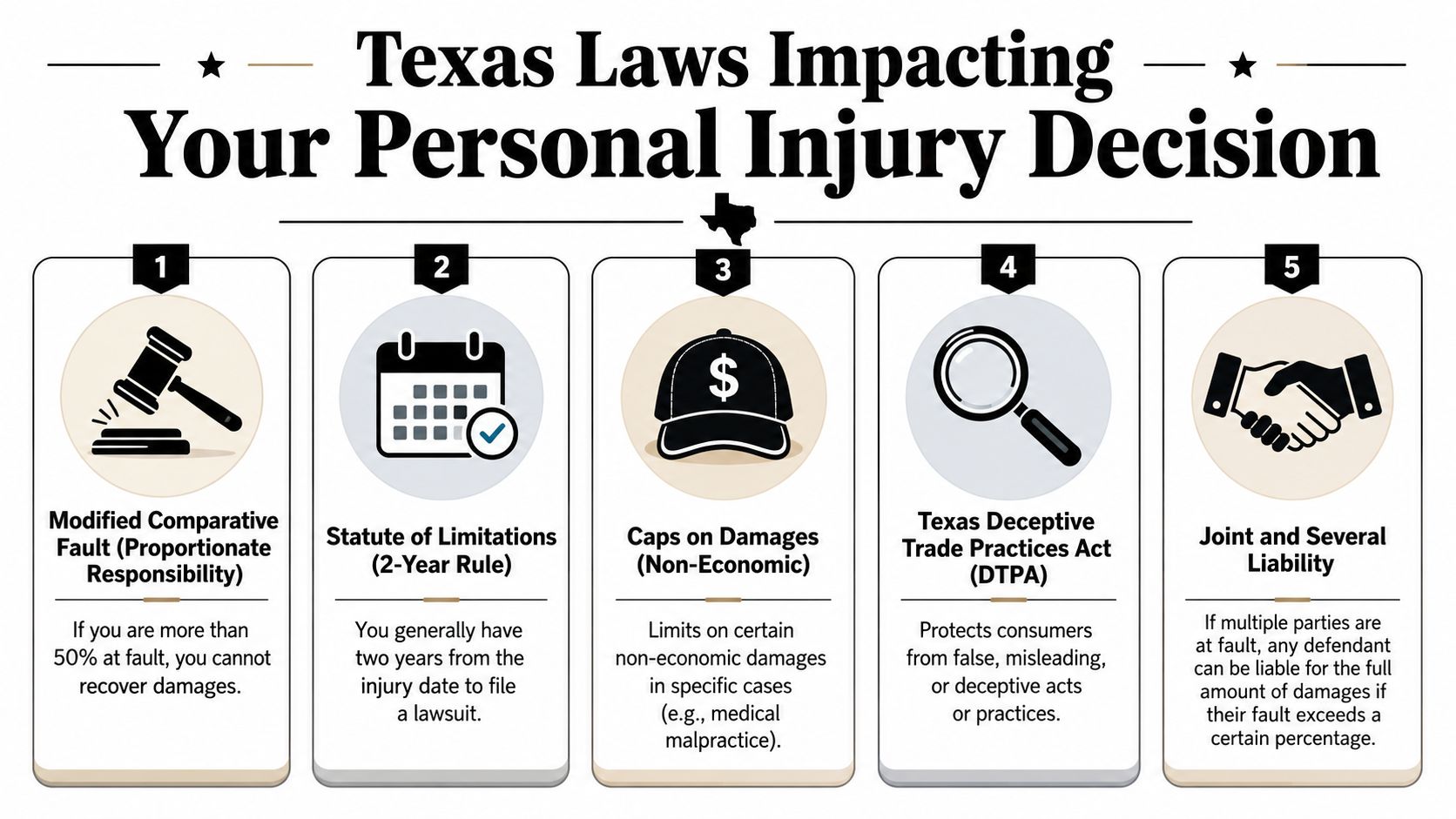
Comparative responsibility under the 51 percent bar rule
Texas follows a modified comparative fault system. If you are found less than 51% at fault, you can still recover damages, but your recovery is reduced by your share of fault. If you are 51% or more at fault, you recover nothing.
One Texas source explains the rule this way: if a jury finds a plaintiff 30% at fault on a $100,000 verdict, recovery drops to $70,000. If the plaintiff is 51% or more at fault, recovery is zero, as described in this explanation of Texas comparative fault and injury recovery.
That rule can change settlement dynamics fast. In a rideshare case, a pedestrian claim, or a multi-vehicle wreck, the insurer may try to shift blame to you because even partial fault changes the math. If you'd like a broader explanation, this guide to comparative fault in Texas injury cases is a useful starting point.
The statute of limitations
Texas personal injury claims are subject to a filing deadline called the statute of limitations. In most standard injury cases, you generally have a limited period to file suit. Waiting too long can destroy an otherwise valid claim.
That doesn't mean you should rush into a weak settlement just to “get something.” It means you should get legal advice early enough to preserve options. A Texas personal injury lawyer can determine the correct deadline, identify any exceptions, and make sure the insurer doesn't use delay against you.
Damage caps and special claim rules
Not every injury case follows the same damages rules. Certain case types, especially those involving specialized legal claims, may involve caps or procedural requirements. That can affect the settlement value and the trial strategy.
For example, if a case includes capped damages, both sides know there may be a ceiling on part of the recovery. In that setting, the legal fight may focus less on dramatic verdict potential and more on proving every recoverable category of loss as clearly as possible.
The law doesn't just answer who was wrong. It also shapes how much risk each side is willing to take.
What Is Your Texas Personal Injury Case Really Worth

A case is not worth what an adjuster says in the first phone call. It is worth what the facts prove, what the losses justify, and what money is available to pay the claim.
That question matters early because families need real numbers, not guesses. Medical bills keep coming. Paychecks may have stopped. You also need to know whether a settlement offer reflects the case as it stands today or whether trial preparation is needed to force a serious evaluation.
The starting point is usually economic damages and non-economic damages. Economic damages include medical bills, lost income, reduced earning capacity, and future care. Non-economic damages cover pain, physical impairment, disfigurement, and the day-to-day ways an injury changes a person's life. In a wrongful death case, the value analysis also includes the losses tied to a loved one's death.
Why headline verdicts can mislead people
Large verdicts get attention, but they do not tell you what your case will likely resolve for.
Averages are especially misleading in injury law. A small number of catastrophic verdicts can pull the number upward, while many claims resolve for far less because the injuries are different, the proof is weaker, or the available insurance is limited. A brain injury case, a fatal 18-wheeler crash, and a soft-tissue rear-end collision should not be measured by the same yardstick.
I often tell clients that case value has two parts. First, what a jury could reasonably award if everything goes well. Second, what can be collected. Those numbers are sometimes very different, and that gap often explains why a case settles after suit is filed but before trial.
What actually drives value
A lawyer putting a real value range on a case usually looks at several practical factors:
- Medical proof: Records, imaging, diagnoses, treatment history, and opinions about future care.
- Liability evidence: Police reports, witness statements, photos, video, company records, and electronic data when available.
- How the injury changed your life: Missed work, physical limits, chronic pain, loss of independence, and strain on family relationships.
- Insurance and collectability: Policy limits, umbrella coverage, business coverage, and whether the defendant has reachable assets beyond insurance.
If your claim arose from a wreck, this guide on how much a Texas car accident case may be worth gives a more detailed breakdown of the factors that affect value.
One practical point gets overlooked. Trial readiness often increases settlement value because it changes how the insurance company measures risk. If the defense believes your lawyer intends to file suit, take depositions, hire the right experts, and present the case to a jury, low offers tend to get harder to justify. Many cases still settle after a lawsuit is filed, after written discovery, after mediation, or even on the courthouse steps. That is common in Texas injury cases, especially when the defense finally sees the full medical picture, the exposure under the policy, and the risk of a verdict they cannot comfortably defend.
For families facing permanent injury or a death, valuation also becomes more fact-specific. The numbers depend on the long-term care needs, the strength of the liability evidence, the available coverage, and whether any judgment beyond insurance would be collectible.
How to Decide Factors for You and Your Attorney to Consider
A family can be one low offer away from a mistake that affects them for years. The hard part is that the wrong decision does not always look wrong in the moment. It can look like relief, speed, and money in hand.
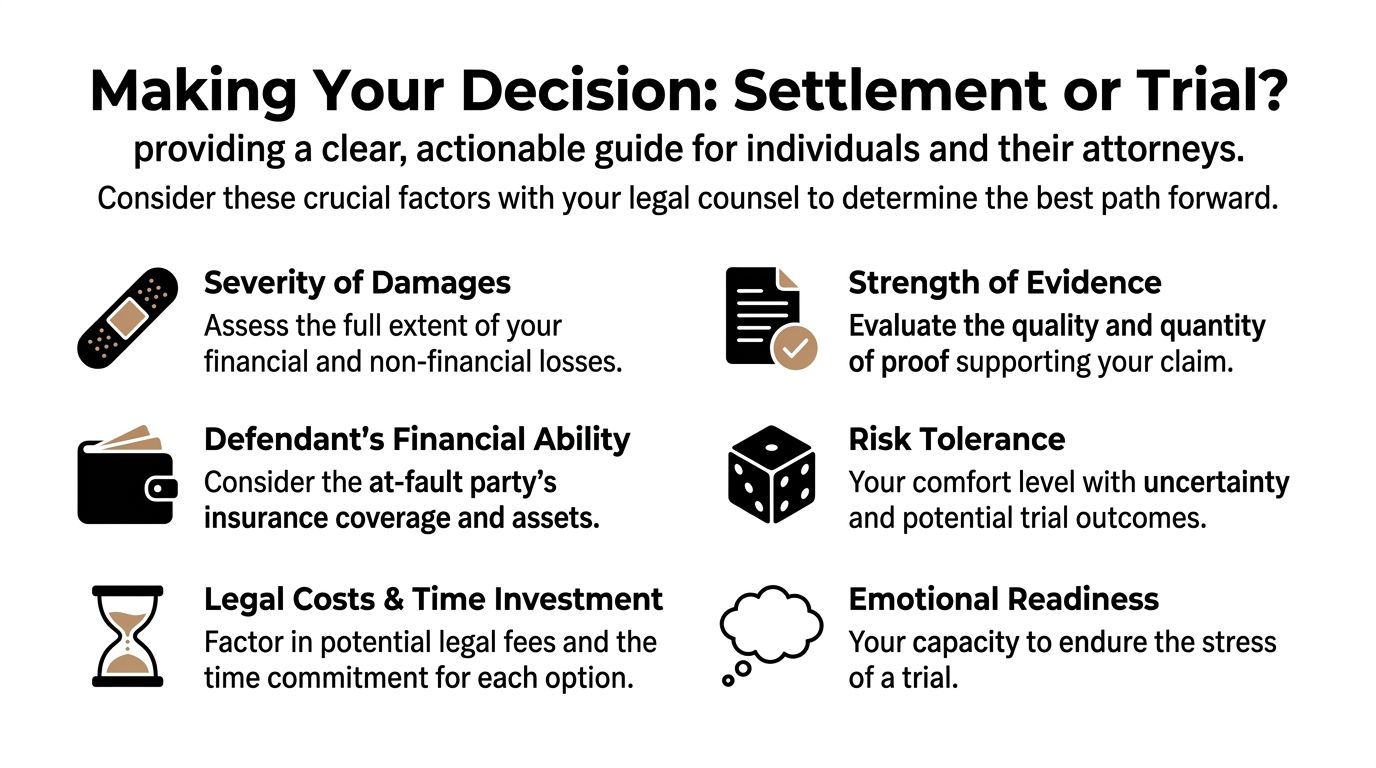
The decision to settle or keep pushing is usually shaped by four practical realities. How strong the proof is. How serious the harm is. How much insurance or reachable money exists. How much delay and uncertainty the client can reasonably carry.
The questions that matter most
When I evaluate whether a case should settle now or be prepared for trial, I focus on questions like these:
- How strong is the evidence? Clear fault, consistent medical records, reliable witnesses, and documented losses put significant pressure on the defense.
- How serious are the damages? Surgery, permanent limitations, future treatment, disfigurement, or a death claim often justify pushing harder.
- Is the insurance company acting reasonably? Some adjusters make fair evaluations early. Others do not pay serious attention until suit is filed and discovery begins.
- What coverage is available? In many Texas injury cases, policy limits shape the realistic recovery range.
- If a verdict exceeds coverage, can it be collected? A paper judgment and money in the bank are not the same thing.
- What does the client need right now? Fast closure matters in some cases. In others, waiting is the better financial decision.
Trial readiness changes settlement value
One point many injured Texans do not hear early enough is this: filing a lawsuit does not mean the case is destined for a jury verdict. It often means your lawyer is building the kind of case the insurance company has to take seriously.
Settlement can happen at any stage. Before suit. After filing. During written discovery. After depositions. At mediation. After the jury is picked. Sometimes even after a verdict while post-trial motions or appeals are still being worked through.
That timing matters. A case often becomes more valuable once the defense sees sworn testimony, expert opinions, full medical proof, and the risk of a result that could reach or exceed available coverage. Trial readiness is not about being dramatic. It is about creating bargaining power by showing the insurer that delay will not force a cheap resolution.
What tends to push the decision one way or the other
Cases often lean toward settlement when the available policy limits are clear, the amount is collectible, and the offer reflects the actual harm done.
Cases often lean toward trial preparation when liability is disputed, the injuries are being minimized, the insurer is ignoring strong evidence, or the offer does not come close to matching the long-term impact on the client's life.
I also look closely at collectability. If the defendant has a $30,000 policy and no meaningful assets, that fact changes the conversation. Even a strong trial case may call for a careful policy-limits strategy instead of chasing a larger number that cannot realistically be recovered.
What helps and what hurts
What usually helps:
- Preserving evidence early
- Following through with treatment
- Documenting wage loss and daily limitations
- Understanding coverage before making demands
- Preparing the case as if trial may be necessary
What usually hurts:
- Taking the first offer because the bills are stressful
- Assuming a lawsuit automatically means months in a courtroom
- Ignoring policy limits and collectability
- Settling before the medical picture is clear
Clients also need a lawyer who can explain these decisions plainly and present the case credibly. For readers interested in how firms communicate trust and clarity online, this guide on optimizing law firm online presence gives a useful outside perspective.
You Don't Have to Face This Decision Alone
A family can be sitting at the kitchen table with medical bills on one side, a settlement offer on the other, and no clear way to judge whether the number is fair. That is usually the moment legal advice matters most.
The settlement-versus-trial decision is personal, but it should be made with clear facts. You need a lawyer who can explain what the claim is worth, whether the insurer is negotiating in good faith, and whether real trial preparation will put more pressure on the carrier to pay fairly. Many cases still resolve after a lawsuit is filed. In fact, filing suit often changes the conversation because the insurance company sees that the case is being prepared for depositions, experts, and a jury.
Collectability matters just as much as case value. A strong verdict on paper does not always turn into money in hand. If the available insurance is limited and the defendant has no meaningful assets, the practical goal may be to secure the full recoverable amount without spending years chasing a judgment that cannot be collected. That practical point is central to any discussion of settlement strategy in injury cases.
What you should do right now
Keep the focus on a few concrete steps:
- Continue treatment: Gaps in care can hurt your recovery and give the insurer an argument that you were not seriously injured.
- Be careful with insurers: Do not guess about your condition, minimize symptoms, or give a recorded statement without legal advice.
- Save documents: Keep bills, discharge papers, prescriptions, wage-loss records, and photos in one place.
- Talk to a lawyer early: Early case review helps preserve evidence, identify insurance coverage, and avoid mistakes that are hard to fix later.
For those interested in how law firms communicate legal information online before choosing counsel, this resource on optimizing law firm online presence offers a useful look at how legal services are presented and found.
Clear advice can restore a sense of control. Some cases should settle early. Some should be filed and pushed through litigation so the insurer takes the risk seriously. Some need a trial date before a fair offer shows up.
If you need guidance after a crash, a catastrophic injury, or the loss of a loved one, Law Office of Bryan Fagan, PLLC offers free consultations for injured Texans and their families. You can speak with a team that handles car, truck, wrongful death, and serious injury claims across Texas, get answers about your rights, and learn what path may make the most sense for your case. You don't have to figure this out alone. Legal help is available, and your recovery matters.