Skip to content
A serious accident can change your life in seconds, but you don't have to face it alone.
If you're reading this after a Houston freeway crash, a truck wreck outside Dallas, or a serious intersection collision anywhere in Texas, you're probably dealing with pain, paperwork, and pressure all at once. It is commonly believed that a claim starts when a lawsuit is filed. In real life, the most important work often starts much earlier, in the hours and weeks after the accident, when evidence is fresh and insurance companies are already sizing up your case.
The personal injury claim process Texas step by step is not just a legal checklist. It's a series of choices that can strengthen your claim or weaken it. What you say to the adjuster matters. Whether you get medical care matters. Whether you document missing wages, save photos, and understand fault rules matters. If you were hurt in a car crash, truck collision, catastrophic injury event, or your family is pursuing a wrongful death case, those early decisions often shape the value of the claim long before anyone talks about trial.
A good Texas personal injury lawyer helps you protect the case before it slips off course. That matters whether you need a Houston car accident attorney after a commuter crash, a truck crash lawyer Houston families can call after a commercial vehicle collision, or a wrongful death lawyer Texas relatives can trust after a fatal wreck.
Your First 24 Hours After a Texas Accident
The first day feels chaotic. Keep your focus narrow. Protect your body, protect the scene, and protect the facts.
If you're able, think of the first hour after a wreck on I-45 or at a neighborhood intersection in terms of sequence, not panic. Texas guidance emphasizes immediate steps like calling police when needed, gathering driver and witness information, taking photos, notifying your insurer, and writing down a timeline early because this intake-and-evidence phase can determine whether a claim remains viable later, as explained by the Texas Department of Insurance guidance after a wreck.
What to do at the scene
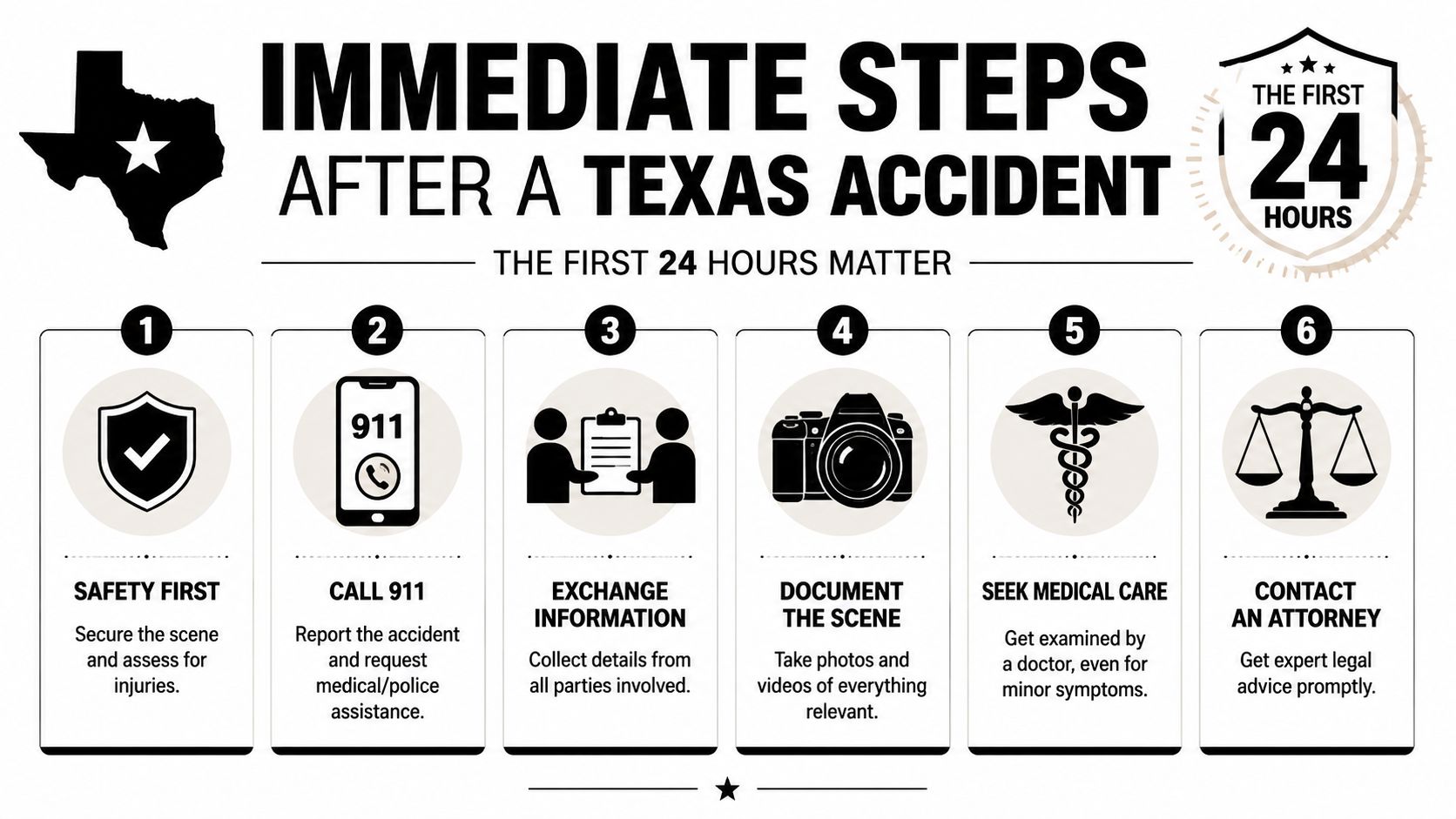
Use this order if you can:
- Get to safety: Move out of traffic if it's safe to do so. Check yourself and others for obvious injuries.
- Call 911: Ask for police and medical help if anyone is hurt or the scene is unsafe.
- Exchange information: Get the other driver's name, contact details, plate number, and insurance information if available.
- Identify witnesses: Ask for names and phone numbers before people leave.
- Photograph everything: Vehicles, skid marks, debris, road signs, weather conditions, visible injuries, and the wider scene.
- Notify your insurer: Report the collision promptly, but keep it factual.
Practical rule: Give facts, not conclusions. “A truck hit my driver-side door” is safer than “I'm fine” or “It was probably my fault.”
What not to say
Many injured people hurt their claim by trying to be polite. Don't apologize for the crash. Don't guess about speed, distance, or who had the light. Don't minimize your condition just because adrenaline is masking symptoms.
If the other driver doesn't have insurance details, document the plate, vehicle make, vehicle model, and the person's identifying information if you can. If you're too injured to gather evidence yourself, ask a passenger, family member, bystander, or responding officer for help. What matters is preserving facts while they still exist.
Start your timeline the same day
Before the day ends, write down what happened in plain language. Include where you were going, what lane you were in, what you saw, what you felt, and when pain started. Small details fade fast.
For a fuller checklist, review these steps to take immediately after an accident in Texas. That kind of early documentation often becomes much more important than people expect.
Building Your Case from Day One
After the wreck, your case grows on two tracks at the same time. One is medical. The other is proof.
A strong claim doesn't come from one dramatic photo or one angry call to the insurance company. It comes from a consistent record that shows what happened, what injuries you suffered, how treatment unfolded, and how your life changed afterward. That's true after a suburban rear-end crash and after a major truck collision on a Dallas highway.
The medical track
Your medical care serves two purposes. It protects your health, and it creates the record that ties your injuries to the accident.
That means you should:
- Get examined promptly: Some injuries show up hours or days later.
- Follow the treatment plan: If a doctor recommends follow-up care, physical therapy, imaging, or a specialist, take that seriously.
- Keep every record: Visit summaries, work notes, prescriptions, bills, and referrals all matter.
- Track symptoms in real time: Pain levels, sleep problems, headaches, mobility issues, and missed daily activities help tell the full story.
Gaps in treatment create problems. Insurance adjusters often argue that if you missed appointments or stopped care too early, you must not have been badly hurt. Sometimes there's a real reason for those gaps, like transportation issues or cost. But if that's your situation, document it and tell your lawyer early.
The evidence track
Physical evidence disappears fast. Vehicles get repaired. Surveillance footage gets deleted. Witnesses stop answering unknown numbers.
Build a simple case file with:
- Scene evidence: Photos, videos, crash report details, witness contacts
- Property evidence: Damaged phone, helmet, child seat, clothing, vehicle parts
- Income proof: Pay stubs, employer letters, missed shift records, self-employment records
- Daily impact notes: Tasks you can't do, events you missed, help you now need at home
Save damaged items unless your lawyer tells you otherwise. A torn jacket or cracked motorcycle helmet can become useful evidence later.
If you want a practical guide to documentation, this article on what evidence is needed for an injury claim in Texas is a useful starting point.
You should also understand what losses may be part of the claim. What Damages Can You Recover in a Texas Injury Case? outlines the categories of compensation available to Texas injury victims.
A simple way to stay organized
| Record type | Why it matters |
|---|---|
| Medical records | Connects treatment to the crash |
| Bills and receipts | Shows financial loss |
| Employer documentation | Supports lost income claims |
| Photos and video | Preserves conditions that quickly change |
| Personal journal | Shows day-to-day impact in your own words |
This is the part of the process where discipline beats drama. The better your record, the harder it is for the other side to rewrite your story.
Navigating Insurance and Initiating Your Claim
Insurance companies need notice of the claim. That does not mean they need unrestricted access to your words.
Many people make the same mistake early. They think cooperation means saying yes to every request, including recorded statements, broad medical authorizations, and casual conversations with adjusters who sound friendly. Careful communication usually works better than quick communication.
Report the claim without oversharing
Give the insurer the basics needed to open the file. Date, location, vehicles involved, and the fact that you were injured and are receiving treatment. Keep it accurate and short.
A recorded statement can lock you into wording before you know the full scope of your injuries. That matters because symptoms often evolve, and disputed facts often become sharper after the crash report, photos, and witness accounts are reviewed.
If the injury happened while you were working or driving for your job, coverage questions can get complicated. In those cases, it may help to understand how Texas workers' compensation insurance fits into the broader picture, especially when more than one policy may be involved.
The adjuster's job is to evaluate exposure for the carrier. Your job is to protect the accuracy and value of your claim.
The demand letter is the turning point
Texas guidance notes that the claim process is shaped by the state's two-year statute of limitations, and that the pre-suit timeline commonly involves filing the claim, sending a detailed demand letter after reaching maximum medical improvement, and negotiating before a lawsuit becomes necessary, as discussed in this overview of the Texas injury settlement process.
A demand letter is not just a letter asking for money. A strong demand package usually pulls together:
- Liability proof: Why the other party is legally responsible
- Medical support: Records, diagnoses, treatment history, and prognosis
- Economic loss documents: Bills, wage loss proof, and related expenses
- Narrative damages: How the injury affected work, mobility, sleep, family life, and routine activities
The timing matters. Sending a demand too early can undervalue the case because the full medical picture isn't clear. Waiting too long can leave you boxed in by deadlines and stale evidence.
Why strategy matters before any lawsuit
The pre-litigation phase is where many claims are won or quietly weakened. A well-prepared file tells the insurer you're organized, medically documented, and ready to escalate if necessary. A sloppy file invites delay.
If you want a clearer picture of how this stage moves toward resolution, review this explanation of the Texas personal injury settlement process. It helps many clients understand why patience and preparation often work better than urgency.
The Negotiation and Settlement Phase
Negotiation rarely starts with the insurance company's best number. It usually starts with a test.
After the demand goes out, the adjuster studies the claim for soft spots. Maybe treatment was delayed. Maybe fault is disputed. Maybe there's a prior injury in the records. The first offer often tells you less about the case value and more about how seriously the insurer thinks it must take your side.

How a typical negotiation unfolds
Take a common example. You're injured in a Houston collision. The other driver's carrier accepts that its insured caused the crash, but the adjuster argues your treatment was excessive and your pain complaints are subjective. The opening offer comes in low.
A good response is not outrage. It's pressure built from proof.
That response may include a tighter summary of medical findings, a more direct explanation of lost income, photos that show force of impact, and a clear explanation of why the insurer's weak points don't hold up. It is through these actions that a Texas personal injury lawyer earns value. Not by making noise, but by making the claim harder to discount.
What works and what doesn't
What works:
- Consistency: Medical records, symptoms, and daily limitations line up.
- Specifics: Dates, providers, work interruptions, and visible injury progression are documented.
- Credibility: The demand asks for compensation that matches the proof.
What doesn't:
- Guessing at value: “My case should be worth a lot” doesn't move an adjuster.
- Angry calls: Emotion without documentation usually goes nowhere.
- Rushing to settle: Early money can look tempting when bills are piling up.
For many clients, learning the mechanics of back-and-forth negotiations helps reduce stress. This guide on how to negotiate a personal injury settlement shows what that process looks like in practical terms.
Here's a helpful overview if you want to see this phase discussed visually.
When to accept and when to hold firm
A fair settlement is not just about the top-line number. It has to account for the full impact of the injury and the risks of continued litigation. Sometimes settlement is the right answer because it gives you certainty and closure. Sometimes the offer is too low because the insurer still thinks you won't push further.
Settlement should happen when the number reflects the evidence and the risk. Not when the pressure feels unbearable.
That judgment call becomes especially important in severe injury, truck crash, and wrongful death claims, where disputed liability or future losses can make the gap between positions much wider.
When Filing a Lawsuit Becomes Necessary
Filing suit is not a failure of the claim process. Sometimes it's the step that finally forces real engagement.
Insurers tend to move differently when they know a deadline is approaching and a plaintiff is prepared to litigate. A lawsuit becomes necessary when the carrier refuses to make a reasonable offer, denies liability despite strong proof, delays until the clock becomes dangerous, or disputes the seriousness of the harm in a way that can't be solved through letters alone.
What filing suit actually does
The Texas claim workflow is time-sensitive. An injured person must typically file a lawsuit within two years of the injury, and missing that statute of limitations usually bars the claim permanently, which is why treatment, evidence preservation, notice, and demand work must be handled efficiently, as explained in this guide to the steps for filing a Texas personal injury lawsuit.
Filing suit protects your legal rights before that deadline expires. It does not mean your case is automatically headed for trial next week. In many cases, filing opens the door to formal evidence exchange and more serious settlement discussions.
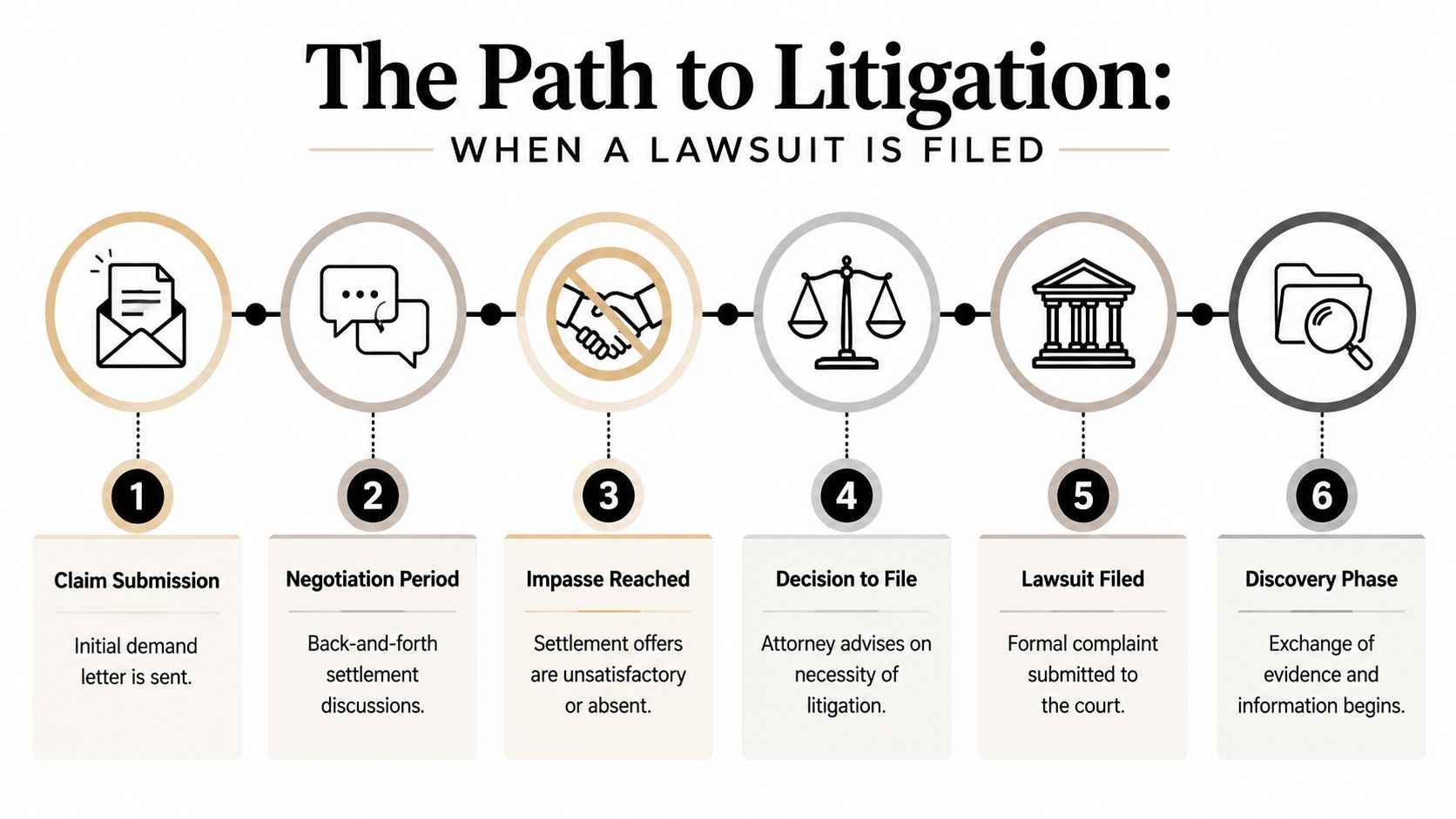
The usual litigation path
Once the lawsuit is filed, the case may move through stages like:
- Petition filed: The formal complaint starts the court case.
- Answer from the defense: The other side responds and raises defenses.
- Discovery: Both sides exchange documents, written questions, and testimony.
- Mediation: A structured settlement effort with a neutral third party.
- Trial preparation: If no agreement is reached, the case gets ready for court.
In a wrongful death case, for example, a defendant may deny fault entirely even when the family believes the facts are clear. Discovery can uncover records, witness statements, and internal materials that weren't available during the claim stage. That's often why litigation provides an advantage.
When to call a lawyer before this point
If liability is disputed, the injuries are serious, a commercial vehicle is involved, or the insurer is dragging its feet, waiting can be expensive. A Texas statute of limitations guide for injury claims can help you understand the deadline issue, but deadlines are only part of the problem. Evidence loss is the other.
The earlier counsel gets involved, the more options you usually have.
How Texas Laws Affect Your Final Compensation
The settlement figure you hear first is not always the amount you receive in the end. Texas law and claim structure can change the result in ways that surprise people.
Many clients need plain answers, not slogans. The most important question is often not “Can I recover?” It's “How much of my compensation could I lose because of fault arguments, low insurance limits, or reimbursement claims?”
Comparative fault can cut or block recovery
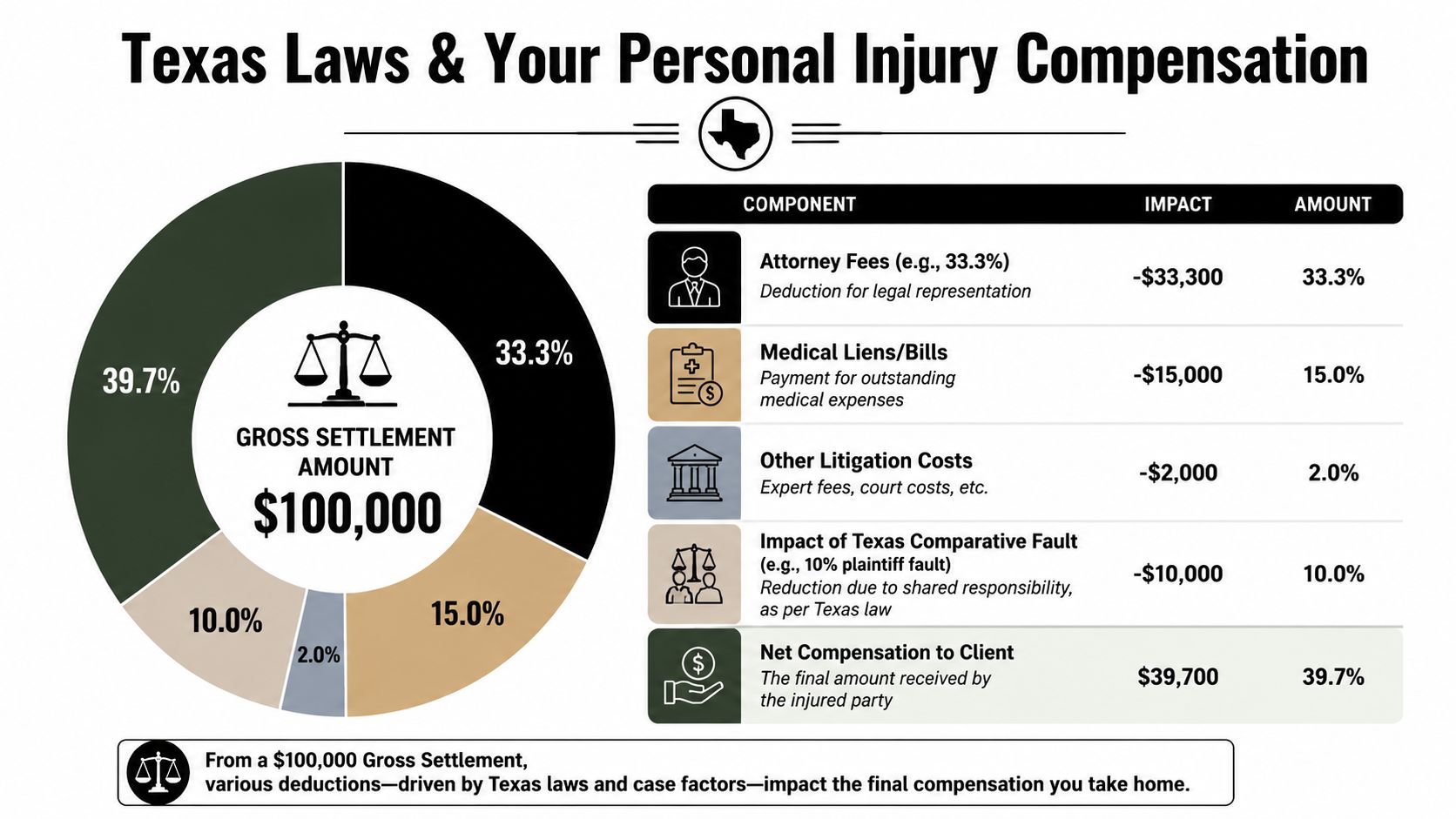
Texas uses a modified comparative fault rule. A defendant can argue that you share responsibility for the accident, and if you're found 51% or more at fault, you are barred from recovering damages, as explained in this overview of the Texas personal injury claim process and comparative fault.
Here's the practical impact. If the defense says you changed lanes without enough clearance, braked suddenly, or were distracted, that argument is not just about blame. It is about reducing what the insurer has to pay.
A simple example helps. If you're less than the bar and your share of fault is established, your recovery can be reduced to reflect that share. That's why accident reconstruction, witness statements, vehicle data, and scene photos matter so much in disputed crashes.
Policy limits and uninsured drivers create hard limits
Even a strong case can run into an insurance ceiling. If the at-fault driver has minimal coverage or no coverage at all, the claim may shift toward uninsured or underinsured motorist issues under your own policy.
That is especially common in serious car wrecks and devastating truck collisions, where losses can exceed available liability insurance. In catastrophic injury and wrongful death matters, this issue often becomes central very quickly.
For commercial trucking cases, liability disputes may also involve safety practices, driver conduct, and company oversight. Broader industry discussions around DOT compliance for nuclear verdict prevention show why trucking companies focus heavily on documentation and risk management long before a crash claim is filed.
Why the final check may be lower than the settlement number
Many clients are frustrated when they learn that liens or outstanding medical claims must be addressed before disbursement. That doesn't mean the case was mishandled. It means the net recovery can differ from the gross settlement.
A lawyer's job often includes identifying those claims early, challenging improper amounts, and negotiating where possible. That work can materially affect what reaches your hands at the end.
Here's the practical takeaway:
- Fault disputes can reduce or eliminate recovery.
- Low policy limits can cap the available pool of money.
- Liens and reimbursement claims can shrink the final payout.
- Strong early evidence gives you the best chance to protect value.
If you need help with a motor vehicle case, a Car Accident Lawyer in Texas may be one option for evaluating liability, insurance coverage, and next steps after a serious crash.
Common Questions About the Texas Claim Process
How long will my personal injury case take
It depends on the injury, the treatment timeline, and whether fault is disputed. A claim usually shouldn't be valued too early because the medical picture may still be developing. Cases also slow down when the insurer contests liability, questions treatment, or forces litigation.
Simple claims often move faster than truck wreck, catastrophic injury, or wrongful death cases. The more serious the harm, the more important it is to get the value right instead of ending the case quickly.
How much does it cost to hire a personal injury lawyer
Most personal injury lawyers handle these cases on a contingency fee. That means the fee is tied to the recovery rather than charged upfront. Ask direct questions during the consultation about attorney fees, case expenses, and how disbursement works at the end.
The goal is transparency. You should understand who pays litigation costs, whether those costs are advanced, and how liens or unpaid medical bills may affect your final amount.
Ask for the fee agreement in writing and read it carefully before you sign. A good lawyer won't dodge those questions.
How is the value of my case determined
There isn't a single formula. Value usually depends on liability, the seriousness of the injury, the course of treatment, lost income, future limitations, available insurance, and whether the defense has credible comparative fault arguments.
That's why two crashes that look similar on the surface can resolve very differently. A rear-end collision with clear fault and clean medical records is a different case from a disputed lane-change wreck with limited coverage and treatment gaps. If you're unsure where your case stands, gathering records early and getting legal advice promptly usually puts you in the strongest position.
If you're trying to make sense of the next step after a serious accident, legal help is available. The Law Office of Bryan Fagan, PLLC represents Texans in car accident, truck crash, catastrophic injury, and wrongful death claims, and offers free consultations so you can get clear answers about your rights, your timeline, and your options. Recovery takes time, but you don't have to figure this out alone.