Skip to content
For most Texas personal injury cases, you generally have 2 years from the date of the injury to file a lawsuit. But that simple answer can be dangerously incomplete, because some claims, especially those involving a government body, can require action in as little as 180 days.
A serious accident can change your life in seconds, but you don't have to face it alone. One day you're driving home on I-45, taking your child to school, or walking through a store. The next, you're dealing with pain, doctor visits, missed work, car repairs, and calls from insurance adjusters who sound helpful until you realize they're building a file on you.
That's usually when the question hits: how long do I have to file an injury claim in Texas?
For many people, the internet gives a partial answer. It says two years, and then stops. In practice, that isn't enough. Deadlines depend on what happened, who caused the harm, and what kind of claim you may need to bring. A person hurt in a Houston freeway crash may have one timeline. A family grieving a fatal collision may have another. Someone struck by a city vehicle may need to act much sooner than they expect.
Clear legal guidance is essential. The law sets deadlines, but your recovery also depends on evidence, medical records, witness statements, and smart decisions in the first weeks after an accident.
After an Accident Your Focus Is Recovery Ours Is Justice
A crash doesn't just leave damage on metal. It disrupts routines, income, sleep, and peace of mind. After a serious wreck, individuals often find themselves trying to do basic things: get to appointments, manage pain, answer work emails, and figure out why the insurer keeps calling.

A common example looks like this. After a Houston-area car crash, a driver goes to urgent care, assumes the soreness will fade, and spends the next few weeks trying to keep life moving. Then the pain gets worse. Physical therapy starts. Bills follow. The insurance company asks for a recorded statement. Only then does the legal deadline feel real.
Why this question matters early
The filing deadline isn't just a technical rule. It shapes how much time you have to investigate the wreck, collect records, identify every responsible party, and decide whether settlement talks are enough or a lawsuit needs to be filed to protect your rights.
If you're still in those first days after a wreck, start with practical guidance on what to do immediately after an accident in Texas. Early choices often affect both your medical recovery and the strength of your claim.
Practical rule: The best time to ask about deadlines is before the insurance company controls the timeline for you.
What works and what doesn't
Some responses help. Some create problems.
- What helps: Getting medical care, saving photos, keeping discharge papers, and writing down what happened while it's still fresh.
- What hurts: Waiting for the pain to “settle,” assuming the adjuster will explain your legal deadline, or believing every case follows the same clock.
- What protects you: Finding out early whether your case involves a private driver, a commercial vehicle, a dangerous property, or a public entity.
Texas injury law can feel intimidating when you're already under stress. It becomes much more manageable when you break it into the right questions and answer them early.
The Texas Two-Year Statute of Limitations for Injury Claims
The phrase statute of limitations sounds more complicated than it is. In plain English, it means the legal deadline to file your lawsuit in court.
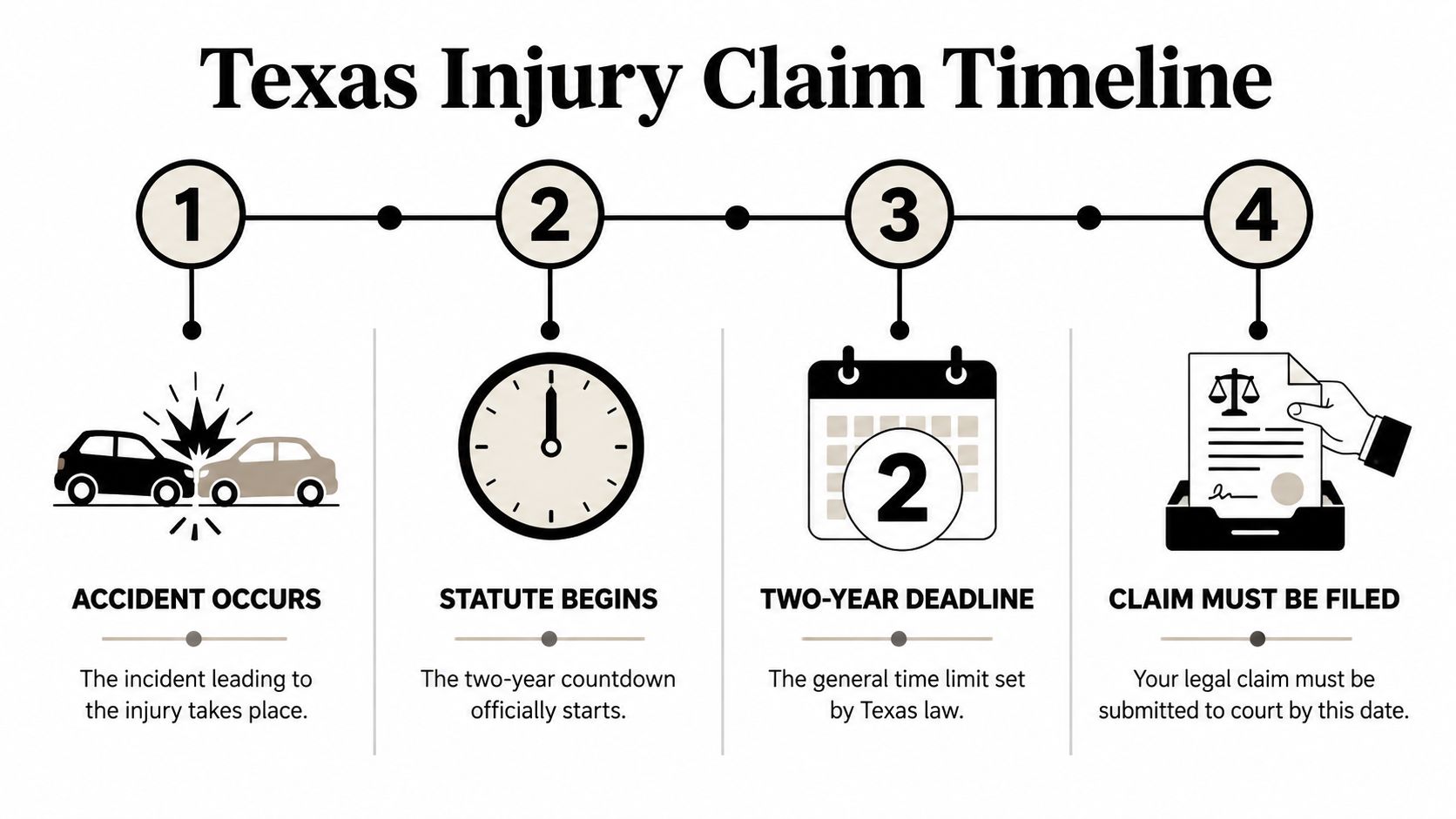
For most Texas personal injury claims, that deadline is 2 years from the date of injury under Texas Civil Practice and Remedies Code § 16.003(a), as discussed here. That same discussion explains that people hurt in car, truck, motorcycle, pedestrian, and premises cases usually must file within 730 days, and missing that window can block recovery even when the underlying case is strong.
When the countdown usually starts
In most injury cases, the clock starts running on the day the crash or injury happened. If a distracted driver rear-ends you in Houston, the timeline usually begins on the date of that collision. If you slip and fall because of a dangerous condition on someone's property, the timeline usually begins on the date of that fall.
That rule sounds straightforward, and often it is. The problem is that people confuse filing a claim with opening an insurance claim. They are not the same thing.
Filing an insurance claim is not the same as filing a lawsuit
Many injured people talk with an insurer for months and assume they are “handling the claim,” so the legal deadline must be protected. It isn't. Insurance negotiations can continue right up to the point where your lawsuit deadline expires.
Here's the practical difference:
| Action | What it means |
|---|---|
| Reporting the crash to insurance | You notified a carrier that the accident happened |
| Sending records or bills | You're supporting a demand for payment |
| Filing a lawsuit in court | You took the legal step required to preserve your claim before the deadline |
If settlement talks drag on and no lawsuit is filed in time, the insurer may still argue the case is over, even if fault is clear.
Why waiting rarely helps
Delay creates avoidable problems.
- Evidence weakens: Photos disappear, video gets overwritten, and witnesses become harder to reach.
- Medical proof gets messier: Gaps in treatment give insurers room to question whether the crash caused your condition.
- Case strategy narrows: The closer you get to the deadline, the fewer options your lawyer has for a thorough investigation.
A Texas personal injury lawyer looks at more than the calendar. The primary question is whether enough time remains to build the case the right way. That matters in a straightforward car wreck, a truck collision involving multiple companies, or a catastrophic injury claim where future care may be disputed.
When the Clock Ticks Faster Critical Exceptions to the Rule
The biggest mistake injured people make is assuming the two-year rule always controls everything. It doesn't.
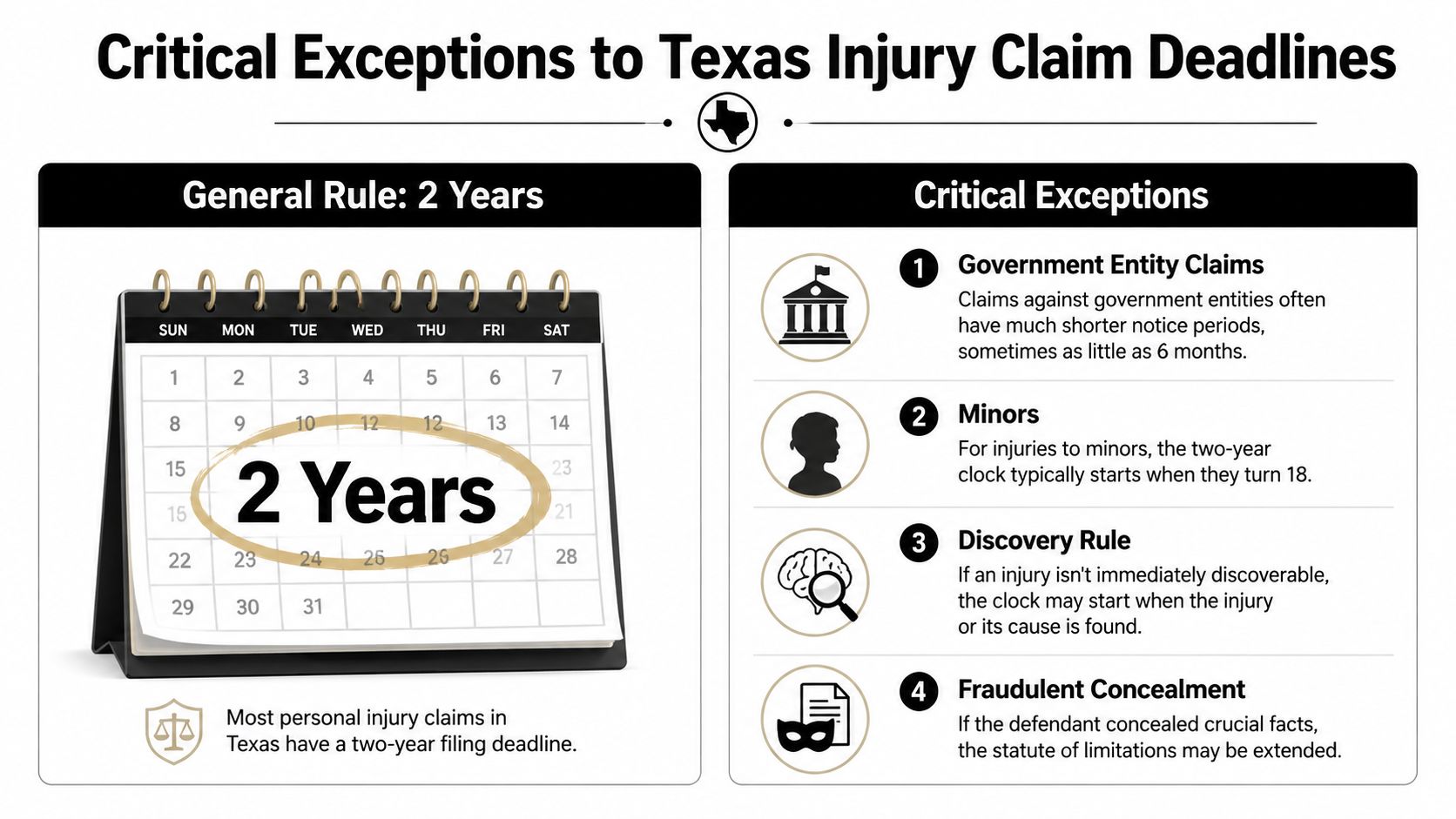
Some cases come with a much shorter notice requirement that can decide whether any recovery is possible. The most important example involves claims against a government entity. A discussion of Texas claim deadlines notes that under the Texas Tort Claims Act, notice can be required in as little as 180 days, and missing that notice can sink a claim even if the lawsuit deadline itself hasn't expired, as explained in this Texas Tort Claims Act notice discussion.
Government claims are where people get blindsided
This comes up more often than people realize. A crash involving a city bus, county truck, public works vehicle, or another government-operated vehicle doesn't follow the same path as an ordinary wreck with a private driver.
If you were hit by a city vehicle in Houston, for example, waiting comfortably under the assumption that “I have two years” can be a costly mistake. The notice issue may arrive much earlier than expected.
Important warning: In government cases, the first missed deadline is often not the lawsuit filing date. It's the notice deadline.
That's why these cases need quick review. A lawyer needs to identify who owned the vehicle, who employed the driver, and whether notice rules apply before routine insurance communications lead you in the wrong direction.
Later medical deadline issues can also overlap with injury cases, especially where diagnosis and timing become contested. If that issue affects your situation, this guide on the medical malpractice statute of limitations in Texas helps explain how different legal clocks can operate.
A short video can help frame why timing issues deserve early attention:
Real-world trade-offs in fast-moving cases
People often hesitate to call a lawyer because they don't want to seem aggressive. That instinct is understandable. But in a government-related case, waiting to “see how things go” usually doesn't preserve anything.
Here's what tends to work better:
- Identify ownership early: Was it a city bus, school district vehicle, county truck, or state-related unit?
- Preserve records fast: Incident reports, onboard camera footage, dispatch materials, and scene photographs can become central.
- Avoid casual assumptions: The insurer or claims office may discuss the claim without reminding you about every legal notice rule.
A skilled Houston car accident attorney or truck crash lawyer Houston residents trust doesn't just ask who hit you. They ask whether that defendant is private, corporate, or governmental, because each answer changes the calendar.
Other Important Deadlines and Tolling Rules You Must Know
Not every injury claim starts and ends with the crash date. That's where many online explanations fall short. Some timelines start later, some pause, and some belong to a different legal claim entirely.
One discussion of Texas timing rules notes that many pages oversimplify these issues, while wrongful-death timing starts on the date of death, insurance-contract disputes may follow a different 4-year period, and bad-faith or Insurance Code claims can have different limitation rules than the underlying injury case, as described in this overview of Texas filing timelines.
Wrongful death doesn't use the same start date
This matters greatly for families.
If your loved one was injured in a crash and later passed away, the legal timeline for a wrongful death claim may start on the date of death rather than the date of the wreck. That distinction can change how a family evaluates its options and when action needs to be taken.
A simple example helps. After a major truck collision, a person may survive for a period of time before passing from complications. The family's wrongful death lawyer Texas families rely on needs to evaluate the timeline based on the death date for that claim, not just the original impact date.
Some claims may start later or pause
Texas law can treat the start of the clock differently when an injury or its cause isn't immediately clear. People often refer to this generally as the discovery rule. A practical example is a crash victim who initially believes they suffered only soft tissue pain, then later learns there is a more serious spinal injury connected to the wreck.
There are also situations where the running of the deadline may be paused, often called tolling. Minors are a common example people ask about. Capacity issues can also complicate the analysis.
The date on the police report matters, but it isn't always the only date that matters.
Comparative responsibility still matters
Timing is one part of the case. Fault is another.
Texas personal injury law also looks at negligence and comparative responsibility. In everyday terms, negligence means someone failed to use reasonable care. Comparative responsibility means the defense may argue you were partly to blame. That doesn't make the deadline less important. It makes early case development more important, because evidence gathered early often shapes how fault gets assigned later.
Consider these common situations:
- A freeway lane-change crash: The other driver says you were speeding.
- A rideshare pickup collision: Several drivers point fingers at each other.
- A store fall: The property owner claims the danger was open and obvious.
In each example, the legal timeline and the liability analysis move together. If you wait too long, you don't just risk a deadline problem. You may lose the records needed to show what really happened.
Insurance disputes can run on a different track
This catches people off guard. They may resolve or lose the injury claim issue, then assume any dispute with an insurer follows the same timeline. It may not. Insurance contract disputes and bad-faith allegations can have different rules than the bodily injury case itself.
That's one reason a serious case should be reviewed as a whole. A catastrophic injury case, a UM/UIM dispute, and a wrongful death matter can involve overlapping claims with different deadlines, different defendants, and different proof.
Protecting Your Right to Compensation Practical Steps to Take Now
Deadlines matter, but your day-to-day actions matter too. If you're asking how long do I have to file injury claim Texas, the strongest next move is not memorizing legal jargon. It's protecting the facts of your case today.
What to do in the first stretch after an accident
Use this as a practical checklist.
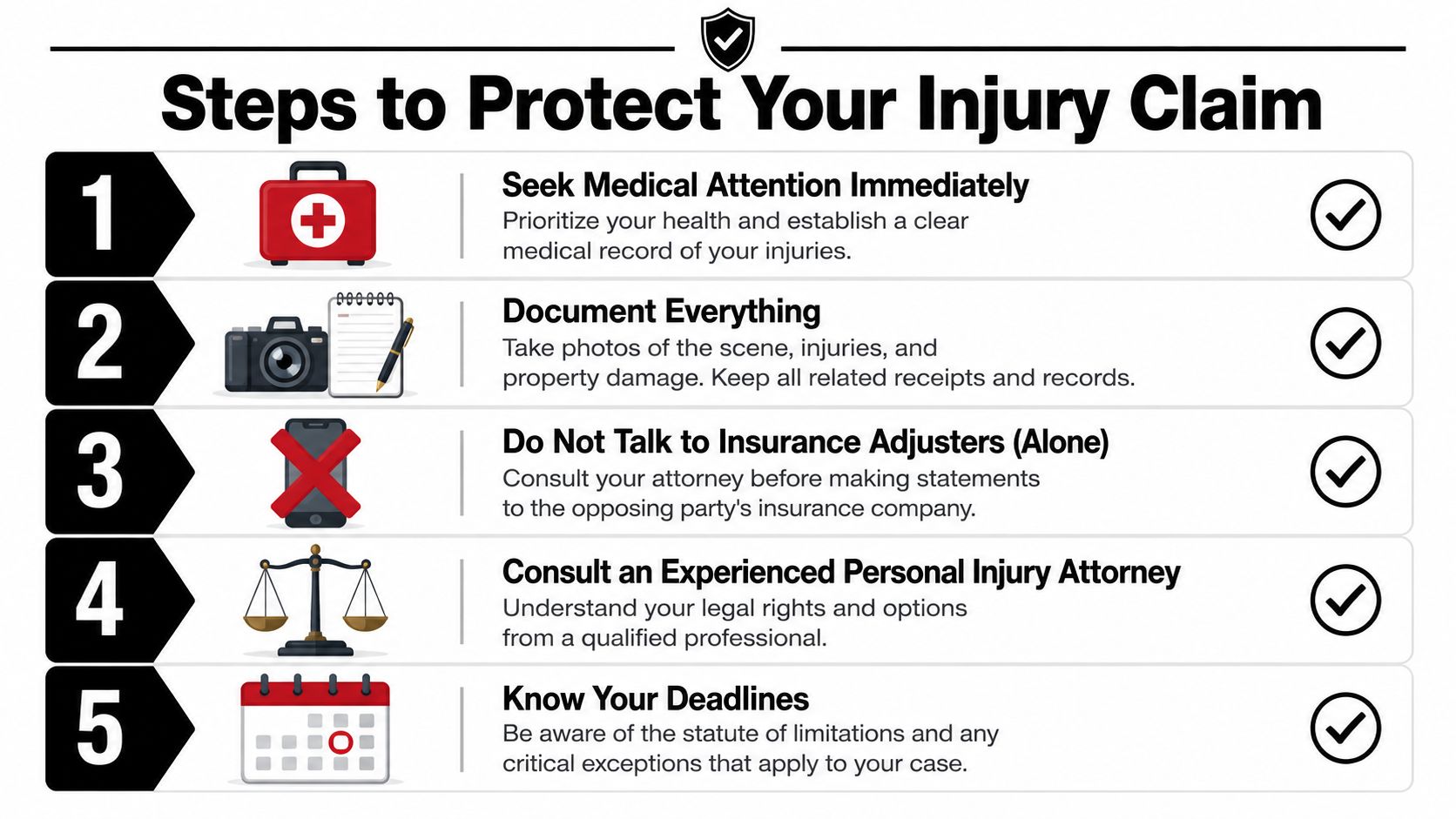
- Get medical care and keep going: Follow-up treatment creates a clearer record of what hurts, how long it lasts, and what care you need.
- Save every piece of paper: Discharge notes, imaging orders, prescriptions, repair estimates, wage records, and insurance letters all matter.
- Take photos while conditions are fresh: Vehicle damage, bruising, road conditions, broken steps, skid marks, and visible hazards can become key evidence.
- Notify your own carrier promptly: Your policy may require notice, and some coverages depend on timely reporting.
- Be careful with recorded statements: The other side's adjuster may sound routine and polite. The questions are still designed to limit exposure.
What to say to insurance companies
You don't have to be hostile. You do need to be careful.
A safe approach is to confirm basic identifying information, say you are receiving medical care, and decline a recorded statement until you've had legal advice. That protects you from guessing about injuries, minimizing symptoms, or adopting the insurer's framing of the wreck.
A steady rule: If you don't yet know the full extent of your injuries, don't speak as if you do.
Keep an eye on medical bills and liens
Many injured people also run into lien and billing issues while treatment is ongoing. If providers, case managers, or support teams are involved, it helps to understand documentation and payment rights early. For readers dealing with that side of recovery, this overview of strategies for lien perfection gives useful context on how healthcare-related claims may be formalized.
When legal help makes the biggest difference
The right time to speak with a lawyer is usually earlier than people think. That's especially true after a truck crash, a fatal accident, a multi-vehicle pileup, or any case involving severe injuries. Early legal work often includes preserving evidence, finding all available insurance, confirming the correct defendant, and preventing a routine claim from turning into a preventable deadline problem.
You Don't Have to Face This Deadline Alone We Can Help
A legal deadline feels heavier when you're already in pain. It's hard to focus on court calendars when you're trying to heal, get your car fixed, or help your family regain some normalcy.
That's why injury law should work this way: you focus on recovery, and your legal team focuses on timing, evidence, and strategy.
Why early guidance changes the outcome
A Texas personal injury lawyer doesn't just count days on a calendar. Good legal help means identifying the correct claim, the correct defendant, and the correct deadline before a mistake limits your options. That can make a major difference in a car wreck case, a truck case, a catastrophic injury claim, or a wrongful death case.
For many people, the first benefit of speaking with counsel is clarity. You learn whether you're dealing with the ordinary injury deadline, a government notice issue, a wrongful death timeline, or an insurance dispute with its own rules.
If you're unsure when to reach out, this article on when you should contact a lawyer after an accident in Texas can help you decide.
A practical way to think about next steps
If any of these sound familiar, don't wait to get answers:
- You were hurt in a Houston crash and the adjuster keeps calling
- A truck, company vehicle, or public vehicle was involved
- A loved one passed away after a collision
- Your injuries turned out to be more serious than you first thought
- You're worried you may have waited too long already
A Houston car accident attorney, truck crash lawyer Houston families trust, or wrongful death lawyer Texas clients can turn to should be able to explain your timing issues in plain English and tell you what needs immediate attention.
You don't need to have every record collected before making that call. You don't need to know the legal label for your claim. You just need to act before uncertainty becomes a missed deadline.
Recovery is possible. Accountability is possible. Legal help is available.
If you were injured in Texas and need clear answers about your deadline, contact Law Office of Bryan Fagan, PLLC for a free consultation. The firm helps accident victims and families across Texas understand their rights, protect critical evidence, and take timely action with confidence.