Skip to content
A serious accident can change your life in seconds, but you don't have to face it alone.
You may have walked away from the crash thinking you got lucky. Then the next morning your neck felt tight. A few days later, the headaches started. Maybe your back stiffened up after you went back to work. Maybe a family member keeps saying you seem different, distracted, or unusually tired since the wreck.
That confusion is one of the main reasons people search how long after an accident can injuries appear in Texas. The short answer is that some injuries can show up hours, days, weeks, or even months later, according to Texas-focused guidance on delayed accident injuries. The hard part is that your body may take time to reveal the damage, while insurance and legal deadlines don't slow down to match your symptoms.
If you're dealing with delayed pain after a crash in Houston, Dallas, Austin, San Antonio, or anywhere else in Texas, you're not overreacting. You're dealing with a very real problem that needs medical attention, careful documentation, and a smart legal strategy.
You Survived the Crash But the Pain is Just Beginning
After a wreck, many people feel relief before they feel pain. That's common. You check your arms and legs, talk to police, exchange insurance information, and focus on getting home. In that moment, “I'm okay” can feel true.
Then life settles down and your body starts sending a different message.
A driver after a Houston freeway crash may feel steady at the scene, only to wake up later with shoulder tightness, a pounding headache, or pain shooting into the lower back. A parent involved in a school-zone collision may spend the evening arranging child care and towing, then notice dizziness and neck stiffness the next day. These situations happen often enough that Texas injury guidance warns people not to assume they escaped injury just because symptoms didn't start right away.
Pain that starts later is still pain from the crash if the medical evidence supports that connection.
That's why it helps to treat delayed symptoms seriously from the start. To determine whether a doctor visit is worth it after what seemed like a minor wreck, this guide on whether you should see a doctor after a minor car accident in Texas can help you think through the risk.
Why this feels so frustrating
Two timelines start running after a collision.
- Your body's timeline may unfold slowly. Pain, stiffness, swelling, and neurological symptoms can develop after the initial shock wears off.
- The claim timeline starts immediately. Insurance documentation, medical records, and legal deadlines all matter from the date of the crash.
That gap is where many valid claims get challenged. If you felt fine at first, an insurance adjuster may later argue that your injury came from something else. The best response is prompt care and a clear paper trail.
Why Your Body Hides Injuries After a Car Accident
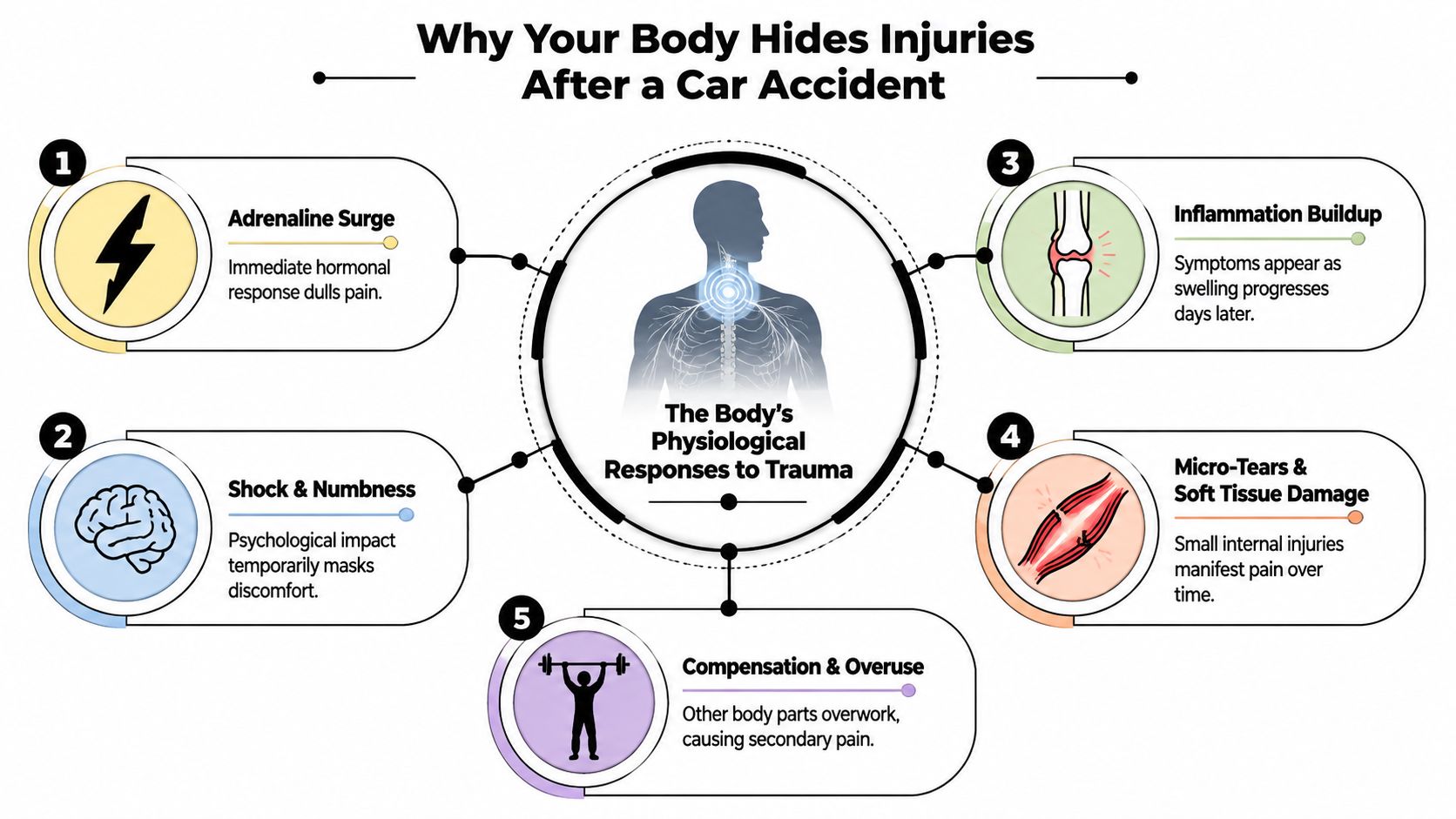
The body doesn't always report damage in real time. After a violent event, trauma can temporarily mask pain, while swelling, inflammation, and internal tissue damage may take time to become noticeable. Texas injury guidance also notes that soft-tissue injuries, head injuries, and internal injuries may not be obvious until symptoms worsen, and symptoms can appear days or weeks after the collision, as explained in this discussion of why some injuries show up later in Texas.
Adrenaline changes what you feel
Right after impact, your body moves into survival mode. People often describe feeling shaky, numb, hyper-focused, or strangely alert. In that state, pain signals can get pushed into the background.
That doesn't mean the injury isn't there. It means your brain and body are prioritizing immediate survival over comfort.
A simple way to think about it is a slow leak in a tire. The damage happens at the moment of impact, but the visible problem builds over time. The same thing happens with strained muscles, irritated discs, inflamed joints, and some head injuries.
Swelling takes time
A lot of crash injuries involve tissue that becomes more painful as inflammation rises. Small tears in muscles and ligaments may not hurt much at first. Several hours later, or after a night's sleep, normal movement becomes hard.
People often notice:
- Morning stiffness that wasn't there right after the wreck
- Reduced range of motion when turning the head or bending
- Headaches that build as neck and shoulder tension increases
- Back pain that flares when standing, lifting, or sitting too long
If your symptoms involve the spine, this article on back injuries after a crash may help you spot patterns that deserve prompt medical attention.
Practical rule: If a new symptom starts after a wreck, treat it as crash-related until a qualified medical provider says otherwise.
Secondary pain can show up later too
Injuries don't always stay where they started. If you protect one painful area, other parts of your body may begin to overcompensate. A sore neck can lead to shoulder tension. A lower back injury can change how you walk, sit, or sleep. That can create a second wave of pain that seems unrelated, even when it traces back to the same crash.
This is one reason delayed injury cases require more than a single urgent care note. The record has to show how symptoms developed over time.
Common Delayed Injuries After a Texas Car Crash
Some of the most disputed claims are also some of the most common. A person leaves the scene without an ambulance ride, then develops symptoms later. That doesn't make the injury minor. It usually means the body needed time to show what the crash did.

Texas guidance specifically warns that whiplash and other soft-tissue injuries may not produce symptoms for days or even weeks after the accident, with common delayed signs including neck stiffness and headaches. The same guidance recommends seeking medical care promptly and reporting the crash to insurance within 24 to 48 hours, as discussed in this Texas article on delayed pain after a crash.
Whiplash and soft-tissue injuries
This is one of the classic delayed-onset injuries.
A driver in a rear-end crash on I-45 may go home feeling sore but functional. Two days later, turning the head becomes painful, sleep gets uncomfortable, and headaches set in at the base of the skull. That pattern often points to whiplash or related soft-tissue strain.
Watch for:
- Neck stiffness
- Headaches
- Shoulder pain
- Pain with turning or looking down
Back injuries and disc problems
Lower back pain often starts after the body cools down. What first feels like “general soreness” can become sharp pain, spasms, numbness, or radiating discomfort into the leg.
If you suspect a disc issue, this page on a herniated disc from a car accident explains why these injuries can be harder to prove without strong medical records.
Concussions and head injuries
Not every head injury involves losing consciousness. Some people never hit their head directly and still develop concussion symptoms from the force of the impact.
Common warning signs include:
- Headaches
- Dizziness
- Confusion
- Memory problems
- Sensitivity to light or noise
- Mood changes
These symptoms can be subtle at first. Family members often notice them before the injured person does.
A short video overview can help if you're comparing your symptoms to common post-crash injury patterns.
Internal injuries and hidden complications
Some injuries stay quiet until they become dangerous. Abdominal pain, unusual bruising, shortness of breath, increasing weakness, and worsening dizziness all deserve immediate medical attention.
If symptoms are getting worse instead of better, don't wait for an insurance decision before getting checked.
Texas Legal Deadlines The Clock is Ticking
A common pattern looks like this. You leave the crash scene thinking you escaped with soreness, then your headaches, neck pain, or numbness show up days later. Medically, that happens. Legally, Texas usually still measures the case from the day of the wreck, not the day the symptoms became hard to ignore.
For most personal injury lawsuits in Texas, the filing deadline is two years from the date of the crash under Texas Civil Practice and Remedies Code § 16.003(a), as outlined in this Texas overview of filing deadlines, discovery issues, minors, and wrongful death timing.
The crash date usually controls
If your back pain flares up a week later, or a concussion is only confirmed after follow-up care, the standard deadline usually does not restart. In most cases, the clock begins on the collision date.
Understanding Texas legal deadlines matters just as much as understanding when symptoms can appear. A delayed diagnosis can still be a real injury. It does not usually buy extra time.
That gap between medicine and the law is where claims get damaged. The body may take time to reveal the injury, while the legal system expects you to preserve evidence, identify witnesses, report the crash, and act before records go stale.
Some deadlines are much shorter
Government-related claims are the biggest danger zone. If the wreck involved a city bus, county vehicle, public works truck, school district vehicle, or another government-owned vehicle, notice rules can apply long before the normal lawsuit deadline.
Texas law addresses notice requirements for claims against governmental units under the Texas Tort Claims Act. Many cities and counties have their own notice rules, and some come due within a matter of months. In practice, waiting to see whether pain improves can put a valid claim at risk before the medical picture is even clear.
I see this mistake often. Someone feels "shaken up" after a crash with a public vehicle, delays treatment, then learns later that both the symptoms and the notice deadline have caught up to them at the same time.
Texas Personal Injury Claim Deadlines at a Glance
| Claim Type | General Deadline | Important Notes |
|---|---|---|
| Most Texas personal injury lawsuits | Two years from the crash date | Usually measured from the date of the accident under Texas Civil Practice and Remedies Code § 16.003(a) |
| Local government-related claims | Often much shorter notice periods | Notice rules can apply long before a lawsuit is filed |
| State agency-related claims | Separate notice requirements may apply | The injury appearing later does not automatically extend those deadlines |
Other exceptions can change the analysis
Some cases do follow different timing rules. That can include claims involving minors, wrongful death cases, and limited situations where the discovery rule becomes part of the analysis. Those exceptions are real, but they are not something to assume on your own after an accident.
The safer approach is simple. Treat the crash date as the controlling date, get medical care as soon as symptoms appear, and start documenting every change right away. If the collision caused facial trauma or dental damage, prompt treatment matters for your health and your records. This guide on first aid for dental emergencies is a useful starting point for immediate steps.
Texas is a fault-based state, which means the at-fault driver can be held responsible for the harm the crash caused. But delayed symptoms give insurance carriers room to argue about causation. The longer the gap between the wreck, the first complaint, and the first medical visit, the more work it usually takes to prove the connection.
What to Do Now to Protect Your Claim
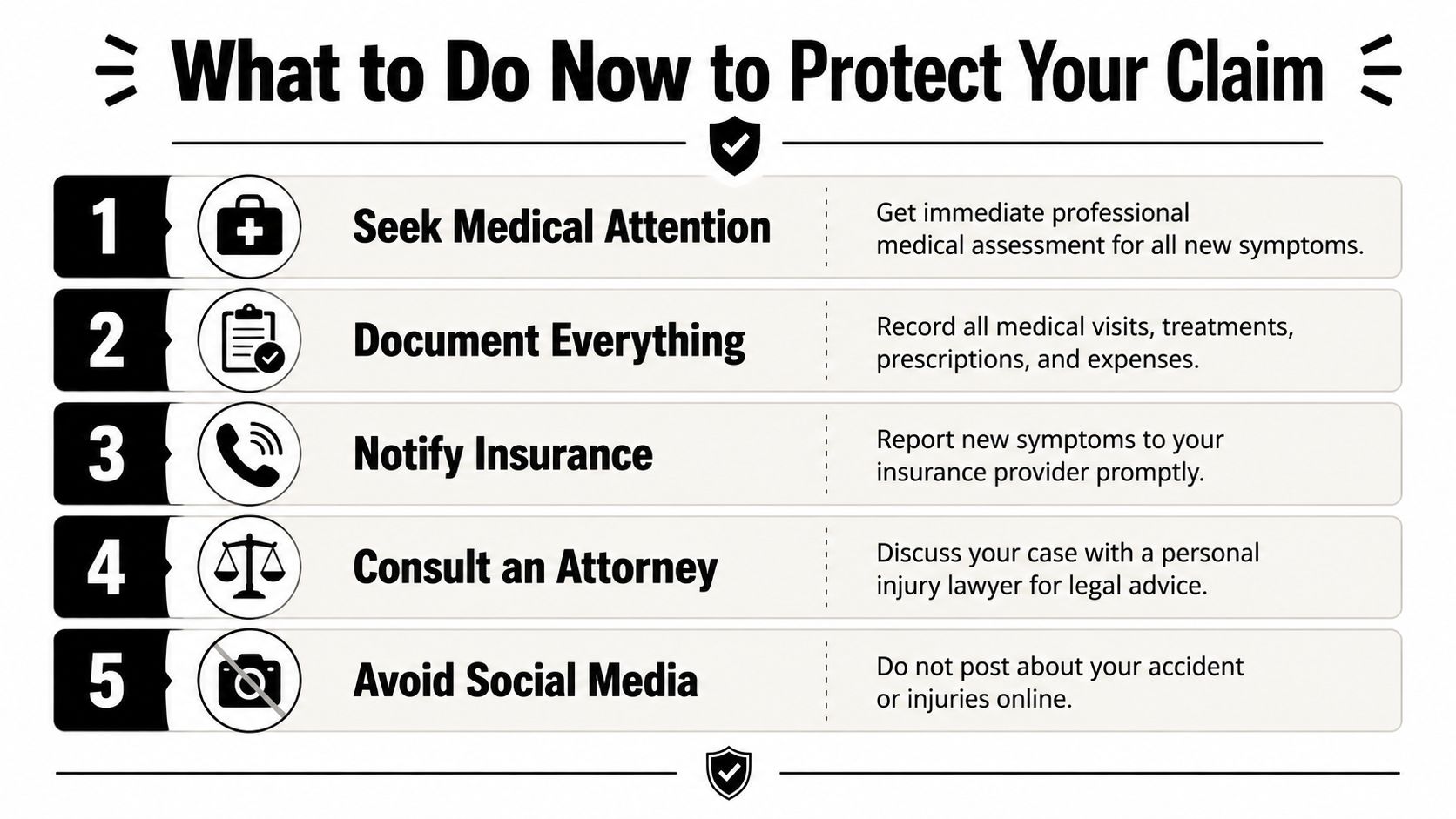
Once symptoms appear, your job is to create a clean timeline. Insurance companies often challenge delayed injuries by arguing the pain is unrelated, exaggerated, or too poorly documented to trust. Texas guidance recognizes that this is a major issue and emphasizes building a detailed evidence trail through prompt medical visits and symptom tracking, as explained in this article on documenting delayed symptoms.
Build the record before the adjuster builds a defense
Start with medical care. Tell the provider exactly what happened, when the symptoms started, and how they've changed. Be specific. “My neck got worse two days after the rear-end collision” is better than “I've been sore.”
Then keep the paper trail going.
Get evaluated promptly
Go to urgent care, your primary doctor, an emergency room, or a specialist if symptoms are serious. Make sure the chart connects the symptoms to the crash.Track symptoms day by day
Write down pain levels, sleep problems, headaches, missed work, trouble driving, lifting, or caring for your kids. Short entries are fine if they're consistent.Keep every document
Save discharge papers, prescriptions, imaging orders, work notes, receipts, and appointment summaries.
Be careful with insurance conversations
You should report the collision to your insurer. But when the other driver's insurance company calls, slow down.
- Don't guess about injuries you don't fully understand yet.
- Don't minimize symptoms just to sound tough or cooperative.
- Don't give a recorded statement without legal advice if delayed symptoms are developing.
A common mistake is saying “I'm fine” on day one, then struggling to explain worsening symptoms later. That single phrase can become part of the insurer's defense.
Think beyond obvious injuries
Not every crash injury is orthopedic. Facial trauma and dental damage can surface as swelling, jaw pain, or a broken tooth once the immediate chaos ends. If that happened, practical emergency guidance on first aid for dental emergencies can help you protect your health while you arrange prompt treatment.
The strongest delayed-injury cases usually aren't the loudest. They're the best documented.
Why You Should Speak with a Lawyer Sooner Rather Than Later
A lawyer doesn't make the injury more serious. A lawyer helps keep the insurance company from taking advantage of the delay.
That matters because delayed-onset claims often turn into credibility fights. The adjuster may focus less on what the crash did and more on the time gap between the collision and your symptoms. A Texas personal injury lawyer can organize that gap into a clear story supported by records, witness statements, and medical follow-up.
Early legal help solves practical problems
A good attorney can step in before mistakes pile up.
- Insurance pressure gets redirected. You don't have to manage every phone call while trying to heal.
- Evidence gets preserved before video disappears, vehicles are repaired, or witness memories fade.
- Medical timeline issues get addressed quickly, especially when providers need a full history of delayed symptoms.
- Deadline problems are easier to spot, including government notice issues and wrongful death timing questions.
If the wreck involved a commercial vehicle, a truck crash lawyer Houston residents trust will usually look at driver logs, company records, and vehicle evidence early. If the collision happened on a major urban roadway, a Houston car accident attorney will often focus on traffic footage, scene evidence, and the first statements made to insurers.
This is especially important in serious cases
Delayed symptoms can show up in cases involving traumatic brain injuries, spinal trauma, and fatalities that later become a wrongful death claim. Families often start with medical uncertainty and end up facing funeral planning, employment disruption, and insurance disputes all at once.
In those situations, talking with a wrongful death lawyer Texas families can rely on isn't about being aggressive. It's about protecting the claim before key steps are missed.
A lawyer can also explain how negligence, fault, and comparative responsibility arguments may affect the case. If the defense claims you were partly responsible for the crash, your legal strategy needs to account for that from the beginning, not after months of back-and-forth.
You Don't Have to Face This Alone We Can Help
Delayed pain after a crash is real. It happens because the body doesn't always reveal trauma immediately, and because some injuries get worse before they become obvious. If that's what you're dealing with, you're not imagining it and you're not too late to take it seriously.
The key is simple. Get medical care. Document what changed and when. Be cautious with insurance adjusters. Don't assume that feeling “mostly okay” at the scene means the claim is weak.
This is also true for emotional recovery. Some people struggle with anxiety, panic, sleep problems, or fear of driving long after the crash. If you need support for that side of recovery, resources that help people access ICBC mental health support can also remind you what trauma-informed care looks like, even though your legal case will follow Texas rules and Texas deadlines.
When injuries appear later, the most important move is often the one people postpone. Get clarity early. The right medical and legal guidance can connect the dots before an insurer tries to break them apart.
Recovery is possible. Legal help is available. And you don't have to sort this out by yourself.
If you're dealing with delayed symptoms after a wreck, the Law Office of Bryan Fagan, PLLC can help you understand your options, protect your evidence, and move your claim forward. Whether you need a Texas personal injury lawyer for a car crash, a truck collision, a catastrophic injury, or a wrongful death case, the firm offers compassionate guidance and a free consultation so you can get answers without added pressure.