Skip to content
A serious accident can change your life in seconds, but you don't have to face it alone.
If you're dealing with pain, doctor visits, car repairs, missed work, and calls from an insurance adjuster, it's easy to feel like everything is happening at once. Many injured Texans are surprised by how quickly the paperwork starts. Before long, the insurance company wants one thing above all else: your medical records.
That request matters because your medical file often becomes the official story of your injury claim. It shows when you first reported pain, what doctors found, what tests were ordered, what treatment you needed, and how your injuries affected your daily life. In a Texas claim, that paper trail can shape how the insurer values your case and whether the defense tries to argue your injuries came from something else.
If you've been searching for answers about how medical records affect injury claim Texas cases, the short answer is this: they affect almost everything. They help prove fault-related harm, connect the crash to your injuries, support damages, and protect you from arguments that your condition is exaggerated or unrelated.
Texas law also adds a few other moving parts. To recover compensation, you generally need to show another party was negligent, meaning they failed to use reasonable care. Texas follows a modified comparative responsibility rule, which means your compensation can be reduced if you were partly at fault, and your ability to recover can be affected if your share of responsibility is too high. You also need to pay attention to the statute of limitations, because waiting too long to act can put your claim at risk.
A Houston car accident attorney or Texas personal injury lawyer won't treat medical records as just another document. A careful lawyer sees them as evidence that has to be built, reviewed, organized, and sometimes protected from overreach.
Your Recovery Story The Central Role of Medical Records
After a crash, you aren't typically thinking in legal terms. You're thinking about whether your neck pain will fade, whether your child is okay, whether your job will understand your absence, and how you'll pay for treatment. That's normal.
Then the claim begins, and suddenly every symptom seems to need proof.
Medical records are often the center of that proof in Texas injury cases. Texas injury-law sources explain that modern injury claims rise or fall on the quality and completeness of medical documentation because insurers look at the full treatment timeline, not just one office visit. Those records can support medical bills, pain and suffering, and long-term impairment when they are consistent and complete, as discussed in this Texas injury law overview of why medical records can make or break a bodily injury case.
What your records are really doing
Your file is doing more than showing you went to the doctor. It may include:
- Emergency records that show what you reported right after the accident
- Imaging reports that document what X-rays, CT scans, or MRIs found
- Doctor assessments that connect your symptoms to the crash
- Prescription records that show the level of pain or impairment being treated
- Follow-up notes that track whether you improved, worsened, or needed more care
A serious truck collision in Houston might leave someone with back pain that seems manageable on day one but gets worse over the next week. If the medical records show that progression clearly, the claim becomes easier to understand and harder to dismiss.
Medical records often become the clearest timeline of what happened to your body after the crash.
Why injured families get confused
A lot of people assume the insurance company will “see” that they're hurt. That's rarely how the process works. Adjusters usually evaluate what is documented, not what is felt but never recorded.
That's especially important in claims involving ongoing pain, soft tissue injuries, traumatic brain injuries, catastrophic harm, and wrongful death losses where the long-term medical picture matters. Families pursuing a claim after a fatal crash often need records that explain treatment decisions, complications, and future losses with precision.
Why Your Medical File Is the Foundation of Your Claim
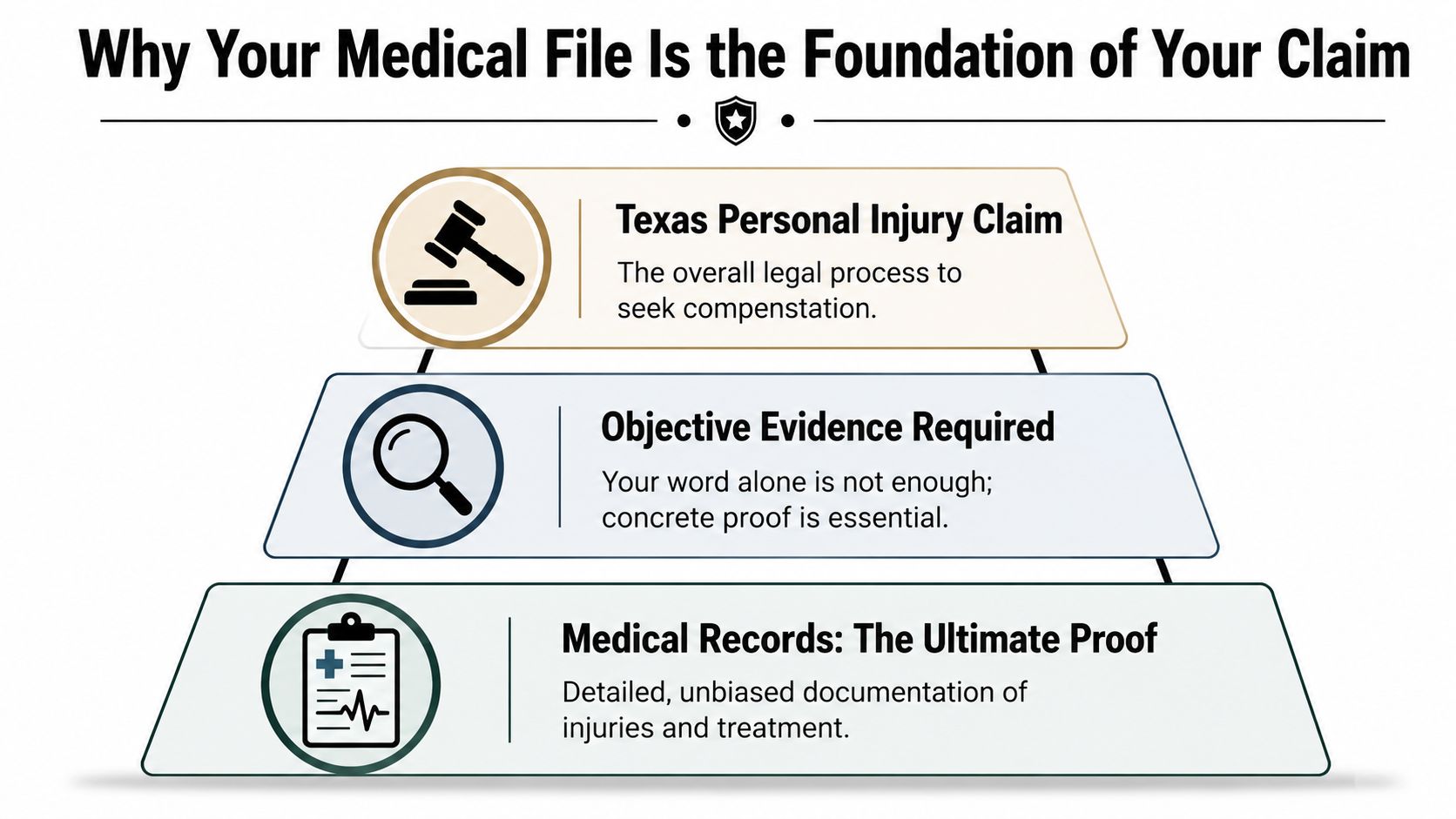
Think of a personal injury claim like a house. Liability is one part of the structure. Damages are another. But your medical records are often the concrete slab underneath everything else. If the foundation is weak, the entire case becomes easier for the insurer to attack.
In Texas, you still have to prove the basic legal elements of a claim. Another driver may have run a red light, followed too closely, or drifted into your lane. That may show fault. But fault alone does not prove the full extent of your losses. You also have to show that the crash caused actual harm and that the harm led to compensable damages.
The legal job your records have to do
A good medical file helps support several parts of a Texas claim:
| Legal issue | What the records help show |
|---|---|
| Causation | The crash led to the injury |
| Severity | The injury was significant enough to need treatment |
| Damages | You incurred losses such as medical care, pain, and limits on daily life |
| Future needs | Ongoing care or long-term problems may continue after settlement |
Texas-focused injury guidance says a claim's strength rises or falls on the quality and completeness of medical records. It also explains that gaps in treatment, missing imaging, or vague physician notes can weaken a claim, while organized records can support not only medical bills but also pain-and-suffering and long-term impairment damages. That same guidance stresses the importance of seeking treatment quickly, keeping follow-up appointments, and making sure providers document symptoms and the crash-related cause of injury in your chart, as explained in this discussion of complete medical proof in injury cases.
Why adjusters care so much about detail
Insurance companies prefer “objective” proof. Your description of pain matters, but records usually carry more weight because they were created during treatment. That's why details in wound photographs, charting, and clinical notes can matter so much. For readers who want a practical example of how careful records support clarity, accurate wound documentation practices offer a useful outside example of how specific medical charting can reduce confusion later.
Practical rule: If a symptom, limitation, or diagnosis never made it into the chart, the insurer may act like it never happened.
What this means in real life
After a Houston freeway crash, one person may tell friends, family, and the adjuster that they can't sleep, can't lift their child, and can't sit through a work shift without pain. But if the records just say “doing okay” and “mild soreness,” the written file starts telling a different story.
That's why a Texas personal injury lawyer looks closely at every ER note, orthopedic record, physical therapy report, and referral. A small wording issue can become a large negotiation issue later.
How Records Prove Your Injuries and Calculate Your Compensation
A real claim often turns on a timeline.
Take a common example. A driver is struck by a commercial vehicle on a Houston freeway. At the scene, the injured person feels shaken and sore but tries to walk it off. Later that night, the pain spreads down the lower back and into one leg. The next morning, the person goes to the ER.

That first ER record may become one of the most important documents in the entire case. It usually shows the date of treatment, the reported mechanism of injury, the body parts affected, and the provider's early observations. If the chart states that symptoms began after the crash, that helps connect the injury to the collision.
Texas-focused guidance says that in personal injury claims, strong medical documentation can be the difference between a $20,000 settlement and a $200,000 settlement for the same injuries, because adjusters use records from ER notes through follow-up care to build a timeline linking the accident to the diagnosis and to evaluate treatment costs, functional limits, and future care needs, as explained in this Texas car accident medical records guide.
How each record adds value
The claim grows stronger when different records support each other.
- ER intake and discharge notes often show immediate complaints and early treatment.
- Imaging reports can provide objective findings that support what the patient has been reporting.
- Specialist evaluations may explain why symptoms persist and what restrictions are medically necessary.
- Physical therapy notes often show pain levels, reduced range of motion, and limits on bending, lifting, walking, or sleeping.
- Surgical recommendations can support future medical damages if more treatment is likely.
Now think about how that affects compensation. If the records show only one urgent care visit and no follow-up, the insurer may argue the injury resolved quickly. If the file shows ongoing care, worsening symptoms, failed conservative treatment, and specialist concern about future procedures, the damages picture changes.
A Houston example
After an I-45 truck crash, a worker may miss time from a warehouse job because lifting causes sharp pain. If therapy notes show repeated problems with bending, lifting, standing, and sleep, those notes help explain why the injury affects both work and home life. If a treating doctor later restricts activity or refers the patient to a spine specialist, the record becomes even more persuasive.
This is one reason attorneys review medical records line by line. Administrative support can matter too. For readers interested in workflow examples around claim organization, Cool Blue VA ROI findings provide a business-side example of how organized insurance claim support can improve process management.
Why future treatment matters
Some injuries don't end when the first bills arrive. A doctor may note that symptoms are ongoing, that further imaging is needed, or that surgery may be considered if conservative care fails. Those records can support a demand for future medical care, not just reimbursement for what has already happened.
Here's a short video that helps explain why documentation and legal strategy matter after a crash:
Where comparative responsibility fits in
Texas comparative responsibility can also affect compensation. If the defense argues you were partly to blame for the crash, they may try to reduce what they owe. Medical records won't settle every liability dispute, but they can stop a different kind of argument, the claim that your injuries are minor, unrelated, or overstated.
That matters whether you need a Houston car accident attorney, a truck crash lawyer Houston, or help with a more serious catastrophic injury claim.
Common Medical Record Problems That Can Hurt Your Claim
Insurance adjusters look for openings. They read medical files to find anything they can use to question causation, severity, or credibility.
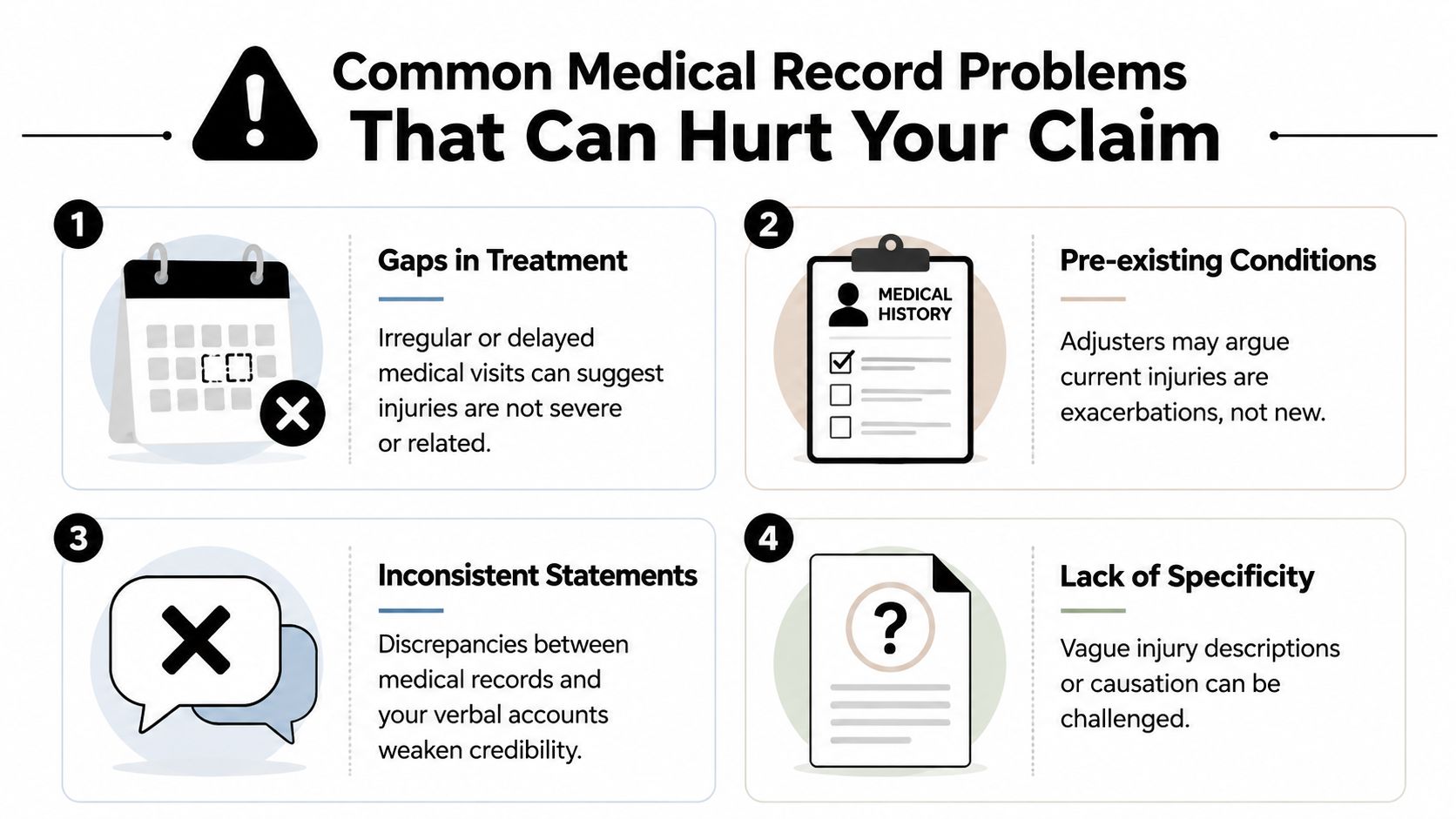
In Texas, medical records are often the main causation file linking the crash to the injury. When that chain is incomplete because of gaps in treatment or inconsistent histories, the defense may argue the injury was pre-existing or happened later. A consistent record that documents both the mechanism of injury and its progression makes the claim materially stronger, as described in this explanation of medical documentation in Texas injury claims.
Red flags adjusters often focus on
Some problems show up again and again.
- Gaps in treatment. If you wait a long time to see a doctor, or stop treatment for a stretch without explanation, the insurer may say you weren't badly hurt.
- Inconsistent histories. If one record mentions neck pain, another mentions only shoulder pain, and a third says you deny symptoms, the insurer may question reliability.
- Vague charting. Notes like “feeling better” or “minor discomfort” can be used out of context if the rest of the record is thin.
- Pre-existing condition arguments. The defense may point to old injuries, degenerative findings, or prior complaints and try to blame your current condition on them.
A simple example
After a Houston rear-end collision, a patient may tell one provider, “My lower back pain started after the crash.” At the next visit, the patient may focus on headaches and forget to mention the back pain. Later, the adjuster argues the back injury must not have been serious because it wasn't consistently reported.
That doesn't always mean the claim is lost. It does mean the record needs careful review and explanation.
A missing detail in one chart note can become a major argument in settlement negotiations.
What you can do if something looks wrong
Don't try to alter records yourself. Do keep copies, read them, and tell your lawyer if something is inaccurate or incomplete. Your legal team may be able to work with providers on clarifications where appropriate.
It's also important to preserve other evidence connected to your claim. If photographs, vehicle data, phone records, or surveillance footage could support your case, prompt action matters. You can learn more about evidence preservation issues in this overview of spoliation of evidence in Texas injury claims.
Families in fatal crash cases face similar issues. A wrongful death lawyer Texas families trust will often review medical and hospital records closely to address treatment history, causation, and damages without letting gaps or misstatements define the case.
Protecting Your Privacy How to Handle Record Requests
One of the most overlooked parts of an injury claim is not whether medical records matter. It's which records the insurance company should get.
After an accident, an adjuster may send you a broad medical authorization and act like signing it is routine. Many people sign because they assume they have no choice. That can open the door to far more disclosure than the claim requires.
Texas injury guidance notes that defense lawyers often try to use overbroad requests to access a victim's entire medical past in search of prior conditions they can use against the claim. At the same time, injured people still have a privacy interest in limiting disclosure to records directly tied to the injuries at issue, and a lawyer can use HIPAA rules and legal objections to push back on those overreaches, as explained in this discussion of medical record scope and privacy in personal injury cases.
Why broad authorizations are risky
A blanket release may allow access to unrelated treatment that has nothing to do with the crash, such as:
| Type of record | Why it may be unrelated |
|---|---|
| Old primary care visits | They may involve routine health issues unrelated to the accident |
| Past orthopedic treatment | It may concern a different body part or a resolved issue |
| Sensitive medical history | It may be personal and legally irrelevant to the claim |
| Long medical timelines | They can create confusion and invite misuse of old information |
The defense may then try to build a story around any prior complaint, even if that complaint was minor, remote, or unrelated.
What controlled disclosure looks like
A narrower approach usually makes more sense. Instead of letting the insurer pull your entire history, your lawyer may seek to limit production to records tied to the body parts, treatment dates, and conditions that matter in the claim.
That's one reason many injured Texans speak with counsel before signing anything from the insurer. A lawyer can send a letter of representation in a Texas injury claim and take over communications, including disputes about what medical information should be released.
Know this: You can cooperate with a claim without giving the insurance company unlimited access to your private medical history.
HIPAA and practical control
HIPAA doesn't mean your records are untouchable in litigation. It does mean there are rules about authorization, disclosure, and scope. In practice, your lawyer may object to requests that are too broad, negotiate narrower releases, or require formal legal process before disclosure.
For readers who want a plain-English outside resource on medical privacy systems and documentation safeguards, Titanium Computing's compliance expertise offers a general overview of HIPAA-related compliance issues from the technology side.
When to call a lawyer
Call a lawyer early if:
- The adjuster wants a blanket release and won't explain why
- You have prior injuries that could be twisted into a causation dispute
- Your claim involves severe harm or a long treatment timeline
- You lost a loved one and the defense is seeking expansive records in a wrongful death case
A Texas personal injury lawyer can use the records that help your claim while resisting demands for records that don't belong in the case.
Your Next Steps How to Build a Strong Medical Case
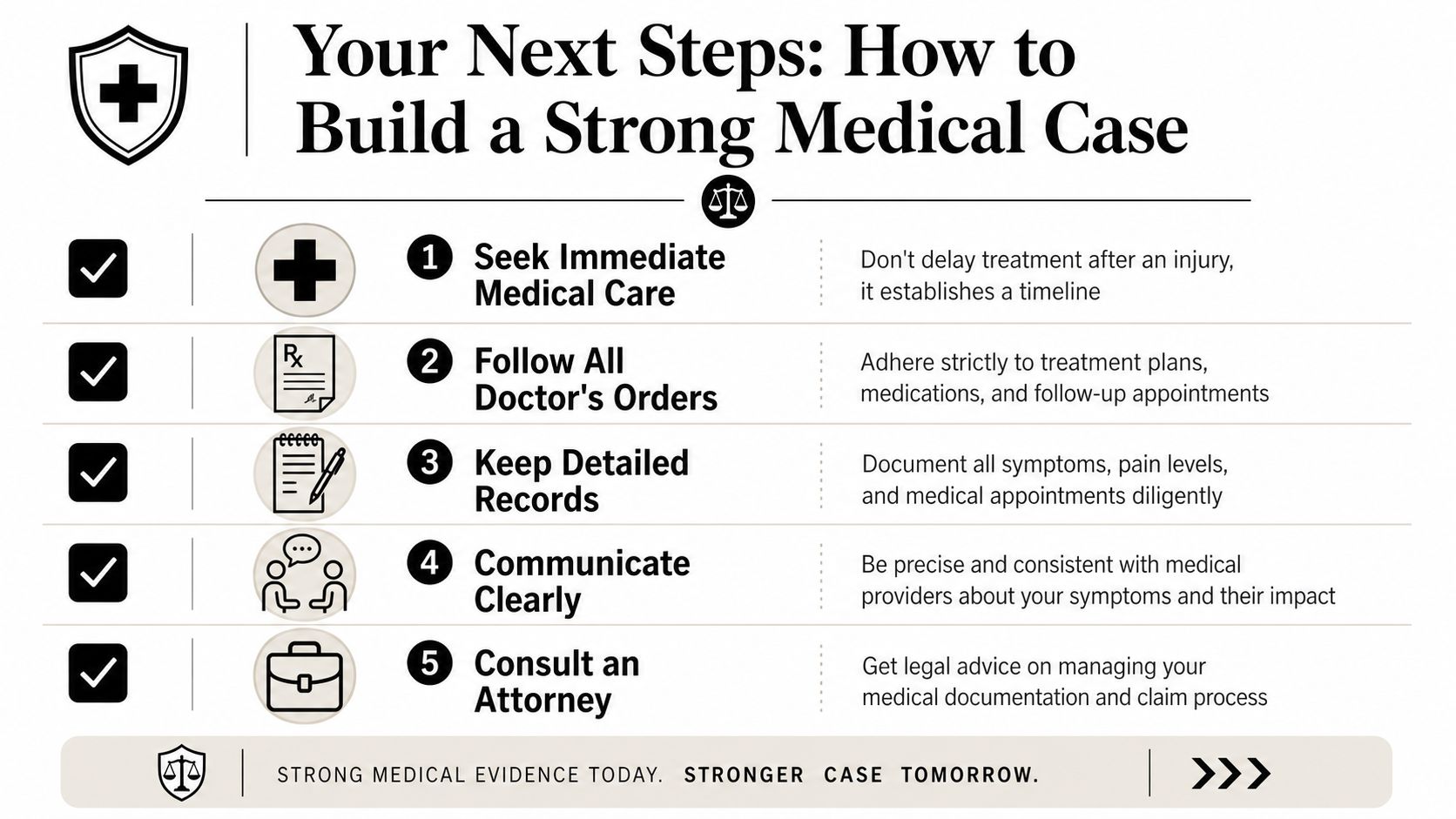
If you feel overwhelmed, keep it simple. Focus on the steps that protect both your health and your claim.
A practical checklist
- Get medical care promptly. Even if you hope the pain will pass, an early evaluation creates a treatment record and helps identify injuries before they get worse.
- Follow the treatment plan. Keep follow-up appointments, take prescribed steps seriously, and don't stop care on your own without talking to the provider.
- Describe symptoms clearly. Tell each provider where you hurt, when it started, what movements make it worse, and how it affects sleep, work, driving, parenting, and daily tasks.
- Keep your own file. Save discharge papers, imaging reports, prescriptions, bills, work notes, and a simple symptom journal.
- Be careful with insurers. Don't guess, minimize, or sign medical releases before you understand what they allow.
- Get legal advice when the case is serious. That includes truck wrecks, surgeries, long-term impairment, disputed fault, and fatal crash claims.
How this looks in everyday life
After a Houston freeway crash, that might mean going to urgent care or the ER, then following up with your primary doctor, an orthopedist, or physical therapy if recommended. If your symptoms change, say so. If you can't lift your child, sit through your shift, sleep through the night, or drive without pain, tell the provider and make sure it is documented.
For families dealing with catastrophic injuries or the loss of a loved one, these steps can feel heavy. You don't have to handle every phone call and records request alone. Some people work directly with a Texas personal injury lawyer early so the case record develops correctly from the start. The Law Office of Bryan Fagan, PLLC handles Texas accident and injury matters involving car wrecks, truck collisions, wrongful death, and serious injuries, including helping clients manage documentation and insurer communications.
Don't lose sight of deadlines
Texas claims also have filing deadlines. The statute of limitations can affect your right to bring a lawsuit, and delay can make records harder to gather and evidence harder to preserve. Early action helps your medical case and your legal case at the same time.
Your recovery comes first. But protecting the record matters too.
If you were injured in a crash and you're worried about what your medical records say, what the insurance company is asking for, or how to protect your privacy while building a strong claim, the Law Office of Bryan Fagan, PLLC offers a free consultation. You can speak with a Texas personal injury lawyer about your next steps after a car wreck, truck collision, catastrophic injury, or wrongful death loss. Recovery is possible, and legal help is available when you're ready.