Skip to content
Most Texas injury cases take about 6 to 18 months if they're straightforward, while more complex cases can take 2 to 3 years or longer. You also generally have 2 years from the date of the injury to file suit in Texas, so the legal deadline can matter just as much as the pace of settlement talks.
A serious accident can change your life in seconds, but you don't have to face it alone. If you're reading this, you may be dealing with pain, medical appointments, missed work, car repairs, and calls from insurance adjusters, all while trying to answer one hard question: How long does a lawsuit take in a Texas injury case?
The honest answer is that there isn't one timeline for every case. A rear-end crash with clear fault usually moves very differently from a truck collision, a catastrophic injury claim, or a wrongful death case. The reason matters. Cases don't stretch out for no reason. They usually take longer because someone is still treating, fault is disputed, more than one party may be responsible, or the evidence needs more work before a fair settlement is possible.
That uncertainty is frustrating, especially when bills are arriving now. Still, understanding each phase of the process can help you feel more in control. When you know why the waiting happens, you can make better decisions, protect your rights, and avoid mistakes that hurt your claim.
Your Life Has Changed Now What Happens Next
After an accident, a common desire is for two things right away: medical care and a clear sense of what comes next. That's normal. Your routine may have been turned upside down in a single afternoon.
A Houston driver hit on a freeway may be wondering when the insurance company will pay. A family after a fatal crash may be trying to understand whether they need a wrongful death lawyer Texas families can trust. Someone hurt in a commercial vehicle collision may already be searching for a truck crash lawyer Houston residents call when liability is contested. Different facts lead to different timelines, but the confusion feels the same.
What usually happens first
The first phase is rarely dramatic. It often involves medical treatment, gathering records, reviewing crash reports, documenting injuries, and trying to understand who was at fault. That can feel slow from the outside, but it's often the foundation of the whole case.
If you haven't taken early protective steps yet, review this guide on what to do immediately after an accident in Texas. Small actions taken early can make later parts of a claim much clearer.
Practical rule: The time after the accident isn't “dead time.” It's often when the most important evidence is collected.
Why the timeline feels longer than expected
People often assume a good claim should settle quickly. Sometimes it does. But a fast settlement isn't always a fair one. If you settle before you understand your injuries, your future care, or the full impact on your work and family life, you may give up rights you can't recover later.
That's why the better question often isn't just “how long does lawsuit take in Texas injury case.” It's “what needs to happen before this case can be resolved the right way?” Once you look at the process through that lens, the timeline starts to make more sense.
The Legal Ground Rules for Your Texas Injury Claim
Before anyone can value a case or predict timing, the basic Texas rules have to be clear. These rules shape nearly every decision, from the first insurance call to a possible trial.
The filing deadline matters more than many people realize
In Texas, the statute of limitations is two years from the date of the injury, and that filing deadline comes from Texas Civil Practice and Remedies Code § 16.003. If suit is not filed within that 2-year window, the claim can be permanently barred. The same Texas legal summary also notes that straightforward personal injury cases may resolve in about 6 to 18 months, while more complicated cases can take 2 to 3 years or longer (Texas injury timeline overview).
That deadline confuses a lot of people because they think talking with the insurance company is the same as protecting the claim. It isn't. Negotiations can continue while the filing deadline gets closer. If no lawsuit is filed in time, the legal power of the case can disappear.
Negligence is the starting point
A personal injury claim usually turns on negligence. In plain English, that means someone failed to act with reasonable care and caused harm.
For example:
- Rear-end crash: A distracted driver follows too closely and hits your vehicle.
- Unsafe property case: A business ignores a dangerous spill and someone falls.
- Commercial vehicle collision: A company driver acts carelessly and causes serious injuries.
The law asks practical questions. Who had a duty to act carefully? What did they do or fail to do? Did that conduct cause the injury?
Comparative responsibility can change the value of a case
Texas also uses comparative responsibility. That means more than one person can share fault. Responsibility is determined much like a referee sorts out a chaotic play. One side may carry most of the blame, but the other side's actions can still be examined.
Insurance companies often use this rule to argue that an injured person was partly responsible. In a car crash, they may say you were speeding. In a premises case, they may claim the hazard was “open and obvious.” In a pedestrian case, they may argue you weren't paying attention.
Fault is not always obvious on day one. It often becomes clearer only after records, photos, witness statements, and medical evidence are reviewed together.
Why these rules affect timing
These legal rules don't just affect whether you can recover compensation. They affect how long the case takes. If fault is obvious and the injury evidence is organized, the path is usually smoother. If fault is disputed, or if the insurance company argues comparative responsibility, the case often takes more work before it can be resolved fairly.
The Four Key Phases of a Texas Injury Lawsuit
A lawsuit timeline becomes easier to understand when you break it into parts. Most Texas injury claims move through four broad phases, even if the details vary from case to case.
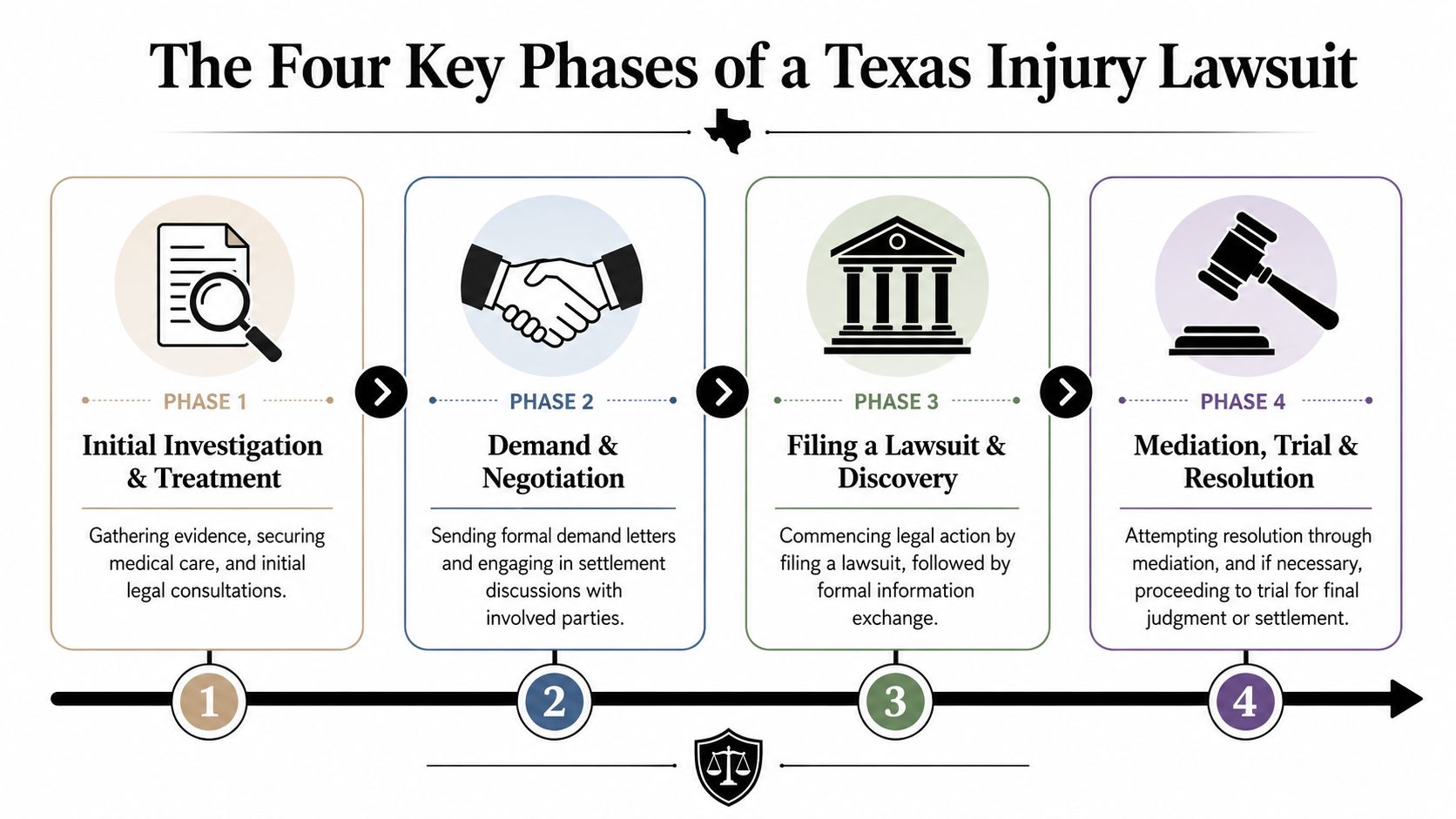
Phase one involves treatment and investigation
Right after the accident, your main job is getting proper care and following medical advice. Your lawyer's job is different. That person starts building the record.
This usually includes collecting crash reports, photographs, witness information, medical records, billing information, employer wage details, and insurance information. In a serious truck case, it may also include vehicle data, company records, or driver qualification materials.
A common source of confusion is that this phase can look quiet. It isn't. The case is often taking shape behind the scenes. If you want a plain-English explanation of the formal lawsuit side, this overview of what litigation lawyers do is a helpful starting point.
Phase two often focuses on demand and negotiation
Once the injuries and evidence are better understood, the claim may move into demand and negotiation. That usually means presenting the other side with the factual basis of the claim, the medical story, and the losses being claimed.
Some cases resolve here. Others do not.
This stage can take patience because the insurer may ask for more records, challenge medical treatment, or dispute who caused the crash. A Houston car accident attorney often spends substantial time pushing back on efforts to minimize the claim.
Phase three begins when a lawsuit is filed
If pre-suit talks don't lead to a fair result, the next step may be filing suit. Once that happens, the case enters formal litigation. The parties exchange written questions, documents, and other evidence through discovery.
The biggest technical reason cases slow down is evidence development and liability complexity. Cases with disputed fault, severe injuries, multiple defendants, or commercial vehicles usually require more discovery, expert analysis, and negotiation. A stronger early record, including police reports, photos, witness statements, medical documentation, and insurance policy analysis, can help a case move faster toward settlement before or after filing (Texas lawsuit delay factors).
Here is a simple view of what each phase tends to involve:
| Phase | What usually happens | Why it may take time |
|---|---|---|
| Treatment and investigation | Medical care, records, evidence gathering | Doctors need time to evaluate injuries |
| Demand and negotiation | Settlement discussions with insurer | Insurer may dispute value or fault |
| Filing and discovery | Formal lawsuit, document exchange, depositions | More parties and experts create more work |
| Mediation, trial, resolution | Final settlement efforts or court decision | Scheduling and unresolved disputes can extend the case |
Some proceedings now happen remotely. If you're curious about how virtual hearings and remote legal events fit into modern case handling, this AONMeetings legal overview gives useful context.
A short video can also help make the process feel less abstract.
Phase four is mediation, trial, or final resolution
Many filed cases still settle before trial. Courts often encourage mediation, where both sides try to resolve the dispute with a neutral third party helping the discussion.
If no agreement is reached, the case may continue toward trial. That is usually the longest and most demanding stage. Preparation becomes more intensive. Witnesses may be scheduled. Experts may be designated. The court controls much of the calendar.
A lawsuit can feel slow because the court's schedule matters, not just the parties' schedules.
Factors That Can Speed Up or Slow Down Your Case
Every injured person wants to know what makes one case move faster than another. The short answer is clarity. Cases with clear facts and organized proof tend to move better. Cases with uncertainty usually take longer.

Strong evidence usually shortens the path
A case often moves faster when the basics are well documented early. That means photographs, names of witnesses, consistent medical records, and a clear explanation of how the injury happened.
Consider the difference between these two situations:
- Faster-moving case: A driver is rear-ended at a stoplight, the crash is documented, treatment begins quickly, and the injuries are well tracked in the medical file.
- Slower-moving case: A multi-vehicle collision involves conflicting statements, unclear video, delayed treatment, and disputes about whether the crash caused all of the injuries claimed.
The second case doesn't mean the injured person is wrong. It just means more proof may be needed before the insurer or a jury can sort things out.
Injury severity can extend the timeline
Serious injuries often lengthen a claim because it takes time to understand the full medical picture. If you're still having procedures, rehabilitation, or specialist evaluations, it may be too early to know the lasting effect on your health or ability to work.
That matters because a settlement should reflect the scope of harm, not just the first emergency room visit. Cases involving permanent limitations, long recovery periods, or catastrophic harm usually need deeper analysis than claims involving short-term injuries.
Liability disputes add friction
When the other side denies fault, timing changes quickly. A simple crash can become a contested legal fight if a driver blames you, a company points at another contractor, or a property owner denies knowing about a dangerous condition.
That issue appears in more than vehicle collisions. Slip and Fall / Premises Liability in Texas involves representation for injuries caused by unsafe property conditions, and those claims often turn on whether the owner knew or should have known about the hazard.
The number of parties matters
A claim with one injured person and one insurer is usually easier to manage than a case involving several drivers, a trucking company, a commercial policy, and multiple attorneys. More parties usually means more records, more defenses, and more scheduling difficulty.
Let's consider this from a practical viewpoint:
| Factor | Tends to move faster when | Tends to move slower when |
|---|---|---|
| Fault | Liability is clear | Parties blame each other |
| Injuries | Recovery is straightforward | Medical course is still unfolding |
| Evidence | Records and photos are organized early | Key proof is missing or disputed |
| Defendants | One person or company is involved | Several people or entities are involved |
Insurance strategy can affect pace
Insurance companies don't always evaluate claims quickly just because the injury is serious. They may ask repeated questions, request more records, or argue that treatment was unnecessary or unrelated.
If you're dealing with that now, the guide on dealing with insurance companies after a Texas accident can help you understand common pressure points and how to protect your claim.
A Texas personal injury lawyer can help organize the claim, respond to those tactics, and keep the process moving without rushing you into an unfair result. One option some injured people consider is working with the Law Office of Bryan Fagan, PLLC, a Texas firm that handles motor vehicle accidents, serious injury claims, wrongful death matters, and related litigation.
Sample Lawsuit Timelines A Realistic Look
The legal process becomes easier to understand when you place it next to real-life situations. These examples are hypothetical, but they reflect patterns many injured Texans recognize.
A Houston freeway rear-end crash
A driver on a Houston freeway is struck from behind in heavy traffic. The police report points to the other driver. Photos show vehicle damage. The injured person gets prompt treatment for neck and back pain and follows up consistently.
That kind of claim often moves more efficiently because liability is relatively clear and the evidence is easier to organize. Settlement may happen without a trial if the records line up and the insurer evaluates the claim reasonably. If you want to compare the lawsuit timeline to the settlement side of the process, this guide on how long it takes to get a settlement in Texas adds helpful context.
An I-35 truck crash near Austin
A family vehicle is hit by a commercial truck on I-35 near Austin. The injuries are severe. The trucking company disputes fault, and there may be questions about the driver, the company, maintenance records, and insurance layers.
This kind of case often takes much longer than an ordinary collision. A truck crash lawyer Houston clients consult in a serious commercial case may need to work through company documents, expert review, and multiple legal defenses before meaningful settlement talks can happen. The complexity, not just the severity, usually drives the timeline.
The more people and records involved, the more likely it is that the case will require formal litigation before resolution.
A wrongful death case in Dallas
A Dallas family loses a loved one after a crash caused by another driver. The legal issues are painful and personal. The family may need to address not only fault, but also the losses tied to that death and how the claim should be presented.
A wrongful death lawyer Texas families turn to in this situation often has to build a careful, detailed presentation of the loss while also giving the family space to grieve. Even when liability is clear, these cases can take longer because the damages are broader and the emotional stakes are high.
These examples show why no lawyer should promise a one-size-fits-all timeline. The better approach is to identify where your case fits on the spectrum and what facts are likely to shape the pace.
Common Questions About Your Injury Case Timeline
People usually ask the same few questions once the first shock wears off. The answers can bring some peace of mind.
Will my case definitely go to trial
No. Many injury cases resolve before trial. Some settle before a lawsuit is filed. Others settle after filing, during discovery, or at mediation.
Still, preparation matters. Cases often settle more effectively when the other side believes you're prepared to prove the claim in court if needed. That's one reason a lawyer may spend substantial time building evidence even while settlement talks continue.
Why can't I just settle now and move on
Sometimes early settlement makes sense. Often it doesn't.
If your doctors still don't know the long-term effect of the injury, settling too soon can be risky. You may not yet know whether you'll need future treatment, whether pain will continue, or whether your ability to work has changed. Once a claim settles, you usually can't reopen it because new problems appear later.
What is maximum medical improvement and why does it matter
Maximum medical improvement means your condition has stabilized enough that doctors can better understand your long-term outlook. It does not always mean you are fully healed. It often means your treatment has reached a point where the likely future picture is clearer.
That matters because a claim should account for the true impact of the injury. If you settle before that picture comes into focus, the case value may not reflect your actual losses.
Can I get financial help while the case is pending
That depends on your situation. Some people use health coverage, medical payment coverage, disability benefits, or other available resources while the case moves forward. In some situations, attorneys also help clients identify practical ways to manage bills and records during treatment.
The safest approach is to ask before signing anything. Financial products tied to pending lawsuits can carry consequences, and insurance paperwork can affect your claim. A Texas personal injury lawyer can help you understand the tradeoffs before you commit.
You Are Not Alone Let Us Guide You Forward
Waiting is one of the hardest parts of any injury case. When you're in pain or grieving a loss, legal timelines can feel cold and frustrating. But there is a reason for the work that happens along the way. The process is designed to uncover facts, document harm, and put you in the strongest position to pursue fair compensation.
That doesn't mean every delay is good. Some delays come from disputed fault, missing records, crowded court schedules, or insurance resistance. But many of the steps that take time also protect you. They help make sure your case reflects what really happened and what the injury has cost you.
If you've been hurt in a crash, injured by unsafe conditions, or lost someone you love because another person acted carelessly, you don't have to sort through this alone. A Houston car accident attorney, a truck crash lawyer Houston families can call after a commercial collision, or a wrongful death lawyer Texas clients trust can help you understand where your case stands and what may come next.
Recovery is possible. Clarity is possible. Legal help is available when you're ready for it.
If you want answers specific to your situation, contact Law Office of Bryan Fagan, PLLC to schedule a free consultation. A Texas personal injury lawyer can review your accident, explain your options, and help you understand what may affect your timeline, your claim, and your next steps.