A serious accident can change your life in seconds. One moment you’re driving home on I-35, I-10, or a Houston freeway. The next, you’re dealing with flashing lights, a crushed vehicle, pain, phone calls from insurers, and a hundred questions you never expected to ask.
If you’re reading this after a collision with a commercial truck, you’re probably trying to make sense of what happened and what comes next. You may be worried about medical bills, missed work, your car, your family, or whether the trucking company is already building its defense. Those concerns are real, and they deserve clear answers.
You Are Not Alone After a Texas Truck Wreck
After a Texas freeway crash, many people describe the same first hours. Everything feels noisy and blurry. You answer the officer’s questions, get checked by EMTs, call a family member, and then the practical problems start showing up all at once.
A semi-truck collision is not a routine fender bender. The size difference alone changes everything. In 2022, 4,764 people died in semi-truck accidents across the United States, and 66% of those deaths were occupants of cars and passenger vehicles, according to semi-truck accident statistics summarized here. That is why ordinary drivers on Texas roads often suffer the worst harm when a large truck is involved.

What shock looks like in real life
A driver in Houston may walk away from the scene thinking they’re lucky, only to wake up the next day with neck pain, a headache, and numbness in an arm. A family near San Antonio may learn that the truck driver’s employer is calling the crash “unavoidable” before the family has even seen the crash report. A spouse in Dallas may suddenly become the person managing hospital updates, child care, and paperwork.
That confusion is normal. So is the feeling that the trucking company has more power, more records, and more resources than you do.
You do not need to know every legal answer on day one. You do need to protect your health and your evidence.
Why truck cases feel different
Truck wreck claims are more complicated because more people may share responsibility. The driver matters, but so do the carrier, maintenance records, onboard data, cargo handling, and the company’s insurance strategy. A semi-truck accident lawyer looks at the full chain of decisions that led to the crash, not just the impact itself.
That matters whether you need a Texas personal injury lawyer, a truck crash lawyer Houston families can call after a major freeway collision, or guidance on whether a case may become a wrongful death lawyer Texas matter after a fatal loss. In many situations, truck cases also overlap with issues that a Houston car accident attorney handles every day, such as fault, insurance, and documenting injuries, but with higher stakes and more moving parts.
The goal right now
Your first goal is stability. Get proper medical care. Keep records. Avoid saying too much to the trucking company’s insurer. Get help before critical evidence disappears.
You don’t have to sort all of this out alone, and you don’t have to do it perfectly to have a valid claim.
The First 48 Hours Critical Steps to Protect Your Claim
The first two days matter more than is commonly recognized. In a truck case, evidence can disappear quickly, memories fade, and insurers start working right away. The steps you take during this short window can strengthen your claim or make it much harder to prove later.

Start with your health, not your pride
If you haven’t already been checked by a doctor, do that first. Some truck crash injuries do not feel serious right away. Adrenaline can mask pain, and symptoms often show up hours later.
Medical treatment also creates a timeline. That timeline helps connect the collision to your injuries. When people wait too long, insurers often argue that something else caused the pain.
The scene evidence you need most
If you are physically able, or if a family member can help, preserve what you can as soon as possible:
- Photograph the vehicles: Get wide shots and close-ups. Include damage, debris, skid marks, road conditions, lane markings, and truck identifiers.
- Capture the truck’s details: Photograph the company name, USDOT markings, trailer number, and license plate.
- Get witness information: Names and phone numbers matter. Independent witnesses can become important if stories change.
- Keep every document: Tow slips, discharge papers, prescriptions, estimates, and the crash report number all help build the record.
A short checklist can help if you feel overwhelmed. This guide on what to do after a truck accident walks through the immediate steps in plain language.
Be careful what you say
Report the crash to your own insurer, but keep your comments brief and accurate. Don’t guess about speed, don’t minimize your injuries, and don’t agree to a recorded statement for the trucking company’s insurer before getting legal advice.
Here’s the practical reason. Adjusters are trained to lock in statements early. If you later learn you had a concussion, back injury, or internal injury, your first casual comments can be used against you.
Practical rule: Stick to the basics. Where the crash happened, who was involved, and that you are still receiving medical evaluation.
Why the 48-hour deadline matters in truck cases
Truck claims involve digital evidence that ordinary car crash cases often do not. That can include ELD data, black box information, driver logs, GPS information, dispatch communications, and maintenance records.
Following the 2025 FMCSA electronic logging device mandate expansions, it is important to have a lawyer send a preservation letter within 48 hours to secure digital data that may show fatigue or hours-of-service violations before the carrier can legally overwrite it, as discussed in this explanation of truck crash evidence preservation.
That is one of the biggest practical differences between a car wreck and a truck wreck. Waiting can cost you evidence you never get back.
A quick overview may help if this process feels unfamiliar:
What works and what doesn't
Here’s a simple comparison of early decisions after a truck crash:
| Action | Usually helps | Usually hurts |
|---|---|---|
| Medical care | Prompt evaluation and follow-up | Waiting and hoping symptoms pass |
| Documentation | Photos, witnesses, records | Relying on memory |
| Insurance contact | Brief notice to your insurer | Detailed recorded statements to the other side |
| Evidence preservation | Early legal request for truck data | Assuming the company will keep everything |
| Social media | Staying quiet | Posting photos or opinions about the crash |
If a family member is handling things
In serious injury cases, the injured person may not be able to manage calls, forms, and records. If you’re a spouse, adult child, or parent helping after a Houston or Austin truck crash, focus on three tasks first: keep all paperwork in one place, make sure follow-up medical care is scheduled, and get legal help quickly enough to preserve the truck’s records.
The first 48 hours are about protecting the truth. Once that happens, the legal case becomes much easier to build.
Unraveling Liability Who Is Really at Fault
Truck wrecks rarely come down to one simple mistake by one person. The driver may have caused the impact, but the deeper question is often why that happened and who had the power to prevent it.
A tire blowout on I-10 near San Antonio is a good example. At first glance, it may look like a driver lost control. A closer investigation may show worn tires, skipped inspections, rushed dispatch schedules, bad maintenance, or defective parts. That changes the case.
The driver is only the starting point
In Texas, fault is tied to negligence. In plain English, negligence means someone failed to use reasonable care and that failure caused harm. In a truck case, that can include unsafe driving, distraction, fatigue, poor maintenance, or improper loading.
But a commercial driver usually doesn’t operate in a vacuum. A company may have hired poorly, trained poorly, ignored service issues, or pressured drivers to keep moving despite obvious safety risks.
The list of possible defendants is often longer than people expect
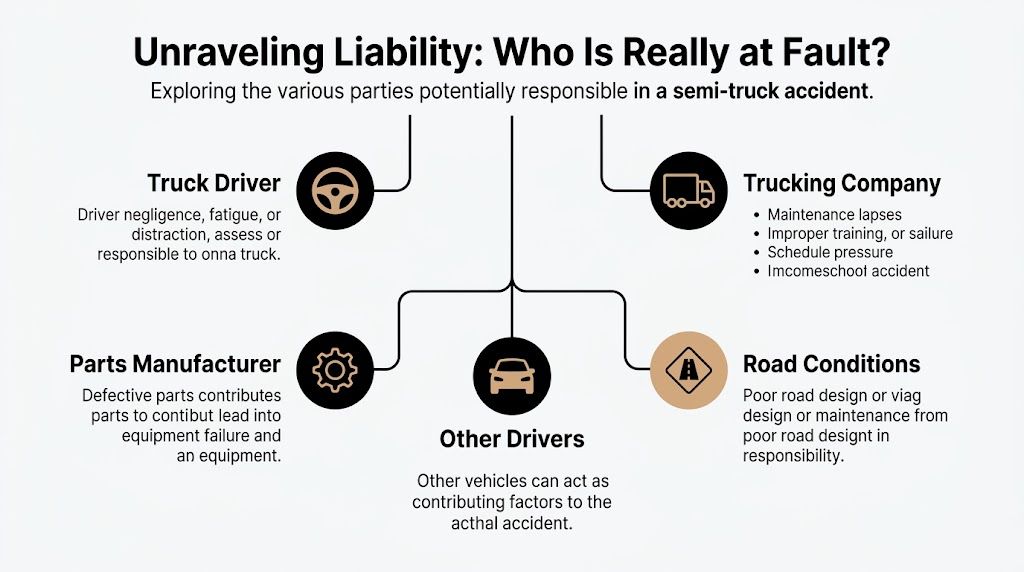
In a serious truck claim, the investigation may look at:
- The truck driver: Unsafe lane changes, distraction, fatigue, or impaired judgment.
- The trucking company: Hiring decisions, supervision, training, scheduling pressure, and vehicle upkeep.
- A maintenance provider: Improper repairs or missed inspection issues.
- A cargo loader: Unbalanced or unsecured freight.
- A parts manufacturer: Brake defects, tire defects, or mechanical failures.
- Another motorist: A separate driver may have contributed to the chain of events.
- A governmental entity in limited situations: Dangerous road design or maintenance issues may matter in some cases.
This is why early assumptions can be expensive. If you only pursue one party when several share responsibility, you may leave major sources of recovery untouched.
The records that often change a case
A skilled semi-truck accident lawyer uses a structured investigation, including subpoenaing carrier maintenance records. Those records can reveal brake failures, and brake failures were identified as a factor in 29% of large truck crashes according to the source summarized in this discussion of truck accident investigative methods.
In practice, the useful records often include inspection files, repair histories, dispatch communications, driver qualification files, and onboard data. Those documents show whether the crash was a one-time event or the predictable result of a pattern.
The police report matters, but it is rarely the whole case in a commercial truck collision.
How Texas comparative responsibility affects fault
Texas uses a modified comparative responsibility system. That means fault can be shared. If the defense says you changed lanes too quickly, braked unexpectedly, or were speeding, your recovery may be reduced by your percentage of responsibility. If you are found more responsible than Texas law allows, you can lose the right to recover damages.
This is one reason fault arguments matter so much. If you want a plain-language explanation, this overview of Texas comparative fault is a helpful starting point.
A practical example from a freeway case
Take a Dallas-area crash where a tractor-trailer rear-ends a smaller SUV in slow traffic. The trucking company may argue the SUV stopped suddenly. A closer review might show the truck’s brakes were overdue for service, the driver had been on the road too long, and dispatch messages pushed an unrealistic delivery window.
In that situation, the legal story is not just “driver hit car.” It becomes a broader negligence case involving operational choices by the carrier.
What works and what doesn't in liability investigations
| Approach | More effective | Less effective |
|---|---|---|
| Fault analysis | Looking at all parties and records | Focusing only on the driver |
| Evidence review | Maintenance, digital data, witness accounts | Depending only on one report |
| Case framing | Showing preventable safety failures | Treating the wreck like a simple car crash |
The key point is simple. Liability in truck cases is layered. The deeper the investigation, the clearer the path to accountability.
The Fight for Fair Compensation Calculating Your True Damages
After a serious truck crash, many people focus on the first hospital bill because it is immediate and visible. That bill matters, but it is only one piece of the damage picture. A fair claim should reflect what the collision has cost you, not just what you paid in the first week.
A Dallas worker with a back injury may need ongoing treatment, time away from work, medication, and help at home. A parent with a head injury may struggle with concentration, sleep, and the ability to care for children the way they did before. Those losses are real even when they don’t fit neatly on one invoice.
Economic damages are the measurable losses
These are the financial harms that can be documented through records, bills, wage information, and professional opinions. They often include:
- Medical expenses: Emergency care, surgery, hospital stays, follow-up visits, physical therapy, medication, and future treatment.
- Lost income: Missed paychecks, missed contract work, lost overtime, and reduced ability to earn in the future.
- Property loss: Vehicle damage and related out-of-pocket costs.
- Future support needs: Long-term care, rehabilitation, mobility assistance, or job retraining when injuries are severe.
These damages should be built carefully. A quick settlement offer may cover the ambulance and the ER, but ignore the months that come after.
Non-economic damages matter just as much
Some harm cannot be measured by a receipt. Texas law also recognizes human losses tied to the injury itself.
That may include physical pain, emotional distress, physical impairment, scarring, loss of normal activities, and the strain the injury places on daily life and relationships. If a loved one died in the crash, the family may also face wrongful death issues that deserve separate analysis.
For readers looking at related claims, these issues often overlap with catastrophic injury cases, wrongful death claims, and even severe car accident injury cases, depending on the facts.

Strong proof changes outcomes
Personal injury claims with strong forensic evidence and skilled legal representation often settle for 2 to 3 times more than claims without that support, and experienced lawyers achieve a 90% to 95% success rate in securing settlements before trial, according to this summary of truck injury claim outcomes.
That does not mean every case should settle quickly or that every case has the same value. It does show something important. Good evidence usually leads to a stronger negotiating position.
A truck claim should be valued based on the life the injury disrupted, not just the first round of bills.
How comparative fault affects compensation
Texas follows modified comparative fault. If the evidence shows you were partly responsible, your compensation can be reduced by your share of fault. That’s why damage calculation and liability proof work together. The stronger the evidence on fault, the stronger your position on compensation.
For example, if the defense claims you merged unsafely before a Houston truck wreck, they are not just disputing blame. They are trying to reduce what they have to pay. A careful case presentation addresses both issues at once.
A realistic way to think about value
Here is a practical framework families can use:
| Type of loss | Questions to ask |
|---|---|
| Medical care | What treatment have you had, and what treatment will you still need? |
| Work loss | How much income have you already lost, and will your ability to work change? |
| Daily life | What activities can’t you do now that you could do before? |
| Human impact | How have pain, stress, sleep problems, or mobility issues changed your life? |
The right claim is not inflated. It is complete.
When people handle a truck claim without fully documenting future care, long-term pain, or work limitations, they often settle the visible part of the case and leave the lasting part unpaid.
Navigating Insurance and Legal Deadlines in Texas
A common Texas truck claim problem starts with a polite phone call. The adjuster asks for “just your side of the story,” offers to move things along quickly, and sounds helpful. If you are still in pain, missing work, and trying to get your car replaced, that pressure can work.
Insurance companies act early for a reason. Early statements can lock people into facts they later learn were incomplete or wrong. A simple comment like “I’m okay” or “I didn’t really see what happened” can be used against you after the medical records and crash investigation fill in the gaps.
Handling insurance calls without hurting your case
Report the wreck to your own carrier promptly. Keep that report short and accurate. If the trucking company’s insurer contacts you, give only the basic identifying facts unless your lawyer advises otherwise.
A practical approach looks like this:
- Stick to the basics: Date, time, location, and the vehicles involved.
- Do not guess: If you are unsure about speed, distance, or lane position, say that.
- Do not minimize your condition: It is fair to say treatment is ongoing and you are still being evaluated.
- Do not agree to a recorded statement on the spot: You usually have no obligation to help the other side build its file.
- Do not sign releases without review: Some forms reach far beyond the crash report or the specific medical records at issue.
Texas deadlines can end a valid claim
Texas law sets a filing deadline for most injury and wrongful death lawsuits arising from a truck wreck. In many cases, that deadline is two years. Miss it, and the court can bar the claim entirely. For a plain-English explanation, review this guide to the Texas personal injury statute of limitations.
The calendar is only part of the problem.
In truck cases, delay also affects proof. Companies may keep some records only for limited periods unless someone demands preservation. That is one reason the first 48 hours matter so much under Texas practice. Waiting a few weeks can make a claim harder to prove even if the lawsuit deadline is still months away.
Insurance coverage is not always as straightforward as families expect
Many injured people assume a commercial truck always means a large, simple insurance policy. Real cases are rarely that clean. There may be a driver policy, a motor carrier policy, excess coverage, a broker dispute, or a fight over whether the driver was working for a company at the time of the crash.
Coverage gaps also happen. As noted by the Insurance Information Institute, uninsured and underinsured motorist coverage can become important when the at-fault driver has no insurance, too little insurance, or there is a hit-and-run issue. In a truck case, that can affect the strategy early because notice rules under your own policy may apply.
An insurance problem does not automatically end a truck injury claim. It changes where recovery may come from and how carefully the claim needs to be handled.
Documents to gather if UM or UIM coverage may apply
If there is any question about available coverage, organize the file early:
- Your declarations page and policy booklet: Look for UM/UIM provisions, notice requirements, and coverage limits.
- The crash report: This helps identify the parties and whether another vehicle fled or lacked coverage.
- Photographs and witness information: Those details matter if fault or vehicle identity is disputed.
- Medical bills and treatment records: Your own insurer will still examine whether the injuries were caused by the wreck.
- Any letters, emails, or claim numbers from insurers: Keep a timeline of every contact.
Texas truck claims often become more complicated because several insurance layers may be in play at once. A missed notice deadline, an overly broad medical release, or a recorded statement given too early can create avoidable problems.
For that reason, many families speak with counsel before they give detailed statements or sign insurance documents. The Law Office of Bryan Fagan, PLLC handles truck crash investigations, insurer communications, and claim development on a contingency-fee basis, which means legal fees are tied to recovery rather than paid upfront.
Why an Experienced Texas Truck Crash Lawyer is Essential
A truck collision claim is not just a bigger car wreck case. It involves different evidence, more possible defendants, more aggressive insurance tactics, and overlapping state and federal issues. That combination is why professional help often changes the outcome.
The first challenge is preservation. Someone has to demand the electronic records, maintenance files, and driver-related data before they disappear. The second challenge is investigation. Someone has to trace responsibility beyond the obvious and identify every party that may owe compensation.
What legal help actually changes
A lawyer does more than file paperwork. In a strong truck case, legal counsel can:
- Control communications: This reduces the chance that an insurer twists your early statements.
- Develop proof: Medical records, witness accounts, and truck-company records have to be collected and organized in a way that tells a clear story.
- Value the full claim: Many unrepresented people focus on current bills and underestimate future losses.
- Prepare for litigation if needed: Settlement talks are different when the other side knows the case can be tried properly.
Experience matters because truck cases are technical
A semi-truck accident lawyer needs to understand how commercial records fit together. Driver logs, maintenance histories, dispatch messages, and onboard data only help if someone knows what to ask for and how to use it.
That is especially true in catastrophic injury and fatal crash cases. Families dealing with grief or a long recovery should not have to learn trucking regulations while also managing hospital care, missed work, and daily life.
The practical trade-off
Some people worry that calling a lawyer will make the case more adversarial. In reality, early legal involvement often brings order to a chaotic situation. It creates one point of contact, one plan for evidence, and one strategy for negotiations.
For many families, that relief matters as much as the legal work itself. And because truck injury firms commonly work on a contingency fee, people can get help without adding an immediate legal bill to an already stressful time.
Your Path to Recovery Starts Today
The days after a truck wreck can feel heavy. You may be hurting, exhausted, angry, or unsure what to do first. All of that is normal.
What matters now is taking the next sensible step. Get medical care. Keep your records. Be careful with insurer conversations. Act fast enough to protect the truck’s data and the rest of the evidence. If you lost a loved one, give yourself space to grieve while making sure your family’s legal rights are protected.
You do not need to have every answer before you ask for help. You only need to know that your case deserves to be taken seriously.
Whether you need guidance from a Texas personal injury lawyer, help after a freeway collision from a truck crash lawyer Houston families trust, support in a fatal case that may require a wrongful death lawyer Texas, or insight that overlaps with what a Houston car accident attorney handles in severe injury litigation, the first conversation should leave you with clarity, not pressure.
A strong legal consultation should answer basic questions plainly. Who may be at fault. What evidence should be preserved. How insurance may respond. How Texas comparative fault works. How long you have to act. Those answers can make the road ahead feel manageable again.
Recovery is possible. Legal help is available. And you do not have to carry this alone.
If you or someone you love was hurt in a commercial truck crash, contact the Law Office of Bryan Fagan, PLLC for a free consultation. We can talk through what happened, explain your options under Texas law, and help you protect the evidence and deadlines that matter most.