A serious accident can change your life in seconds, but you don’t have to face it alone.
You may be reading this from an urgent care waiting room, your kitchen table, or your phone during a break while you’re trying to figure out what just happened. One minute you were lifting, driving, climbing, stocking, welding, typing, or operating equipment. The next, you were hurt, missing work, and wondering how you’ll pay bills if your paycheck stops.
That’s when a dallas workers compensation attorney can make a real difference. Not just by filing forms, but by helping you protect the claim from the first day, deal with the insurance company’s tactics, and spot a major issue many workers miss in Texas. Some work injuries belong in the workers’ compensation system. Some don’t. If your employer is a non-subscriber, your case may follow a completely different path.
An Injury at Work Can Change Everything Here’s What to Do First
A warehouse worker in Dallas twists hard while moving inventory. A nurse feels a sharp pain while helping a patient. A construction worker slips coming down a ladder and lands on his hand. In the first hour after a job injury, many individuals don’t think like claimants. They think like workers. They try to shake it off, finish the shift, or wait to see if the pain gets worse.
That instinct can hurt your case.
The first move is simple. Report the injury to your employer, and do it in writing. The second is just as important. Get medical care right away. Those two actions protect both your health and your legal position.

Why these first two steps matter
When you report the injury promptly, you create a record of when it happened, where it happened, and what part of your body was hurt. If you wait, the employer or insurer may argue the injury happened somewhere else, happened later, or isn’t as serious as you say.
Medical treatment does something similar. It creates the first clear link between the accident and the condition you’re now dealing with. If your doctor’s records say you were injured at work and describe your symptoms early, that record becomes a foundation for the claim.
Practical rule: If you’re hurt at work, don’t “wait and see” before reporting it. Delays create avoidable arguments.
A written report can be an email, text, incident report, or other message your employer can later identify. Keep a copy. If your supervisor brushes you off, report it anyway and keep going up the chain if needed.
What to say and what not to say
Keep it factual. State the date, time, location, and how the injury happened. List every body part that hurts, even if some symptoms still seem minor. A shoulder injury can turn into a neck issue. A sore wrist can turn into a serious hand injury.
Avoid guessing, minimizing, or trying to sound tough. “It’s probably nothing” is the kind of statement insurers like to revisit later.
If you need more guidance on the immediate steps after a job injury, review this guide on what to do if you were hurt at work in Texas.
How to File Your Texas Workers’ Compensation Claim
A lot of injured workers think telling the boss is the same as filing the claim. It isn’t. Reporting the injury starts the process at work. Filing the claim protects your rights with the state system.
In Texas, the key form is Form DWC-041, also called the Employee’s Claim for Compensation for a Work-Related Injury or Occupational Disease. The Texas workers’ compensation system operates on strict deadlines, and your attorney handles critical administrative tasks, including submitting Form DWC-041 within the mandatory one-year deadline after the injury, as explained in this overview of a Dallas workers’ compensation lawyer and DWC-041 filing.
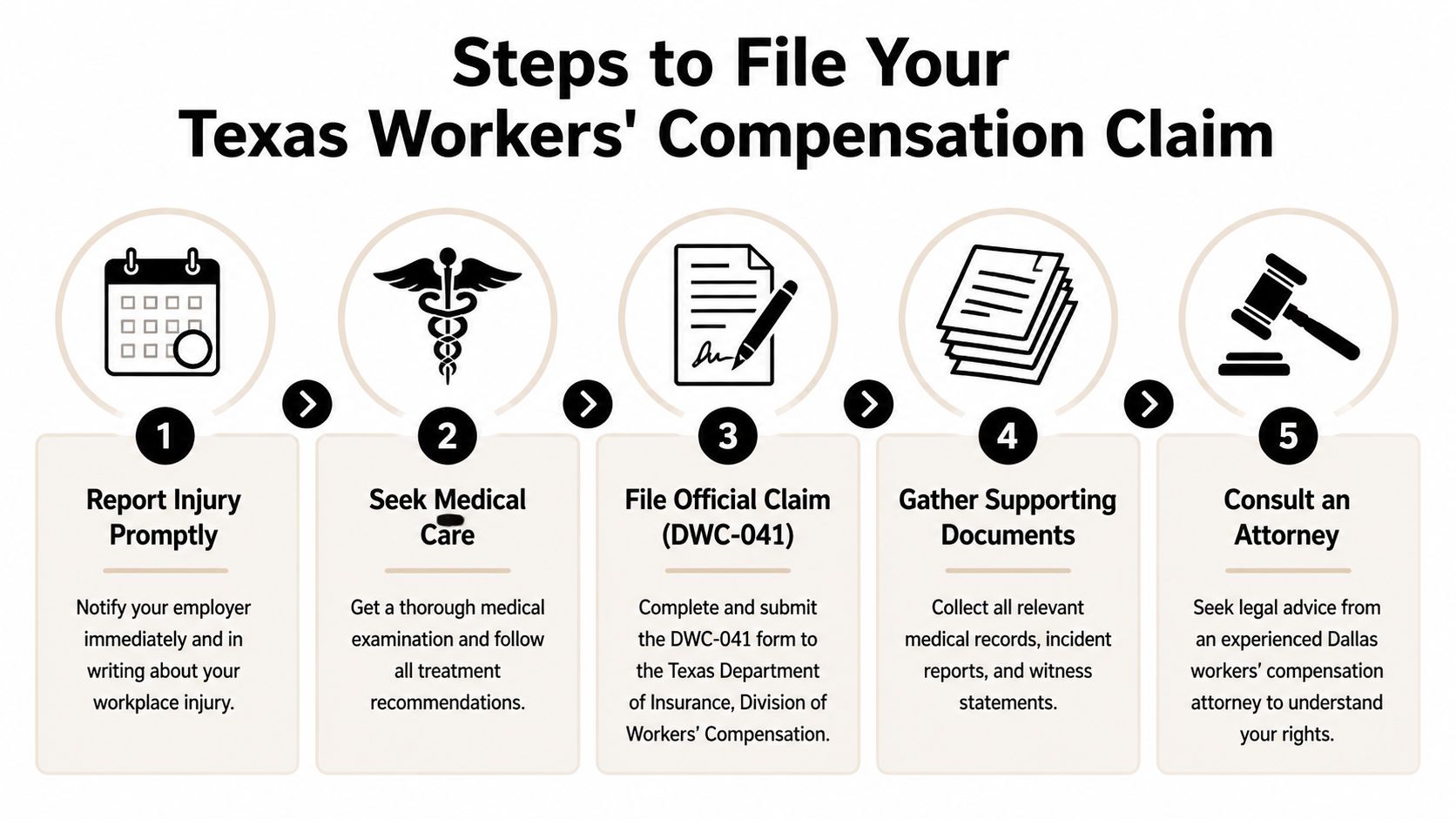
The five parts of filing it correctly
Tell your employer you were injured
Do this promptly and in writing. Keep the wording clear and direct.Get medical treatment
Tell the doctor the injury happened at work. Make sure the records reflect that.Submit Form DWC-041
This is the formal claim. If you miss the filing deadline, your case can become much harder to recover.Collect the records that support your claim
These often include incident reports, clinic notes, imaging, work restrictions, and witness names.Get legal advice early if anything feels off
A delayed response, denied treatment, or pressure from the employer are all signs to get help.
What counts as a work-related injury
Texas law generally looks at whether the injury happened in the course and scope of employment. In plain English, that means you were doing your job or doing something connected to your job when you got hurt.
A simple example helps. If you hurt your back while lifting boxes during your shift, that usually fits. If you’re injured in a routine commute to work, that usually raises different issues. The details matter. So do timing, location, and what you were being asked to do.
Good claims are built on specifics. Where were you, what task were you doing, who saw it, and what did the doctor document that same day?
The paperwork is only part of the job
Many people assume the form itself wins the claim. It doesn’t. The form opens the door, but the supporting records are what keep the case moving. Insurance carriers look for gaps. They compare your report, your medical records, your work history, and your symptoms for inconsistencies.
That’s why it helps to keep your own file with:
- Medical visit summaries that mention the work injury
- Work status slips showing restrictions or time off
- Employer communications such as texts or emails
- Witness information from coworkers who saw the incident
If you want a broader overview of the process, this page on Texas workers’ compensation rules is a helpful starting point.
What if Your Employer is a Texas Non-Subscriber
Many injured workers assume every employer in Texas carries workers’ compensation coverage. That assumption causes real problems, because Texas is different. Some employers are non-subscribers, which means they don’t participate in the state workers’ compensation system.
That changes everything about the case.

Why the distinction matters
If your employer is a non-subscriber, you can sue for full compensation, including pain and suffering damages, which aren’t available in a standard workers’ comp claim. But you must prove employer negligence, such as safety violations or inadequate training, as explained in this discussion of Dallas non-subscriber work accident claims.
That is a very different legal path from a standard workers’ comp claim.
In a traditional workers’ comp case, the focus is usually on whether the injury happened at work and what benefits are owed. In a non-subscriber case, the focus shifts to fault. You have to show the employer did something wrong or failed to do something it should have done.
Signs your case may be a non-subscriber claim
Examples of negligence can include:
- Missing safety gear such as required protective equipment
- Poor training for machinery, lifting, driving, or hazardous tasks
- Known hazards ignored after prior complaints or prior incidents
- Unsafe staffing decisions that force people into risky work without support
A worker injured by a defective forklift, missing guardrail, or poorly enforced safety policy may have a much stronger case than they realize.
For a side-by-side look at these two legal paths, review this guide on workers’ comp vs personal injury in Texas.
Employers and business owners who are trying to understand broader workers' compensation insurance requirements across different states may find that comparison useful, especially because Texas handles coverage differently from many other states.
Why strategy changes in non-subscriber cases
In a workers’ comp claim, much of the fight centers on medical evidence, deadlines, and benefit disputes. In a non-subscriber case, the evidence often includes training records, safety policies, internal reports, maintenance history, witness statements, and photographs from the scene.
That’s why early investigation matters.
Here’s a short explanation of how lawyers often evaluate these workplace injury paths in Texas:
If you’re not sure whether your employer subscribes to workers’ compensation, don’t guess. That single answer changes the benefits available, the proof required, and the value of the case.
The Role of a Dallas Workers Compensation Attorney
A good lawyer does much more than submit forms. In a serious claim, the primary work is strategic. The issue usually isn’t whether you can fill out paperwork. It’s whether you can build a claim that holds up when the insurer starts looking for reasons to limit, delay, or deny it.
That’s where specialization matters. Dallas County has over 17,600 active attorneys, but less than 1% report workers’ compensation as their primary practice area, according to the Texas Bar demographic and economic trends data. A true dallas workers compensation attorney understands the DWC system, the hearing process, and the medical issues that shape the claim.
What an attorney actually handles
Some of the most important work happens behind the scenes:
Evidence development
A lawyer gathers medical records, work restrictions, incident reports, witness statements, and employer communications in a way that tells a consistent story.Insurance communication
Adjusters often ask questions that sound routine but are designed to lock you into a position early. Counsel manages those exchanges and keeps the claim from getting framed unfairly.Medical issue tracking
When records are incomplete or vague, insurers use that gap. A lawyer watches for missing causation language, unclear diagnoses, and treatment denials.Dispute preparation
If the claim turns adversarial, your file should already be organized for mediation or hearing.
What works and what usually doesn’t
Some choices help injured workers. Others create problems fast.
| Situation | What tends to work | What often backfires |
|---|---|---|
| Early reporting | Clear written notice and prompt treatment | Waiting because you hope the pain goes away |
| Medical records | Consistent symptom reporting | Telling one doctor your shoulder hurts and another that you're fine |
| Insurance calls | Thoughtful, limited communication | Casual explanations that get taken out of context |
| Benefit disputes | Building the record before the hearing | Showing up angry but unprepared |
A strong claim is usually calm, documented, and consistent. A weak claim is often rushed, incomplete, and reactive.
The fee question most people worry about
Most workers’ compensation lawyers in Dallas work on a contingency-fee basis, which means the fee comes out of recovered compensation rather than from your pocket upfront. For injured workers, that matters. It lets you get legal help when you need it most, not after the case is already damaged.
The practical benefit is simple. You can focus on treatment and work restrictions while your lawyer handles deadlines, filings, and strategy.
Businesses that want to understand coverage options from the employer side sometimes review resources such as Tailored Dallas workers' compensation for employers. For injured workers, the key takeaway is different. The employer and insurer already have systems in place. You need someone focused on protecting your side of the case.
Personal injury issues can overlap
Some workplace injury cases go beyond the workers’ comp system. If a third party caused the injury, or if the non-subscriber issue applies, broader Texas personal injury law may matter. That includes fault, negligence, comparative responsibility, and the statute of limitations that applies to injury lawsuits.
For example, after a delivery driver is hit while working, there may be both employment-related issues and a separate claim against the at-fault driver. The same can happen after a defective machine injury, a plant explosion, or a catastrophic fall. In those cases, a Texas personal injury lawyer looks not only at benefits, but at the full scope of damages and who may be legally responsible.
What to Do When Your Workers Comp Claim is Denied
A denial letter can make it feel like the system has already decided you’re not telling the truth. That isn’t the right way to read it. A denial usually means the insurer thinks it can defend the claim, often based on medical records, notice issues, causation disputes, or the severity of the injury.
The response should be deliberate, not emotional.

The first stage is usually mediation
If your claim is disputed, the first formal step is a Benefit Review Conference, or BRC. With skilled legal representation, 80-92% of cases are resolved at this stage, avoiding the need for a more complex Contested Case Hearing, which fewer than 5% of cases reach, according to this explanation of workers’ comp appeal and mediation outcomes.
A BRC is not just a meeting. It’s a structured effort to narrow the issues and reach an agreement. Preparation matters. The side with the cleaner timeline, stronger medical support, and clearer theory of the case usually has the advantage.
If the case doesn’t settle
If the dispute remains unresolved, the case can move to a Contested Case Hearing before an administrative law judge. At that point, the claim becomes more formal. Evidence has to be organized. The medical story has to make sense. The legal issues have to be framed clearly.
That’s also why self-represented workers often struggle at this stage. The insurer comes prepared.
Here’s the usual progression:
Benefit Review Conference
The parties try to resolve the dispute through mediation.Contested Case Hearing
If mediation fails, the case goes before an administrative law judge.Appeal
If needed, the next step is challenging the hearing decision through the appeals process.
Denial doesn’t end the claim. It changes the job from filing to proving.
How lawyers improve denied cases
Once a claim is denied, the weak spots become obvious. Maybe the emergency room record didn’t clearly tie the injury to work. Maybe a prior condition is being used against you. Maybe the employer says you never reported the accident properly.
A lawyer works backward from the denial reason. That may mean obtaining more detailed physician records, gathering witness statements, correcting timeline gaps, or organizing records in a way the hearing officer can follow.
This is also where negotiation skill matters. Many denied claims don’t fail because the worker was wrong. They fail because the file was incomplete, inconsistent, or poorly presented at the wrong moment.
For families dealing with severe harm, these disputes can overlap with other major injury claims too. A workplace crash involving a commercial vehicle may raise issues a truck crash lawyer Houston would recognize. A fatal incident on the job may involve the same negligence principles a wrongful death lawyer Texas handles in other contexts. And if a worker is injured in a company vehicle by another driver, the analysis may resemble what a Houston car accident attorney or Texas personal injury lawyer would evaluate in a roadway case.
Avoid These Common Mistakes in Your Workers Comp Case
Most workers don’t hurt their own claims on purpose. They do it because they’re in pain, stressed, and trying to keep their job. But a few avoidable mistakes show up again and again.
Insufficient medical evidence and missed reporting deadlines are among the top reasons claims are denied, and claimants with attorney representation are several times more likely to secure benefits than those who file alone, as discussed in this review of workers’ compensation lawyer success-rate factors.
Four mistakes that cause trouble fast
Waiting too long to get care
A delay gives the insurer room to argue the injury wasn’t serious or wasn’t work-related.Leaving out body parts
If your back, shoulder, and knee all hurt, say so early. Injuries often become clearer over time, but the initial report still matters.Being inconsistent with doctors
If you tell one provider the pain is severe and another that you’re doing fine, that inconsistency can show up later.Talking too freely with the adjuster
A casual recorded statement can become evidence. People often guess, minimize symptoms, or speak too loosely when they’re nervous.
A better approach
Keep your story accurate and consistent. Follow treatment recommendations. Save your paperwork. If you can’t work, make sure your restrictions are documented.
Say what happened. Say where it hurts. Say what you can’t do now that you could do before. Then let the records support the rest.
If your injury was caused by another driver, a dangerous product, or an unsafe employer outside the comp system, broader negligence rules may apply too. In those cases, comparative responsibility can affect recovery in a personal injury lawsuit, and the statute of limitations becomes a major issue. Those cases need early review, especially when the injury is severe.
Your Path to Recovery Starts Today You Don’t Have to Walk It Alone
A workplace injury can leave you dealing with pain, lost income, paperwork, and pressure from every direction. But you do have options. Report the injury. Get medical care. Find out whether your employer carries workers’ compensation or is a non-subscriber. Then protect the claim before small mistakes become big obstacles.
Texas law can be confusing, especially when a work injury also raises personal injury issues involving fault, negligence, comparative responsibility, or filing deadlines. Whether you were hurt on a jobsite in Dallas, injured in a company vehicle, facing a catastrophic injury, or helping your family after a fatal accident, legal help can bring order to a very difficult situation.
Recovery is possible, and you don’t have to figure it out alone.
If you need answers after a workplace injury, contact Law Office of Bryan Fagan, PLLC for a free consultation. The firm helps injured Texans understand their rights after work accidents, vehicle collisions, catastrophic injuries, and wrongful death cases. You can also learn more about related claims involving car accidents, truck accidents, wrongful death, and catastrophic injuries. A clear plan can make the next step easier, and help is available when you’re ready.