A serious accident can change your life in seconds, but you don’t have to face it alone.
You may have gone to work expecting a normal day. Then a lift gave out, a delivery van crashed, or your back gave way carrying something your supervisor said had to move now. By that evening, you weren’t just hurting. You were worried about your paycheck, your doctor, and whether your employer was really going to help.
Then a new name shows up. Sedgwick.
For many injured Texans, that’s the moment the process starts to feel cold and confusing. You expected HR or an insurance company. Instead, you’re dealing with adjusters, forms, approvals, networks, and long stretches of silence. If you’ve felt frustrated, ignored, or pressured, your reaction makes sense.
A Work Injury Can Change Your Life But You Are Not Alone
A warehouse worker in Houston hurts his shoulder loading inventory. The company sends him to a clinic. He thinks the hardest part will be the pain. A few days later, he learns the harder part may be the claim itself.
He starts getting calls from someone he’s never met. He’s told to use certain doctors. He asks about imaging because he can’t lift his arm over his head, but nobody gives him a straight answer. Bills start arriving. His family asks when he’ll be back at work, and he doesn’t know what to tell them.
That kind of uncertainty wears people down fast.

If you’re in that position right now, you’re not weak and you’re not overreacting. Pain changes your sleep, your mood, and your ability to think clearly. If the injury keeps lingering, it may help to learn ways to manage chronic pain while you work through treatment and paperwork.
Why this feels so overwhelming
Workers’ compensation sounds simple when employers describe it. Report the injury. Get treated. Receive benefits. In real life, many claims get bogged down in approval issues, paperwork mistakes, and disputes about what care is “necessary.”
Sedgwick workers comp claims often feel especially difficult because you’re not dealing with a system designed around your comfort. You’re dealing with a system designed to process claims efficiently for the company side.
Practical rule: If something about your claim feels off, trust that instinct and start documenting everything right away.
What you need most right now
You need plain answers.
You need to know who Sedgwick is, why they’re involved, what rights you still have under Texas law, and what steps protect you if your claim starts going sideways. You also need to understand that a work injury can overlap with a personal injury case, especially after a vehicle crash or a dangerous worksite incident caused by someone outside your company.
In Texas personal injury law, fault matters. If another person or company caused your injury through negligence, you may have a claim beyond workers’ comp. Texas also follows modified comparative responsibility, which can affect recovery in a negligence case if fault is shared. And deadlines matter. The statute of limitations can limit how long you have to file a personal injury lawsuit.
What Is Sedgwick and Why Are They Handling My Claim
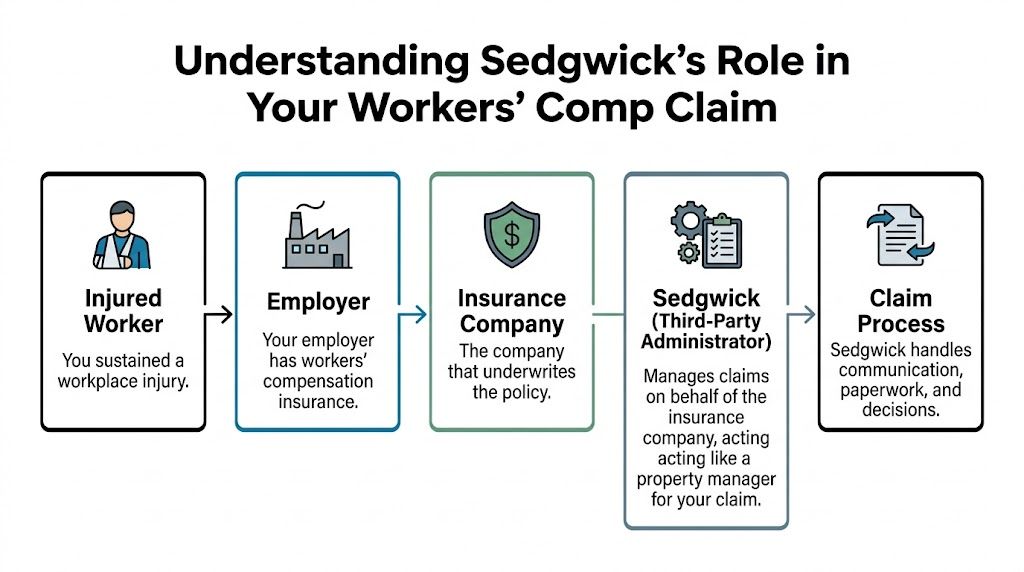
Sedgwick is usually not your employer and not the doctor making treatment decisions. In many cases, Sedgwick is a third-party administrator, often called a TPA.
Think of a TPA like a property manager. The property manager doesn’t own the building, but they handle the day-to-day issues for the owner. Sedgwick plays a similar role with claims. It handles paperwork, communication, claim decisions, and coordination on behalf of the company paying for coverage.
Who Sedgwick works for
Many people find this confusing.
Sedgwick may speak to you often, ask for records, and direct parts of your claim. That can make it seem like they’re a neutral helper. They aren’t your advocate. Their client is the employer or insurance side.
That doesn’t mean every adjuster is personally unfair. It does mean the structure of the relationship matters. The company paying Sedgwick wants claims managed and costs controlled. Your goal is different. You want proper care, wage benefits, and a fair process.
Sedgwick workers comp claims often become stressful because the injured worker expects support, while the administrator is focused on managing exposure for the employer side.
How technology shapes your claim
Sedgwick has said it uses artificial intelligence-driven severity scoring in claim workflows, and that higher-risk claims can be routed to experienced examiners, litigation specialists, or clinical resources, while claim severity affects duration, indemnity decisions, and litigation likelihood, according to Sedgwick’s discussion of using AI and data to identify emerging risks before they impact operations.
That matters more than it may seem.
If a system flags your injury as routine, your file may move down a faster administrative path. If it flags your claim as complex or likely to lead to litigation, different people may get involved and different levels of scrutiny may follow. In plain language, internal scoring can affect how much attention your case receives and how hard the claim is questioned.
The doctor network issue
Sedgwick also uses provider benchmarking. It says it analyzes more than two million claims through a scoring model that looks at cost, duration, litigation, recidivism, and disability days to match workers with providers who score well.
That kind of system can create practical concerns for injured workers. A doctor may be viewed favorably because claims close faster or involve less litigation. But your concern is whether the doctor fully sees your injury, orders the right testing, and won’t rush you back before you’re ready.
If you’ve wondered why you were directed to a specific clinic or why your preferred doctor may not be approved, this is part of the answer.
Common Hurdles When Dealing with Sedgwick in Texas
The most common complaint I hear isn’t just pain. It’s that the process starts to feel like a battle over every step.
A roofer in Dallas falls and injures his knee. The clinic recommends further evaluation because swelling doesn’t improve. Instead of getting a quick answer, he gets delay. Calls aren’t returned. Work status becomes unclear. Then someone suggests he should be getting better by now.
That pattern is common enough that injured workers should be ready for it.

Treatment denials and delayed care
One of the most striking facts available is that Sedgwick publicly touted a 54% denial rate for injured worker treatment requests and paired that with a claimed 5-to-1 return on investment for employers, as discussed in DaisyBill’s report on Sedgwick’s 54% denial rate for injured worker treatment.
If you’ve had an MRI, physical therapy, pain treatment, or specialist referral questioned, that statistic helps explain why your experience may not be an isolated problem.
A denial doesn’t always arrive as a dramatic letter saying “no.” Sometimes it looks like silence, repeated requests for records, demands for more review, or a narrow approval that doesn’t match what the treating doctor recommended.
Pressure to return before you’re ready
This issue is easy to miss because it’s often framed politely.
You may hear that “light duty is available” or that you should be improving enough to resume normal tasks. But if your body isn’t ready, returning too soon can make the injury worse. A back injury can turn chronic. A shoulder tear can become harder to treat. A brain injury can be aggravated by stress and exertion.
When a worker is hurt in a company vehicle, things can get even more complicated. There may be a workers’ comp claim and a third-party negligence claim at the same time. This guide on workers comp vs personal injury explains why the distinction matters.
Communication problems that wear you down
People don’t just complain about denials. They complain about not knowing what’s happening.
You may leave messages and get no response. You may be told a request is under review but never told who is reviewing it. You may hear one thing from the clinic and another from the adjuster.
That kind of confusion creates risk. If you don’t know whether treatment is approved, you may miss care. If you don’t know your work status, you may say the wrong thing to your employer. If you don’t know a denial deadline is approaching, you may lose valuable time.
This short video helps show how injured workers often experience the process:
Keep your own timeline. Don’t rely on the adjuster’s notes to tell your story later.
Your Step-by-Step Action Plan After a Work Injury
The right first moves can protect your claim long before any dispute begins. If Sedgwick workers comp is now part of your life, focus on building a clean record from day one.
Report the injury fast and in writing
Tell your employer as soon as possible.
In Texas, a worker generally must report the injury within a set time period. Don’t trust memory or a verbal hallway conversation. Send a text, email, or written report that says when, where, and how you got hurt. Save a copy.
If your supervisor brushes it off, report it to HR too.
Get medical care and describe every symptom
Don’t minimize what happened.
Tell the doctor about the main injury, but also mention headaches, numbness, sleep problems, anxiety, or pain that radiates into another body part. Small details can become big issues later. If it wasn’t recorded early, Sedgwick may argue it wasn’t related.
Sedgwick’s published trend discussion says claims involving workers aged 60 and older rose 2.8% year over year, with 9 extra disability days and a 35% increase in medical service costs for that group. The same source says mental health claims are 2% of volume but cost 3.5 times more and last 3.5 times longer, according to Sedgwick’s article on workers’ compensation hot topics shaping the future. The practical lesson is simple. Age, recovery time, and mental health can all affect your claim, so document all of it.
Keep a daily claim file
A notebook works. So does a notes app.
Track:
- Pain changes: What hurts, when it hurts, and what activities make it worse.
- Medical visits: Clinic names, provider names, restrictions, referrals, and medications.
- Claim contacts: Who called, what they said, and what they promised.
- Work impact: Missed shifts, reduced duties, and tasks you can’t perform at home.
If you send records by fax, use a proper cover page that protects privacy. A simple HIPAA Compliant Fax Cover Sheet can help you organize medical transmissions more safely.
Don’t ignore your mental health
People often feel guilty bringing this up. You shouldn’t.
Pain, lost income, fear about your job, and poor sleep can hit hard. If your injury has affected your mood, concentration, or stress level, tell your doctor. That isn’t weakness. It’s part of the injury picture.
Watch the deadlines
Deadlines can sink a valid claim if you miss them. Here’s a simple guide.
| Action Required | Deadline | What This Means for You |
|---|---|---|
| Report your work injury to your employer | Within 30 days | Tell your employer promptly and keep proof that you reported it |
| File your workers’ compensation claim with the state | Within 1 year of the injury | If you wait too long, you can lose the right to benefits |
| Respond to claim disputes or requests for information | As quickly as possible | Delays can give the other side room to challenge care or benefits |
A separate problem can exist outside workers’ comp. If someone other than your employer caused the incident, such as another driver after a Houston freeway crash or a contractor on a jobsite, you may also have a negligence claim. Texas personal injury law looks at fault, breach of duty, and damages. Texas also uses modified comparative responsibility in negligence cases, which means shared fault can affect recovery. The statute of limitations matters there too, so don’t assume the workers’ comp timeline is the only one that applies.
For a broader overview of job injury rights, this resource on being hurt at work is a good place to start.
Quick check: Before you go to bed tonight, gather your accident report, discharge papers, work restrictions, and every text or email about the injury into one folder.
When to Hire a Texas Workers Comp Lawyer for Your Sedgwick Claim
Some people can handle an uncomplicated claim on their own. Many can’t, especially once Sedgwick starts disputing care, timing, or severity.
The key question isn’t whether you’re tough enough to do it alone. It’s whether the claim has reached the point where mistakes are costly.
Signs you shouldn’t wait
You should strongly consider legal help if any of these are happening:
- Your treatment was denied: If your doctor recommends care and the claim stalls or rejects it, the dispute usually won’t fix itself.
- Your injury is being minimized: This is common with back injuries, head injuries, repetitive trauma, and conditions that don’t show up clearly on a basic exam.
- A pre-existing condition is being blamed: Sedgwick may argue your symptoms came from old wear and tear instead of the work event.
- You were hurt in a vehicle crash: A Houston delivery driver struck by another motorist may have both a workers’ comp issue and a third-party injury case, which is where a Houston car accident attorney or truck crash lawyer Houston may also be important.
- The injury is catastrophic: Amputation, severe burns, spinal injury, or permanent disability raises the stakes immediately.
- You’re overwhelmed: That alone is a valid reason to get advice.
Why early legal help can matter
Sedgwick has acknowledged a growing trend of early attorney involvement in workers’ comp matters, and its discussion of claim barriers says mental health aspects cost 3.5 times more, while early behavioral health intervention within 90 days can cut temporary disability days by 40%, in Sedgwick’s article on new barriers to optimal outcomes in workers’ comp.
That supports something injured workers already know from experience. Early guidance can change the direction of a claim before bad assumptions harden into official decisions.
Why this also matters in personal injury law
Workers’ comp and personal injury law are not the same.
In a negligence case, a Texas personal injury lawyer looks at who caused the harm, whether safety rules were ignored, whether a company failed to train or supervise, and whether another driver, contractor, or manufacturer contributed to the injury. Texas comparative responsibility rules may apply in that type of case. If the accident caused a fatal injury, the family may need to speak with a wrongful death lawyer Texas residents trust.
If your claim has moved beyond simple paperwork, speaking with a lawyer isn’t overreacting. It’s strategy. If you want a local resource focused on this area, review these workers compensation attorneys in San Antonio, Texas.
How the Law Office of Bryan Fagan Fights for You
When Sedgwick controls the calls, the paperwork, and the pace, injured workers often feel boxed in. That changes when a law firm takes over the pressure points.
The Law Office of Bryan Fagan, PLLC helps Texas injury victims by stepping in where claims commonly break down. That can mean taking over communications, organizing medical proof, challenging unfair denials, and protecting your rights if your work injury also involves a personal injury claim against someone else.
What that looks like in practice
A strong legal team can:
- Handle Sedgwick directly: You shouldn’t have to spend your recovery chasing callbacks and defending your symptoms.
- Build the medical record: Lawyers work to gather the records, opinions, and timelines that show how the injury affects your life.
- Investigate fault outside workers’ comp: If a third party caused the accident, a separate negligence case may exist.
- Pursue the full scope of damages: Medical bills, lost wages, pain and suffering, future care, and family losses may all matter depending on the case.
- Prepare for serious litigation: That’s especially important in catastrophic injury and fatal accident claims.
Cases that may involve more than workers’ comp
A worker hurt in an 18-wheeler collision may need a truck crash lawyer Houston. A family grieving a fatal workplace-related crash may need a wrongful death lawyer Texas. Someone facing permanent limitations after a major incident may need help with a catastrophic injury claim. And if the injury happened in a road collision, a Houston car accident attorney may need to pursue the driver or company that caused it.
You don’t have to know which claim comes first before asking for help. That’s part of the lawyer’s job.
Frequently Asked Questions About Sedgwick Claims in Texas
Can I see my own doctor
Sometimes yes, sometimes no.
That depends on the workers’ comp setup, including whether a provider network applies. If Sedgwick directs care through an approved network, going outside it without guidance can create problems. Before switching doctors, get advice so you don’t hand the other side an avoidable argument.
What if Sedgwick denies surgery or another major treatment
Don’t assume the denial is final.
Ask for the written reason, get a copy of the doctor’s recommendation, and preserve every record tied to the request. A denial can often be challenged, and in some cases an independent medical review or similar dispute process may become important.
Can I be fired for filing a workers’ comp claim
Texas law can protect workers from retaliation for asserting rights related to a claim. But employers may still try to frame job actions in other ways. If your hours suddenly change, your duties disappear, or you’re pressured to resign after reporting an injury, get legal advice quickly.
What if I was hurt in a company vehicle
That can create two tracks.
You may have a workers’ comp claim through your employer and a separate negligence claim against the at-fault driver or another company. Those cases can affect each other, so don’t settle or give statements casually.
How long do I have to file a claim in Texas
Workers’ comp deadlines and personal injury deadlines are not always the same.
Report the work injury quickly, and don’t wait to ask about any third-party case. If another person’s negligence caused the crash or incident, the statute of limitations for a personal injury lawsuit may control that part of the case.
Do I really need a lawyer if Sedgwick is still “reviewing” everything
Maybe not for every claim, but delay is often how disputes begin.
If care is stalled, wages are interrupted, or your injury is being questioned, getting legal advice early can prevent much bigger problems later.
If Sedgwick is handling your claim and you feel stuck, confused, or worn down, the Law Office of Bryan Fagan, PLLC is here to help. Our team represents injured Texans in workplace accident, vehicle collision, catastrophic injury, and wrongful death cases across the state. We offer a free consultation, and we can help you understand whether you have a workers’ comp issue, a personal injury case, or both. Recovery is possible, and you don’t have to figure this out alone.