A serious accident can change your life in seconds, but you don’t have to face it alone.
If you’re reading this after losing a spouse, parent, or child in a Dallas crash, you may still be dealing with shock, funeral plans, unanswered questions, and calls from insurance companies. You may also be wondering whether what happened was legally preventable, and whether a dallas wrongful death attorney can help your family find answers.
The short answer is yes. Texas law gives certain family members the right to bring a wrongful death claim when another person or company caused a death through carelessness, recklessness, or other wrongful conduct. No lawsuit can undo what happened. But legal action can help protect your family’s finances, preserve evidence, and hold the at-fault party accountable.
Losing a Loved One in Dallas and Understanding Your Rights
A lot of families come to a lawyer with the same first thought: “I’m not trying to profit from this. I just want to know what we’re supposed to do now.”
That reaction makes sense. In the first days after a fatal crash, affected individuals aren’t thinking like litigants. They’re thinking like grieving spouses, adult children, or parents trying to make it through one hour at a time. Then the practical reality starts to hit. Bills still arrive. Income may stop. Children still need support. Questions about fault become impossible to ignore.

Dallas families are not alone in facing this kind of loss. Dallas experiences exceptionally high rates of fatal car crashes, with the Texas Department of Transportation reporting 173 fatal crashes resulting in 185 fatalities in Dallas County, along with 908 suspected serious crashes, according to Dallas County fatal crash reporting discussed here.
What a wrongful death claim means for your family
A wrongful death claim is a civil case. It’s separate from any criminal charge. If a drunk driver, distracted driver, trucking company, property owner, or another negligent party caused a death, Texas law may allow surviving family members to seek compensation and accountability in court.
That matters for very practical reasons:
- Financial protection: A claim can seek money for lost income, funeral costs, and other losses the family now has to carry.
- Accountability: A lawsuit forces the at-fault party and their insurer to answer for what happened.
- Answers: A legal investigation often uncovers facts families would never get on their own.
Grief and legal action can happen at the same time. Starting a claim doesn’t mean you’re moving on. It means you’re protecting your family while you heal.
A familiar Dallas example
After a late-night crash on a Dallas roadway, a family may learn only that the other driver “drifted” or “failed to brake.” That’s not enough. A lawyer’s job is to dig deeper. Was the driver texting? Intoxicated? Speeding? Was a company vehicle involved? Was there video, black box data, or witness testimony that tells the full story?
That’s why many families turn to a wrongful death lawyer Texas families can trust, especially when a fatal crash leaves both emotional and financial damage behind. The same need for guidance often arises in other serious injury cases too, including work with a Texas personal injury lawyer, a car accident attorney, a truck accident lawyer, or a catastrophic injury lawyer.
What Is a Wrongful Death Claim in Texas
A wrongful death claim is based on a simple idea. If someone’s careless or wrongful conduct caused your loved one’s death, the law may require that person or company to pay for the harm done to the surviving family.
In plain English, most of these cases come down to negligence. That means a person failed to act with reasonable care.
The four building blocks of negligence
Lawyers often break negligence into four parts. You don’t need to memorize legal terms, but it helps to understand the basics.
Duty
A duty is a legal responsibility to act with reasonable care.
For a driver, duty means following the rules of the road. Stop at red lights. Watch traffic. Stay sober. Keep a safe speed. For a trucking company, duty may include maintaining vehicles and hiring qualified drivers. For a property owner, it may mean fixing dangerous conditions.
Think of duty as the basic obligation everyone has not to create unnecessary danger for other people.
Breach
A breach happens when someone breaks that duty.
If a driver runs a light, checks a phone instead of the road, or speeds through traffic, that may be a breach. If a company ignores safety rules, that may be a breach too.
A simple way to think about it is this. The law asks, “What should this person have done?” If the answer is obvious, and they didn’t do it, breach may be present.
Causation
Causation connects the careless act to the death.
This part often confuses families because bad conduct alone isn’t enough. You must show that the conduct caused the fatal event. If a distracted driver crosses the center line and causes a head-on collision, the connection is clear. In other cases, it takes more investigation to tie the wrongful act to the death.
Practical rule: A wrongful death case isn’t about proving that something tragic happened. It’s about proving why it happened and who legally caused it.
Damages
Damages are the losses the family suffered because of the death.
Those losses can include financial support the deceased would have provided, funeral expenses, and the emotional loss of love, companionship, care, and guidance. The law recognizes that a death can harm a family in ways that go far beyond a hospital bill.
Wrongful death is civil, not criminal
Families sometimes worry that if prosecutors don’t file charges, they have no case. That isn’t true.
A criminal case asks whether the state can punish someone. A wrongful death case asks whether surviving family members can recover compensation from the party who caused the death. A civil claim may still exist even when no criminal case is filed.
Everyday examples
A wrongful death claim can grow out of many situations, such as:
- A fatal freeway crash: A driver was looking at a phone and rear-ended stopped traffic.
- A truck collision: A commercial vehicle operator ignored safety rules and caused a fatal impact.
- A drunk driving death: An intoxicated driver caused a crash that killed a parent or child.
- A dangerous product or property condition: A known hazard went uncorrected and caused a fatal injury.
When families understand these building blocks, the legal process starts to feel less mysterious. It becomes a question of proof, evidence, and accountability.
Who Is Legally Entitled to File a Wrongful Death Lawsuit
One of the first questions families ask is also one of the most important: Who can file the case?
Texas law gives that right to a limited group of people. Texas wrongful death statutes limit eligible claimants to the surviving spouse, children, or parents of the deceased, as described in this discussion of Texas Civil Practice and Remedies Code § 71.004.

Who can file
Under Texas law, the people who usually have the right to bring a wrongful death claim are:
- A surviving spouse: This includes the husband or wife of the person who died.
- Children: Adult children can have rights too, not only minor children.
- Parents: A mother or father may be able to file for the loss of a son or daughter.
These family members may file together or, in some situations, move forward through shared legal representation so the claim is presented in a clear and coordinated way.
Who usually cannot file
This part can feel painful, especially in close families. But it’s better to know the rule early than to build expectations around a claim the law doesn’t allow.
Generally, the following people cannot file a wrongful death claim directly:
- Siblings
- Grandparents
- More distant relatives
- Unmarried partners
That doesn’t mean their grief matters less. It means the statute gives filing rights to a narrower group.
Why this rule matters early
After a death, families aren’t always united on paperwork, finances, or legal decisions. One relative may be speaking with the insurance company. Another may be collecting records. Another may believe they have legal standing when they don’t.
That confusion can slow down a case. It can also create avoidable conflict.
A good attorney helps the family answer three early questions:
- Who has the legal right to file
- Whether those people should proceed together
- How information and responsibilities should be handled going forward
A real-world example
If an adult man dies in a Dallas crash and leaves behind a wife, two children, and a brother, the wife and children may have wrongful death rights. The brother may be extensively involved in the family’s support, but he generally would not file the claim directly.
That distinction often surprises people. It’s one reason families benefit from legal guidance before signing insurance documents or making assumptions about who “represents” the claim.
Families often think the closest relative in daily life automatically has legal authority. In wrongful death cases, Texas law decides that question, not family custom.
If you’re unsure whether you qualify, ask early. This isn’t the kind of issue you want to discover after weeks or months have passed.
The Critical Deadline How Long You Have to File a Claim in Texas
Time matters in every injury case, but it matters even more after a fatal crash.
In Texas, you must file a wrongful death claim within two years of the date of death, and attorneys often use that time to secure evidence, including work by accident reconstructionists who analyze event data recorders that can reveal pre-crash behavior such as distracted driving, as explained in this overview of the Texas wrongful death filing deadline.
The deadline is more than a calendar date
Families sometimes hear “two years” and assume they have plenty of time. In practice, delay can damage a case long before the legal deadline arrives.
Video can disappear. Vehicles can be repaired or destroyed. Witnesses move away. Memories fade. Insurance carriers start building their defense quickly, often while the family is still arranging a funeral.
That’s why contacting a lawyer early isn’t just about filing papers. It’s about preserving proof.
What early legal action protects
An experienced attorney may move quickly to gather and protect evidence such as:
- Police reports and crash records
- Witness statements
- Photos from the scene
- Surveillance or dashcam footage
- Vehicle event data recorder information
- Autopsy and medical records
In a fatal motor vehicle case, event data recorder evidence can be especially important. That information may help show speed, braking, and other driver actions before impact.
A practical Dallas example
After a Dallas freeway collision, a family may believe the at-fault driver “made a mistake.” Weeks later, key evidence may show the driver never braked at all. That can change how fault is argued and how strongly the insurer fights the claim.
If no one acts quickly to preserve the vehicle and related data, that evidence may be lost.
Waiting to call a lawyer can help the insurance company more than it helps your family.
Don’t let insurance delay become your problem
Insurance adjusters may sound sympathetic. Some are respectful and professional. But their job is still to protect the company’s financial interests.
If the insurer asks for time, asks for repeated paperwork, or delays meaningful answers, the statute of limitations keeps running. Your family carries the risk of waiting, not the insurance company.
If you suspect negligence caused your loved one’s death, get legal advice as soon as possible. You don’t need every answer before you make the call. In many cases, the first job of a dallas wrongful death attorney is to secure the evidence your family can’t reach on its own.
Understanding the Compensation Your Family Can Recover
Many families feel uncomfortable talking about compensation. That’s understandable. Money doesn’t measure a person’s life.
Still, a wrongful death claim is the legal system’s way of addressing real loss. It gives a family a path to recover the financial and human harms caused by a preventable death. Top Texas firms handling these cases often pursue compensation for medical bills, lost wages, pain and suffering, loss of inheritance, and parental guidance, as described in this discussion of Dallas wrongful death representation.
A helpful way to understand damages is to divide them into categories.
Types of wrongful death damages in Texas
| Damage Type | What It Covers |
|---|---|
| Economic damages | Financial losses such as medical expenses related to the final injury, funeral and burial costs, and the income or benefits the deceased would likely have provided |
| Non-economic damages | Human losses such as companionship, emotional support, care, guidance, and the family’s mental anguish |
| Exemplary damages | Additional damages that may be sought in cases involving especially serious misconduct, such as gross negligence |
For more background on how lawyers value these claims, you can review this guide on wrongful death settlement considerations in Texas.
Economic damages and the practical losses families feel first
Economic damages are often the most visible at the start.
A spouse may lose the paycheck that covered the mortgage. A parent may lose the adult child who helped with household bills. A family may face emergency treatment costs, burial expenses, and other bills tied directly to the death.
Common examples include:
- Final medical expenses: Care provided before death
- Funeral and burial costs: Services, burial, cremation, and related expenses
- Lost earnings: The income the person likely would have earned and contributed
- Lost benefits or inheritance: Retirement contributions, benefits, or wealth the person may have passed on
Non-economic damages and the losses that don’t come with invoices
Some of the deepest harms in a wrongful death case are impossible to total with receipts.
A child may lose a parent’s daily guidance. A husband may lose the companionship of his wife. Parents may lose the relationship, support, and shared future they expected with their son or daughter.
These losses may include:
- Loss of companionship
- Loss of care and counsel
- Loss of parental guidance
- Mental anguish
- Loss of love and society
This part of a case matters because the law recognizes that a person is more than an income stream. Families lose presence, comfort, routine, and stability.
A strong wrongful death claim tells the full story of the person who was lost and the life the family lost with them.
Exemplary damages in serious misconduct cases
In some situations, the law may allow exemplary damages. These are not available in every case. They are generally tied to especially serious conduct, such as gross negligence.
A common example is a fatal crash involving extreme recklessness, including drunk driving. In those cases, the civil system may seek not only compensation, but also a stronger measure of accountability.
How lawyers prove the value of a claim
Building damages takes work. Attorneys may use:
- Medical records and invoices
- Employment records and tax documents
- Testimony from family members
- Expert analysis about earnings and future support
- Evidence showing the role the deceased played in the family
That process can feel intensely personal because it is. But it’s also necessary. Insurance companies often reduce a life to a limited file. A careful wrongful death case pushes back with evidence, detail, and the truth about what your family lost.
Your Family's Journey The Wrongful Death Claim Process Step-by-Step
The legal process feels less intimidating when you can see the road ahead. Most wrongful death claims follow a sequence, even though the details vary from case to case.
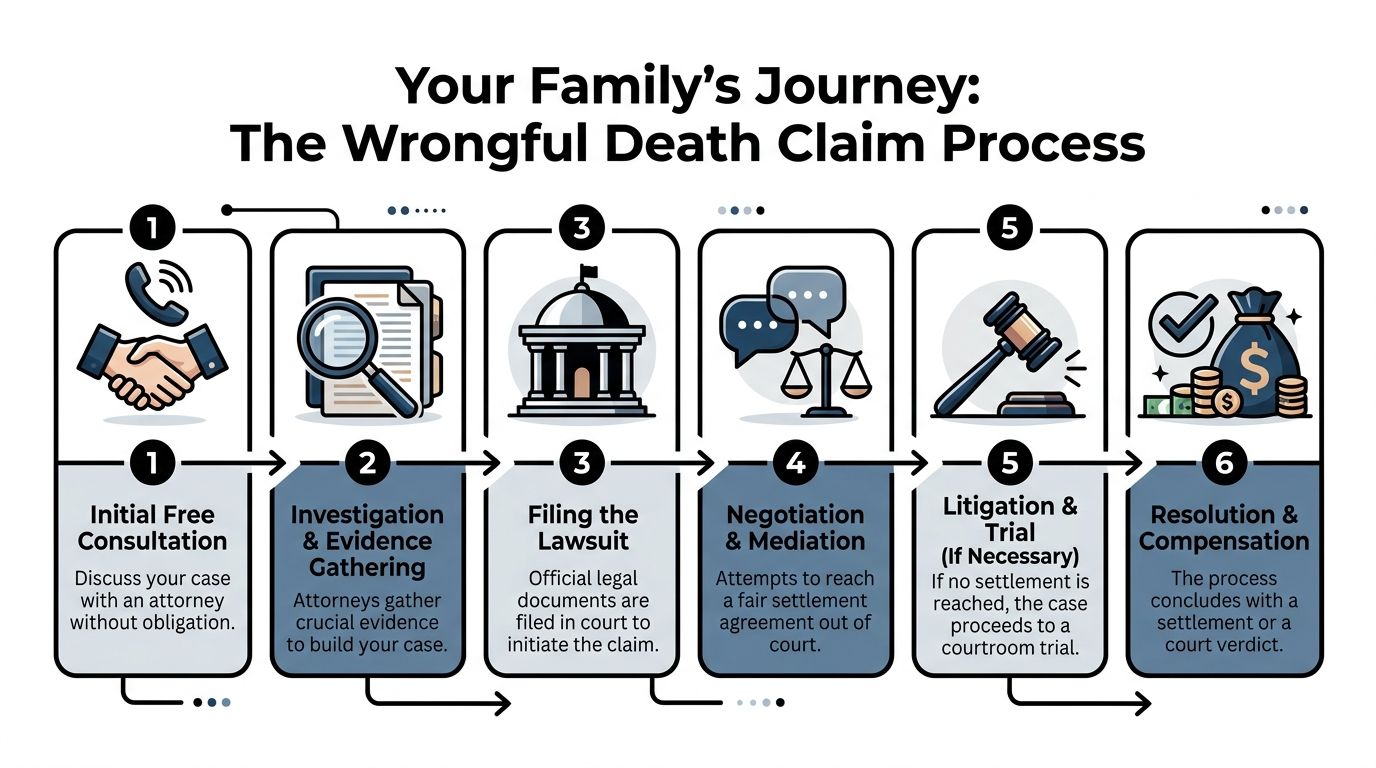
Step one meets your family where you are
The process usually starts with a free consultation. You explain what happened. The attorney asks questions about the crash, the people involved, available records, and your family relationship to the person who died.
You don’t need to arrive with a perfect file. If you have the police report, insurance information, photos, or medical documents, bring them. If you don’t, the lawyer can often begin gathering records.
Investigation comes before courtroom pressure
Next comes the investigation. During this phase, the case begins to take shape.
An attorney may collect reports, interview witnesses, request footage, inspect vehicles, review insurance coverage, and identify all possible defendants. If the case involves a commercial vehicle, that may also include company records and maintenance materials.
A Dallas fatal crash case may require attention to details families can’t easily access alone, especially when multiple insurers or corporate parties are involved.
Filing the lawsuit starts the formal case
If the claim doesn’t resolve early, the lawyer files a petition in court. That officially begins the lawsuit.
This step matters because it sets deadlines, identifies the parties, and puts the defense on formal notice. It also gives your legal team tools to demand information through the court system.
Discovery is where both sides exchange evidence
During discovery, each side asks for documents, written answers, and testimony.
Families often worry this means they’ll be dragged into constant conflict. Usually, your attorney handles most of the heavy lifting. You may still answer questions, provide documents, and possibly give testimony, but you won’t be left to manage the process alone.
Most of the work in a wrongful death case happens outside the courtroom, in investigation, evidence gathering, strategy, and negotiation.
Negotiation and mediation may resolve the case
Many cases move into negotiation or mediation after the evidence becomes clearer.
Mediation is a structured settlement meeting. A neutral third party helps both sides discuss resolution. Some cases settle there. Others don’t.
Settlement isn’t surrender if the amount is fair. It can spare a family time and stress. But a weak settlement offer should be challenged, especially when the defense is counting on grief, fatigue, or financial pressure.
Trial remains the backstop when needed
If the defense won’t offer fair compensation, the case may go to trial.
At trial, each side presents evidence, questions witnesses, and argues the law. A judge or jury decides the outcome. Most families hope to avoid trial, but strong trial preparation often strengthens negotiations long before a verdict becomes necessary.
What you can do during the process
Your role matters too. Families can help by:
- Saving documents: Keep bills, letters, pay records, and insurance paperwork
- Writing things down: A journal can help preserve your memory of events and losses
- Avoiding casual insurer statements: Don’t guess or speculate when speaking with adjusters
- Staying in touch with counsel: Prompt communication helps the case keep moving
This process doesn’t erase the pain. But it gives structure to a moment that otherwise feels chaotic.
How an Experienced Dallas Attorney Investigates and Builds Your Case
A strong wrongful death case is built, not assumed. The difference matters.
Families sometimes think the police report will tell the whole story. It usually won’t. A report may identify basic facts, but many fatal cases turn on deeper issues such as distracted driving, speed, driver fatigue, company responsibility, vehicle data, or insurance coverage that isn’t obvious at first glance.
Investigation starts with facts others may miss
Experienced Texas lawyers often begin by locking down evidence before it disappears. In vehicle cases, that may include the crash scene, vehicle damage, onboard data, witness interviews, and electronic records.
Some cases also require outside experts. One common example is the use of an accident reconstruction expert witness in Texas injury cases. These experts can help explain how the crash happened and challenge defense claims that try to shift blame onto the person who died.
That work becomes especially important when the insurer argues comparative responsibility. Texas law can reduce or bar recovery depending on fault, so the evidence on who caused the crash matters from the beginning.
Trial readiness changes how insurers respond
Not every lawyer prepares every case the same way. Insurance companies know which firms are likely to push hard and which ones may look for a quick exit.
According to the verified background on Dallas wrongful death representation, top Texas firms have decades of experience, have secured billions in recoveries, and include lead attorneys who have tried over 200 cases, with trial readiness playing a major role in obtaining stronger compensation, including in difficult uninsured and underinsured motorist cases.
That matters because insurers evaluate risk. If they believe your legal team can prove negligence and present the case to a jury, they often take the claim more seriously.
The uninsured and underinsured driver problem families often overlook
One of the most frustrating discoveries in a fatal crash case is this: the at-fault driver may not have enough insurance, or any insurance at all.
When that happens, families often assume there’s no real claim. That’s not always true.
A lawyer may investigate whether recovery is available through uninsured motorist or underinsured motorist coverage under your own policy or another applicable policy. These cases can be technical. The same insurer that collected premiums may suddenly dispute coverage, damages, or fault.
Important steps often include:
- Getting the policy: The actual policy language matters
- Reviewing notice requirements: Prompt notice can protect coverage rights
- Checking every possible vehicle or household policy: There may be more than one source of coverage
- Preparing as if the case may be litigated: UM/UIM cases often require aggressive proof
A practical example helps. Suppose a Dallas driver causes a fatal collision, but their liability coverage falls far short of the family’s losses. The surviving spouse may still have a path forward through UM/UIM coverage tied to the household vehicle policy, depending on the facts and policy terms.
A lawyer also builds the damages story
Investigation isn’t only about fault. It’s also about showing the full extent of loss.
Attorneys may work with economists, employers, medical providers, and family witnesses to show what the deceased contributed financially and personally. In a strong case, the legal team doesn’t present a name on a death certificate. It presents a whole life, a family role, and a future that was taken away.
The best wrongful death cases combine two kinds of proof. Proof of what the defendant did, and proof of what your family lost.
An experienced dallas wrongful death attorney adds real value. Not just by filing documents, but by seeing the gaps, finding the evidence, and preparing the case with the kind of discipline that insurance companies respect.
Finding Hope and Help After a Tragedy
After a sudden death, most families want two things at the same time. They want space to grieve, and they want clear answers.
Both are possible.
A wrongful death claim won’t fix what happened. But it can help your family move from confusion to action. It can protect evidence, identify fault, pursue compensation, and create a path toward financial stability. It can also bring a measure of accountability when another person’s choices caused a life-ending loss.

You don’t need to solve everything today
Families often feel pressure to understand every legal issue immediately. You don’t have to.
You don’t need to know how to read an insurance policy. You don’t need to know whether black box data exists. You don’t need to know how to calculate future losses. A lawyer’s job is to sort through those questions and explain your options in plain language.
What you can do today is simple:
- Keep records you already have
- Avoid detailed insurer conversations until you get legal advice
- Ask whether you are one of the family members allowed to file
- Reach out before valuable evidence disappears
Recovery is possible
Legal action is only one part of healing, but it can remove major burdens from a family already carrying too much. It can also give you a plan at a time when life feels unrecognizable.
If you’re searching for a Texas personal injury lawyer, a wrongful death lawyer Texas families can rely on, or even help after a serious crash involving a Houston car accident attorney or truck crash lawyer Houston issue, the right legal support starts with clarity, honesty, and steady guidance.
You deserve answers. You deserve respect. And you deserve the chance to protect your family’s future.
If your family lost a loved one because of another driver’s negligence, a trucking collision, a catastrophic crash, or an uninsured or underinsured motorist situation, the Law Office of Bryan Fagan, PLLC is ready to help. We offer free consultations, clear guidance, and contingency-fee representation, so you won’t pay attorney’s fees unless we win for you. If you’re ready to speak with a compassionate Texas legal team about your next steps, contact us today and schedule your confidential case review. Recovery is possible, and help is available.