A serious accident can change your life in seconds, but you don’t have to face it alone.
If you’re searching for answers after a motorcycle accident tx, you may be dealing with pain, a damaged bike, missed work, worried family members, and an insurance company that seems to want a statement before you’ve even had time to breathe. That combination can leave anyone overwhelmed.
What matters now is getting control back. The choices you make in the next few hours and days can affect your medical recovery, your finances, and your legal rights. Texas motorcycle cases often turn on details that people miss in the moment, especially at intersections and in failure-to-yield crashes where a driver later says, “I just didn’t see the bike.”
Your Guide to Navigating the Aftermath of a Crash
A motorcycle wreck rarely feels “minor” when you’re the rider. Even when the property damage looks limited, the body takes the force directly. That’s one reason these cases need careful handling from the start.
Texas riders face a growing safety problem. Texas recorded 145 motorcycle fatalities in 1999 and 563 in 2022, and motorcyclists now account for 18% of all traffic-related deaths in Texas, up from 10% in 1999, according to Texas motorcycle fatality data discussed here.
That reality shows up in real life every day. A rider gets cut off on a Houston feeder road. A driver turns left across traffic in Dallas. A pickup changes lanes on I-35 near Austin and clips a bike because the driver misjudged how quickly the motorcycle was approaching. The legal issues may sound similar, but the evidence needed to prove fault often is not.
Practical rule: Treat the crash scene, your medical treatment, and the first insurance call as three separate battles. A mistake in any one of them can weaken the whole claim.
Texas law gives injured riders important rights, but it also imposes deadlines and fault rules that can reduce or even block recovery if the case isn’t handled correctly. You need to know how negligence works, what comparative responsibility means, how long you have to file, and what to do if the at-fault driver has too little insurance.
Clear steps help. Get safe. Get treated. Protect the evidence. Be careful with adjusters. Learn how Texas fault law applies before you accept anyone else’s version of what happened.
Immediate Steps to Take at the Scene of a Motorcycle Accident
The first minutes after a crash are chaotic. Your heart is racing, traffic may still be moving, and your body may be masking injuries. Start with safety.
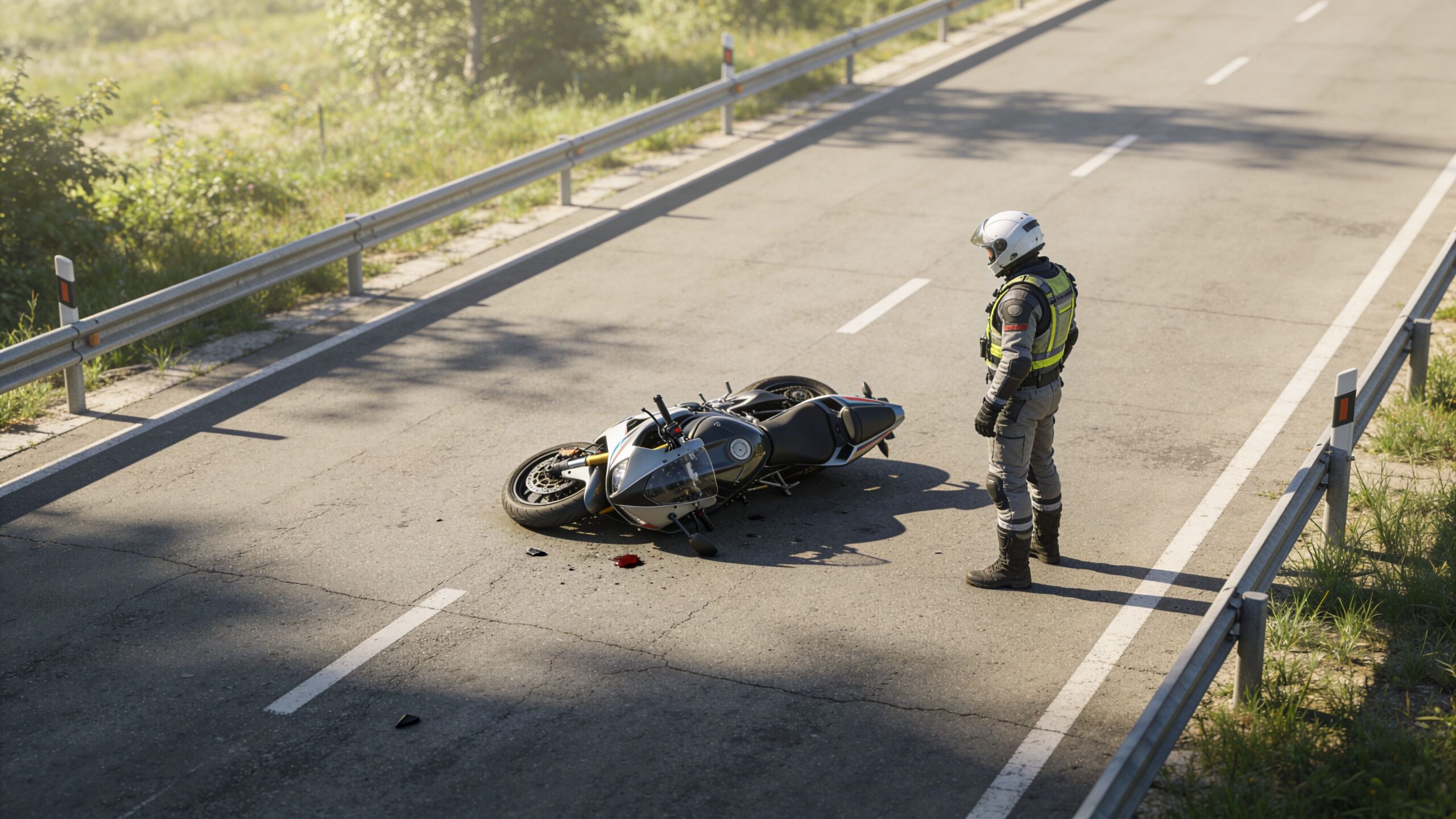
Texas is a dangerous place to ride. A 2024 study found Texas had 12.1 crashes per 10,000 riders, nearly double the national average, and Houston recorded 1,158 crashes in the most recent reporting year, as described in this review of Texas motorcycle crash trends. That makes roadside decisions especially important on crowded urban roads.
Focus on safety before anything else
If you can move without worsening your condition, get out of the traffic lane and to a safer location. If you have head, neck, back, leg, or severe pain, stay put and wait for EMS unless remaining in place creates immediate danger.
Call 911. Don’t assume someone else already has.
Tell dispatch:
- Your exact location including road name, direction, nearest cross street, exit, or landmark
- That a motorcycle is involved so responders understand the risk profile
- Your symptoms such as dizziness, trouble breathing, numbness, or inability to stand
- Any roadway hazard like blocked lanes, spilled fuel, or poor visibility
What to say and what not to say
Keep your comments short and factual. Give the officer the basics about where you were, where you were headed, and what the other vehicle did immediately before impact.
Don’t guess about speed, distance, or timing if you’re not sure. Don’t apologize just to be polite. And don’t tell the other driver “I’m okay” if you haven’t been checked by a doctor.
A Houston freeway example shows why this matters. After a lane-change collision on a busy multi-lane road, a rider may say, “I came out of nowhere” because they’re shaken. An insurer may later treat that sentence like an admission. The better approach is simple: “I was traveling in my lane when the other vehicle moved into me.”
Gather the right evidence fast
Phones are powerful evidence tools if you use them before the scene changes.
Take photos of:
- Vehicle positions before anything is moved, if it’s safe
- Damage points on your bike and the other vehicle
- The roadway layout including lane markings, turn lanes, signals, and signs
- Skid marks and debris that may help reconstruct impact
- Your gear and injuries including helmet damage, torn clothing, bruising, and road rash
Get contact information from:
- The other driver
- Witnesses
- Responding officers
If a witness is in a hurry, ask them to text you their name and number. That small step can save a case later.
A short visual walkthrough can help you remember what to preserve after a wreck.
Exchange information, not opinions
At the scene, stick to the essentials:
- Driver identity including full name and contact information
- Insurance details from the policy card
- Vehicle details like plate number and owner information if different from the driver
- Witness names and a short note about what they saw
A clean exchange of facts helps. A roadside debate about fault usually hurts.
If you leave by ambulance, ask a family member or trusted friend to help preserve photos, locate the tow yard, and confirm which law enforcement agency is preparing the report.
Prioritizing Medical Care and Documenting Your Injuries
A lot of riders make the same mistake after a crash. They try to push through it.
That instinct is understandable. You may be worried about work, cost, your bike, or just the hassle of the emergency room. But after a motorcycle collision, waiting can damage both your health and your claim. Adrenaline often covers symptoms that become obvious hours later, especially after head trauma, internal injury, soft-tissue damage, or spinal strain.

Get evaluated even if you think you can walk it off
Emergency care isn’t only for broken bones. A rider can be alert, talking, and standing, yet still have a concussion, internal bleeding, rib injury, or nerve involvement.
The medical record created right after the crash is often the backbone of the legal case. It ties the collision to the symptoms, identifies what body parts were injured, and shows that you took the event seriously from day one.
If the hospital discharges you, follow up with the providers they recommend. That may include orthopedics, neurology, imaging, physical therapy, wound care, or pain management depending on your injuries. If you stop after one visit, the insurer may argue you healed quickly or were never seriously hurt.
For a practical overview of treatment issues after a wreck, this guide on motor vehicle accident injuries and treatment in Texas is a useful starting point.
Consistency matters more than toughness
Insurance adjusters read medical records with one goal in mind. They look for gaps, missed appointments, and anything they can use to argue that your pain came from something else.
That means you should:
- Attend follow-up visits even when progress feels slow
- Tell each provider about every symptom instead of mentioning only the worst one
- Describe functional limits such as trouble sleeping, lifting, gripping, walking, or driving
- Follow home instructions for wound care, medication, therapy, and activity restrictions
A rider with road rash and a shoulder injury may focus only on shoulder pain at the first follow-up. Weeks later, the insurer may claim the skin injuries were minor because the records barely mention them. Good documentation closes that gap.
Medical reality: If it hurts, limits you, wakes you up, keeps you from working, or changes how you care for yourself, it belongs in the chart.
Build your own injury record at home
Your doctors’ records matter most, but your own notes help show what daily life looks like between appointments.
Keep:
- A pain journal with short daily notes on symptoms and limitations
- Photos over time as bruising, swelling, and road rash evolve
- Prescription receipts and discharge papers
- Mileage and out-of-pocket costs tied to treatment
- Work notes showing missed shifts or restricted duties
Real-world example: after a Houston commuter crash, a rider may return home thinking the main problem is knee pain. By the next morning, they can’t turn their neck and their hands tingle when they grip a coffee cup. If those new symptoms get documented quickly, the medical timeline stays credible.
Some people also want non-medication comfort tools between appointments. If your doctor says it’s appropriate, you can discover drug-free pain relief options that may help you manage soreness or stiffness at home. Those tools are not a substitute for professional care, but they can support recovery.
What doesn’t work
Several choices tend to weaken cases fast:
| Problem | Why it hurts your claim |
|---|---|
| Waiting too long for treatment | The insurer may argue the crash didn’t cause the injury |
| Skipping follow-ups | Creates gaps the defense will highlight |
| Minimizing symptoms | Understates the true scope of harm |
| Ignoring restrictions | Lets the insurer argue you made things worse |
Your body needs care. Your case needs proof. In motorcycle claims, those two tracks are closely tied.
Handling Insurance Companies and Preserving Critical Evidence
Soon after the wreck, the phone starts ringing. The other driver’s insurer may sound polite, organized, and concerned. That doesn’t mean they’re on your side.
Their job is to protect the company’s bottom line. They do that by collecting statements early, framing the facts in a way that helps their defense, and closing the claim before the full medical picture is known.
The insurance adjuster is not your friend. Their job is to protect their company’s bottom line.
The first call matters more than most people think
Adjusters often ask questions that sound harmless:
- How are you feeling today?
- Did you see the other car before impact?
- How fast were you going?
- Did you have your lights on?
- Are you sure you need more treatment?
Those questions are designed to lock you into details before you’ve reviewed the police report, seen all medical providers, or understood the full crash sequence. In motorcycle cases, they also look for ways to shift blame onto the rider by suggesting visibility problems, speed, or lane position.
If the other driver turned left in front of you, the adjuster may still try to recast the event as a “speed-and-closing-distance issue” caused by the rider. That is exactly why careful wording matters.
What to do when the insurance company calls
Use a short script. Be polite. Stay controlled.
Good responses include:
- Confirming basic facts like your name, contact information, and the claim number
- Saying you are receiving medical care
- Requesting that questions be sent in writing
- Declining a recorded statement until you’ve had legal advice
If you want a deeper explanation of how to respond, review this article on what to say to insurance after an accident.
Don’t:
- Give a recorded statement
- Sign medical releases without reviewing them carefully
- Accept a quick settlement
- Guess about speed, timing, distance, or fault
- Downplay symptoms just to sound reasonable
Quick settlements usually benefit the insurer
A fast offer can feel tempting when bills are arriving and work is on hold. But early offers often come before anyone knows whether you’ll need imaging, specialist care, scar treatment, physical therapy, or future procedures.
A rider who accepts money for an ER visit and bike damage may later learn they have a lingering wrist injury, nerve symptoms, or a shoulder problem that keeps them off the job longer than expected. Once a release is signed, reopening the claim is difficult or impossible.
Preserve physical evidence before it disappears
Motorcycle cases often depend on things people throw away too soon. Keep everything in its post-crash condition if possible.
Save:
- Your helmet with all scuffs, cracks, and impact marks
- Jacket, gloves, boots, and torn clothing
- The motorcycle before repairs begin
- Broken parts such as mirrors, levers, fairings, or pegs
- Tow paperwork and storage information
These items can help an accident reconstruction expert analyze impact points, slide path, and the force of the collision. They also help counter claims that the crash was minor.
Evidence outside your garage matters too
Some of the strongest proof is time-sensitive:
- Traffic camera footage
- Business surveillance video
- 911 audio
- Witness follow-up statements
- Scene measurements and photographs
A practical example helps here. After an intersection crash in San Antonio, a nearby gas station may have video showing the left-turning driver entered late. If no one requests that footage quickly, it may be overwritten. Once it’s gone, a strong liability angle can vanish with it.
Short, factual communication protects you better than a long explanation ever will.
Preserving evidence is not about being dramatic. It’s about giving yourself a fair chance when the insurer starts minimizing what happened.
Understanding Your Rights Under Texas Motorcycle Accident Law
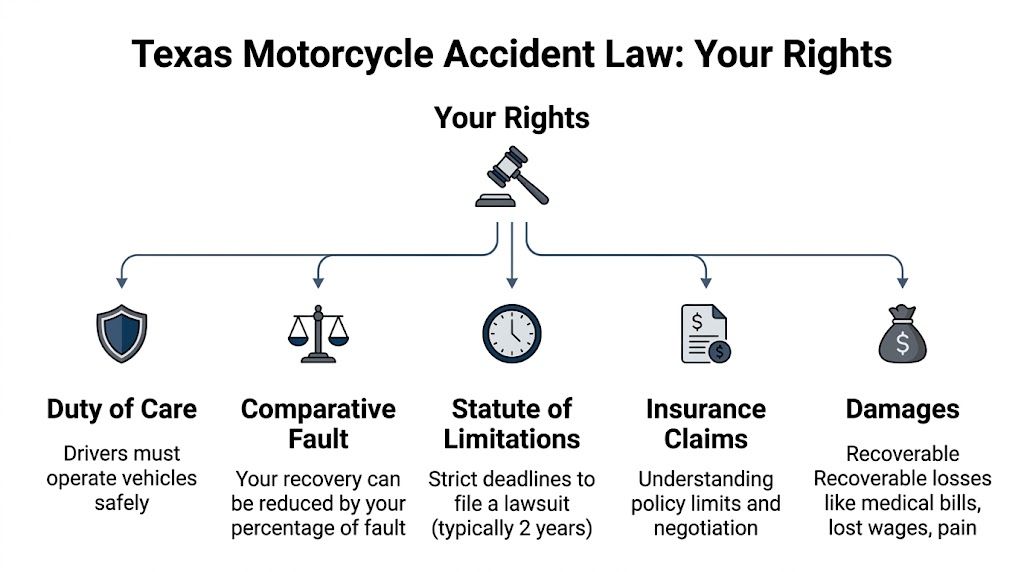
Texas motorcycle injury law isn’t just about who hit whom. It’s about proving negligence, handling fault allocation, meeting deadlines, and identifying every available source of coverage.
In plain English, a negligent driver is one who failed to use reasonable care. In a motorcycle case, that often means turning left without yielding, changing lanes without checking blind spots, following too closely, driving distracted, or misjudging the rider’s approach.
A key issue in many claims is perception. A primary cause of motorcycle accidents is drivers’ failure to yield, often due to misjudging a motorcycle’s speed and distance because of its smaller profile, and intersection-related fatal crashes jumped by 21% from 2022 to 2023, according to this discussion of Texas motorcycle intersection danger. That matters because the defense often tries to frame a visibility error as an unavoidable mistake. It usually isn’t. Drivers still have a duty to yield only when it’s safe.
Fault and negligence in Texas
Texas follows a modified comparative responsibility system. If you are partly at fault, your recovery can be reduced by your share of responsibility. If you are more responsible than the law allows, you can be barred from recovering damages.
That rule becomes important in common defense arguments:
- The rider was speeding
- The rider was hard to see
- The rider changed lanes unexpectedly
- The rider wasn’t wearing enough visible gear
- The rider took an unsafe position at the intersection
A left-turn crash is a good example. The driver says, “I thought I had time.” That statement often reveals the core problem. The driver saw the motorcycle but misjudged its speed and closing distance. A careful lawyer can use scene evidence, vehicle damage, witness statements, and reconstruction analysis to show that the driver’s decision, not the rider’s existence, caused the collision.
The two-year filing deadline matters
Texas cases also run on a strict clock. In most injury cases, the statute of limitations is two years. If a lawsuit is not filed on time, the claim can be lost.
That doesn’t mean you should wait until the deadline approaches. Important evidence is often strongest at the beginning:
- Witness memories fade
- Video gets erased
- Physical evidence gets repaired or discarded
- Medical narratives become harder to tie together if treatment is delayed
A strong case is usually built early, not at the end of the deadline.
Lane splitting and related fault arguments
Some motorcycle-specific conduct issues come up often in Texas claims. One of the biggest is lane splitting. If that issue may be part of your case, it’s important to understand the legal background before speaking in detail with an adjuster. This explanation of whether lane splitting is legal in Texas can help clarify how insurers use that topic in fault arguments.
That does not mean every insurer accusation is correct. It means your words matter. A poorly phrased statement can turn a disputed traffic position issue into a larger comparative fault fight than the facts support.
Your own insurance may matter too
Many injured riders assume only the at-fault driver’s policy matters. That’s not always true.
If the driver has no insurance, not enough insurance, or leaves the scene, your own UM/UIM coverage may become a major source of recovery. Your policy may also include other benefits depending on what you purchased. Those claims still require careful handling. Your insurer may use many of the same tactics another carrier would use.
Here is the practical takeaway. Texas law gives you the right to pursue compensation, but that right works only if you prove the driver’s negligence clearly and protect yourself from avoidable fault arguments.
What Is My Texas Motorcycle Accident Claim Worth
This is one of the first questions injured riders ask, and it’s a fair one. You need to know how the crash has affected your finances and what the law may allow you to recover.
There isn’t a one-size-fits-all number. Claim value depends on liability, injury severity, treatment needs, time away from work, future limitations, visible scarring, the quality of the evidence, and the insurance available. Motorcycle claims are often more serious than car claims because the rider has far less physical protection.
That difference is reflected in the data. Motorcyclists face a fatality rate approximately 29 times higher than passenger car occupants, and 85% of motorcycle crashes result in injury, according to this legal analysis of motorcycle crash severity. In practice, that often means damages are broader and more personal than insurers want to admit.

Two main categories of damages
Texas claims usually involve economic damages and non-economic damages.
| Damage Category | Examples |
|---|---|
| Economic damages | Medical bills, future medical care, rehabilitation costs, lost wages, reduced earning ability, motorcycle repair or replacement, out-of-pocket expenses |
| Non-economic damages | Pain and suffering, mental anguish, physical impairment, disfigurement, loss of enjoyment of life |
Economic losses are usually easier to document because they come with bills, receipts, wage records, or repair estimates. Non-economic losses are more personal, but they are just as real. A rider who can’t sleep comfortably, return to hobbies, pick up a child, or work the same physical job has suffered harm that doesn’t fit neatly into an invoice.
What tends to increase or reduce value
A claim often becomes stronger when:
- Liability is clear such as a strong failure-to-yield case
- Medical treatment is consistent
- Doctors document lasting limitations
- The injury changes work or daily life
- The rider preserves physical evidence and scene evidence
A claim often becomes weaker when:
- There are treatment gaps
- The rider gives a damaging recorded statement
- Fault is disputed
- The case settles before the full prognosis is known
A practical example helps. After a Houston-area intersection crash, a rider may have emergency care, follow-up orthopedic treatment, months of therapy, and visible scarring from road rash. That case isn’t just about the first hospital bill. It may also involve lost earning capacity, permanent discomfort, cosmetic damage, and long-term limitations.
Severe injury and fatal cases
Some motorcycle wrecks lead to life-altering injuries. Traumatic brain injuries, spinal injuries, crush injuries, burns, multiple fractures, and amputation cases often require a different level of case preparation because the future losses can be substantial. If your case involves long-term harm, information about catastrophic injury claims may be relevant.
If your family lost someone in a motorcycle crash, the legal focus changes again. A wrongful death lawyer Texas families trust can help pursue accountability for the financial and personal losses that follow a fatal collision. This overview of wrongful death claims in Texas can help explain that process.
The value of a motorcycle claim is not just what the crash cost you last week. It’s also what the injury will keep costing you in the future.
How a Texas Personal Injury Lawyer Can Help You Win
Motorcycle cases are not ordinary vehicle claims. The injuries are often more serious. The fault arguments are more aggressive. And insurers often arrive with assumptions about riders before they have the facts.
In Texas, fatal motorcycle crashes make up 5% of all motorcycle accidents, compared with 0.3% for passenger vehicle crashes, a 16.67 times higher fatality rate, as discussed in this Texas motorcycle accident severity analysis. That gap helps explain why these claims need focused legal work from the start.
What a lawyer actually does
A strong Texas personal injury lawyer does more than “handle paperwork.” The job includes:
- Taking over insurance communication so you don’t get boxed into harmful statements
- Investigating liability through reports, witness interviews, video, photos, scene analysis, and bike damage
- Framing the negligence theory correctly, especially in left-turn and failure-to-yield cases involving speed and distance misjudgment
- Working with experts when reconstruction, medical opinion, or future-care analysis is needed
- Calculating damages fully instead of letting the insurer define the case by the first few bills
That approach matters whether you’re looking for a Texas personal injury lawyer, a Houston car accident attorney after a related vehicle collision, a truck crash lawyer Houston families can call after a commercial vehicle wreck, or guidance in a fatal case where a wrongful death lawyer Texas may be needed.
Settlement leverage comes from preparation
Most cases resolve through negotiation, but good settlements usually happen because the insurer believes the lawyer is ready to prove the claim in court if necessary. Preparation creates advantage.
That means preserving the helmet, locking down witness statements, obtaining the right records, and building a case around what happened, not around the insurer’s first phone-call theory. In motorcycle cases, that often includes showing that the driver did not merely “miss” the rider. The driver failed to judge the rider’s visible approach safely.
You do not have to carry this by yourself. A lawyer can help protect your claim while you focus on healing.
If you were hurt in a motorcycle crash, or if your family lost someone in one, Law Office of Bryan Fagan, PLLC is available to help you understand your options. You can schedule a free consultation to talk through fault, insurance coverage, medical evidence, deadlines, and the next steps for your recovery. There are no upfront fees in contingency-fee cases, and you don’t have to figure this out alone. Recovery is possible, and legal help is available.