Skip to content
A serious accident can change your life in seconds, but you don't have to face it alone.
You may be reading this because something feels off. Your mother has new bruises no one can explain. Your father seems frightened when a certain staff member enters the room. A loved one who once chatted freely now goes quiet during visits. When that happens in a nursing home, families often feel two painful things at once: deep worry and deep guilt.
Those feelings are common. They also matter.
When a person moves into a nursing home, your family places trust in that facility to provide safety, dignity, nutrition, medication, supervision, and basic human care. If that trust has been broken, what you're feeling is not an overreaction. Suspicion is often the first sign that something needs closer attention.
Some families hesitate because they don't want to accuse anyone unfairly. Others freeze because they aren't sure what counts as abuse, what counts as neglect, or what a lawyer can do. If that's where you are, clarity helps. A personal injury lawyer's role in Texas injury cases often starts with listening, gathering records, and helping a family understand whether poor care crossed the line into legal negligence.
This process isn't just about filing papers or starting a fight. It's about finding answers. It's about protecting your loved one. It's about creating a structured path from uncertainty to accountability.
If you're looking for a nursing home abuse lawyer in Texas, you deserve plain English, practical steps, and honest guidance. You also deserve to know that families do have rights, and there are ways to investigate what happened.
Introduction You Are Not Alone in This Fight
When families first suspect nursing home abuse, they rarely have the full story. They usually have fragments. A missed medication. Dirty bedding. Sudden weight loss. Fear in a loved one's face. A vague explanation from staff that doesn't match what you see.
That uncertainty can be exhausting. You may wonder whether you're reading too much into normal aging, or whether something serious has been happening behind closed doors.
Trust your observations. If your loved one's condition, mood, or surroundings have changed in a way that doesn't make sense, it's worth asking why.
A Texas family often starts this journey with a simple question: "What happened?" The next questions come fast. Is this abuse or neglect? Who should we report it to? Should we move our loved one? Do we need medical care first? Can the nursing home deny what happened?
Those are the right questions.
A compassionate legal approach doesn't treat your family like a case file. It looks at the full picture. How your loved one was living. What staff knew. What should have been prevented. What records exist. Whether injuries came from a fall, dehydration, bedsores, rough handling, emotional mistreatment, or a pattern of neglect.
A clear path helps families breathe again
Many people think legal action means instant conflict. In reality, a strong claim begins with order. First, protect the resident. Then preserve records. Then identify what the nursing home was supposed to do and where that duty may have been breached.
That kind of structure matters. It gives families a roadmap when emotions are running high.
If your loved one suffered severe harm, the legal issues may overlap with other injury claims Texas families face, including wrongful death representation, catastrophic injury issues, or even situations where outside transportation or medical providers played a role. The legal label matters less than the core question: did someone fail to provide safe, competent care?
Suspicion deserves investigation
Consider a familiar example. After repeated visits to a Houston-area facility, a daughter notices that her father is wearing the same clothes, his room smells strongly of urine, and staff members seem irritated when she asks about his medications. No one event proves abuse. Together, those details may point to neglect.
That's why families should never ignore a pattern just because each piece seems small on its own. Small signs often lead to larger truths.
What Are the Signs of Nursing Home Abuse and Neglect
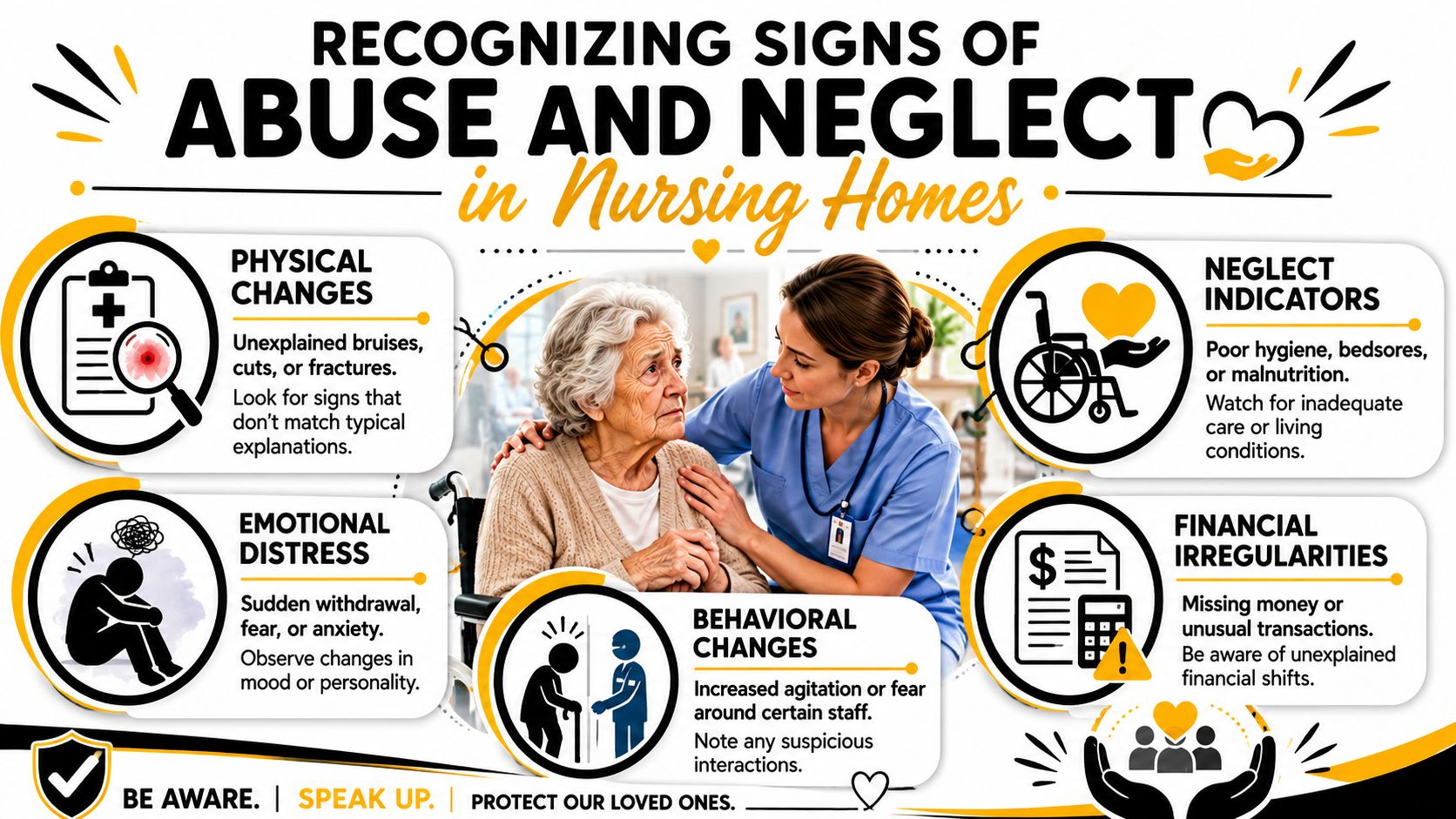
Abuse in a nursing home doesn't always look dramatic. Sometimes it's obvious, like a slap or a shove. More often, it shows up in changes to the resident's body, mood, hygiene, finances, or daily care.
Families tend to feel more confident once they can name the warning signs clearly.
Physical signs to watch for
Physical abuse can involve hitting, rough handling, improper restraint, or force during transfers and care.
- Unexplained bruises or cuts: If the story keeps changing, or the injury doesn't match the explanation, pay attention.
- Fractures or repeated falls: A fall may be accidental, but repeated incidents can point to poor supervision.
- Marks on wrists or ankles: These may raise concerns about improper restraints.
- Pain during movement or bathing: If your loved one flinches when touched, ask why.
If your grandfather suddenly has bruising on both arms and staff says he is "just clumsy," but he has limited mobility, that mismatch matters.
Emotional and behavioral changes
Emotional abuse often leaves no visible mark. It can involve threats, humiliation, intimidation, isolation, or mocking.
- Sudden withdrawal: A once talkative resident becomes unusually quiet.
- Fear around certain staff: Watch your loved one's face and posture when specific employees approach.
- Anxiety or agitation: New nervousness, crying, or startle responses can be meaningful.
- Sleep changes: Restlessness may follow mistreatment or fear.
If your mother used to enjoy activities but now refuses to leave her room and becomes tense around one aide, don't dismiss that change.
Signs of neglect
Neglect is one of the most common concerns families raise. It usually means the facility failed to provide basic care.
| Concern | What you might notice | Why it matters |
|---|---|---|
| Poor hygiene | Unwashed hair, dirty clothes, strong odors | Staff may be failing with daily care |
| Bedsores | Skin breakdown on heels, hips, or back | Pressure injuries can signal lack of repositioning |
| Dehydration or malnutrition | Dry mouth, confusion, weight decline, untouched meals | Residents may not be getting needed help eating or drinking |
| Medication issues | Missed doses, unusual drowsiness, confusion | Errors can cause serious harm |
| Unsafe room conditions | Soiled bedding, clutter, call light ignored | Basic safety and supervision may be lacking |
For families worried about pressure injuries, it can help to learn about understanding air mattress types for pressure relief. That kind of practical information helps you ask better questions when a facility claims it was doing everything properly.
Practical rule: One isolated issue may be a mistake. A pattern of dirty conditions, unanswered questions, unexplained injuries, and emotional changes often points to something larger.
Financial exploitation can happen too
Some residents are harmed without physical contact at all.
- Missing money or belongings: Wallets, jewelry, or cash disappear.
- Unusual bank activity: Withdrawals or transfers the resident can't explain.
- Changes to legal documents: New signatures, powers of attorney, or account access should be reviewed carefully.
This is different from cases like Uninsured and Underinsured Motorist Claims in Texas, which focus on how to recover when the at-fault driver lacks adequate insurance. But the underlying lesson is similar. Documentation matters, and the paper trail often tells the story.
Sexual abuse and severe mistreatment
These cases are especially hard for families to process. Warning signs may include genital injuries, torn underclothing, sexually transmitted infections, or intense fear during personal care.
If you see these signs, act quickly. Safety comes first.
Your Loved One's Rights Under Texas Law
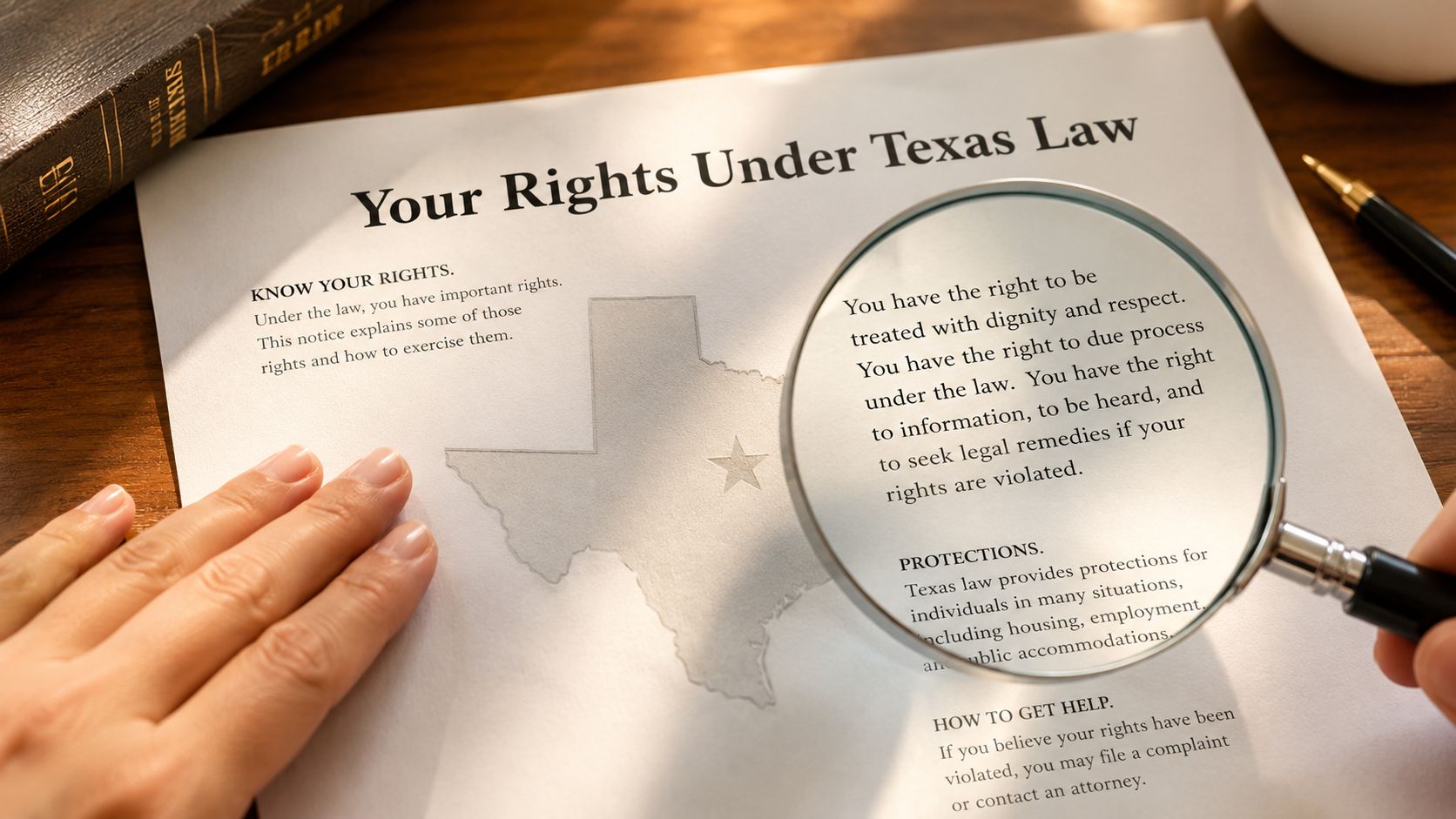
A nursing home resident does not lose basic rights by moving into a facility. They still have the right to dignity, safety, reasonable care, and respect.
When a facility ignores those obligations, the issue isn't just poor service. It may be negligence, and negligence is the foundation of many Texas personal injury claims.
What negligence means in plain English
Negligence happens when a person or business fails to use reasonable care, and someone gets hurt as a result. In a nursing home setting, that can mean failing to prevent falls, ignoring infections, not turning a bedbound resident, hiring unsafe staff, or leaving a vulnerable resident without supervision.
A claim usually turns on a few basic ideas:
- Duty: The facility had a legal obligation to care for the resident safely.
- Breach: The facility failed to meet that obligation.
- Causation: That failure contributed to the injury or decline.
- Damages: The resident suffered harm.
A Texas personal injury lawyer helps families connect those pieces with records, witness statements, and medical evidence.
Resident rights are not optional
Texas law recognizes that nursing home residents deserve humane treatment. That includes a clean environment, appropriate medical attention, protection from abuse, and respect for personal dignity.
If your loved one was ignored, mocked, isolated, overmedicated, left in unsafe conditions, or harmed by rough care, those actions may violate both accepted care standards and legal duties.
Families often ask how this compares to a car wreck case. The legal principles are similar. In a freeway collision, a Houston car accident attorney looks at fault, careless conduct, and resulting harm. In a nursing home case, the conduct is different, but the legal analysis still focuses on duty, breach, and injury.
Comparative responsibility and fault
Texas injury law also looks at fault carefully. In some injury cases, the defense argues that someone else caused the harm, or that the injured person shares responsibility. In a nursing home case, a facility may try to blame aging, dementia, a prior illness, or a resident's frailty.
That doesn't automatically excuse poor care.
Frailty increases the need for proper care. It doesn't reduce the facility's duty to provide it.
This is why records matter so much. A chart, care plan, staffing note, or incident report may show what staff knew and what they failed to do. Broader conversations about ensuring patient well-being can be useful background for families trying to understand what safe care should look like in practice.
What to Do Immediately if You Suspect Abuse
If you think your loved one is in danger, don't wait for the perfect explanation. Start with safety.
Families often lose valuable time because they're worried about being wrong. You don't need to prove the whole case before taking protective steps.
First protect the resident
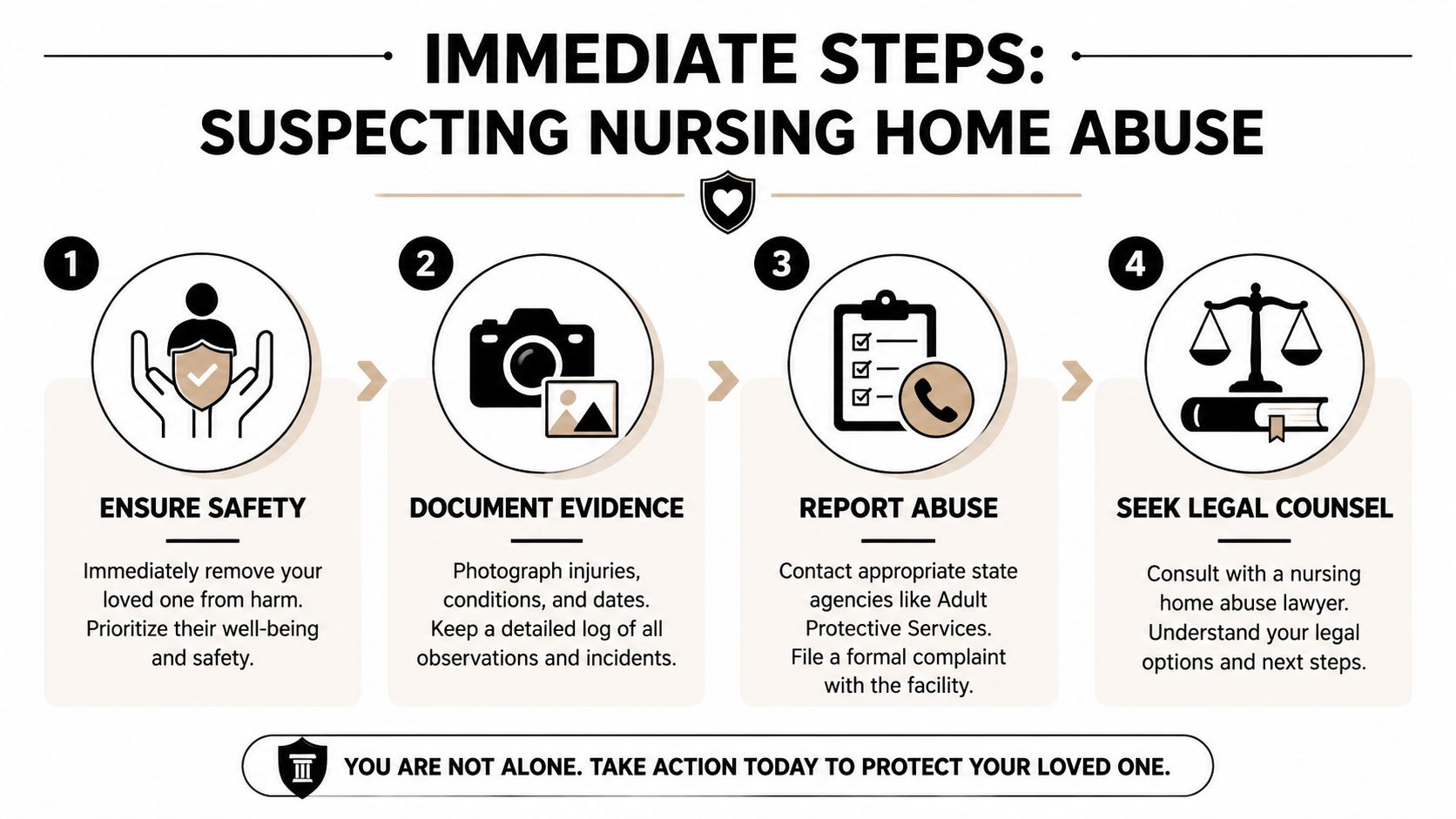
If there's an urgent medical issue, call 911. If the danger isn't immediate but the resident needs prompt care, arrange for a doctor, hospital evaluation, or another qualified medical assessment.
Ask yourself:
- Is your loved one safe right now?
- Do they need treatment today?
- Should they be moved away from a staff member or unit that may be unsafe?
If your father has a head injury after an unexplained fall, the first priority isn't an argument with the facility. It's medical care.
To help families organize these first decisions, this visual breaks down the order of response.
Report and document
After safety is addressed, begin preserving what you can.
- Take photographs. Document bruises, bedsores, dirty bedding, unsafe rooms, broken equipment, or poor hygiene.
- Write down details. Include dates, times, names of staff, and what each person said.
- Request records. Ask for medical charts, medication lists, incident reports, and care plans when appropriate.
- Save communications. Keep texts, emails, voicemails, billing statements, and handwritten notes.
Small details matter. Families often remember the major incident but forget the call they made the day before, the nurse who seemed evasive, or the repeated complaints about skipped meals.
Write things down the same day. Memories fade faster than most people expect.
You should also report concerns to the appropriate state agency, including Adult Protective Services when abuse or neglect is suspected. A formal complaint creates a record and may trigger an investigation.
Be careful when speaking with the facility
It's reasonable to ask questions. It's also wise to stay calm and avoid long, unrecorded debates with administrators or insurers before you understand the full situation.
A nursing home may minimize what happened. It may describe obvious neglect as a misunderstanding, a personality issue, or a normal result of aging. If your loved one later dies from suspected neglect or abuse, these same early records can become important in a case handled by a wrongful death lawyer Texas families trust to investigate preventable loss.
For families weighing alternatives after a dangerous placement, resources on maintaining independence with home care may help you think through care options while legal questions are being sorted out.
A short video can also help you think through the first legal and practical steps.
When to call a lawyer
Call a lawyer as soon as you suspect serious harm, repeated neglect, unexplained injuries, financial exploitation, or a facility cover-up. Early legal guidance can help preserve evidence before records disappear or witness accounts change.
That matters in every type of major injury case, from elder neglect to claims involving a truck crash lawyer Houston families may need after a commercial wreck. Serious cases often turn on prompt investigation.
How Long You Have to File a Claim in Texas
Deadlines matter in every injury case. If you wait too long, you may lose the right to file a lawsuit even if the underlying facts are strong.
Under Texas law, the statute of limitations for most personal injury and wrongful death claims is two years, as explained in Texas Civil Practice and Remedies Code § 16.003.
What that means for a nursing home case
In many situations, the clock starts on the date of the injury. But nursing home abuse cases can be more complicated than a single-event accident. Some harm develops over time. Some injuries are hidden. Some families don't discover the truth right away.
That's where people often hear about the discovery rule. In simple terms, that idea may matter when the injury wasn't known, and couldn't reasonably have been known, when it first happened.
For example, if staff concealed a fall or failed to tell the family about a serious pressure injury, the timing analysis may be different from a case where the event was obvious on day one.
Why acting early still matters
Even when a deadline seems far away, delay can hurt the case. Staff members leave. Notes get harder to interpret. Recollections soften. Surveillance footage may not be preserved.
A lawyer can evaluate timing and exceptions, but families shouldn't assume they have endless time. If you're unsure how the deadline applies, review how long you have to file an injury claim in Texas and get advice specific to your situation.
How a Lawyer Investigates a Nursing Home Abuse Claim
Families sometimes imagine that hiring a lawyer means waiting for a lawsuit to unfold on its own. In reality, the primary work begins with investigation.
A nursing home abuse lawyer in Texas doesn't just repeat your concerns in legal language. The lawyer builds a timeline, tests the facility's explanations, and looks for the records that tell the truth.
A case often starts with one inconsistency
Consider a simple example. A son learns his mother suffered a serious infection after staff allegedly followed all wound-care instructions. But the charted notes don't line up with the condition documented later by outside providers. That gap becomes the starting point.
The investigation may involve:
- Medical records: Hospital notes, nursing charts, medication administration records, wound assessments.
- Facility documents: Incident reports, staffing schedules, internal complaints, care plans.
- Witness interviews: Family members, current or former staff, roommates, visitors, or outside providers.
- Photographs and communications: Images, emails, text messages, voicemail, and handwritten notes.
Each piece helps answer the same question: what should have happened, and what happened instead?
Looking for patterns, not just incidents
Neglect often isn't one dramatic event. It may be a chain of failures. Missed repositioning. Delayed treatment. Ignored call lights. Incomplete charting. Staffing problems. Poor supervision during transfers.
That pattern becomes even more important in severe injury cases. If neglect led to sepsis, a major fall, brain injury, or another catastrophic injury, the lawyer has to show how the facility's conduct connects to the medical outcome.
A strong case also anticipates defenses. Nursing homes often argue that the resident was medically fragile, noncompliant, or already declining. Sometimes that's part of the picture. But vulnerability doesn't excuse preventable harm.
Good investigation separates unavoidable decline from injuries caused by careless or understaffed care.
Handling the pressure for the family
Once a claim becomes serious, the facility and its insurers may begin managing risk. That can mean polished explanations, requests for statements, or efforts to narrow what happened.
A lawyer steps in to manage those communications and preserve evidence. That includes sending requests for records, identifying missing documentation, and asking the right follow-up questions before the case gets boxed into the facility's version of events.
Families also benefit from understanding what evidence is needed for an injury claim in Texas. The same basic principle applies here. Cases are built with proof, not suspicion alone.
In some situations, a law firm such as Law Office of Bryan Fagan, PLLC can handle record collection, witness outreach, insurance communications, and litigation steps while the family focuses on the loved one's care and recovery.
How to Choose the Right Advocate for Your Family
Not every lawyer is the right fit for a nursing home case. Your family may be grieving, overwhelmed, and trying to protect someone who can't fully speak for themselves. You need more than a generic intake process.
You need an advocate who listens carefully and explains things clearly.
What to look for
Start with the lawyer's approach, not just the advertisement.
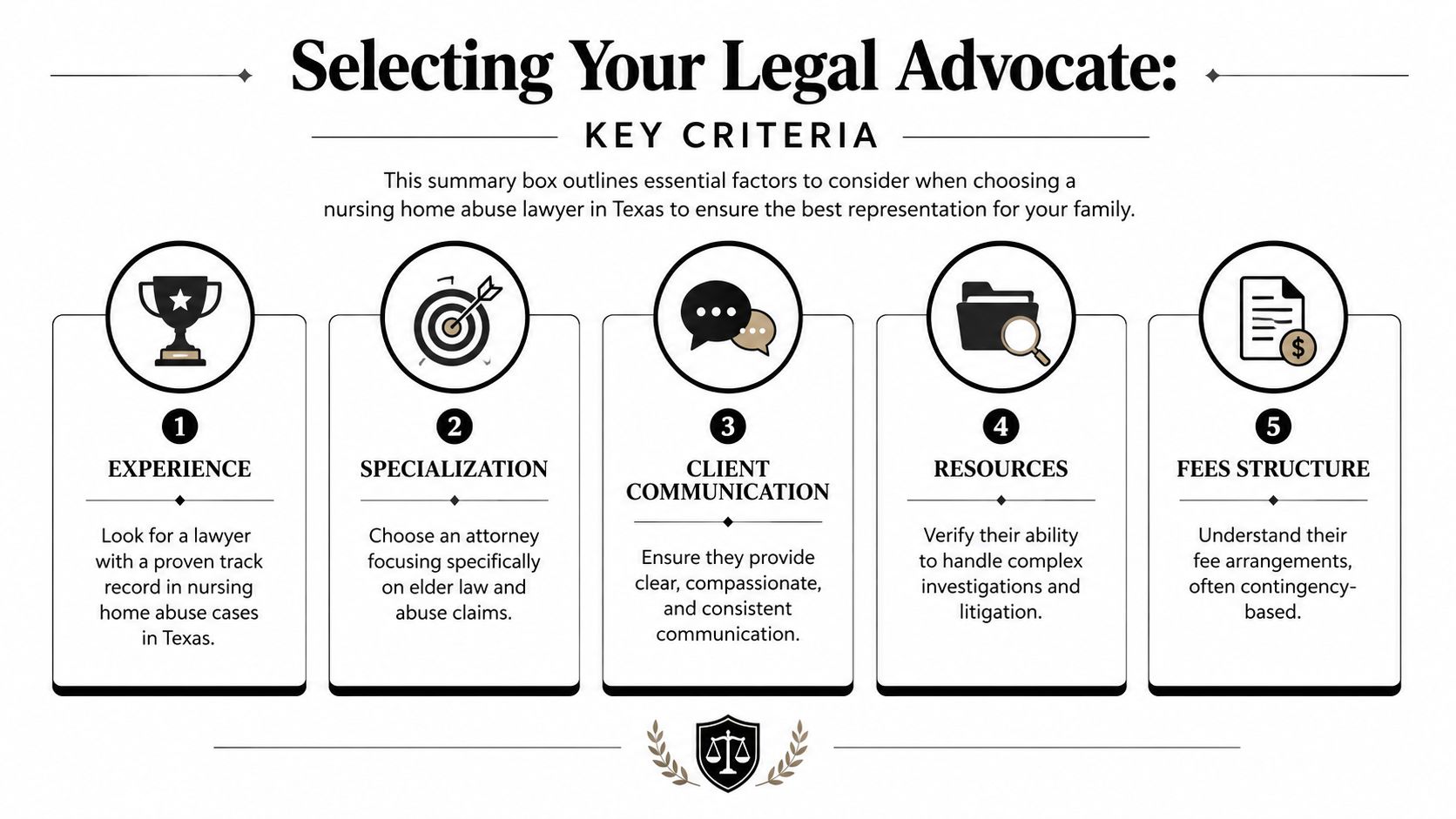
- Relevant case experience: Nursing home abuse claims involve medical records, facility policies, and vulnerable witnesses. That work differs from a routine fender-bender.
- Clear communication: You should understand what's happening without needing a translator for legal jargon.
- Investigation resources: These cases often require record review, witness development, and persistence.
- Compassion for families: The lawyer should recognize that this isn't just an injury file. It's your parent, spouse, or grandparent.
- Fee clarity: Many injury firms handle cases on a contingency basis, which means the fee arrangement should be explained plainly from the start.
Questions worth asking in a consultation
A consultation should help you judge both skill and fit.
| Ask this | Why it matters |
|---|---|
| How would you begin investigating this case? | You want to hear a concrete plan |
| Who will communicate with my family? | Good communication reduces stress |
| What records do you usually request first? | This shows how the lawyer thinks |
| How do you handle insurer contact? | Families often need a buffer |
| What happens if the facility denies everything? | Strong cases often start there |
If the answers are vague, rushed, or overly aggressive, keep looking. A good lawyer should sound organized, steady, and honest about uncertainty.
Choose someone who respects the family's journey
Families often start by doubting themselves. Then they notice a pattern. Then they act. The right advocate understands that emotional path.
A careful lawyer won't promise a result on the first call. What they should do is explain your options, help protect evidence, and tell you what the next steps look like. That gives families confidence.
For those considering a nursing home abuse lawyer in Texas, remember this: accountability is not about revenge. It's about truth, safety, dignity, and making sure your loved one's suffering is taken seriously.
If you believe a loved one has been abused or neglected in a facility, you can speak with Law Office of Bryan Fagan, PLLC in a free consultation. You can discuss what happened, what evidence to preserve, and what legal options may be available for a personal injury, catastrophic injury, or wrongful death claim. Recovery is possible, and legal help is available when you're ready to take the next step.