Skip to content
A serious accident can change your life in seconds, but you don't have to face it alone.
If you're reading this after a house fire, a workplace flash burn, or a crash that left you or someone you love with severe burns, you're probably dealing with more than pain. You may be trying to understand discharge papers, answer calls from insurance adjusters, figure out how work will continue, and calm family members who are scared too. That kind of pressure can make even simple decisions feel heavy.
A burn injury claim in Texas isn't just about paperwork. It's about getting the treatment you need, protecting your right to recover compensation, and creating stability while your life feels unsettled. A Texas personal injury lawyer can help with that, especially when the injury involves permanent scarring, infection risk, surgeries, or a long recovery.
You may also be wondering how this fits with other legal issues. If the burn happened after a freeway collision, you may need a Houston car accident attorney. If a commercial vehicle caused the fire or impact, a truck crash lawyer Houston families trust may need to investigate the trucking company and its insurer. If a loved one died from burn complications, your family may need to speak with a wrongful death lawyer Texas families turn to for guidance.
Your Life Changed in an Instant But You Are Not Alone
One moment, life feels ordinary. Then a pan fire spreads across a kitchen. A water heater explodes in an apartment complex. A worksite spark turns into a flash fire. After a Houston freeway crash, a trapped driver may suffer burns before first responders can even reach the vehicle. In those first hours, individuals aren't thinking about legal claims. They're thinking about survival.

Burn injuries often affect every part of daily life. Pain can be constant. Sleep gets harder. Returning to work may not be possible for a while. Parents worry about how their children will react to visible scarring. Spouses take on new caregiving roles overnight. Even routine tasks, like getting dressed or driving to a follow-up appointment, can become difficult.
What people usually need first
Most injured people need three things right away:
- Clear medical direction so treatment stays on track
- Practical help dealing with insurers, records, and deadlines
- A simple explanation of what happens next
That's where the lawyer-client relationship should help, not add stress. A good burn injury lawyer in Texas doesn't bury you in jargon. The job is to make the process understandable, protect your claim, and give you room to heal.
Recovery after a severe burn is rarely quick, but it is possible. The legal process can create breathing room while you focus on treatment.
If you're feeling overwhelmed, that's normal. You don't need to have every document organized or every answer ready before asking for help. You just need a starting point.
First Steps to Protect Your Health and Your Claim
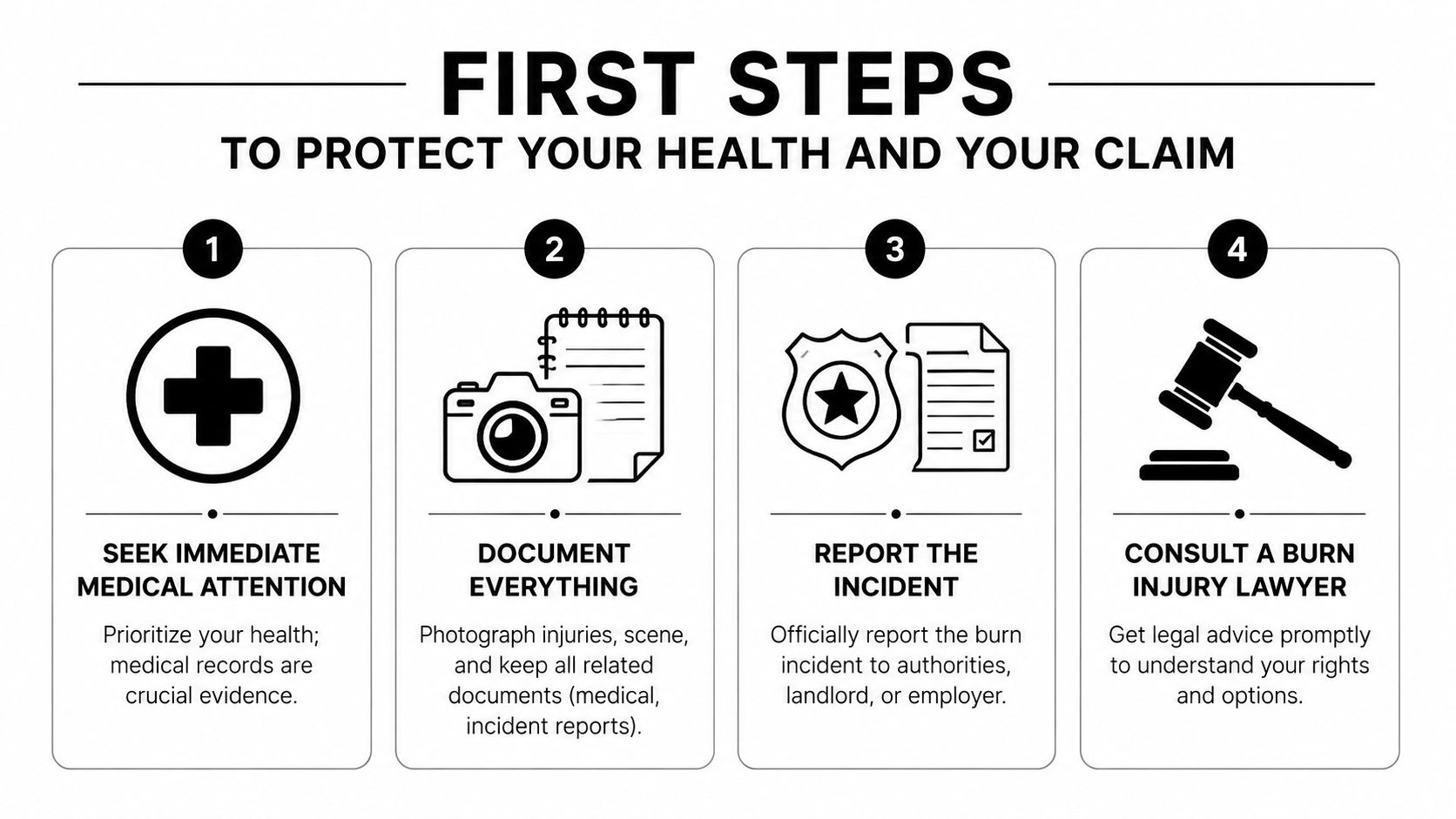
The first few hours and days matter. What you do now can affect both your recovery and your legal case.
Start with medical care
Get full medical attention immediately and follow through on treatment. Burn injuries can worsen after the initial event, and records from emergency care, specialists, wound treatment, and follow-up visits often become key evidence later. If you want a deeper look at why records matter, this guide on how medical records affect an injury claim in Texas is worth reading.
Burn cases don't all look the same. In Texas, burn injuries are most frequently caused by residential fires (60%), workplace incidents (25%), and motor vehicle accidents (15%), which is why the legal strategy often depends on where and how the injury happened, according to Texas burn injury statistics discussed here.
Document what you can
You don't need a perfect evidence file. You do need to preserve what's available before it disappears.
- Photograph injuries early: Take clear photos over time, not just on the first day.
- Save scene evidence: Keep pictures of the kitchen, apartment unit, vehicle, machinery, clothing, or defective product if it's safe to do so.
- Hold onto records: Preserve discharge instructions, prescriptions, receipts, employer reports, and messages from insurers.
- Write things down: A short daily journal about pain, sleep, mobility, and emotional distress can help show how the injury affects your life.
A residential fire case may involve lease documents, inspection reports, smoke detector issues, or appliance history. A workplace burn may involve incident reports, witness names, and safety procedures. A vehicle fire claim may depend on crash reports, photographs, and vehicle preservation.
Here's a short overview that may help you think through the early steps:
Report the incident and be careful with insurers
Report the injury through the right channel. That may mean a landlord, property owner, employer, police department, business, or insurance carrier. A prompt report creates a paper trail and reduces later arguments that the event didn't happen the way you described.
What not to do: Don't give a recorded statement to an insurance company before you understand your rights.
Adjusters often sound helpful at first. Sometimes they are polite, responsive, and reassuring. But their job is to evaluate the claim for the company. In practice, early recorded statements can lock you into details before the full medical picture is clear.
If an insurer calls, keep it simple. Confirm basic contact information, say you're receiving treatment, and tell them future communication should go through your attorney once you've hired one.
Understanding Negligence and Fault in Texas
A burn injury case usually turns on one central question. Who failed to act safely, and can that failure be proven?
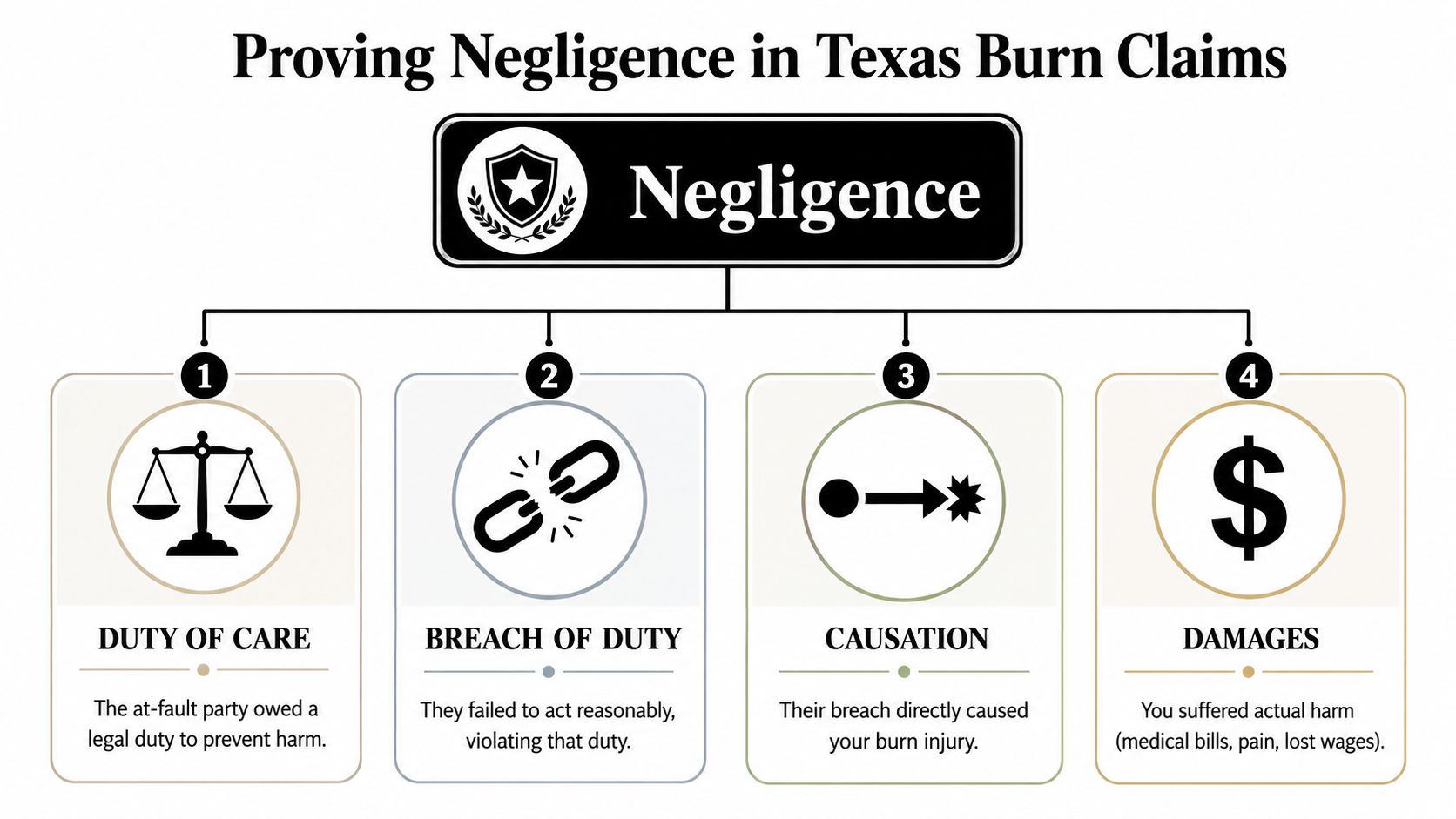
Texas negligence law is built around four elements. The injured person must prove that the other party owed a duty of care, breached that duty, caused the injury, and created actual damages. Texas courts apply the preponderance of the evidence standard, meaning the claim must be shown to be more likely true than not, as explained in this discussion of how negligence is proven in Texas injury cases.
A simple example
Take an apartment case. A landlord has a duty to maintain reasonably safe conditions. If a faulty water heater had known problems, wasn't repaired, and later caused a fire, that may be a breach of duty. If the fire caused your burns, that's causation. Your medical bills, lost pay, pain, and scarring are damages.
The same framework applies in other settings:
- Vehicle burn case: A driver runs a light, causes a crash, and a fuel-fed fire injures a passenger.
- Worksite burn case: A contractor ignores safety procedures around electrical equipment.
- Product case: A defective appliance ignites during ordinary use.
If the burn happened in a crash, a Car Accident Lawyer in Texas handles representation for drivers and passengers injured in Texas car accidents, while the burn-specific issues often require additional medical and damages analysis.
Why fault arguments matter so much
Insurance companies often try to reduce exposure by shifting part of the blame to the injured person. They may argue you ignored a warning, used equipment improperly, failed to leave quickly enough, or contributed to the accident in some other way.
Texas uses a proportionate responsibility system where you can be barred from recovering any compensation if you are found 51% or more at fault for the accident. If you are 50% at fault, your damages are cut in half. At 51%, they become zero, according to this explanation of Texas modified comparative negligence laws.
If the defense can push your fault from 50% to 51%, your case changes from reduced compensation to no compensation.
That's why evidence work matters. Photos, witness statements, maintenance records, inspection history, crash reconstruction, and medical proof all help answer blame-shifting arguments. In serious burn cases, the legal fight often isn't only about whether you were hurt. It's about who gets assigned responsibility and by how much.
What works and what doesn't
What works is a factual, disciplined claim built around records and timelines. What doesn't work is arguing from emotion alone, assuming the insurer will “do the right thing,” or waiting too long to preserve evidence.
A burn injury lawyer in Texas should be looking for the unsafe condition, the ignored warning, the missing repair, the defective part, or the preventable driving error that connects the event to your injury. That's how a claim moves from suspicion to proof.
What Is Your Burn Injury Claim Worth
This is one of the first questions people ask, and it's a fair one. Burn injuries can create huge financial pressure quickly, especially when the injury affects work, mobility, or appearance.
The short answer is that a claim is worth what your losses can be proven to be. That includes what the injury has already cost you and what it is likely to cost you going forward. A fast settlement offer may sound helpful when bills are arriving, but early offers often leave out future treatment, scar revision procedures, complications, and the daily impact of permanent disfigurement.
Damages usually include more than medical bills
Here's a practical way to look at the categories.
| Type of Damage | Description & Examples |
|---|---|
| Medical expenses | Emergency care, hospitalization, wound care, medications, surgeries, specialist visits, rehabilitation |
| Lost income | Missed work, reduced hours, job loss, loss of earning ability if you can't return to the same work |
| Pain and suffering | Physical pain, discomfort during treatment, sleep disruption, limitations in daily life |
| Disfigurement and impairment | Permanent scarring, limited motion, nerve damage, visible changes that affect confidence and routine activities |
| Emotional harm | Anxiety, trauma, depression, fear of fire, distress linked to appearance changes or long recovery |
| Future care needs | Additional procedures, therapy, long-term follow-up, assistive support, home modifications in severe cases |
If you want a broader look at valuation issues, this article on what factors affect an injury settlement in Texas gives useful context.
Severity changes value
Some burn claims are limited and heal with relatively short treatment. Others involve grafts, repeated procedures, major scarring, or life-altering impairment. That difference matters.
While second-degree burns often settle for $25,000 to $75,000, severe cases involving third-degree burns over 60% of the body can yield median jury verdicts of $7.75 million, far exceeding the national median recovery for all burn cases, according to this review of burn case recoveries and verdict ranges.
That doesn't mean your case will land at any specific number. It does mean severity, permanence, and proof of future harm can dramatically change the value of a claim.
Low offers usually miss the long view
Insurers often evaluate a case early, before the full course of treatment is known. That creates a predictable problem. The offer may account for the emergency room and a few follow-ups, but not future surgery, visible scarring, reduced function, or the emotional toll of living with a changed body.
A stronger case usually includes:
- Medical records that show progression: not just the initial burn, but ongoing treatment
- Photos over time: these can be powerful in showing healing, scarring, and setbacks
- Employment evidence: proof of missed work, changed duties, or loss of earning capacity
- Detailed personal impact evidence: how the injury affects sleep, movement, family roles, and confidence
Burn claims aren't valued well when they're rushed. They're valued better when the full impact is documented.
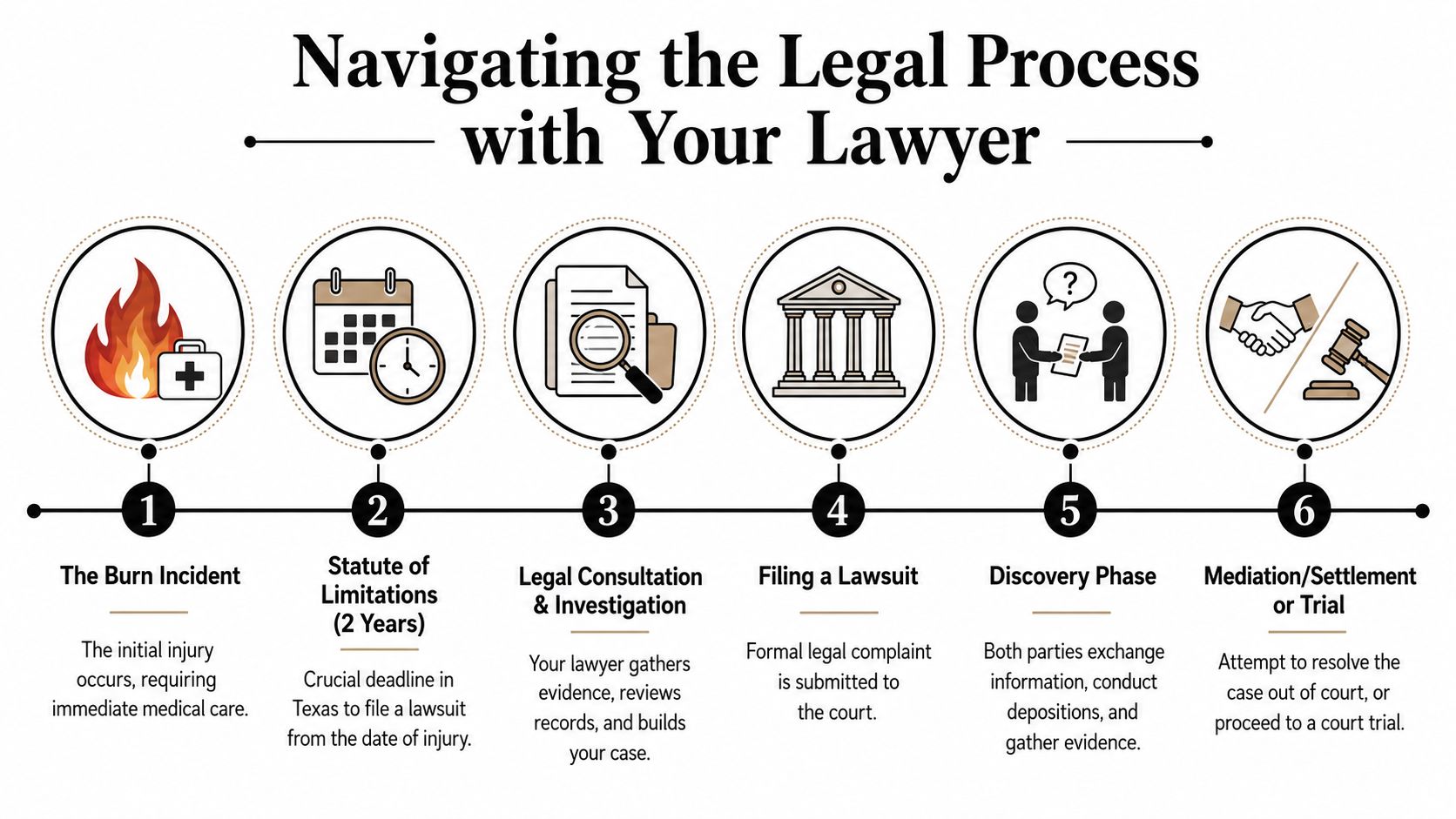
Navigating the Legal Process with Your Lawyer
Few individuals have navigated a serious injury case before. The process feels less intimidating when you know what each stage looks like.
One deadline comes first. In Texas, the statute of limitations for personal injury claims is two years from the date of the injury, as defined in Texas Civil Practice and Remedies Code § 16.003. Missing this deadline, even by a day, results in the automatic dismissal of your case, as explained in this discussion of the Texas personal injury statute of limitations.
The first call
The first conversation is usually straightforward. You explain what happened, where it happened, when it happened, and what treatment you've had so far. If a family member is helping because the injured person is still hospitalized, that's common.
A lawyer will usually want to know:
- How the burn happened
- Who may be involved
- What insurance coverage may exist
- What medical care has already been provided
- Whether evidence needs to be preserved immediately
For some people, this is also the first time they hear that the legal process can run alongside medical recovery. You don't have to wait until treatment is over to start protecting the case.
Investigation and case building
After the consultation, the legal work becomes more detailed. Records are requested. Witnesses are identified. Photos are collected. In some cases, the attorney may send letters telling a business, landlord, trucking company, or insurer to preserve evidence.
A vehicle-related burn case may overlap with other accident claims. If a commercial vehicle caused the crash, a Truck Accident Lawyer in Texas provides representation for victims of commercial truck and 18-wheeler collisions. If the injury later proves fatal, the family may also need guidance commonly associated with wrongful death litigation.
The strongest cases are usually built early, while records are available, memories are fresher, and physical evidence hasn't been lost.
At this stage, your lawyer is also looking at the trade-offs. Filing too early can mean the medical picture is incomplete. Waiting too long can weaken evidence or pressure the deadline. Good case management balances both problems.
Negotiation with the insurer
Most cases involve negotiation before trial. That process usually begins after your condition is better understood and the claim can be supported with records, bills, photographs, and a clear theory of liability.
People often feel frustrated. The insurer may question the cause of the burns, dispute future care, or argue that some treatment was unrelated. In a residential fire case, they may point at the tenant. In a worksite case, they may point at another contractor. In a crash case, they may blame the injured driver or passenger.
That's also why legal representation matters. The negotiation isn't just about asking for money. It's about showing why the defendant is responsible and why the damages are real, documented, and likely to continue.
If the case doesn't settle
If a fair settlement doesn't happen, the next step may be filing suit and moving into formal litigation. That can include written discovery, document exchange, depositions, motions, mediation, and trial preparation.
Not every case reaches a courtroom, but the possibility matters. A lawyer who prepares a case as if it may be tried often negotiates from a stronger position. That preparation can also help clients feel steadier, because they know what to expect instead of getting surprised by each development.
The Law Office of Bryan Fagan, PLLC represents Texas injury victims and families in personal injury matters involving serious accidents and catastrophic injuries, including cases where burn harm overlaps with vehicle collisions, workplace events, or wrongful death issues.
Choosing the Right Burn Injury Lawyer in Texas for You
You don't just need a law license on the other end of the phone. You need someone who can explain things clearly, spot liability issues early, and deal with insurers without losing sight of what your family is going through.
Questions worth asking in a consultation
A consultation should help you evaluate fit, not just tell your story. Ask direct questions.
- How will you prove negligence in my case? In Texas, a plaintiff must establish by a preponderance of the evidence that the defendant owed a duty of care, breached that duty, caused the injury, and that actual damages resulted, as outlined in this explanation of Texas negligence standards in personal injury cases.
- Who do you think may be responsible? In burn cases, there may be more than one answer.
- What evidence should be preserved right now? This tells you whether the lawyer is thinking practically.
- How will you communicate with me? You need to know who will return calls and how updates are handled.
- How do you approach settlement versus trial? You want realism, not empty promises.
What tends to work better
The right attorney usually does a few things well. They listen carefully at the beginning. They don't make instant promises about value. They identify missing evidence quickly. They explain trade-offs in plain language.
It also helps when the lawyer has experience with severe injury cases generally, not just routine claims. Burn cases often involve scar evidence, long-term treatment, emotional trauma, and future damages that can't be guessed in a quick phone call.
A good consultation should leave you calmer and better informed, not pressured.
Signs to be cautious about
Be careful if a lawyer seems more interested in signing the case than understanding it. Be cautious if they avoid your questions about communication, case strategy, or responsibility. And be wary of anyone who treats a severe burn like a simple soft-tissue claim. It isn't.
Choosing a burn injury lawyer in Texas is a partnership decision. You're trusting someone to handle painful facts, private records, insurer contact, and a claim that may affect your future for years. You deserve clarity, respect, and practical guidance from the start.
If you or your family is dealing with a serious burn injury, you can schedule a free consultation with Law Office of Bryan Fagan, PLLC. You'll get clear answers about your rights, the next steps in a Texas claim, and what can be done to protect your recovery. Healing takes time, but you don't have to carry the legal burden alone. Recovery is possible, and help is available.