Skip to content
A serious accident can change your life in seconds, but you don't have to face it alone.
You may be reading this with an ice pack on your ankle, a brace on your wrist, or discharge papers next to you on the table. Maybe you fell in a Houston grocery store, outside a Dallas apartment building, or on uneven steps at a San Antonio business. You're hurting, you're frustrated, and you're probably asking the same question commonly asked after a fall. Was this my fault, or should someone else be responsible?
That uncertainty is normal. Slip and fall cases often look simple from the outside, but they rarely feel simple to the injured person. One minute you're running an errand or heading into work. The next, you're dealing with pain, missed paychecks, medical appointments, and calls from people who want statements before you've even had time to think clearly.
A Texas personal injury lawyer looks at more than the fall itself. The key questions are what caused the hazard, how long it was there, who knew about it, and what evidence still exists. Those details can make the difference between a denied claim and a successful recovery.
People often find our firm while also searching for help with other injury matters, such as a Houston car accident attorney, a truck crash lawyer Houston, or a wrongful death lawyer Texas. The legal principles overlap in important ways. Fault matters. Evidence matters. Deadlines matter.
You're Not Alone After a Slip and Fall Accident
A fall can leave you feeling embarrassed as much as injured. Many people apologize right after they get hurt, even when a wet floor, poor lighting, or a broken handrail caused the incident. That reaction is human, but it can also make people second-guess valid claims.
Take a common example. A woman walks into a retail store in Houston after work. She doesn't see a slick patch near the entrance, falls hard, and lands on her side. At first, she thinks she's just shaken up. By that night, she can't put weight on her leg, and by the end of the week she's missing work, arranging child care, and trying to figure out whether the store is going to take responsibility.
That's when the emotional side of a case shows up. You may be worried about money. You may be replaying the fall over and over. If a loved one was seriously hurt, your whole family may be adjusting around doctor visits, transportation, and new physical limits.
You don't need to have every answer before you ask for legal help. You only need to act before key evidence disappears.
A good slip and fall lawyer in Texas should help you feel grounded, not pressured. You should get clear advice about your rights, realistic expectations about what works, and honest guidance about what doesn't. Sometimes a case is strong because the evidence shows the property owner ignored a known danger. Sometimes a case is harder because there's little proof the owner had time to discover the hazard. Either way, you deserve a straightforward assessment.
What most injured people need first
After a serious fall, legal advice matters, but so does reassurance. Individuals often need three things right away:
- Medical direction so injuries are diagnosed and documented.
- A plan for preserving evidence before it's gone.
- A calm explanation of whether Texas law gives them a path to compensation.
If your injuries came from unsafe property conditions, Slip and Fall / Premises Liability in Texas refers to legal representation for injuries caused by unsafe property conditions.
What to Do Immediately After a Slip and Fall in Texas
You fall hard on a wet floor in a Texas store. An employee helps you up, someone says they will file a report, and a manager tells you they will handle it. In that moment, many injured people are shaken, embarrassed, and focused on getting out of there. Those first decisions can affect your health and your case for weeks.
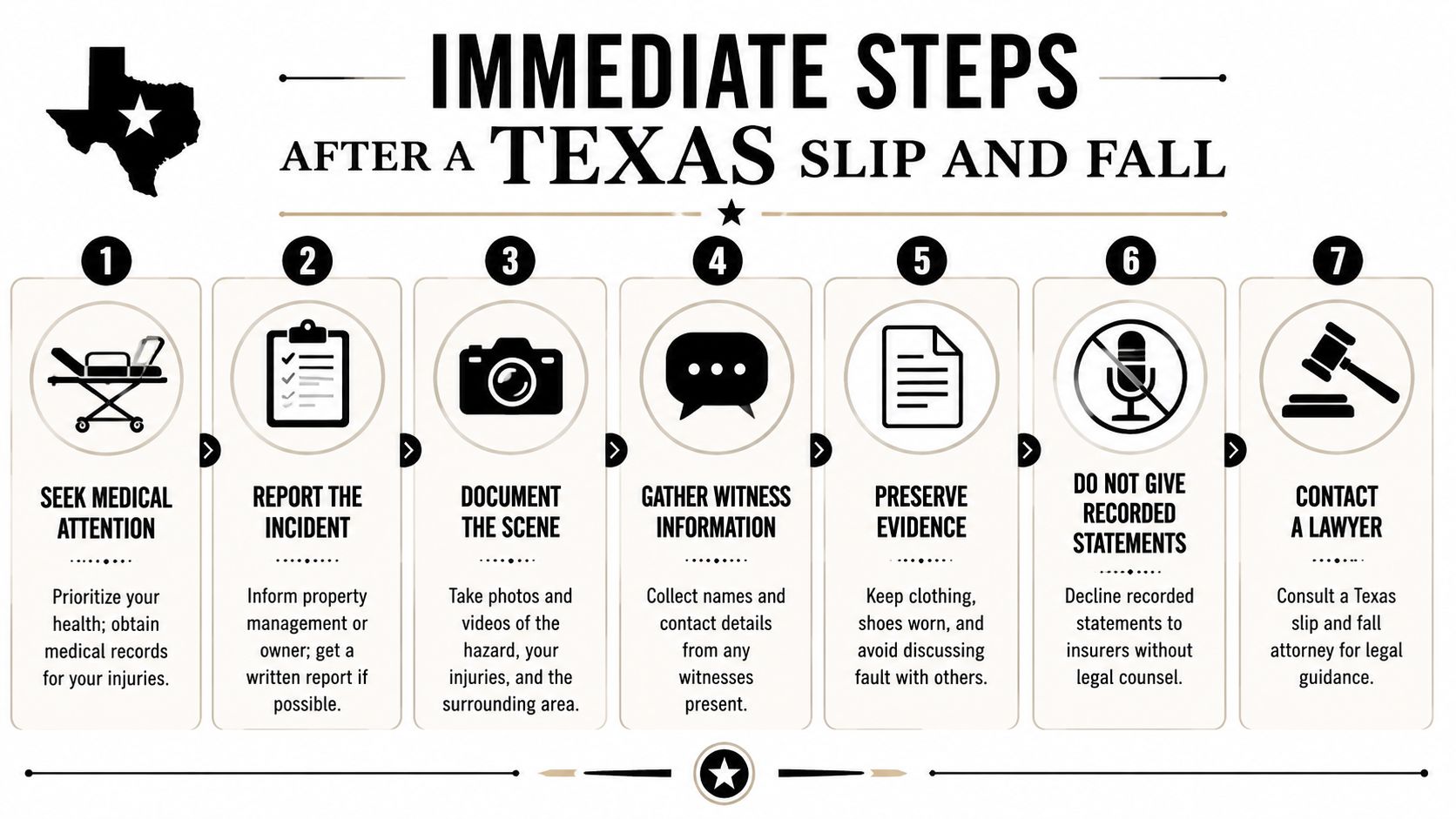
The goal is simple. Protect your body, preserve proof, and avoid saying or doing anything an insurance company can later use against you.
What to do right now
Get medical care first. Some injuries feel minor at the scene and worsen later, especially head injuries, back injuries, and soft tissue damage. Prompt treatment also creates records that connect the fall to your symptoms.
Report the fall to management, the owner, or property staff. Ask whether they prepared an incident report. If they refuse to give you a copy, write down the name of the person you spoke with, the time, and what was said.
Photograph the scene before it changes. Take clear photos of the hazard and the surrounding area. Include liquid, debris, a torn mat, poor lighting, a broken handrail, missing warning signs, and anything else that helps show why the area was unsafe.
Record a short video. Video often captures distance, layout, and visibility better than still photos. It can show how close the hazard was to an entrance, checkout lane, or restroom, and whether any warning cones were in place.
Get witness names and contact information. Neutral witnesses can make a major difference if the property owner later denies the hazard existed or disputes how long it was there.
Keep your shoes and clothing in the same condition. Do not wash them or throw them away. Defense lawyers sometimes argue the footwear, not the property condition, caused the fall.
Limit what you say about fault or your injuries. Give basic facts for reporting purposes, but do not guess about what happened, and do not agree to a recorded statement from an insurer.
What to do this week
The next several days matter because evidence disappears quickly. Stores clean floors. Surveillance footage gets overwritten. Witnesses forget details.
Start a simple claim file and keep everything in one place:
- Medical records and discharge papers
- Bills, receipts, and pharmacy costs
- Photos of bruising, swelling, or cuts as they develop
- Work records showing missed time or changed duties
- Notes about pain, sleep problems, and daily limitations
- Emails, texts, or voicemails from the property owner or insurer
Practical rule: Take updated photos of your injuries every day for at least the first week if bruising, swelling, or reduced movement are getting worse.
This is also the stage when many people need clear legal guidance. A lawyer can help identify what evidence should be requested early, including incident reports, maintenance records, and surveillance footage. If you want a plain-English overview of how unsafe property cases work, this explanation of Texas premises liability law is a useful starting point.
What to do this month
Follow through with treatment. Gaps in care can hurt both your recovery and your claim. If a doctor refers you to imaging, physical therapy, or a specialist, keep those appointments unless you have a real reason you cannot.
Write down how the injury affects normal life. That includes trouble walking, driving, working, lifting, sleeping, bathing, or caring for your children. People often remember the emergency room visit but forget the daily losses that end up being just as important.
Common mistakes that can hurt your claim
Avoid these common mistakes that can hurt your claim:
- Saying you are "fine" before you know the extent of your injuries. Early statements often show up later in the insurance file.
- Posting on social media. A single photo or casual comment can be taken out of context and used to argue you were less injured than you claim.
- Waiting too long to get legal advice. Video footage, cleaning logs, and witness statements are much easier to secure early.
- Throwing away damaged items. Shoes, clothing, and even a broken phone can become evidence.
- Assuming the business will preserve everything on its own. Sometimes it does. Sometimes it does not.
A strong case is built step by step. What you do right now, next week, and next month can make the difference between a claim that is easy to challenge and one supported by clear, credible proof.
How Texas Premises Liability Law Affects Your Case
A wet grocery store floor, a dim apartment stairwell, a loose mat at a clinic entrance. The location changes, but the legal question stays the same. Did the property owner act reasonably to keep the place safe for people who were allowed to be there?
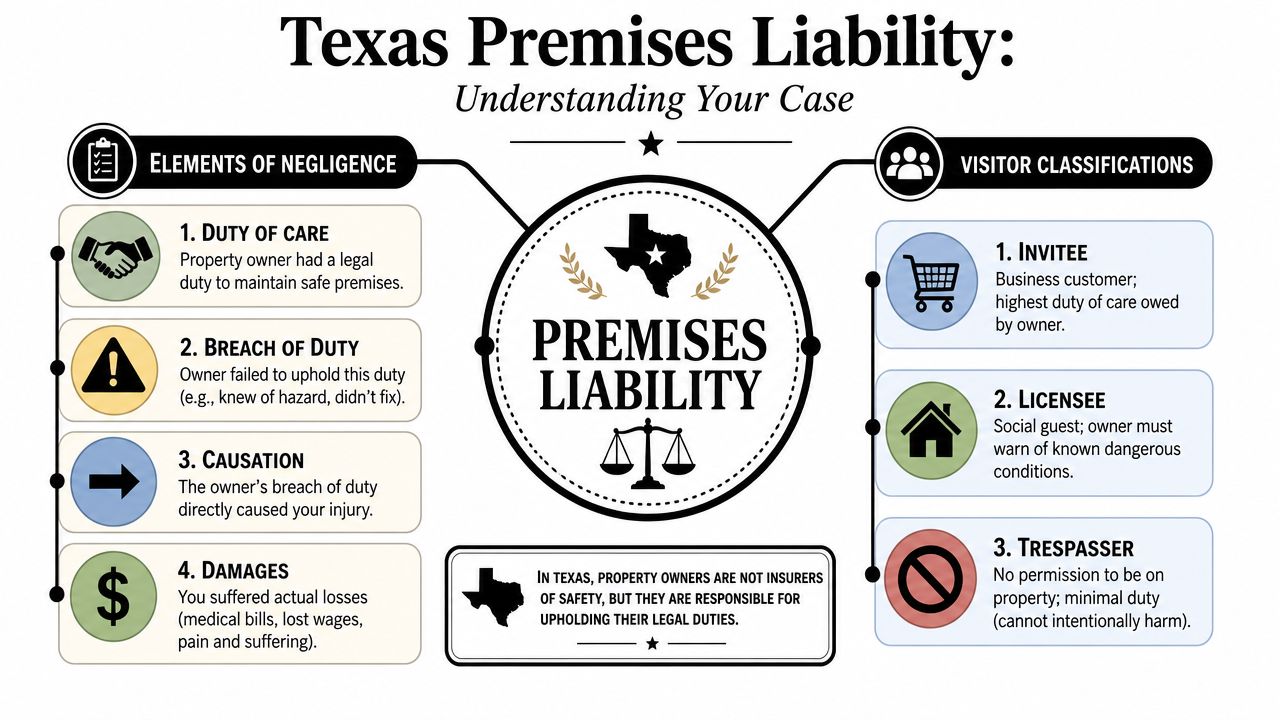
Texas slip and fall cases usually fall under premises liability law. That area of law looks at the condition of the property, the owner or occupier's conduct, and whether a preventable hazard was left in place long enough to injure someone. If you want a plain-language overview, this explanation of Texas premises liability law is a helpful reference.
What you must prove
A strong case usually comes down to four parts:
| Element | What it means in real life |
|---|---|
| Duty | The property owner had a legal obligation to keep the area reasonably safe |
| Breach | The owner failed to fix a danger or failed to warn about it |
| Causation | That unsafe condition caused your fall |
| Damages | You suffered losses such as medical bills, lost income, and pain |
That sounds straightforward on paper. In practice, each part needs proof.
If you were injured in a store, restaurant, office building, or apartment common area, you were likely there lawfully. In many of those settings, the owner has a duty to inspect for hazards, correct unsafe conditions, and warn visitors about dangers that are not obvious.
Owner knowledge often decides the case
The hardest fight in many slip and fall claims is not whether you fell. It is whether the property owner knew, or should have known, about the danger before you got hurt.
That issue can look very different from case to case. A handrail that has been loose for days points toward poor maintenance. A drink spilled seconds before a customer steps into it raises a different question. Was an employee nearby? Did surveillance video capture the spill? Did staff create the hazard themselves? Those facts matter.
This is often where valid claims stall. Businesses and insurers argue there was no notice, no time to respond, or no reason the hazard should have been discovered earlier.
A short video can make these concepts easier to follow:
Why notice evidence matters so much
To show notice, lawyers look for details that place the danger on the owner's radar, or that show it should have been found through reasonable care. That may include cleaning logs, inspection policies, maintenance requests, prior complaints, employee incident reports, or surveillance footage. Sometimes the condition itself helps tell the story. A puddle with dirt, footprints, or cart tracks may suggest it was there long enough for staff to catch it.
A hazard alone is not enough. The evidence needs to connect that hazard to what the property owner created, knew about, ignored, or should have discovered.
This part of the case can feel frustrating for injured people. You know you were hurt. You may know exactly what caused the fall. Texas law still requires proof that ties the condition back to the property owner's responsibility.
That is why early case work matters. A Texas slip and fall lawyer should move quickly to preserve video, request records, identify witnesses, and pin down who was responsible for inspections or repairs. For readers comparing different injury systems, understanding workers' comp in Florida shows how timelines and proof issues can differ from a Texas premises liability claim.
Navigating Texas Comparative Fault and Filing Deadlines
A common call comes in a week or two after a fall. The person is hurt, bills are starting to arrive, and the property owner's insurer is already hinting that the fall was partly their fault. At the same time, the legal clock is running. In Texas, those two issues can decide whether a case has value or disappears.
How comparative fault works in Texas
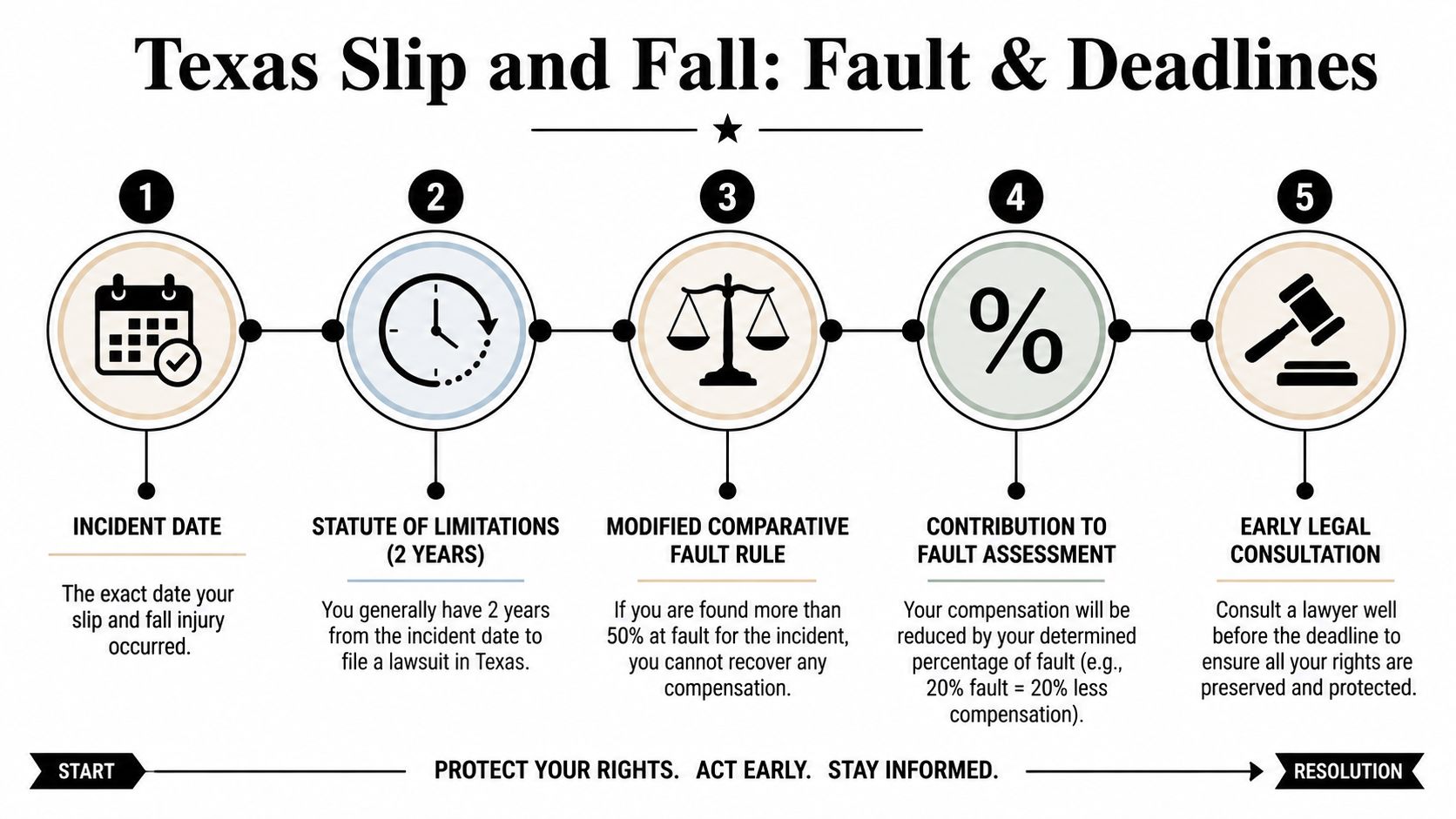
Texas follows a modified comparative fault rule. You can still recover damages if you were partly responsible for the fall, but only up to a limit.
Under Texas law, you can recover damages only if you were 50% or less responsible for the incident. If a jury finds you 51% or more at fault, your recovery becomes exactly $0. For a plain-English explanation, see how comparative fault works in Texas injury claims.
Here, real trade-offs become evident. The insurance company may argue that you were distracted, failed to notice an open hazard, wore unsafe footwear, or ignored a warning. Every percentage point matters. If they can push your share of fault high enough, they reduce what they have to pay. If they push it past 50%, they can defeat the claim entirely.
That is why the story of the fall matters so much. The timing, lighting, placement of the hazard, whether warnings were clear, and whether a reasonable person would have seen the danger all affect how fault is assigned.
Filing deadlines can end a valid claim
Most Texas slip and fall cases must be filed within two years of the date of injury. Miss that deadline, and courts will usually dismiss the case, even when the injury is serious and liability is strong.
Claims involving a city, county, or other government entity can move much faster. Some require formal notice well before the normal two-year deadline. Those claims are frequently lost because injured people do not realize special notice rules apply.
A fall in a grocery store and a fall on government-controlled property may look similar at first. Legally, the timing can be very different.
Waiting to see whether the pain improves can cost you more than evidence. It can cost you the right to bring the claim at all.
Situations that can change the timeline
A few exceptions can affect how the deadline is calculated:
- Minors: If the injured person is under 18, the limitations period is usually tolled until age 18.
- Wrongful death cases: The two-year period generally runs from the date of death, not the date of the original injury.
The practical lesson is simple. Do not guess about deadlines. Get the incident date, identify who controlled the property, and have a lawyer check the timeline right away. That gives you a plan for what to do now, what records to gather next week, and what filing steps may be needed next month.
Families dealing with treatment or claim issues in more than one state sometimes compare how different systems work. If you are also sorting out a separate work injury matter, understanding workers' comp in Florida can help show how different deadlines and procedures apply in another setting.
Recovering Damages and Handling Insurance Companies
A fall can change the next few months of your life fast. One day you are walking through a store, apartment complex, or parking lot. The next, you are dealing with doctor visits, missed work, pain when you stand up, and calls from an insurance adjuster who wants to “wrap things up.”
That claim needs to reflect the full effect of the injury on your life, not just the first bill that hit your mailbox.
What damages may be available
In Texas, damages usually fall into two categories.
Economic damages are the losses you can measure with records and bills, such as:
- Medical expenses
- Lost income
- Future treatment
- Physical therapy and rehabilitation
- Medication, medical equipment, and other out-of-pocket costs
Non-economic damages cover harm that is harder to measure but no less real, including:
- Pain and suffering
- Mental anguish
- Physical impairment
- Loss of enjoyment of normal daily activities
A good claim ties these losses to your real day-to-day experience. If you cannot pick up your child, drive without pain, return to your job, or sleep through the night, those facts matter. For a closer look at how these categories are evaluated, this guide on maximizing a Texas personal injury settlement is a useful starting point.
What usually drives case value
No two slip and fall cases have the same value because no two injuries affect people in the same way.
The biggest factors usually include the seriousness of the injury, whether surgery was required, how long recovery lasts, whether you are left with permanent restrictions, how much work you miss, and how clear the property owner's fault is. A severe fracture, head injury, or back injury that changes mobility for months or years will usually be valued very differently from a soft tissue injury that improves with conservative care.
Occupation matters too. The same ankle injury can have a very different financial effect on an office worker, a nurse, a mechanic, or a warehouse employee. Age, prior health, and future care needs also shape the claim. The legal question is not only what happened on the day of the fall. It is what this injury is likely to cost you next week, next month, and later.
How insurance companies usually handle these claims
Insurance adjusters often sound polite and reasonable early on. Their job is still to limit what the company pays.
In practice, that often means arguing that the hazard was open and obvious, that you were not watching where you were going, that your injuries were preexisting, or that your treatment was excessive. Some carriers make a quick offer before the medical picture is clear. That can feel tempting when bills are stacking up, but early settlements often leave out future treatment, future wage loss, and the everyday limitations that become obvious only after a few weeks of recovery.
A few practical rules help protect the claim:
- Do not give a recorded statement without legal advice.
- Do not minimize your symptoms just to sound tough or cooperative.
- Do not accept an offer before you understand your diagnosis, treatment plan, and likely recovery time.
- Keep records of bills, missed work, prescriptions, and the ways the injury affects daily life.
Families dealing with serious injuries sometimes face expenses beyond routine care. If transportation becomes part of the medical picture, this guide to medical transport costs for families can help you understand one category of expense that may arise in severe cases.
The goal is simple. Build the claim around the full loss, present it with solid proof, and do not let the insurance company define your recovery for you.
Why You Should Speak with a Texas Slip and Fall Lawyer Today
You slip on a wet floor, report it, go home sore, and assume the facts will speak for themselves. A week later, the pain is worse, work is harder, and the property owner is already questioning what happened. That is often the point when people realize a fall claim is not simple.
What a lawyer actually does for you
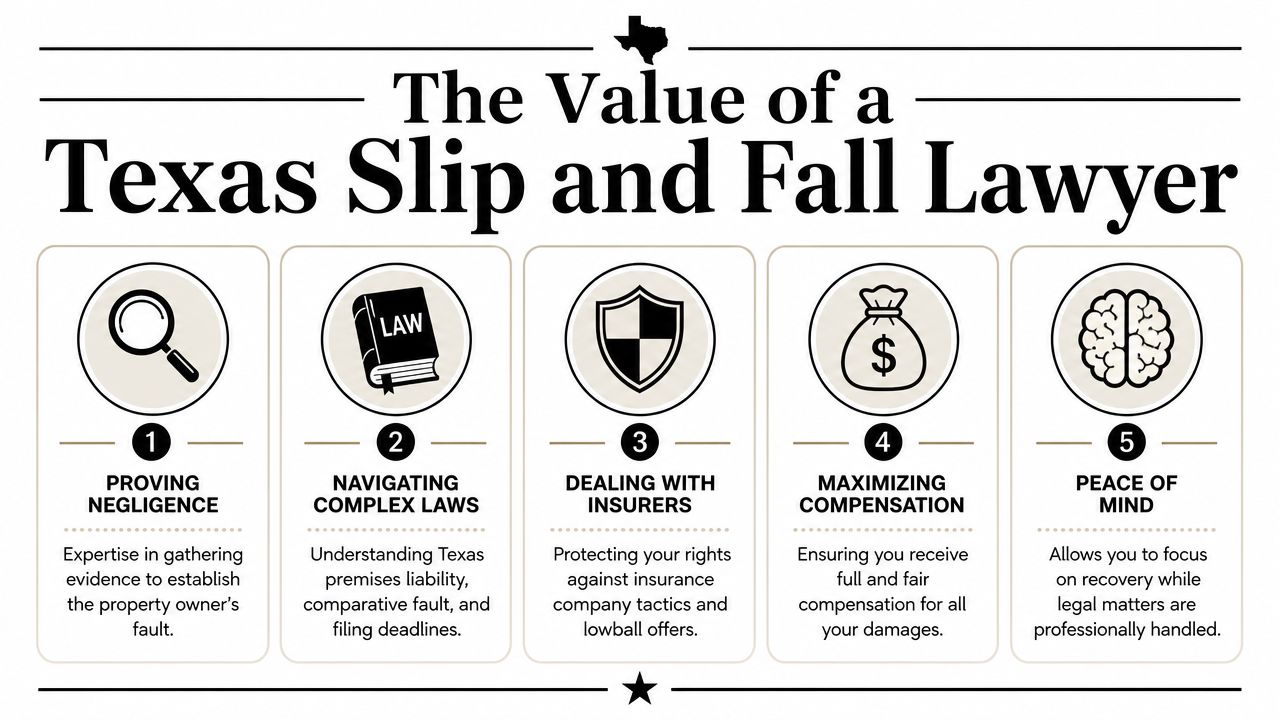
The vast majority of injury cases settle before trial, but trial risk still shapes every serious claim. Results are never guaranteed. The cases that resolve well usually have one thing in common. Someone gathered the proof early, framed the legal issues correctly, and presented the harm in a way an insurer, judge, or jury could understand.
In a Texas slip and fall case, a lawyer's job is practical. Find out what the dangerous condition was. Determine who controlled the property. Secure video before it is erased. Get maintenance records, incident reports, and witness statements. Tie the medical evidence to the fall. Then build a claim that accounts for the injury you had on day one and the problems that showed up three weeks later.
That work matters because property owners and insurers often defend these cases by attacking details. They may argue the condition was not dangerous enough, that no one had notice, or that your injury came from something else. A lawyer addresses those points with evidence, not assumptions.
Why timing changes the case
Slip and fall evidence disappears fast.
Video may be overwritten within days. A spill gets cleaned up. A broken handrail gets repaired. Witnesses forget what they saw. If you wait too long to get legal help, the case can become harder than it needed to be.
For many injured people, the best approach is to think in stages. Right now, protect your health and preserve what you have. Next week, make sure the record matches what happened and how you feel. Next month, once treatment is clearer, evaluate the full value of the claim instead of reacting to pressure from the other side.
What tends to help
A lawyer can help you work through decisions that are easy to get wrong when you are injured and stressed:
- Preserve evidence before it disappears
- Identify all potentially responsible parties
- Match medical records to the mechanics of the fall
- Calculate lost income and future care needs
- Present pain, limitations, and disruption to daily life in a credible way
- Prepare the claim for settlement talks while keeping trial as a real option
Good legal advice also helps people make better treatment decisions. If your recovery includes therapy, rehabilitation, or pain management, information on integrative personal injury solutions may help you consider the care side of recovery while the legal claim is being developed.
When to make the call
The right time to speak with a lawyer is usually earlier than people think. You do not need a lawsuit filed, a denial letter, or a final diagnosis before you ask questions. Early advice can help preserve proof, avoid preventable mistakes, and give you a clearer plan for what to do now, next week, and next month.
The Law Office of Bryan Fagan, PLLC handles Texas personal injury matters, including premises liability claims, on a contingency-fee basis. That means attorney's fees are owed only if there is a recovery.
Recovery is possible. The legal process can feel heavy at first, but you do not have to sort through fault, deadlines, evidence, and insurance tactics on your own. Speaking with a Texas slip and fall lawyer today can give you a grounded view of the case and a realistic path toward compensation.