Skip to content
A serious accident can change your life in seconds, but you don't have to face it alone.
One minute, you're on shift, focused on the job. The next, there's a blast, a crushing injury, a vehicle impact, or a call telling your family to get to the hospital. In the first few hours after an oilfield injury, individuals aren't thinking about legal strategy. They're thinking about pain, surgery, missed paychecks, and whether life will ever feel normal again.
That's exactly why early decisions matter. In Texas oilfield cases, the path you choose at the start can affect everything that follows, from medical benefits to whether you can bring a lawsuit at all. If you're searching for an oilfield accident lawyer in Texas, you probably need more than legal vocabulary. You need a steady explanation of what to do next, what mistakes to avoid, and how to protect every option that may still be open.
Your Life Changed in an Instant You Are Not Alone
A roughneck in West Texas finishes one task and heads to the next. Then a valve fails, a truck swings wide, pressure releases, or heavy equipment shifts the wrong way. By the time the call reaches home, the family has more questions than answers. Is he stable. Who is paying for treatment. Was this reported as a work injury. Which company was in charge of that part of the site.
That confusion is common in oilfield cases. Several companies may be involved on one location, and each one has its own insurer, supervisors, and version of what happened. Families are often asked for statements before they even know the full diagnosis.
Texas oil and gas work carries serious risk. Burn injuries, crush injuries, falls, explosions, toxic exposure, and transportation incidents happen in conditions where speed and production often compete with safety.

What that means for you right now
If you were hurt, or if your family lost someone, you are dealing with a legal problem and a life problem at the same time. Those two tracks start immediately. Medical decisions cannot wait. Neither can the steps that protect the evidence.
In the first days, facts start disappearing. The scene gets cleared. Equipment is repaired or put back into service. Contractors leave the site. Witness memories change. Incident reports are written in language that may help the company more than the worker.
A lot can turn on one early question. Is this a workers' compensation claim, a non-subscriber case, a third-party lawsuit, or some combination of those paths. In Texas, that choice is not technical paperwork. It can change the medical benefits available, the proof required, and the amount of money a family may be able to recover.
Practical rule: Treat the first stage of an oilfield injury case as evidence-preservation time. Get clear medical care. Make sure the incident is documented. Do not assume the company has correctly told you what kind of claim this is.
Oilfield cases are rarely simple
Many injured workers are told some version of, "This is just workers' comp." Sometimes that is true. Often it is only part of the story.
An oilfield accident may involve the well operator, a drilling contractor, a service company, a trucking company, a maintenance crew, a tool manufacturer, or a property owner. One employer may carry workers' compensation. Another may be a non-subscriber. A separate company may have caused the unsafe condition altogether. That is why early case review matters so much. If the wrong path is chosen at the start, valuable claims can be limited or lost.
I have seen families wait because they were trying to be fair and patient. Meanwhile, the companies involved were already sorting out defenses, contracts, and insurance positions. Workers deserve to know that from the beginning.
You do not need every answer on day one. You do need to protect every option that Texas law may still leave open.
Your First Steps After an Oilfield Injury
The first moves after a serious injury can protect your health and preserve your claim. They don't need to be perfect. They do need to happen quickly.
Start with medical care and reporting
Get medical treatment as soon as possible. Even if you think you can “walk it off,” oilfield injuries can involve head trauma, internal damage, spinal injuries, crush injuries, burns, or exposure-related complications that get worse with time. Medical records also create a timeline that can become important later.
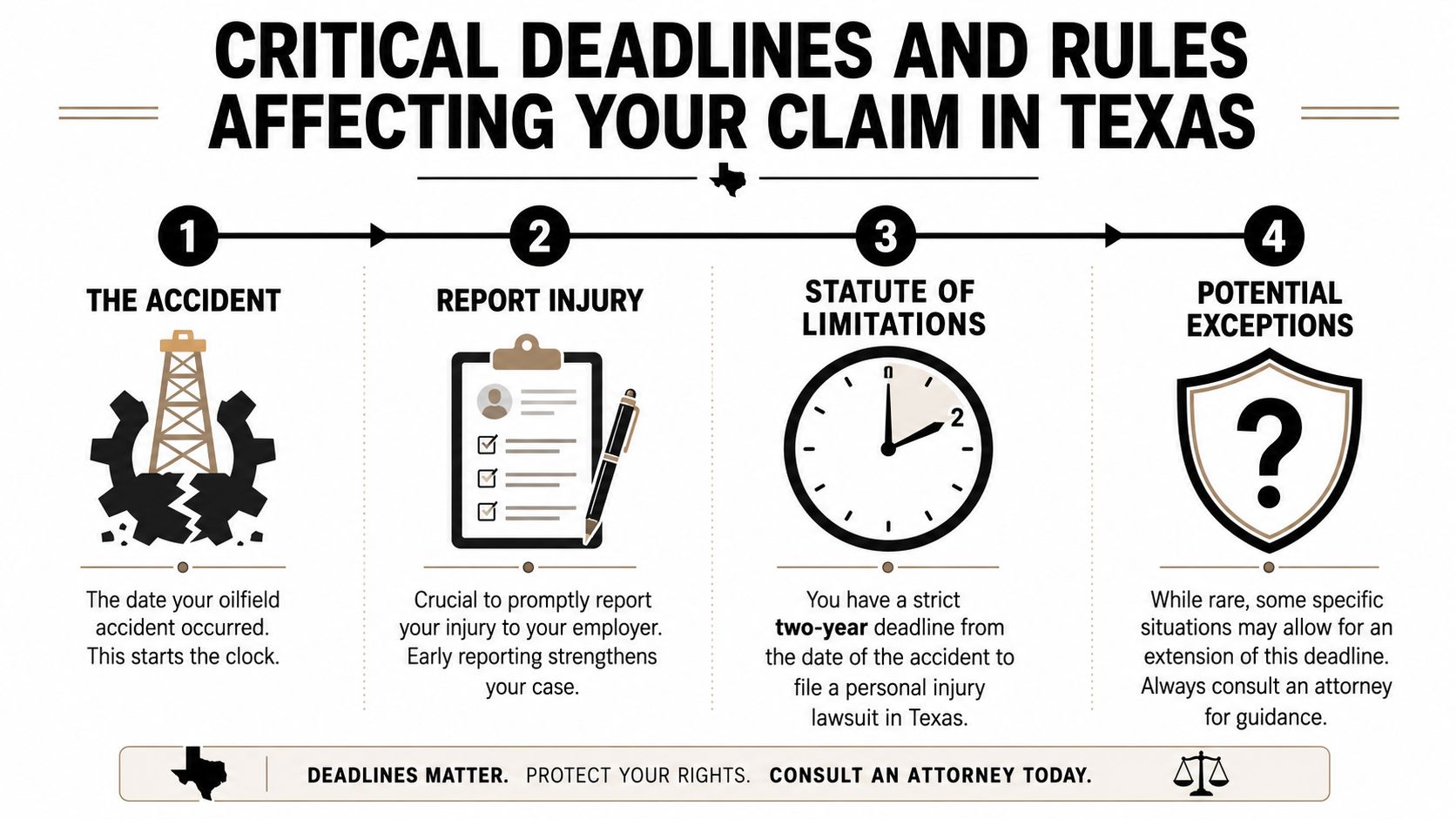
Then report the injury to your employer. A critical but often missed step is the 30-day internal reporting deadline to employers required by Texas Labor Code Section 409.001; missing this short window can void a worker's claim for benefits even if they file a lawsuit within the two-year statute of limitations (Nix Law oil field injury lawyers).
Tell your employer about the injury in a way that creates a record. If possible, use writing, save a copy, and note who received it.
If your injury involved a work truck, tanker, or another commercial vehicle on or near the site, basic crash liability rules can overlap with workplace injury issues. A helpful overview is 18-Wheeler and Commercial Vehicle Accidents in Texas, which explains how liability works in Texas crashes involving large commercial vehicles.
Preserve what you can
Oilfield cases often turn on physical evidence and site records. If you can do so safely, or if a family member can help, preserve what's available early.
- Photograph the scene: Take pictures of machinery, vehicles, debris, burn marks, broken guards, fluid leaks, warning signs, and your visible injuries.
- Identify witnesses: Write down names of coworkers, supervisors, contractors, medics, and anyone who saw what happened or arrived right after.
- Save documents: Keep discharge papers, work schedules, pay records, text messages, incident reports, and any communication from the employer or insurer.
- Keep the gear: Don't wash, repair, or throw away damaged clothing, boots, gloves, helmets, or personal protective equipment.
- Write your own account: As soon as you can, record what happened in plain language while the timeline is still fresh.
Be careful with insurance and company statements
After a Houston freeway crash, people often learn the hard way that an adjuster's “routine questions” can shape the whole claim. The same is true in an oilfield injury case. Don't assume a recorded statement is harmless just because the caller sounds polite.
A company representative or insurer may ask leading questions about fatigue, training, prior injuries, or whether you “weren't paying attention.” Those questions can be used later to shift blame onto you.
If you're not sure what kind of claim you have yet, that's normal. The point is to avoid locking yourself into someone else's version of events before the facts are fully investigated.
Navigating Your Legal Options Workers Comp vs Lawsuits
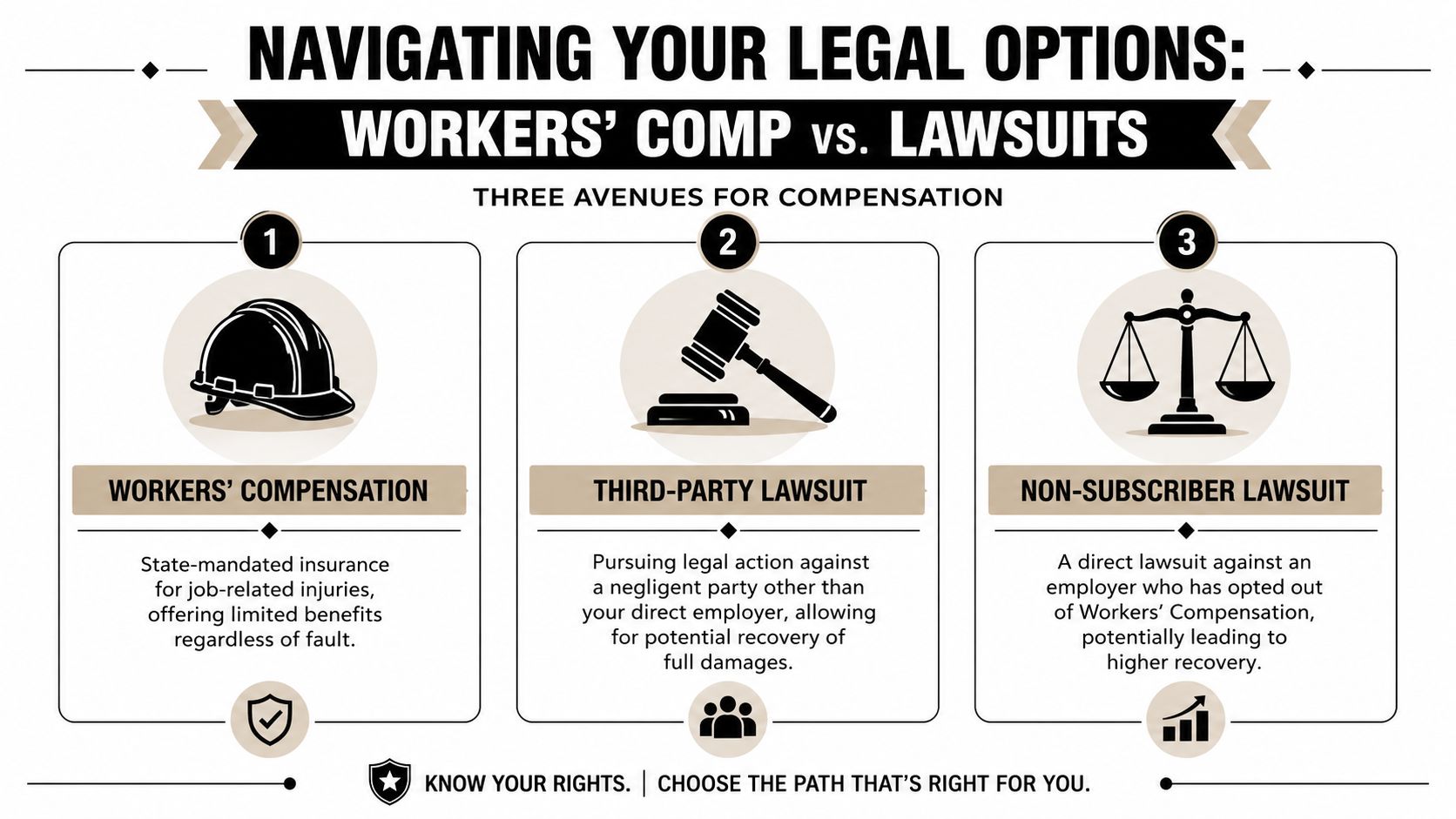
The biggest mistake many injured workers make is assuming there's only one path. In Texas oilfield cases, there may be three different avenues to consider, and they don't all work the same way.
The three paths that matter
Some employers carry workers' compensation coverage. Some don't. Some cases also involve another company entirely, such as a contractor, trucking company, or equipment maker. That's why the right question isn't “Do I have a claim?” It's “What claims do I have?”
| Claim Type | Who You Sue | Can You Sue Your Employer? | Can You Recover for Pain & Suffering? |
|---|---|---|---|
| Workers' Compensation | Usually no lawsuit against the employer for negligence | Generally no | Generally no |
| Third-Party Lawsuit | A company other than your direct employer | Not through this claim | Potentially yes |
| Non-Subscriber Lawsuit | An employer that opted out of workers' comp | Yes | Potentially yes |
Workers' comp is one option, not the whole picture
Workers' compensation can provide limited benefits for a job-related injury regardless of fault. That can help with immediate needs. But workers' comp usually restricts your ability to sue your employer for negligence, and it generally doesn't allow recovery for pain and suffering.
For many families, that comes as a surprise. A worker may have severe physical pain, permanent limitations, and a damaged future career, yet the available benefits still fall short of the full loss.
For a plain-language overview of how these rules work, see Texas workers' compensation rules.
A related safety issue also matters on industrial sites. Property owners and operators often face difficult choices about contamination, cleanup, and worker exposure after serious incidents. This resource on addressing industrial accident risks for property owners gives useful context for how those responsibilities can affect safety and liability.
Non-subscriber claims can change the case
Texas is unusual because many employers choose not to subscribe to workers' compensation. A key strategy involves identifying non-subscriber employer claims, as many Texas oil companies opt out of workers' compensation, enabling direct lawsuits for unsafe conditions. In addition, recent data shows that 40% of recent settlement increases in the Permian Basin came from suing non-employer third parties for defective machinery or negligent safety practices (Zehl Law oilfield accident lawyer).
That means an injured worker may be able to sue the employer directly if the employer is a non-subscriber and unsafe conditions caused the injury. In practical terms, this can expand the kinds of damages available.
The label on the company's insurance program doesn't answer the case. The facts do.
Third-party claims are often the overlooked claim
Consider a common oilfield example. A rig hand is badly hurt when machinery starts unexpectedly during service, or when another contractor's crew creates a hazard in the work area. The employer may say it's an internal matter. But the legal exposure may belong to a maintenance company, equipment manufacturer, trucking vendor, or outside contractor.
That's why oilfield cases need a broad investigation. A worker can have a workers' comp claim and still have a third-party lawsuit. A worker can also have a direct case against a non-subscriber employer. Those are different paths with different consequences.
This short video gives additional context on legal options after a workplace injury.
What tends to work and what doesn't
What works is identifying every potentially responsible party early, preserving maintenance records, incident reports, and witness statements, and refusing to assume the company's first explanation is complete.
What doesn't work is treating an oilfield injury like a routine HR issue. Serious cases often involve layered contracts, overlapping safety duties, and more than one insurance policy. If those facts aren't examined early, a valuable claim can disappear before it's ever fully understood.
Critical Deadlines and Rules That Can Affect Your Claim
A strong case can still fail if it misses a deadline or if the other side shifts enough blame onto the injured worker. Texas law has rules that directly affect whether you recover anything at all.
The two-year filing deadline
Under Texas Civil Practice and Remedies Code § 16.003, you have exactly two years from the date of your injury to file a lawsuit. Also, under § 33.001, you can recover damages only if you are 50% or less responsible for the accident; if a jury finds you 51% or more at fault, your recovery is barred completely (Texas comparative negligence explanation).
That deadline sounds generous until you look at what has to happen first. Records have to be gathered. Witnesses have to be found. Experts may need to inspect equipment. Defendants have to be identified correctly. If you wait until the deadline is close, you put pressure on every part of the case.
If you want a broader explanation of filing cutoffs, this overview of the personal injury statute of limitations can help, along with this page on the Texas personal injury statute of limitations.
The 51 percent bar rule
Texas uses a modified comparative responsibility system. In plain English, that means fault gets assigned. If you are 50% or less responsible, your recovery may be reduced. If you are 51% or more responsible, you recover nothing.
Here's how that plays out in practice. A company may argue that you ignored training, took a shortcut, failed to inspect equipment, or entered an unsafe area. Even when the site itself was badly managed, those arguments can become central.
Keep this in mind: The defense doesn't need to prove you caused everything. They often try to push your share of fault just high enough to block recovery.
Fault fights start early
After a serious injury, blame-shifting often appears in incident reports, witness interviews, and insurer calls. That's why early documentation matters. A worker's own notes, photographs, and prompt legal review can help counter a version of events that unfairly puts the worker at the center of the problem.
Families should also know that negligence rules in Texas affect more than oilfield incidents. They show up in freeway crashes, premises cases, and wrongful death claims. After a fatal worksite event, a wrongful death lawyer Texas families trust will usually focus on the same core issues: who had the duty to act safely, who failed, and how the defense is trying to divide fault.
Calculating the Full Value of Your Oilfield Accident Claim
Insurance companies often start with the easiest numbers to count. Hospital bills. A portion of missed wages. Short-term treatment. That approach leaves out much of what a serious oilfield injury costs.
Economic damages and future losses
Economic damages are the financial losses you can identify on paper. They may include medical care, rehabilitation, income you've already lost, and reduced earning ability if you can't return to the same kind of work.
For an oilfield worker, future earning capacity can be one of the biggest parts of the case. A person who spent years building a career in physically demanding field work may not be able to return after a crush injury, severe burn, spinal injury, or traumatic brain injury. The loss isn't just this month's paycheck. It's the ability to keep earning in that trade.
A useful breakdown of these categories appears in this guide to economic vs non-economic damages.
The human losses matter too
Non-economic damages address harm that doesn't come with a simple invoice. Pain. Suffering. Mental anguish. Physical impairment. Disfigurement. Loss of normal life.
A derrickhand in the Permian Basin who can no longer lift, sleep normally, play with his children, or work the way he once did has suffered losses that reach far beyond emergency care. The same is true for families after a fatal incident. Wrongful death claims can involve the loss of support, companionship, and the stability a loved one provided.
A quick settlement often reflects the easiest losses to measure, not the full impact of the injury.
That's why a careful damages analysis matters. A proper claim values the whole injury, not just the first stack of bills.
How an Oilfield Accident Lawyer Fights for You
By the time a family reaches this point, the hardest part is usually clear. The case isn't just about filing papers. It's about identifying the right claim, meeting the right deadline, proving fault, protecting against blame-shifting, and valuing the loss accurately.

What legal help actually looks like
An experienced Texas personal injury lawyer doesn't just “handle a claim.” The work usually includes investigating the site, securing documents, reviewing contracts between companies, preserving equipment evidence, interviewing witnesses, and dealing with insurers so you don't have to carry those conversations alone.
In equipment-related cases, understanding failure analysis can also matter. This resource with insights for industrial equipment failures helps explain why early technical review is often important when machinery, maintenance, or mechanical breakdown is involved.
A firm such as the Law Office of Bryan Fagan, PLLC handles Texas personal injury matters on a contingency-fee basis, which means clients don't pay attorney's fees unless there is a recovery.
When to call a lawyer
Call early if any of these are true:
- You suffered a severe injury: Major burns, amputations, head trauma, spinal injuries, crush injuries, or a long hospitalization usually mean the consequences are significant.
- The employer's role is unclear: If you don't know whether the company has workers' comp coverage, that needs to be answered quickly.
- Another company may be involved: Contractors, truck drivers, maintenance vendors, and equipment manufacturers can change the case completely.
- The insurer wants a statement: Early statements often shape fault arguments before the evidence is fully known.
- Your family lost someone: A wrongful death case deserves immediate review so evidence and testimony don't disappear.
The road ahead may feel heavy right now. That's normal. Recovery takes time, and legal answers don't fix everything overnight. But with the right guidance, you can protect your rights, steady your finances, and hold the right people accountable.
If you or your family needs answers after an oilfield injury, schedule a free consultation with Law Office of Bryan Fagan, PLLC. You can talk through what happened, learn whether workers' comp, a non-subscriber claim, or a third-party lawsuit may apply, and get clear guidance on the next steps. Recovery is possible, and legal help is available when you're ready.