A serious accident can change your life in seconds, but you don't have to face it alone.
If you're reading this after a crash with a semi-truck or 18-wheeler, you may be dealing with pain, medical appointments, vehicle damage, missed work, and constant calls from insurance companies. You may also be wondering whether you need an 18 wheeler accident lawyer Texas families can trust, or whether it's too early to call.
In Texas, truck wreck cases are different from ordinary car wreck claims. They often involve larger insurance policies, more evidence, and more than one party who may be legally responsible. A Texas personal injury lawyer can help you understand fault, protect evidence, and push back when the trucking company tries to control the story early.
Texas also remains one of the most dangerous states for deadly truck crashes. In 2023, the state recorded 730 fatalities in crashes involving large trucks, accounting for 17% of Texas's 4,291 motor vehicle fatalities, according to Texas truck accident statistics. For injured people and grieving families, those numbers reflect a hard truth. These crashes are often devastating, and the legal path afterward can feel overwhelming.
First Steps to Protect Your Rights After a Crash
The first hours after a truck crash are chaotic. You may be in shock. You may feel pressure to answer questions before you even understand what happened. Slow the moment down and focus on a few basic steps that protect both your health and your claim.
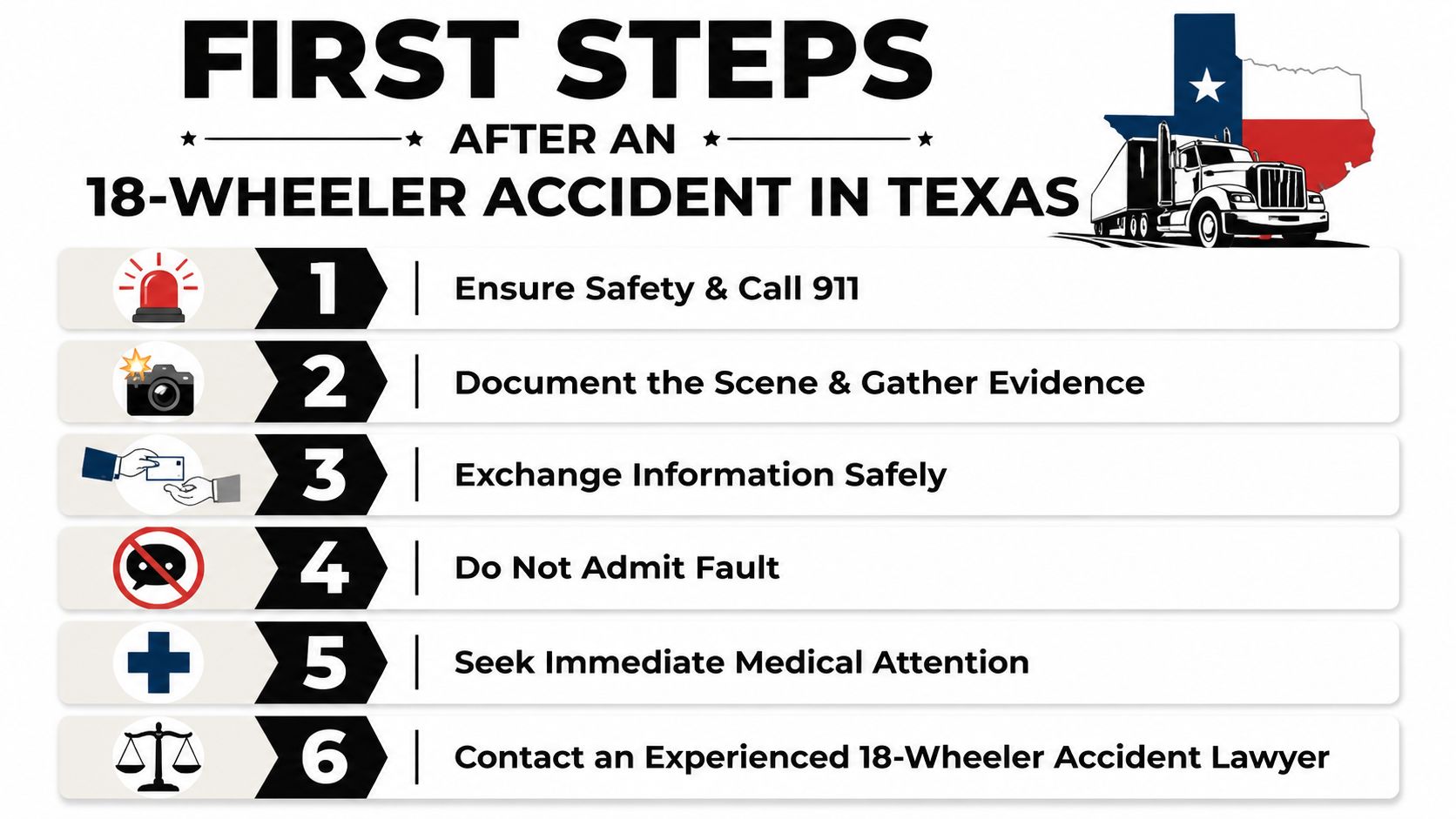
What to do at the scene
If you can do so safely, start with this short checklist:
- Call 911 first: A police response creates an official record. In truck wreck cases, that early report can matter later.
- Get medical help: Even if you think you're “mostly okay,” get checked. Some serious injuries don't show symptoms right away.
- Take photos: Capture the vehicles, skid marks, road conditions, debris, visible injuries, and any company markings on the truck.
- Collect information carefully: Get the truck driver's name, employer, insurance details, and contact information for witnesses.
- Say less than you think: Don't argue about fault at the scene. Don't guess. Don't apologize in a way that could be twisted into an admission.
- Keep what you have: Save discharge papers, prescriptions, towing paperwork, and every message from insurers.
Practical rule: If you wouldn't want a defense lawyer reading it out loud later, don't say it at the scene and don't post it online.
What to do in the next few days
Texas law requires proof, not assumptions. In Texas, establishing a successful 18-wheeler accident claim requires proving negligence by a preponderance of the evidence, and securing evidence immediately, such as medical records and witness statements, is critical as the two-year statute of limitations begins to run from the date of the accident, as explained by this Houston truck accident lawyer guide.
That legal phrase sounds technical, but the idea is simple. You need enough evidence to show your version of events is more likely true than not.
A few smart moves early on can make a real difference:
- Follow your treatment plan: Missed appointments give insurance adjusters a chance to argue that you weren't badly hurt.
- Start a file: Keep medical bills, work-loss records, photos, and a daily note about pain, sleep problems, or mobility limits.
- Be careful with insurance calls: The trucking company's insurer may ask for a recorded statement. You usually don't benefit from giving one before getting legal advice.
- Use a reliable checklist: If you want a more detailed walkthrough, this guide on what to do after a truck accident is a helpful next read.
After a Houston freeway crash, for example, a driver might feel sore but decline an ambulance. Two days later, neck pain worsens, headaches begin, and the trucking insurer is already asking for a statement. That's a common moment when people realize they need structure and support.
The same early evidence habits matter in other serious roadway cases too, including work done by a Motorcycle Accident Lawyer in Texas for motorcyclists injured in Texas crashes. The principle is the same. Fast documentation protects the truth.
Uncovering All Liable Parties in a Texas Truck Accident
A truck wreck case often turns on one question that people don't ask soon enough: Who caused this crash?
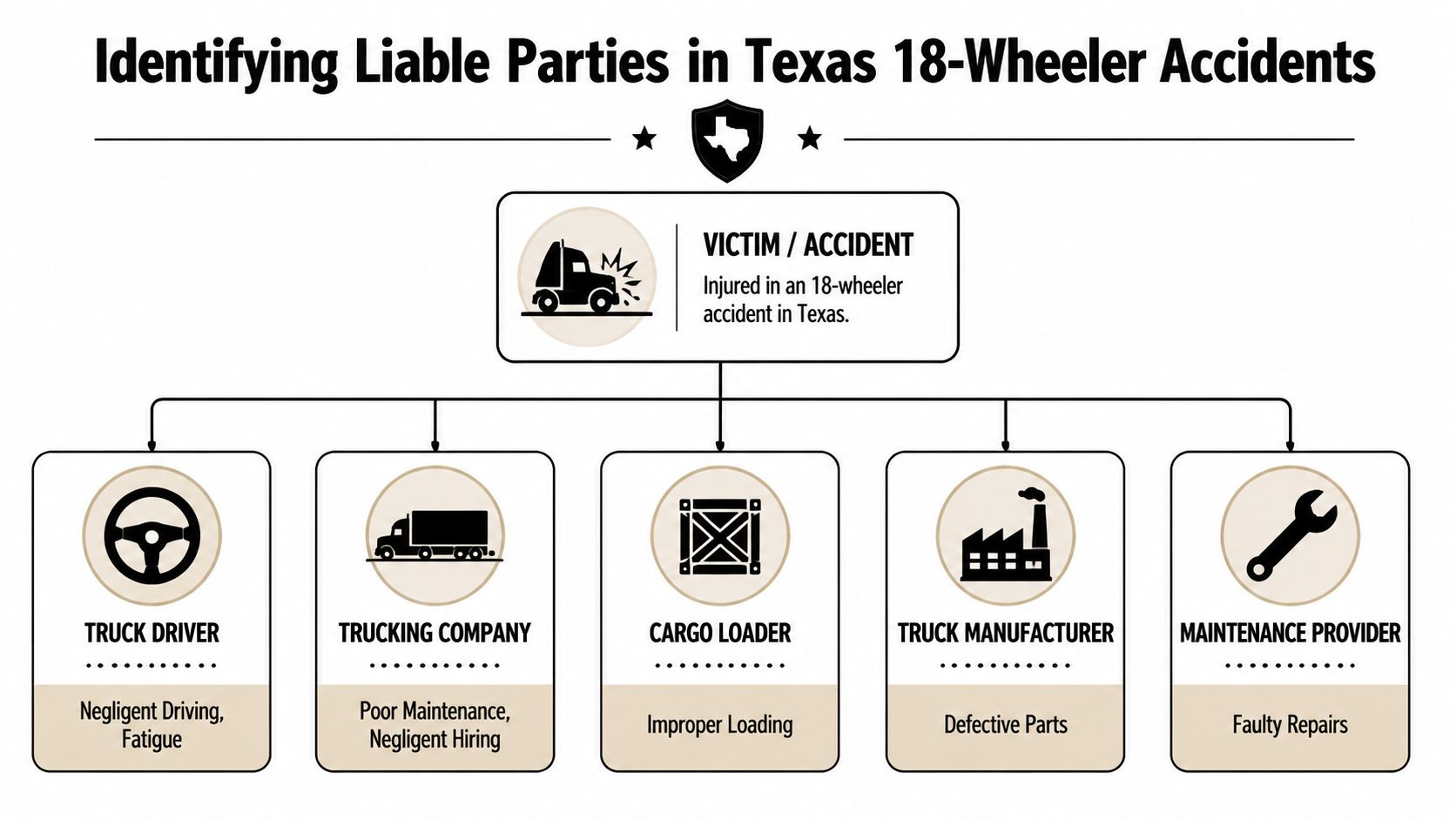
In a regular two-car collision, the answer may seem straightforward. In an 18-wheeler case, fault can be layered. The driver may have made a mistake, but the company, maintenance provider, cargo loader, or manufacturer may also share responsibility.
Why truck cases are rarely simple
A critical nuance often missed is that multiple entities, including the driver, trucking company, cargo loaders, and manufacturers, can be held liable simultaneously. Victims need a lawyer skilled in identifying all parties to maximize compensation, using tools like mandatory accident reports under Texas Transportation Code §550.061 to uncover early evidence of negligence, as discussed in this article on a Houston 18-wheeler accident lawyer.
That matters because each party may hold different records and raise different defenses.
Who may be legally responsible
Here are some common examples:
- Truck driver: Fatigue, distraction, speeding, unsafe lane changes, or failure to brake.
- Trucking company: Negligent hiring, poor supervision, unsafe scheduling, or skipped maintenance.
- Cargo loader: Unbalanced or unsecured cargo that causes a rollover or loss of control.
- Maintenance provider: Faulty repairs, missed inspections, or overlooked brake and tire issues.
- Manufacturer: Defective tires, brakes, steering parts, or other equipment failures.
A truck crash lawyer in Houston should look beyond the police report and ask who controlled the truck, the load, the repairs, and the safety decisions before the wreck.
A real-world example
Take a crash on I-35 near Austin. A trailer swerves, a tire blows, and the truck crosses into another lane. On the surface, it may look like driver error.
But a deeper investigation may show several causes at once. The maintenance company may have installed the wrong tire. The trucking company may have ignored inspection issues. The driver may have kept driving despite warning signs. If cargo was unevenly loaded, that can add another layer.
That's why a thorough investigation matters so much. If you only pursue one party, you may miss key evidence and leave compensation on the table.
For families after a fatal collision, this issue becomes even more important. A wrongful death lawyer Texas families consult should examine every person and business involved, not just the driver named in the crash report.
What Compensation You Can Recover After an 18-Wheeler Crash
After a serious truck wreck, many individuals ask the same practical question. What can I recover?
Texas law allows injured people to seek compensation for losses tied to the crash. That usually includes financial losses, human losses, and, in some cases, extra damages meant to punish especially dangerous conduct.
The main categories of damages
| Damage Type | Description | Example |
|---|---|---|
| Economic damages | Financial losses you can document | Medical bills, lost wages, future care, rehabilitation costs |
| Non-economic damages | Personal losses that don't come with a simple receipt | Pain, emotional distress, physical impairment, loss of normal life |
| Punitive damages | Additional damages that may apply when gross negligence is proven | Cases involving chronic fatigue, falsified logs, or ignored maintenance problems |
If your injuries keep you from returning to work, your claim may include both current lost income and expected future earnings losses. If you need ongoing treatment or assistance at home, those future costs can also become part of the case.
For a deeper plain-English explanation of how these categories work, this guide on economic vs. non-economic damages can help.
How fault can reduce compensation
Texas uses a modified comparative negligence system. In Texas, you are barred from recovering any compensation if you are found to be 51% or more at fault for an accident. This 51% bar rule under Section 33.001 of the Texas Civil Practice and Remedies Code makes fault allocation central to the case, as explained in this discussion of comparative negligence.
Here's what that means in everyday language:
- If you are 50% or less responsible, you can still recover damages.
- Your recovery is reduced by your percentage of fault.
- If you are 51% or more responsible, you recover nothing.
A clear example helps. After a Dallas freeway crash, suppose a jury finds that your losses total $100,000 and that you were 40% at fault. You could still recover $60,000. But if the jury decides you were 52% at fault, you recover $0.
That's why trucking insurers work hard to shift blame onto you early. They may argue you merged unsafely, stopped suddenly, or failed to avoid impact. Your lawyer's job is to challenge weak blame-shifting and support your side with evidence.
The fight over fault is often the fight over value.
What families may recover after a fatal truck crash
When a loved one dies, the case may involve more than one type of claim. A wrongful death claim focuses on losses suffered by surviving family members. A survivor claim is different. It seeks recovery for the person's own pain, suffering, and medical expenses before death.
That distinction matters. It can affect what evidence you gather, what damages are pursued, and how the case is structured. If you're also dealing with vehicle damage questions, this guide to diminished value claims offers useful background on a separate issue that sometimes arises after a serious collision.
If you're speaking with a Houston car accident attorney or truck crash lawyer Houston families trust, ask directly whether both wrongful death and survivor claims may apply in your case.
The Texas Statute of Limitations and Your Claim Timeline
Time can damage a strong case even before a courtroom gets involved. Witnesses forget details. Records disappear. Trucks get repaired. Surveillance footage gets overwritten.
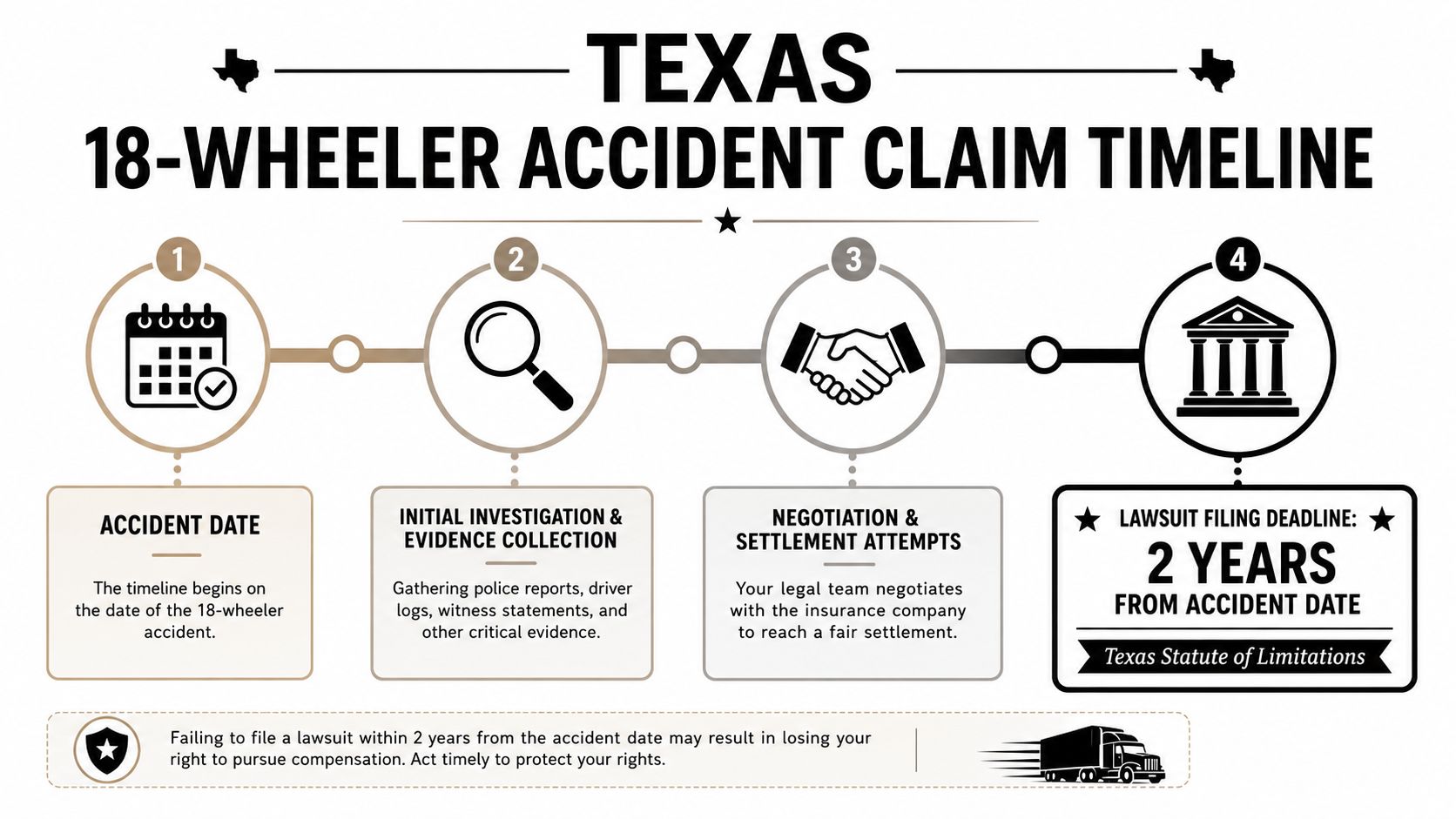
Texas law also imposes a hard filing deadline. Think of it as a countdown clock that usually starts on the date of the crash.
The basic two-year rule
Texas law enforces a strict two-year statute of limitations for most personal injury claims under Section 16.003 of the Texas Civil Practice and Remedies Code. If you do not file your lawsuit within two years from the date of the injury, Texas courts will almost certainly dismiss your case, permanently ending your right to seek compensation, as explained in this overview of Texas negligence laws.
That deadline is easy to underestimate because many people spend the first months after a crash just trying to stabilize their lives. Medical treatment, surgery, grief, and insurance pressure can make legal timing feel secondary. But the court won't pause the deadline because negotiations were ongoing.
If you want a plain-language overview, this resource on the statute of limitations in Texas personal injury cases is worth reading.
Exceptions that sometimes apply
There are limited situations where the timing works differently.
- Minors: If the injured person is under 18, the limitations period may be tolled until adulthood.
- Wrongful death claims: The two-year period generally begins on the date of death, not necessarily the date of the original injury.
These exceptions can be important, but they're not something to assume without legal review. Small timeline mistakes can cost a valid claim.
Waiting feels safe to many people. Legally, it usually isn't.
Why calling early helps
Early action isn't just about the courthouse deadline. It also helps preserve the evidence that gives your case strength.
After a San Antonio truck crash, for instance, a family may spend months dealing with trauma before speaking to counsel. By then, witness memories may be weaker, the vehicle may be gone, and company records may be harder to obtain. That doesn't mean the case is lost, but it often means the path gets steeper.
A Texas personal injury lawyer can help line up the timeline, preserve records, and move the claim forward before delay becomes another obstacle.
How Our Lawyers Investigate and Build a Winning Case
A strong truck accident case doesn't come together by accident. It's built piece by piece, often under pressure, while the trucking company and insurer are already protecting themselves.
The first call usually starts the same way. You tell your story. We listen, identify immediate risks, and look for the evidence that needs to be preserved before it changes hands or disappears.

What happens after you hire counsel
A common pitfall is delaying attorney involvement. Lawyers often act immediately to investigate, gather evidence like black box data, interview witnesses, and coordinate medical care. Truck accident cases are also commonly handled on a contingency fee, typically 33% for pre-trial settlements and 40% for trials, meaning clients usually face no upfront costs while the case is built, as described in this article about truck accident lawyer costs.
That early work may include:
- Sending preservation notices: These letters demand that key evidence be kept.
- Requesting records: Driver logs, maintenance records, employment files, and crash reports may all matter.
- Reviewing onboard data: Electronic data can help show speed, braking, and vehicle movement.
- Interviewing witnesses: Independent witnesses can support details that companies dispute.
- Tracking medical proof: Records must connect the crash to your injuries and treatment.
A case-building example
After a Houston freeway collision, a trucking insurer may say the injured driver caused the wreck by changing lanes too late. But the truck's data may show late braking. The driver's records may reveal fatigue issues. Maintenance files may show overdue repairs.
That's how a case changes shape. What began as a disputed lane-change story can become a broader negligence case against several defendants.
The Law Office of Bryan Fagan, PLLC handles Texas injury matters involving car, truck, wrongful death, and catastrophic injury claims. In a serious truck case, that work often includes reviewing how the crash happened, who may share liability, and what evidence best supports the client's recovery.
Why insurance companies push early settlement
Insurance carriers often move quickly after a major wreck for a reason. They know injured people are vulnerable early.
They may offer a fast settlement before future treatment needs are clear. They may ask for broad medical authorizations. They may frame a recorded statement as routine. It usually isn't routine for you, even if it is routine for them.
If you're also trying to understand insurer tactics in plain language, Dealing With Insurance Companies After a Texas Accident explains how adjusters try to reduce payouts and how to protect your claim.
Your Path to Recovery Starts with a Free Consultation
The days after an 18 wheeler crash often feel like a fog. You may be trying to manage pain, missed work, car damage, and constant calls from insurance adjusters, all while wondering what Texas law allows you to recover.
A free consultation gives you a starting point. It is a chance to sit down with a lawyer, explain what happened, and get clear answers in plain English. You can learn whether the case may involve only the truck driver or a wider group, such as the trucking company, a maintenance contractor, a cargo loader, or another business tied to the wreck. In fatal cases, families can also ask whether both a wrongful death claim and a survival claim should be filed, which can make a real difference in the value and structure of the case.
You also do not need to arrive with a perfect file.
Many people wait because they think they need every record, every bill, and every answer first. That is like refusing to see a doctor until you already know the diagnosis. A consultation is where the fact-finding begins. A lawyer can explain what documents matter, what evidence should be requested quickly, and what mistakes could weaken the claim if an insurer gets ahead of the story.
Cost matters too. Texas truck accident lawyers often handle these cases on a contingency fee, which usually means the fee is paid from a settlement or verdict rather than upfront. For families under financial pressure after a major crash, that arrangement can make legal help realistic instead of out of reach.
If you were hurt in a truck wreck, or your family lost someone in one, it helps to get answers before the filing deadline gets closer and key evidence becomes harder to secure. A Houston car accident attorney, truck crash lawyer Houston families rely on, or wrongful death lawyer Texas families turn to can explain the next steps and help you make informed decisions.
The Law Office of Bryan Fagan, PLLC handles Texas injury matters involving truck accidents, wrongful death claims, and catastrophic injuries. If you were injured in an 18 wheeler crash or lost a loved one in Texas, schedule a free consultation with Law Office of Bryan Fagan, PLLC. You can get clear answers about fault, deadlines, compensation, and whether the facts may support claims against multiple parties or even punitive damages in an extreme case. Help is available, and you do not have to carry this alone.