Skip to content
A serious accident can change your life in seconds, but you don't have to face it alone.
One moment you're finishing a shift, climbing down from a truck, lifting inventory, driving between job sites, or cleaning up as your workday ends. The next, you're in pain, missing work, answering questions from a supervisor, and wondering who will pay for treatment and bills. That confusion is common after a job injury in Texas, especially because your legal path may depend on something most workers never think about before an accident: whether your employer carries workers' compensation coverage at all.
If you're searching for a work injury lawyer Texas workers can trust, you need more than general advice. You need a practical explanation of what applies to your case, what can go wrong, and what steps protect your rights from day one.
Your Life Changed After a Workplace Accident What Now
A warehouse worker in Houston strains his back when a forklift operator turns too sharply. A delivery driver gets hit at an intersection while making a route for work. A refinery contractor suffers burns after equipment fails on site. Different jobs. Different injuries. The same immediate questions follow. Who pays for medical care? Can you sue? Will you lose your job? How do you keep your household afloat while you recover?
Those questions matter because Texas work injury cases don't all follow the same track. Some workers have a workers' compensation claim. Some have a claim against a negligent third party. Others may have a lawsuit against a non-subscriber employer, which means an employer that chose not to carry workers' comp coverage. If you were hurt on the job, that distinction can change the kind of compensation you can seek.
For many people, the hardest part is the first week. Pain sets in. Paperwork starts. Insurance adjusters call quickly. Family members want answers you may not have yet. That's why it helps to start with a clear overview of your options and your deadlines.
You don't need to know every legal rule on day one. You do need to avoid early mistakes that can weaken your claim.
If your injury happened at work, start by learning the basic recovery options for hurt at work cases in Texas. The right path depends on how the accident happened, who caused it, and what coverage applies. A Texas personal injury lawyer can sort that out, but the first step is understanding that you may have more than one possible claim.
Families dealing with fatal job accidents face the same uncertainty, only under much heavier circumstances. In those cases, a wrongful death lawyer Texas families rely on can investigate whether the death involved employer negligence, a third-party failure, unsafe driving, defective equipment, or another preventable cause.
What to Do Immediately After a Work Injury in Texas
The first hours after a workplace accident matter. They matter for your health, and they matter for your claim. Even injuries that seem manageable at first can get worse after the adrenaline fades.
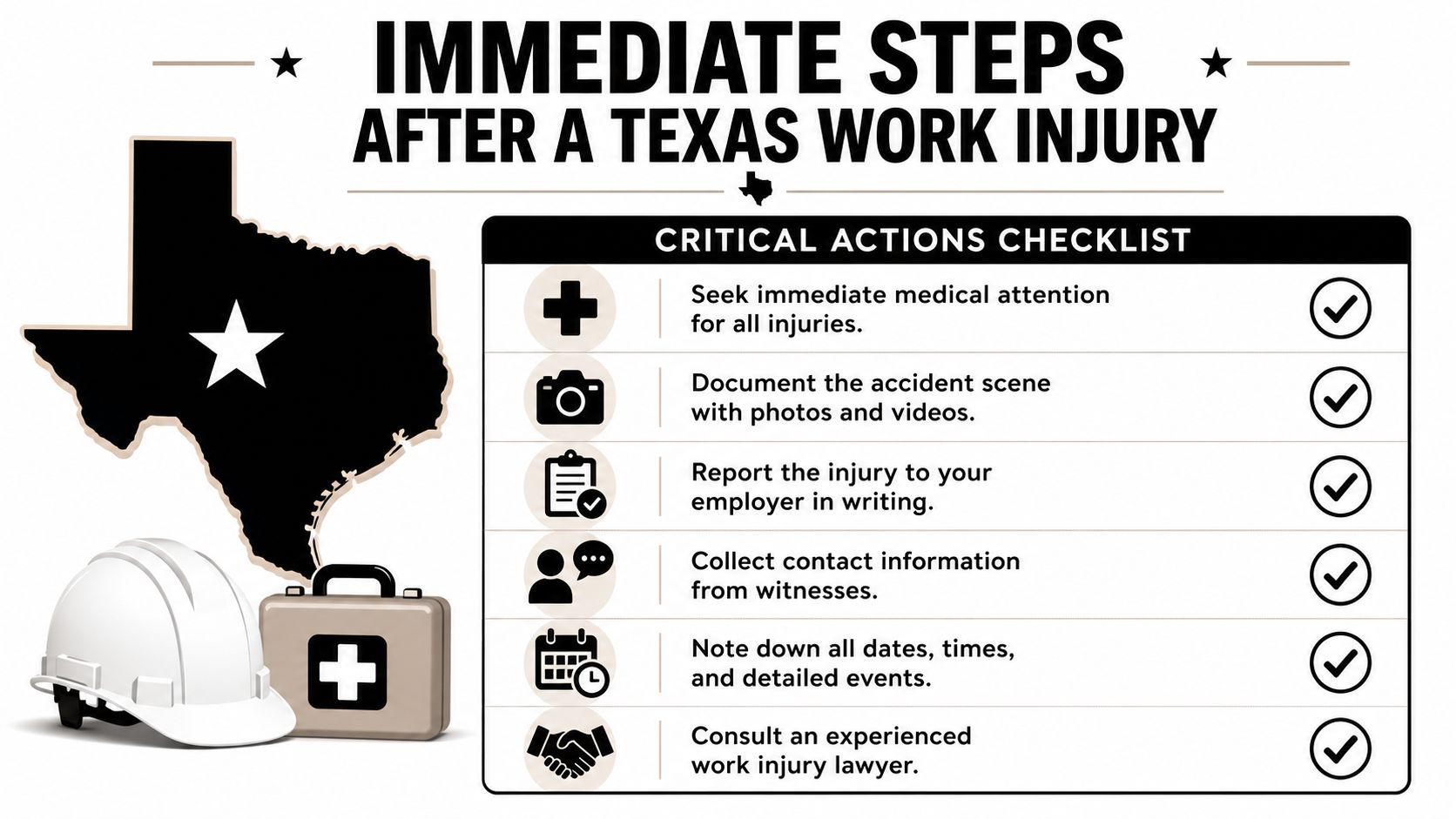
Get medical care and create a record
See a doctor as soon as you can. Tell the provider clearly that the injury happened at work and explain how it happened. If you leave out details or delay treatment, the insurance company may later argue that your injury wasn't serious or wasn't job-related.
Texas also has deadlines you can't ignore. Texas requires injured workers to report their injury to their employer within 30 days of the incident and file formal claims with the Division of Workers' Compensation within one year. Missing these deadlines can jeopardize your right to benefits, as explained by Texas Legal Group's discussion of Texas work injury deadlines.
Put everything in writing
Don't rely on a verbal report to a manager. Send a written report by email, text, incident form, or another method that creates a time-stamped record. Keep a copy.
Use plain facts:
- State when it happened: Include the date and approximate time.
- State where it happened: Name the job site, vehicle, warehouse area, or floor.
- State how it happened: Keep it simple and accurate.
- State what hurts: Mention every body part involved, even if symptoms seem minor.
If you need a broader checklist, review what to do immediately after an accident in Texas. The same habits that help after a car wreck also help after a workplace injury. Fast documentation protects your credibility.
Preserve evidence before it disappears
Job sites change fast. Spills get cleaned. equipment gets moved. Video gets overwritten. Witnesses forget details.
Take these steps if you can do so safely:
- Photograph the scene. Capture equipment, floor conditions, damaged tools, vehicles, warning signs, and visible injuries.
- Get witness information. Names, phone numbers, and job titles help later.
- Keep a symptom journal. Note pain levels, mobility problems, sleep issues, missed workdays, and medical visits.
- Save every document. Hold onto discharge papers, prescriptions, work restrictions, mileage logs, and wage records.
A short overview of Workplace Injury and Third-Party Claims in Texas can also help you understand the recovery options when you're hurt on the job in Texas.
Practical rule: If a document, photo, text message, or email helps explain what happened to you, save it now. It may be harder to get later.
Be careful with insurance conversations
Answer basic questions truthfully, but don't guess, exaggerate, or minimize. If you don't know something, say so. If you're still being evaluated, say that too.
That matters whether your case stays in the workers' comp system or turns into a lawsuit. It also matters if your work injury involved a company vehicle or a roadway collision. In that situation, a Houston car accident attorney or truck crash lawyer Houston workers call after serious commercial crashes may need to examine both the injury claim and the auto liability side of the case.
Workers Comp vs Lawsuit Which Path Is for You
Texas work injury claims confuse people because the word “claim” can mean different things. In practice, there are usually three separate paths after a job injury. The right one depends on who caused the harm and whether the employer subscribed to workers' compensation coverage.
The three paths that matter
A standard workers' compensation claim is usually a no-fault system. You don't have to prove the employer caused the injury, but your trade-off is significant. In most situations, you can't sue the employer, and pain and suffering isn't part of the recovery.
A non-subscriber lawsuit applies when the employer chose not to carry workers' comp. That can open the door to a direct personal injury case against the employer for broader damages, including pain and suffering, if negligence played a role.
A third-party lawsuit is different. Even if your employer carries workers' comp, you may still have a claim against someone else, such as a negligent driver, outside contractor, property owner, or equipment manufacturer.
Texas Work Injury Claims Compared
| Claim Type | Who You Can Sue | Compensation Available | Do You Need to Prove Fault? |
|---|---|---|---|
| Workers' compensation claim | Generally not your subscribing employer | Medical benefits and wage-related benefits under the comp system | No |
| Non-subscriber lawsuit | A non-subscriber employer | Broader personal injury damages, including pain and suffering | Yes |
| Third-party lawsuit | Someone other than your employer who caused the injury | Personal injury damages based on the facts of the case | Yes |
Why non-subscriber status changes everything
Many injured workers assume every Texas employer has workers' comp coverage. That assumption causes people to miss stronger claims.
While 28% of Texas employers are non-subscribers who can be sued directly for full damages, many injured workers are unaware of this option. Non-subscriber claims average $92,000 in compensation compared to just $54,000 for standard workers' comp claims, according to Williams Caputo's overview of Texas non-subscriber work injury claims.
That doesn't mean every lawsuit pays more. It does mean the legal route can affect what categories of damages are even available. If your employer is a non-subscriber, the difference between filing the wrong kind of claim and pursuing the right case can be substantial.
For a side-by-side look at these legal options, see workers' comp vs personal injury claims in Texas.
Real-world examples of how the path changes
After a Houston freeway crash, a technician injured while driving for work may have both a work-related claim and a claim against the at-fault driver. In that situation, a Houston car accident attorney may investigate the traffic collision while the work injury side develops in parallel.
A construction laborer struck by another subcontractor's equipment may have a third-party case even if the direct employer has workers' comp coverage.
A plant employee injured by faulty machinery may have a product-related claim against the manufacturer rather than only a workplace benefits claim.
If you're trying to understand how employer coverage often works on job sites, especially in construction and contracting settings, this contractor insurance requirements guide gives useful background on employer liability coverage and related issues.
The label on your case matters. Workers' comp, non-subscriber, and third-party claims are not interchangeable, and treating them like they are can cost you compensation.
How to Prove Fault and Maximize Your Compensation
When your case involves a non-subscriber employer or a third party, proof drives value. It's not enough to say you got hurt at work. You have to show how another person or company caused it.

The evidence that usually matters most
Strong cases are built with layers of evidence, not one dramatic piece.
A lawyer may gather:
- Accident reports: Internal incident reports, OSHA-related records if available, and vehicle crash reports where applicable.
- Medical records: These link the event to the injury and show how the injury affects your daily life.
- Witness statements: Co-workers, supervisors, drivers, contractors, and bystanders may each hold part of the timeline.
- Photos and video: Surveillance footage, dashcam clips, site photos, and pictures of defective equipment can be decisive.
- Expert review: In serious cases, engineers, medical specialists, or safety experts may help explain what went wrong.
If you want to understand the building blocks of a strong injury case, review what evidence is needed for an injury claim in Texas.
Comparative responsibility can reduce or block recovery
Texas follows modified comparative negligence, also called proportionate responsibility. You can only recover damages if your share of fault is 50% or less. If a jury finds you 51% responsible for the accident, you are barred from receiving any compensation, as explained in Hartley Law's discussion of comparative negligence in Texas.
Here's what that looks like in real life.
A worker slips on an unmarked spill in a loading area. The employer or property operator may argue the spill was open and obvious, or that the worker ignored a safety rule. The worker may answer that the area was poorly lit, no warning signs were posted, and employees were expected to keep moving through the zone. Those details affect fault.
What helps and what hurts
Some choices make a case stronger. Others create problems fast.
- Helpful: Prompt treatment, clear reporting, consistent medical follow-up, and preserved evidence.
- Harmful: Gaps in treatment, changing versions of the story, social media posts that undercut your injuries, and missing witnesses.
- Helpful: Identifying every potentially responsible party early, especially in contractor-heavy workplaces.
- Harmful: Assuming your employer's version of events is final.
A serious injury case often turns on small facts. Which door was locked. Who cleaned the spill. When the machine was last serviced. Whether a supervisor knew about the hazard.
That's why a Texas personal injury lawyer should treat workplace cases like investigations, not paperwork exercises. The goal isn't just to prove you got hurt. The goal is to prove why the law requires someone else to pay.
How an Experienced Attorney Makes a Difference
The right lawyer changes the direction of a work injury case early, often before the insurance company or employer defines the story for you. In Texas, that matters because the first question is not just how you were hurt. It is which legal path applies.

A lawyer checks the issue most workers miss
I look at one issue right away. Is the employer a workers' comp subscriber or a non-subscriber?
That answer shapes almost everything that follows. A workers' comp claim usually limits what can be recovered, while a non-subscriber case may open the door to damages that workers' comp does not pay, including pain and suffering. If another company, driver, contractor, or manufacturer played a role, a third-party claim may need to be built at the same time.
That is the part injured workers are rarely told clearly. They may assume every job injury goes through the same system. In Texas, it does not.
Roadway cases are a good example. If you were hurt while driving for work, the case may involve both a work injury claim and an auto liability case. A lawyer needs to identify that overlap early so evidence is not lost and the wrong claim is not filed first.
A lawyer builds the case before the defense does
Defense lawyers and adjusters start working quickly. They gather statements, search for policy defenses, and look for ways to shift blame to the worker.
Texas law does not treat shared fault as automatic. Comparative negligence is an affirmative defense, which means the defendant must raise it and prove it, as explained in Crosley Law's discussion of shared fault defenses in Texas injury cases.
A good attorney answers that defense with facts. Maintenance records. training logs. Witness interviews. Phone data. Video footage. Prior incident reports. In serious cases, those details often decide whether the injury gets dismissed as "worker error" or recognized as the result of unsafe conditions, poor supervision, or a preventable equipment failure.
Small details carry real weight in workplace litigation. Who controlled the area. Who knew about the hazard. Who had the authority to fix it. Those facts often matter more than the first accusation made after the accident.
The Law Office of Bryan Fagan, PLLC handles Texas personal injury matters involving serious injuries, including workplace accidents and vehicle-related injury cases. In a work injury case, legal counsel can help investigate liability, preserve evidence, and handle communications with insurers and defense attorneys.
Here's a short video that gives more context on injury representation and what early legal guidance can do for a case:
Lawyers also manage the pressure points
Serious injuries create legal problems and financial pressure at the same time. You may be out of work, still treating, and getting calls from an adjuster who wants a recorded statement before you understand your options.
An attorney helps by:
- Handling communications: This reduces the risk of offhand statements being used against you later.
- Valuing the full case: That includes medical care, lost income, reduced earning capacity, and, in non-subscriber or third-party cases, damages such as pain and suffering when the law allows them.
- Preserving evidence early: Video, vehicle data, inspection records, and witness accounts are easier to get at the beginning than months later.
- Preparing for suit from day one: Cases settle better when the other side sees that the file is ready for court.
- Coordinating overlapping claims: Some injured workers have a work injury case, an auto claim, and a third-party negligence claim at the same time.
If you're dealing with claim delays or pushback from an insurer in a vehicle-related case, this guide for drivers facing insurance claim denial gives practical context on how claim disputes often unfold.
That broader legal approach matters even more in catastrophic injury and fatal accident cases. Families may be dealing with long-term care planning, lost household income, probate issues, and multiple defendants, all while trying to keep up with medical decisions and deadlines. An experienced Texas work injury lawyer helps put those moving pieces in order and keeps the case focused on the recovery the law allows.
You Don't Have to Face This Alone Your Path to Recovery Starts Here
If you've made it this far, you already know the main truth about Texas work injury cases. The path to compensation isn't automatic, and it isn't always obvious. A workers' comp claim, a non-subscriber lawsuit, and a third-party case can lead to very different outcomes. Choosing the right path early can affect what medical care gets paid, whether pain and suffering is available, and how much evidence needs to be developed.
You also shouldn't feel isolated in what you're going through. In 2022, Texas private industry employers reported 178,800 total recordable nonfatal workplace injury and illness cases, representing an incidence rate of 1.9 cases per 100 equivalent full-time workers. Past third-party work injury lawsuits resulted in average awards of $464,000, according to the Texas Department of Insurance workplace injury report. Outcomes vary, but those numbers show two important things. Work injuries are common, and the financial stakes can be significant.
When to call a lawyer
Call a lawyer quickly if any of these apply:
- Your employer says there's no coverage or gives unclear answers
- A third party may have caused the injury
- You're being blamed for the accident
- Your injuries are severe, permanent, or life-changing
- A loved one died in a workplace incident
- The accident involved a company vehicle or commercial truck
People in these situations often need more than a basic claim form. They need a Texas personal injury lawyer who can identify every source of recovery, whether that includes a workplace case, a Houston car accident attorney review, a truck crash lawyer Houston investigation, a catastrophic injury claim, or support for a wrongful death lawyer Texas case.
Recovery is possible. Legal help is available. And you don't have to figure it out by yourself while you're trying to heal.
If you were hurt on the job or lost a loved one in a workplace accident, contact Law Office of Bryan Fagan, PLLC to schedule a free consultation. You can get clear answers about workers' compensation, non-subscriber claims, third-party lawsuits, and related personal injury issues involving car crashes, truck wrecks, catastrophic injuries, and wrongful death. There's no obligation, and you pay no fees unless the firm wins your case. The right legal plan can protect your future, and help is available when you're ready.