Skip to content
A serious accident can change your life in seconds, but you don't have to face it alone.
If you're reading this after a fender-bender in Houston, Dallas, Austin, or somewhere else in Texas, your question is probably simple: Should I go to a doctor after a minor car accident? In most cases, yes. Even a crash that looks minor can leave you with injuries that don't show up right away, and waiting can make both your recovery and your insurance claim harder.
People often leave the scene saying, “I'm okay.” Then the stiffness starts later. A headache shows up that night. The next morning, turning your neck hurts. That's common. It's also one reason this issue matters so much in personal injury law.
Your First Question After a Minor Texas Car Accident
Right after a minor wreck, you might be shaken, busy, and trying to get home. You may be checking your bumper, talking to police, swapping insurance information, and wondering whether going to urgent care would be overreacting.
It usually isn't.

A minor crash can still jolt your neck, back, shoulders, knees, or head. Some people feel soreness in the foot or ankle from bracing at impact. If that becomes part of your recovery, this resource on effective physical therapy for foot gives practical examples of how targeted rehab can help after injury.
What matters most in the first hours
The first goal is your health. The second is protecting the facts before they start getting blurry.
Here's the practical approach:
- Get medically checked if anything feels off: Pain, dizziness, headache, stiffness, numbness, or confusion all justify a prompt evaluation.
- Don't rely on vehicle damage alone: A car can have limited visible damage while your body still absorbed force.
- Start documenting early: Save photos, exchange information, and keep notes about how you feel as the day goes on.
- Review the immediate steps Texans should take: This guide on what to do immediately after an accident in Texas helps you organize the first day after a crash.
Practical rule: If you're asking whether you should get checked, that usually means you should.
The question “should I go to doctor after minor car accident Texas” stops being a search query and becomes a real decision with health and legal consequences. The good news is that the next steps are straightforward when you know what to do.
Why Feeling Fine Can Be Dangerously Misleading
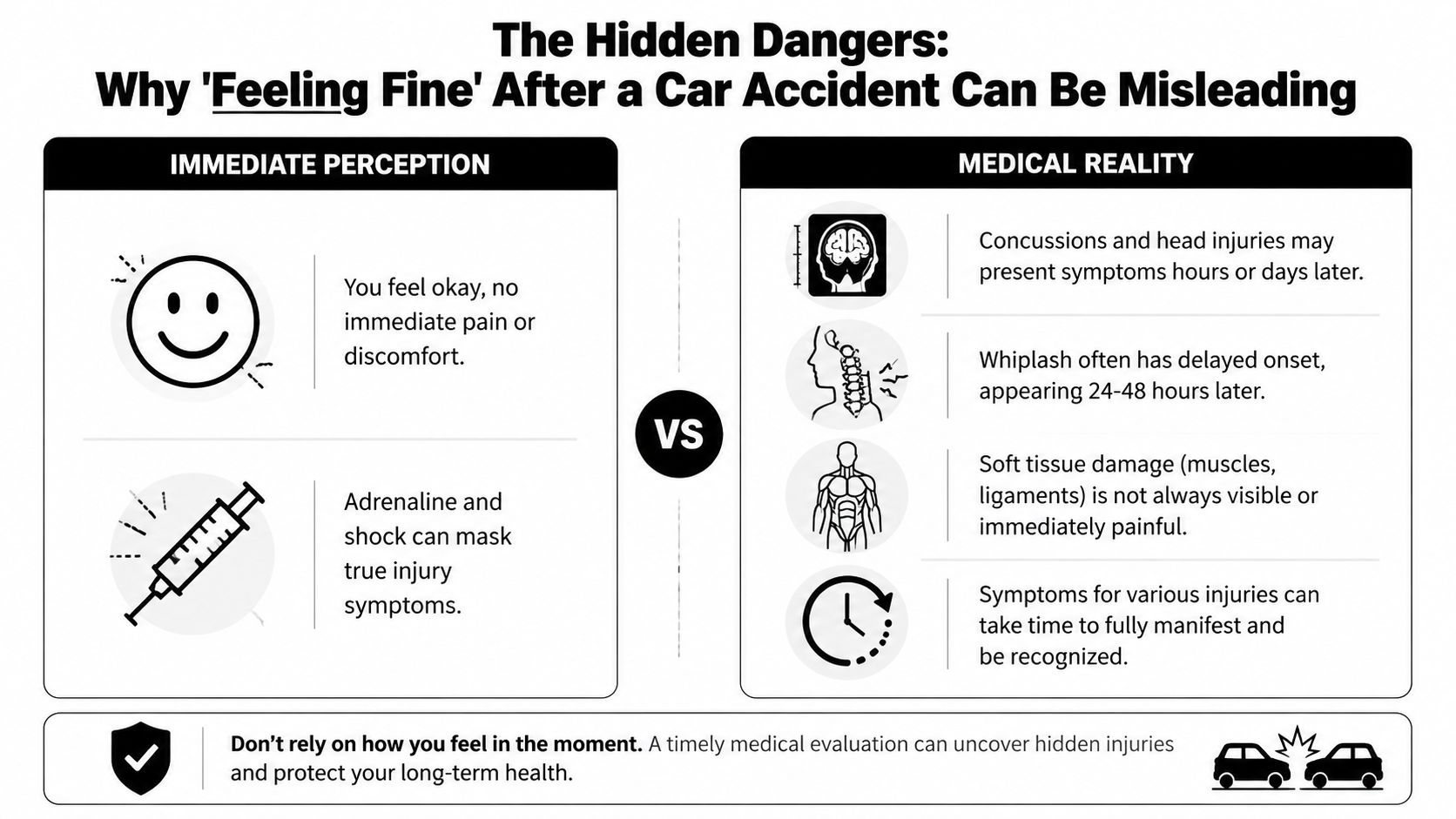
After a crash, your body can mask pain. That's why “I felt okay at the scene” doesn't always mean you escaped injury.
A common Texas example goes like this. You're rear-ended in slow traffic on I-45. You step out, inspect the cars, and tell everyone you're fine. By bedtime, your shoulders feel tight. The next morning, you can't turn your neck without pain.
Injuries that often show up later
Several crash injuries can be delayed or easy to dismiss at first:
- Whiplash and neck strain: You may feel only mild tightness at first, then develop sharper pain and limited motion later.
- Soft-tissue injuries: Muscles, tendons, and ligaments can be injured without obvious bruising or immediate severe pain.
- Concussion symptoms: Headaches, light sensitivity, dizziness, brain fog, or nausea can appear after the initial shock wears off.
- Back pain and nerve irritation: Tingling, numbness, or pain shooting into an arm or leg may not start right away.
What works and what doesn't
What works is getting evaluated by a medical professional and paying attention to symptom changes over the next day or two.
What doesn't work is self-diagnosing based on how you felt in the parking lot.
If your symptoms are mostly in the neck and shoulders, this guide to relieving neck and shoulder discomfort may be useful later in recovery, after you've been properly evaluated and know what you're dealing with.
Feeling “mostly okay” after impact is not the same thing as being medically cleared.
Why minor crashes still matter
People often associate serious injury with dramatic wrecks. In practice, some of the most disputed claims come from low-speed collisions because the injured person waited, assumed it was nothing, and lost the chance to create an early medical record.
That's why a minor crash deserves respect. Not panic. Just respect.
How a Medical Visit Protects Your Texas Legal Rights
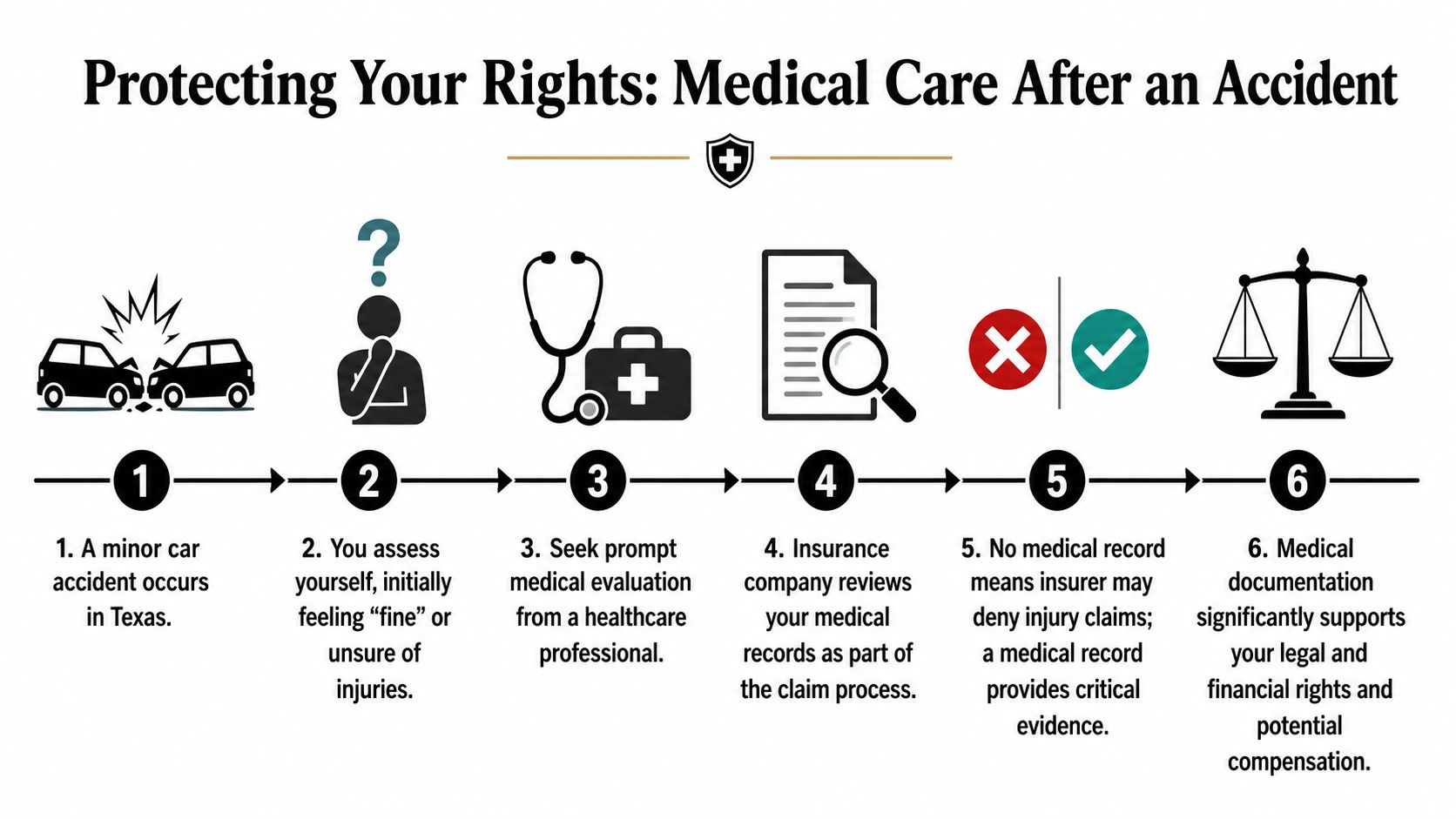
A doctor's visit does more than identify injuries. It creates a timestamp. In injury claims, that timing can make the difference between a clear case and a disputed one.
Texas accident guidance often treats within 72 hours as an important benchmark for getting evaluated after a crash, even if symptoms seem mild, because insurers and courts may see that as a reasonable window for connecting the injury to the collision. Texas personal injury claims also generally have a 2-year statute of limitations from the date of the accident. Early care matters for both your health and preserving the claim, as noted in this discussion of post-crash medical timing in Texas.
Why insurance companies care about delay
Insurance adjusters look for gaps. If there's no prompt evaluation, they often argue one of three things:
- The crash didn't cause the injury
- The injury wasn't serious enough to need treatment
- Something else happened later
That's the true legal value of the appointment. It gives your claim a starting point grounded in records, symptoms, provider notes, and follow-up recommendations.
A strong claim usually begins with evidence needed for a Texas injury claim such as records, photos, and other documents that support causation and damages. Medical records are usually the center of that file.
Texas law moves fast after a crash
Timing matters in more than one way. If police don't complete the crash report at the scene, Texas law requires the driver to file a written crash report within 10 days when the wreck causes injury or more than $1,000 in property damage. Many auto insurance policies also require notice within 24 to 72 hours, and missing that window can complicate coverage, rental benefits, or medical-payment issues, according to this Texas accident guidance.
That doesn't mean every missed step destroys a claim. It does mean delay creates avoidable problems.
Here's a simple comparison:
| Situation | How insurers often respond |
|---|---|
| You get checked promptly and describe your symptoms clearly | They have a harder time arguing the injury came from somewhere else |
| You wait and seek care only after pain becomes severe | They may question causation and seriousness |
| You start treatment but don't follow through | They may argue you recovered quickly or weren't badly hurt |
Later in the process, this overview can help reinforce why the medical timeline matters:
Texas fault and negligence still matter
Texas follows a fault-based system. That means the person who caused the crash, and usually that driver's insurer, may be responsible for the harm that follows. To recover compensation, you generally need to show negligence caused the collision and your injuries flowed from it.
That's why prompt treatment is so powerful. It helps connect the wreck to the injury in a way that's much harder to dispute later.
What to Say and Do at Your Medical Appointment
Once you're in the exam room, be accurate and complete. This is not the time to tough it out, minimize symptoms, or guess at what happened.
Your job is simple. Tell the doctor this was from a car accident, describe every symptom accurately, and explain when each one started.

What to say
Use plain, factual language:
- Describe all symptoms: Neck stiffness, headache, dizziness, shoulder pain, low-back pain, numbness, trouble sleeping, or concentration problems.
- Explain progression: Say whether the symptom started right away, later that day, or the next morning.
- Identify body areas clearly: Don't just say “I'm sore.” Point to the exact places that hurt.
- Mention functional limits: If you can't lift, turn your head, sit comfortably, drive normally, or work without pain, say so.
Don't downplay symptoms to sound tough. Doctors can only document what you report and what they observe.
What not to say
Keep fault discussions out of the medical visit unless the doctor specifically asks for basic context. The visit is for diagnosis and treatment, not a debate over who caused the wreck.
Avoid these mistakes:
- Guessing about injuries: Don't diagnose yourself.
- Speculating about fault: Don't volunteer legal opinions.
- Minimizing pain: “It's probably nothing” can become part of the record.
- Skipping follow-up care: Inconsistent treatment can weaken both recovery and credibility.
Texas guidance on preserving evidence emphasizes that stronger claims come from a clean medical timeline, including symptom notes, an early first visit, and follow-up care that fits the injury pattern. It also stresses collecting police reports, photos, witness contacts, and medical records and bills, as explained by the Texas Department of Insurance wreck guidance.
What works after the first appointment
A good post-visit routine looks like this:
- Follow the treatment plan
- Keep every bill, receipt, and visit summary
- Write down symptom changes
- Attend follow-ups on time
- Tell your provider if pain spreads or gets worse
That consistency matters. In my experience, people run into trouble when they go once, feel busy, and stop. If you need physical therapy, imaging, specialist care, or additional visits, follow through unless a doctor changes the plan.
When to Call a Texas Personal Injury Lawyer
A doctor diagnoses the injury. A lawyer protects the claim.
If the other driver's insurer is calling, if fault is being disputed, if your symptoms are growing, or if you're missing work, it's smart to speak with a Texas personal injury lawyer early. A Houston car accident attorney can help gather records, organize deadlines, and deal with the insurance company while you focus on treatment.
Situations where legal help matters most
You should strongly consider calling a lawyer if:
- The insurer is pushing for a recorded statement
- You were blamed, even partly, for the crash
- Your injuries are affecting work or daily life
- There are multiple vehicles or conflicting stories
- A family member suffered severe harm or a fatal injury
That last category may require a very different case approach, including help from a wrongful death lawyer Texas families can turn to when a crash becomes fatal. If the wreck involved a commercial vehicle, a truck crash lawyer Houston accident victims consult will often look at driver logs, company records, and other evidence that doesn't exist in a standard two-car claim.
Comparative responsibility in plain English
Texas uses a comparative responsibility rule. In practical terms, your compensation can be reduced if you share fault, and if your share of responsibility is too high, you can lose the right to recover at all.
That's one reason unrepresented people get pressured into harmful statements. A casual comment like “I didn't see him” or “maybe I stopped short” can be used later in ways you didn't expect.
A legal consultation isn't about filing a lawsuit that day. It's about finding out what not to say, what to preserve, and what your case may actually require.
Choosing help that fits your case
Not every case needs the same level of involvement. Some people mainly need guidance on records and insurer communication. Others need full representation. If you're weighing options, this guide on how to pick a personal injury attorney gives practical criteria to use.
The Law Office of Bryan Fagan, PLLC handles Texas injury matters involving car crashes, truck wrecks, catastrophic injuries, and wrongful death claims. For many injured drivers, the essential value of counsel is early damage control. That includes keeping the claim organized, preserving proof, and preventing avoidable mistakes before they become expensive ones.
You Don't Have to Face This Recovery Alone
If you've been asking whether you should go to a doctor after a minor car accident in Texas, the safest answer is usually yes. It protects your health first. It also protects your ability to show what the crash caused.
A “minor” wreck can still produce real pain, delayed symptoms, and weeks of disruption. Getting checked early, following treatment, and being careful with insurance communication can make a major difference in what happens next.
You don't need to have everything figured out today. You just need to take the next right step.
Recovery is possible. Answers are available. And if the insurance company starts making things harder than they should be, legal help is there when you need it.
If you were hurt in a crash and need clear guidance on what to do next, schedule a free consultation with the Law Office of Bryan Fagan, PLLC. You can talk through your accident, your medical treatment, and your options with no obligation. If you're dealing with a car wreck, truck collision, catastrophic injury, or a fatal crash involving a loved one, the firm can help you understand your rights and the next steps under Texas law.