Skip to content
A serious accident can change your life in seconds, but you don't have to face it alone.
If you're searching for answers after a pile-up on a Texas freeway, you're probably dealing with more than a damaged vehicle. You may be hurting, missing work, fielding calls from insurance adjusters, and trying to figure out who caused the crash. In a multi vehicle accident in Texas, who is at fault isn't always obvious at the scene. What felt clear in the moment can look very different once police reports, witness statements, vehicle damage, and video footage are reviewed.
That's especially true after chain-reaction wrecks on roads like I-45, I-10, or the Dallas North Tollway. One driver may have started the crash, but another driver may have made it worse by following too closely or failing to brake in time. Texas law allows fault to be shared, and that can directly affect whether you recover compensation at all.
You Are Not Alone After a Multi-Vehicle Crash
After a Houston freeway crash, many people tell me the same thing. They remember the first impact, then another hit from behind, then horns, smoke, and people stepping out of cars asking what happened. In those first few minutes, most injured drivers have no idea how many vehicles were involved or whose insurance will end up paying.
That confusion is normal.
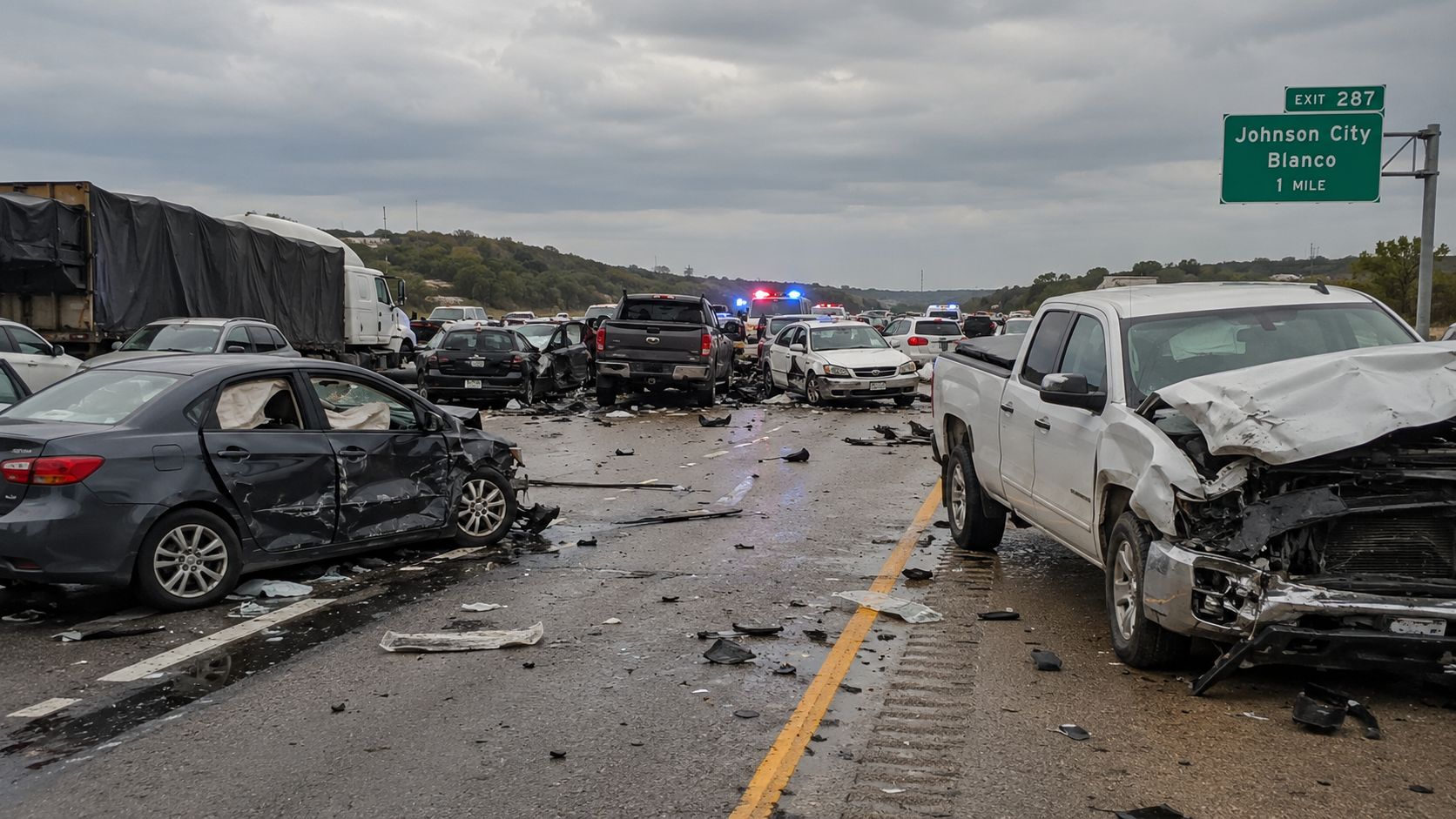
A multi-vehicle collision creates layers of uncertainty. You may know the driver behind you hit your car, but you may not know whether that driver was pushed forward by someone else. You may believe the first driver caused everything, only to learn later that several drivers may share responsibility. When injuries are serious, the stress gets heavier fast.
Why these cases feel so overwhelming
Unlike a simple two-car collision, a pile-up creates competing stories from several people at once. One driver blames the lead car for braking suddenly. Another says traffic was already stopping. A third insists they were hit from behind and had no chance to avoid the crash.
That's why these cases often turn on details that don't seem important at first, such as:
- The order of impacts
- Where each vehicle came to rest
- Whether anyone changed lanes suddenly
- Whether a driver was tailgating or distracted
- What nearby witnesses or cameras captured
When you're injured, you shouldn't have to solve the crash reconstruction puzzle by yourself.
You can still get clear answers
Texas law has a framework for sorting this out. Fault can be divided. Evidence matters. Insurance companies don't get the final word just because they say you were partly to blame.
If you lost a loved one in a chain-reaction wreck, these same questions matter in a wrongful death lawyer Texas case. If a commercial vehicle was involved, the legal analysis can become even more complex, which is why many families also look for a truck crash lawyer Houston residents can turn to for help with evidence and insurer disputes.
The good news is that chaos at the scene doesn't mean your case is hopeless. It means the facts have to be gathered carefully and presented clearly.
The 51 Percent Rule How Texas Law Defines Fault
After a pile-up, people often ask one urgent question: if several drivers were involved, can I still recover if I made some mistake too?
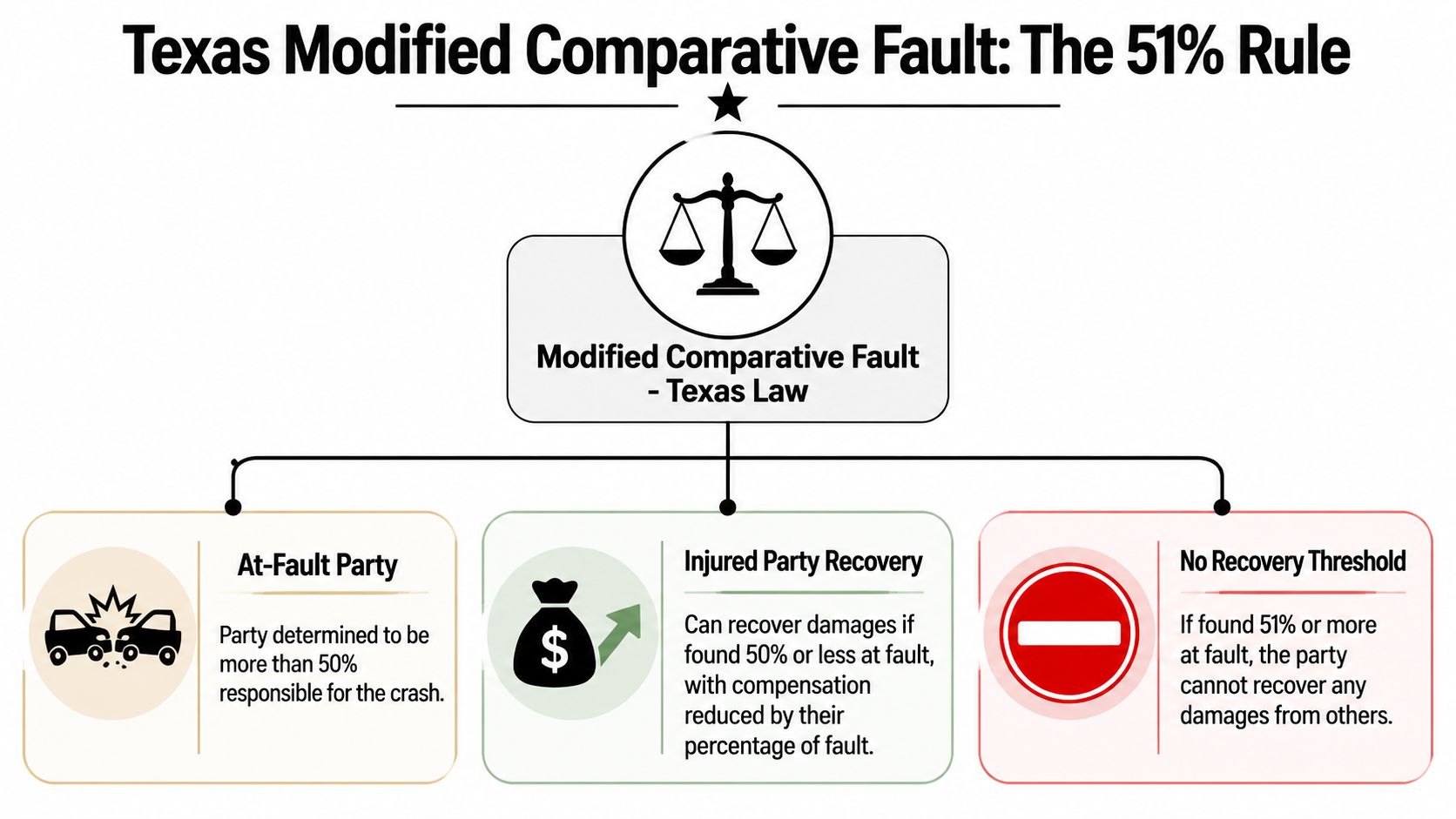
In Texas, the answer is often yes. Texas follows a modified comparative fault rule. That means blame can be divided among multiple drivers, and your compensation is usually reduced by your percentage of fault. If you are more than 50% responsible, you generally cannot recover damages from the other at-fault parties.
A simple example helps. If your damages are valued at $100,000 and you are found 30% at fault, your recovery would usually be reduced to $70,000.
What the rule means in everyday terms
Fault in a multi-car crash works like dividing a bill at dinner. One person may owe the biggest share, but others may still owe part of it if their choices contributed to the outcome.
That is why Texas law does not stop at identifying the first car that hit someone. It asks a second question that matters just as much: how did each driver's conduct contribute to the chain of events? Speeding, following too closely, distracted driving, unsafe lane changes, and failing to react reasonably can all affect the percentages assigned.
If you want a clearer picture of the evidence used in that process, this guide on how to prove fault in a Texas car accident case explains the types of proof that can support or weaken a liability argument.
| Fault finding | What it usually means for your claim |
|---|---|
| You are 50% or less at fault | You may still recover damages, reduced by your percentage of responsibility |
| You are more than 50% at fault | You're generally barred from recovering damages from others |
Why the 51% line matters so much in a pile-up
This rule matters because percentage points are not abstract. They directly affect money.
In a chain-reaction crash, insurers often argue over small shifts in blame because each shift changes what they may have to pay. A driver who is 20% at fault may still recover a substantial part of a claim. A driver pushed above 50% may recover nothing. For that reason, these cases often turn into disputes about judgment calls such as whether you left enough following distance, whether you braked reasonably, or whether you could have avoided a secondary impact.
That is also why a quick statement at the scene can create problems later. Saying "I should have seen it sooner" may sound polite or honest in the moment. An insurance adjuster may later treat that as an admission that your share of fault should be increased.
The rule is simple on paper, but harder in real crashes
Many people hear the 51% rule and assume the process is mechanical. It is not. In a three-car or six-car wreck, fault percentages are assigned after people argue about what happened, in what order it happened, and whether each driver had a fair chance to avoid the collision.
That distinction matters. The legal rule itself is short. Applying it to a pile-up is where the fight begins.
Texas also requires minimum liability coverage, and those limits can become strained when several injured people are making claims from the same crash. So even when fault appears fairly clear, there may still be disputes over who pays what and how much coverage is available.
If you are trying to understand multi vehicle accident Texas who is at fault, start with this principle: your case does not rise or fall only on who hit whom first. It often depends on how blame is divided, who is trying to shift that blame, and whether the evidence keeps your percentage below the 51% cutoff.
Untangling the Chaos How Fault Is Proven in a Pile-Up
Knowing the rule is one thing. Proving fault is where these cases are won or lost.
In Texas multi-vehicle crashes, fault isn't assigned by counting which car hit which. Investigators look at the sequence of impacts, traffic-law violations, witness statements, police reports, and sometimes accident reconstruction to estimate each driver's percentage of responsibility, as explained in this discussion of Texas multi-vehicle accident liability.
The first impact is important, but it isn't everything
Suppose traffic is slowing on I-45. Car A brakes. Car B rear-ends Car A. Car C then slams into Car B because Car C was following too closely. Car D changes lanes late and clips the side of the wreckage.
In that example, Car B may have triggered the first collision. But that doesn't automatically mean Car B pays for every injury and every vehicle. Investigators will ask separate questions about each driver's conduct.
- Car B may be blamed for failing to stop in time.
- Car C may carry fault for tailgating or not reacting reasonably.
- Car D may share blame if an unsafe lane change worsened the crash.
That's the heart of comparative negligence. Several bad decisions can combine into one event.
What evidence usually matters most
A strong fault analysis usually starts with the physical evidence. Vehicle damage patterns often tell a story. Front-end crush damage, rear-end damage, side-swipe markings, paint transfer, debris location, and final resting positions can help show who struck first and how the crash spread.
The most useful evidence often includes:
- Police reports that document the scene, involved drivers, and initial observations
- Witness statements from people who saw the sequence unfold
- Scene photos and video showing traffic lanes, skid marks, debris, and weather conditions
- Dashcam or surveillance footage that captures lane changes, braking, or impact order
- Vehicle inspections that help identify direction and force of impact
If you want a closer look at how lawyers build that proof, this guide on how to prove fault in a Texas car accident gives a useful overview.
A rear-end hit doesn't always end the analysis. The real question is why it happened and whether another driver's conduct set it in motion.
Why later drivers can still be liable
Many people assume the first negligent driver automatically bears all responsibility. Sometimes that's close to true. Often it isn't.
A later driver can still be assigned a meaningful share of fault if they were speeding, following too closely, distracted, or failed to brake when a reasonably careful driver could have reduced the harm. This often surprises people in chain-reaction crashes because they see the event as one single wreck. Legally, it may be one event with several separate acts of negligence inside it.
When reconstruction becomes necessary
Some pile-ups are too complex to sort out by memory alone. Drivers are shaken. Witnesses disagree. The police report may be incomplete. In those cases, attorneys may rely on deeper technical review.
That can involve:
| Evidence question | Why it matters |
|---|---|
| Which impact came first | Helps identify the initiating event |
| Could a later driver have avoided impact | Supports or weakens a negligence claim |
| Did a traffic-law violation occur | Connects conduct to fault |
| Did the force of later impacts worsen injuries | Can affect which party owes for which losses |
This is why preserving photos, dashcam footage, and vehicle-position evidence matters so much. The more clearly you can show the chain of events, the harder it is for an insurer to assign fault based on guesswork.
Your First Steps Protecting Your Rights After a Crash
The hours after a pile-up can shape the rest of your claim. Texas roads see constant collision investigations. In 2024, Texas recorded 4,150 traffic deaths and 251,977 injuries, with a crash occurring about every 57 seconds, according to Texas crash statistics summarized here. In that environment, early evidence collection matters.
What to do at the scene if you can
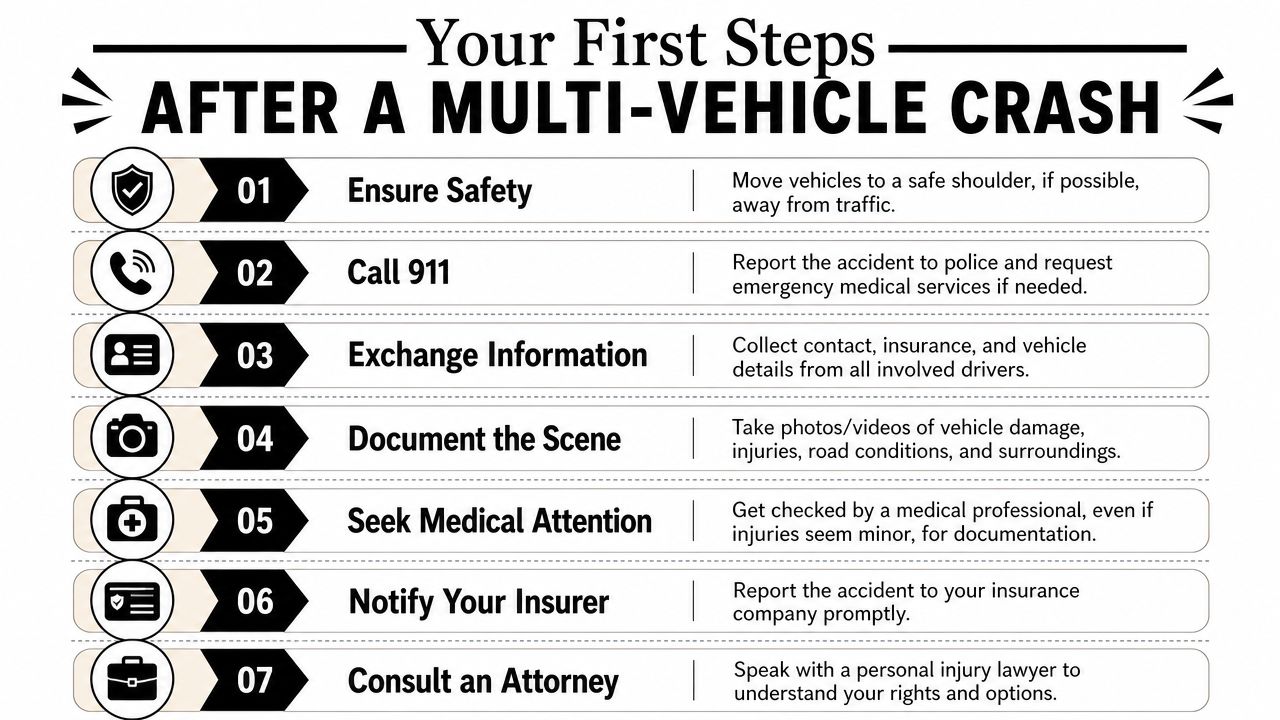
If you're physically able, focus on safety first. Then start preserving the facts before vehicles are moved and memories begin to change.
- Get to safety. If the vehicles can be moved safely, get out of active traffic.
- Call 911. Ask for police and medical help if anyone may be hurt.
- Identify everyone involved. In a multi-vehicle crash, don't stop with the driver who hit you directly.
- Photograph broadly. Take wide shots and close-ups. Capture all vehicles, plate numbers, lane positions, damage, debris, traffic signs, and road conditions.
- Get witness contact information. Independent witnesses can make a major difference when drivers give conflicting stories.
- Seek medical care. Even if you think you're “just sore,” documentation matters.
- Report the crash to your insurer. Keep it factual and brief.
For a more detailed checklist, this resource on what to do immediately after an accident in Texas can help you stay organized.
A short video can also help you think through those first decisions:
What not to say
You don't need to argue with other drivers at the scene. You also don't need to guess about speed, timing, or fault.
Avoid statements like:
- “I'm sorry, this was my fault.”
- “I didn't see them at all.”
- “I'm fine.”
- “Maybe I stopped too fast.”
Those comments may be incomplete, but insurers can still use them against you later.
Say what happened as you know it. Don't fill in blanks, and don't accept blame just to be polite.
Don't lose track of deadlines
Texas injury claims are controlled by filing deadlines, and waiting too long can damage or even end a case. If you want a broader reference point, this essential guide for PI firms gives a helpful overview of how personal injury filing deadlines vary by state. In Texas, you should speak with a Texas personal injury lawyer as soon as possible so evidence can be preserved and deadline issues can be reviewed early.
If your crash involved a fatality, catastrophic injury, or a commercial vehicle, that urgency increases. A Houston car accident attorney can help secure photos, vehicle data, and witness statements before they disappear.
Navigating Multiple Insurers and Uninsured Drivers
A pile-up claim often turns into a second collision, this time between insurance companies.
One adjuster says their driver was only involved in the final impact. Another says your injuries came from a different vehicle. A third may argue you had enough time to avoid the crash. In a multi-vehicle accident, fault is not assigned in one clean step. It is pieced together across several impacts, several policies, and sometimes several competing versions of the same few seconds.
That is why these cases feel so frustrating. You are not just dealing with the question of who caused the wreck. You are also dealing with who pays for which part of the harm.
Why fault disputes get harder when several insurers are involved
In a two-car crash, one insurer may accept liability and argue only about the value of the claim. In a chain-reaction crash, each carrier has a reason to shrink its driver's role.
Fault percentages work a lot like slices of a pie. If one insurer can reduce its driver's share from 40% to 20%, that can change how much it may owe. The fight is often not only about the first hit. It can also involve later impacts, worsening injuries, and whether one driver's conduct started the chain while another driver made it worse.
That is why you may hear different arguments at the same time:
- “Our driver did not cause the first collision.”
- “Your injuries were caused by the vehicle behind you, not ours.”
- “You were following too closely or stopped too suddenly.”
- “Another driver with little or no coverage is the primary problem.”
Each argument is aimed at the same goal. Limit what that insurer has to pay.
Problems that show up again and again
Certain issues are common in Texas pile-up claims:
- Blame shifting between carriers. Each company points to another driver as the main cause.
- Low policy limits. Serious injuries can exceed the coverage available under one policy.
- Uninsured or underinsured drivers. One missing policy can leave a gap in recovery.
- Inflated fault allegations against you. A small change in percentage can have a large effect on your claim.
If that last point sounds abstract, here is the practical version. An insurer may not need to prove you caused most of the crash to gain an advantage. It may only need enough evidence, or enough pressure, to push your share of fault higher than the facts support.
Your own policy may become part of the solution
Many clients are surprised to learn that their own insurance can matter even when another driver clearly caused part of the wreck.
If one at-fault driver has no insurance, or not enough insurance, your policy may provide another path through uninsured or underinsured motorist coverage. If you want a plain-English explanation, this guide to uninsured and underinsured motorist coverage in Texas breaks down how that coverage may apply.
This does not mean your insurer automatically agrees with you. Your own carrier may still review fault, medical records, and the sequence of impacts with a careful eye. But that coverage can be an important backstop when one piece of the pile-up has no reliable source of payment.
In a multi-vehicle crash, “who is at fault” and “which policy pays next” are related questions, but they are not always answered at the same time.
How to deal with several adjusters without hurting your case
The safest approach is to treat every insurer as if it has only part of the story, because that is usually true.
| Situation | Better response |
|---|---|
| An adjuster wants a recorded statement immediately | Get the claim information first, then respond carefully without guessing about speed, distance, or timing |
| Different insurers give you different versions of the crash | Keep a written log of who called, what they said, and which claim number they referenced |
| You are told you were partly at fault | Ask what facts, documents, photos, or witness statements support that position |
| An at-fault driver has no insurance or very low limits | Review all available policies, including your own, before assuming there is no coverage left |
Organization matters here. In a pile-up, small details often decide larger disputes. Which vehicle struck first. Whether your car was pushed into another lane. Whether your injuries became worse after a second impact. Those are not minor points. They can change how liability is divided among drivers and insurers.
If you have ever seen businesses sort out overlapping risk through policies such as ISU Insurance Services for advertising liability, the same basic lesson applies here. Multiple policies can exist at the same time, but that does not mean the carriers agree on who should pay first or how much each one owes.
Do not assume the first fault assessment is the final one. In multi-vehicle cases, early insurance decisions are often negotiating positions, not the last word.
How a Texas Personal Injury Lawyer Can Help
After a pile-up, it is common to feel like everyone has a different story about the same crash. One insurer says you stopped too late. Another says you were pushed forward by the vehicle behind you. A third points to the driver who started the chain reaction. A lawyer's job is to sort that mess into a clear timeline backed by proof.
That matters because fault in a multi-vehicle accident is not assigned in one big block. It is often divided step by step, impact by impact, driver by driver.
A Texas personal injury lawyer works to answer the questions that usually decide the case:
- Which driver set the crash in motion
- Whether there was enough time and distance for other drivers to avoid a second or third collision
- Whether your vehicle was struck and pushed, rather than driven carelessly into another car
- How each impact relates to your injuries
- Which insurance policy applies to each part of the loss
That process works a lot like putting together a timeline after a power outage in a neighborhood. You do not just ask whether the lights went out. You ask which line failed first, what happened next, and which homes were affected by each failure. In a chain-reaction crash, those details can change fault percentages and change who owes compensation.
A lawyer helps gather and preserve the proof before it disappears. That may include crash reports, photographs, vehicle damage patterns, dashcam video, 911 calls, black box data, witness statements, medical records, and scene evidence. In harder cases, the lawyer may also work with an accident reconstruction professional to test whether the insurers' version of events fits the physical evidence.
Lawyers also separate issues that insurance companies often blur together. Causing the first impact is one question. Failing to avoid a later impact is another. The driver who started the pile-up may carry most of the blame, but another driver may still share part of it if the evidence shows an avoidable second collision. Texas fault rules leave room for that kind of split, which is why early blame decisions are often challenged.
This is also where legal help can protect you from being assigned a higher percentage of fault than the facts support. If an adjuster says you were partly responsible, your lawyer can press for the basis of that claim and compare it against the scene evidence, vehicle damage, and witness accounts. In many pile-up cases, the actual dispute is not whether fault exists. It is how much fault belongs to each driver.
If the crash involved a death, the legal work expands beyond the collision itself. A lawyer may need to evaluate wrongful death claims, survival claims, and the full financial and personal losses tied to the death. If a commercial vehicle was involved, the case may also require review of driver logs, company records, maintenance history, and multiple layers of coverage.
Insurance disputes get harder when several policies are in play. Businesses deal with overlapping risk in many settings, and the same basic idea appears here. This resource from ISU Insurance Services for advertising liability offers a useful example of how insurers analyze liability exposure across different policies. In a multi-car crash, that kind of overlap can lead carriers to argue about who pays first, how much each owes, and whether one policy should cover losses another carrier is trying to avoid.
The Law Office of Bryan Fagan, PLLC handles Texas vehicle-collision claims involving fault disputes, serious injuries, and insurance conflicts.
You should be able to focus on medical treatment and your family. Your lawyer can handle the evidence, deal with the insurers, challenge unfair fault claims, and build the strongest case for compensation under Texas law.
If you or your family are dealing with the aftermath of a chain-reaction crash, help is available. The Law Office of Bryan Fagan, PLLC offers a free consultation to discuss your rights, review the facts, and explain your next steps in clear, practical terms. Recovery is possible, and you do not have to handle this alone.