Skip to content
Most straightforward Texas car accident settlements take about 6 to 12 months to resolve, and the final payout often takes an additional 2 to 6 weeks after the agreement is signed. If your case is disputed, involves serious injuries, or requires a lawsuit, the process can take much longer.
A serious accident can change your life in seconds, but you don't have to face it alone. If you're reading this while dealing with medical bills, missed work, calls from insurance adjusters, and constant uncertainty, your question is completely reasonable: how long does it take to get settlement texas? The short answer is that there are usually two waits, not one. First, there's the time it takes to reach an agreement. Then there's the time it takes to get the money into your hands.
That distinction matters. Many injured people hear that their case has “settled” and expect payment right away. In real Texas personal injury practice, settlement and payout are different steps. Knowing that upfront can spare you a lot of frustration and help you make better decisions while your claim is pending.
How Long Will My Texas Personal Injury Settlement Take?
You get the call you have been waiting for. The insurance company says it wants to talk settlement. Many injured clients hear that and assume the hard part is over, but two different clocks are usually running in a Texas injury case. One measures how long it takes to reach an agreement. The other measures how long it takes for the money to clear liens, paperwork, and disbursement and reach you.
The first clock depends on what your case needs to be valued correctly. In some claims, that means a relatively short investigation and a clear course of treatment. In others, it means waiting to see whether surgery is needed, whether you can return to work, and whether the other side will accept responsibility. A quick offer can relieve immediate pressure, but it can also undervalue a claim if the full medical picture is still developing.
That is why settlement timing often feels slower than injured people expect.
Insurance carriers usually want enough information to evaluate fault and damages before they pay real money. Your lawyer needs that same information to know whether an offer is fair. Records, billing, wage loss proof, and opinions from treating doctors all matter. If any of those pieces are incomplete, the case may stall for a practical reason, not because anyone is ignoring it.
Texas law also shapes the timeline. Texas uses a fault-based system, so the claim often turns on proving who caused the injury and how much that injury has cost. Texas also applies modified comparative responsibility. If the insurer argues that you were partly at fault, negotiations can slow down while both sides sort out witness statements, crash reports, photographs, and other evidence.
Deadlines matter too. In most Texas personal injury cases, the statute of limitations is generally two years. Claims against a city, county, or other government entity can trigger much shorter notice deadlines, which is why early case review matters even when settlement discussions seem promising.
The Two Timelines Claim Settlement vs Final Payout
Many injured clients call my office after hearing the words, “We have a settlement,” expecting the money to arrive right away. In practice, that moment usually marks the end of one timeline and the start of another.
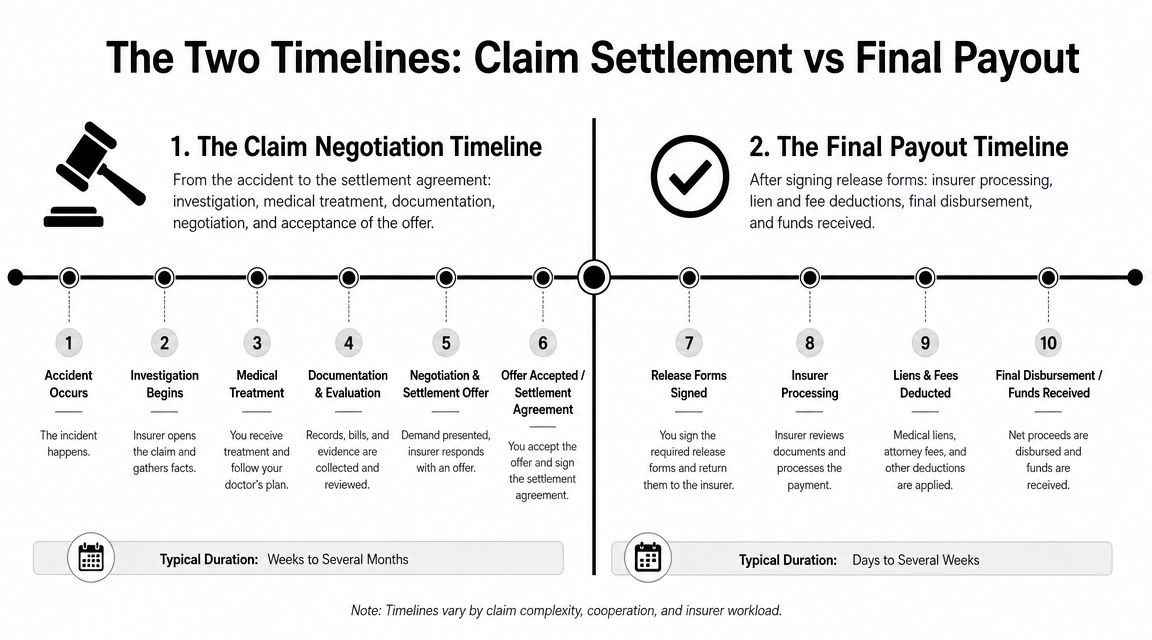
The claim settlement timeline
The first timeline is the case itself. It starts with the injury and continues until both sides agree on a number. During that period, the work centers on proving liability and documenting damages well enough for the insurance company, or a jury, to take the claim seriously.
That usually means collecting evidence such as:
- Crash or incident reports
- Witness statements and photos
- Medical records and billing
- Proof of lost income
- Doctor opinions about future care or work restrictions
This timeline can move quickly in a smaller case with clear fault and completed treatment. It can stretch out in a case involving disputed responsibility, ongoing care, surgery decisions, or questions about future medical needs. If you want a clearer sense of what affects that first phase, review the factors that affect an injury settlement in Texas.
The final payout timeline
The second timeline begins after the settlement agreement is reached and the release is signed. This is the part many people are never warned about. A case can be settled on paper while the payout is still pending for practical, legitimate reasons.
Post-settlement work often includes:
- Reviewing and signing the release
- Waiting for the insurer to issue the check
- Depositing the funds into the lawyer's trust account
- Allowing the check to clear
- Confirming and resolving medical liens or subrogation claims
- Paying case expenses and attorney's fees
- Sending the net proceeds to you
Lien resolution is often the slowest part of this second timeline.
For example, if health insurance, Medicare, Medicaid, or a hospital claims a right to reimbursement, those amounts need to be confirmed before disbursement. If the lien is inaccurate, your lawyer may be able to challenge or reduce it, but that takes time. Clients usually prefer that extra work if it means more of the settlement stays in their pocket.
Reaching a settlement is a major milestone. It is not the same as having the funds cleared, liens resolved, and money in hand.
That distinction matters because it helps set realistic expectations. If your lawyer says the case has settled but the check has not gone out yet, or the lien numbers are still being finalized, that usually means the file is in the payout phase, not that anything has gone wrong.
Key Factors That Can Delay Your Texas Settlement
Some delays are unavoidable. Others come from preventable mistakes, unclear records, or an insurer that sees an opportunity to drag things out. If you understand what causes the slowdown, you'll be better positioned to protect your claim.

Disputed fault
Liability fights are one of the biggest reasons cases take longer. If the other driver denies fault, if there are conflicting witness accounts, or if several vehicles were involved, the insurer has more room to resist.
After a multi-car pileup on I-45 in Houston, proving each driver's share of responsibility can take time. The insurance company may look for statements, vehicle damage patterns, traffic camera footage, and prior claims history. In that setting, comparative responsibility becomes a live issue, not a legal footnote.
Ongoing treatment and unclear medical picture
Insurers usually prefer finality. They want to know what treatment you received, whether you improved, and whether future care is likely. If you're still in treatment, the value of the case may still be developing.
That's why many serious cases don't settle quickly. If someone has a back injury, head injury, or multiple fractures, waiting for a clearer medical picture can protect the claim even if it adds time.
Bigger damages mean more scrutiny
High-value claims often face tougher review. A serious injury case may involve larger medical bills, lost earning capacity, long-term pain, home modifications, or life-care needs. Insurance companies don't usually write larger checks without examining the file closely.
That added scrutiny can involve repeated requests for records, challenges to causation, or arguments that some treatment was unrelated. This is common in catastrophic injury claims and in fatal cases pursued by a wrongful death lawyer Texas families trust to investigate every layer of loss.
Litigation changes the clock
If negotiations fail and a lawsuit must be filed, the timeline expands. One Texas source explains that filing suit, conducting discovery, attending mediation, and preparing for trial can extend a case to 12 to 24 months or longer, and appeals can add another 1 to 2 years according to this review of Texas insurance settlement timing.
That doesn't mean filing suit was the wrong move. Sometimes it's the only way to force meaningful progress. It does mean you should be prepared for a more demanding process.
For a closer look at issues that shape value and timing, see this guide on factors that affect an injury settlement in Texas.
Insurance companies move faster when fault is clear, treatment is documented, and the claimant can prove damages cleanly.
Practical Steps to Help Protect Your Timeline
A case can feel settled long before the money arrives. That gap is where people get frustrated. The best way to protect your timeline is to build the file carefully from the start so the insurer has fewer openings to dispute the claim, and so the payout stage is easier once an agreement is reached.
Good preparation helps both timelines. It can shorten the path to settlement, and it can reduce post-settlement delays tied to missing records, unpaid balances, or lien questions.
What helps a case move more smoothly
- Get medical care promptly: Early treatment protects your health and creates a clear record linking the incident to your injuries.
- Follow through with treatment: Gaps in care often become defense arguments. Insurers use missed appointments to say you healed quickly or were not seriously hurt.
- Keep documents in one place: Save bills, discharge instructions, prescriptions, wage-loss proof, repair estimates, photos, and correspondence from the insurance company.
- Preserve evidence early: Scene photos, vehicle damage, witness contact information, and surveillance requests are easier to secure at the beginning than months later.
- Use caution with adjusters: Give accurate basic facts, but do not guess or agree to a recorded statement without understanding how it may affect the claim.
- Watch what you post online: Insurance companies and defense lawyers look for photos or comments they can use out of context.
- Ask about liens before settlement: Health insurance reimbursement claims, hospital liens, and other balances can slow the money-in-hand timeline even after the case itself is resolved.
When to call a lawyer
Early involvement often saves time later. If fault is disputed, your injuries are serious, a company vehicle is involved, or the carrier is pressing for a quick release, a lawyer can address problems before they turn into delays.
A Texas personal injury lawyer should be doing more than sending demand letters. The job includes collecting records, preserving evidence, tracking treatment, identifying liens, and preparing the file for both negotiation and payout. Our attorneys at the Law Office of Bryan Fagan, PLLC, often handle those issues from the beginning to help prevent avoidable slowdowns.
If your questions are tied to a crash claim, this guide on how long it takes to settle a Texas car accident claim gives a more focused breakdown.
A real-world example
After a Houston freeway wreck, an injured driver may wait months to gather photos, wage records, and follow-up treatment notes because the police report seems like enough. Later, the carrier disputes the severity of the injury, asks for more documentation, and raises questions that could have been answered early.
I see this often. Early organization does not force an insurance company to be fair, but it does limit the excuses they can use to delay the case settlement timeline and the final payout timeline.
Average Settlement Timelines for Different Cases
Not every claim follows the same pace. A rear-end collision with clear fault doesn't move like a commercial truck case or a fatal crash claim. The legal issues, the medical evidence, and the number of parties all change the timeline.
Estimated Texas Personal Injury Settlement Timelines
| Case Type | Average Pre-Litigation Timeline | Factors Affecting Timeline |
|---|---|---|
| Straightforward car accident | Often about 6 to 12 months | Clear fault, completed treatment, organized records, limited disputes |
| Commercial truck accident | Often longer and may move into litigation | Multiple parties, company records, maintenance issues, serious injuries, federal regulation issues |
| Wrongful death claim | Often longer and highly fact-specific | Estate issues, family damages, liability disputes, larger losses, emotional and legal complexity |
The car accident category is where many people start their search for answers. If you want a more focused look at that process, this page on how long it takes to settle a Texas car accident claim is a useful next step.
Why truck cases often take longer
A truck crash lawyer Houston families call after a major wreck often has to investigate more than just the driver. The trucking company, a maintenance contractor, a cargo loader, or another commercial entity may all be relevant. Records can include driver logs, inspection history, dispatch communications, and other business documents.
That means more evidence requests, more insurance carriers, and often more aggressive defense work. A case can still settle, but it usually takes stronger preparation.
Why wrongful death claims move differently
A wrongful death case isn't just a bigger car wreck case. It involves devastating losses, legal questions about who may bring claims, and deeper disputes about the financial and human impact of the death. Families often need time to stabilize before making major legal decisions, and that's understandable.
A Houston car accident attorney or wrongful death lawyer Texas families speak with should account for both the legal process and the emotional reality. Rushing these cases rarely helps.
What Happens After You Settle The Payout Process
This is the part many people aren't warned about. You may have reached an agreement, signed papers, and even heard that the insurer has approved payment, but there's still a process between “settled” and “money received.”

Step one is signing the release
The release is the document that ends the claim. In exchange for the settlement, you agree not to pursue that claim further. If you want a plain-English explanation of that document, review this page on what a release of liability means in Texas.
Once you sign, the insurer can process the payment. But even then, the funds usually don't go straight from the insurer to your checking account that day.
Step two is issuing and clearing the check
A Texas source explains that many clients receive their settlement check within 4 to 6 weeks after signing the release agreement, but delays in resolving medical liens or other obligations can push the wait to 8 weeks or longer. The same source notes that the attorney must hold funds until liens, fees, and expenses are finalized, as explained in this discussion of Texas settlement check timing.
That waiting period usually includes the insurer sending the check, the law firm depositing it into a trust account, and the bank clearing the funds. Those are ordinary protection steps, not signs that something has gone wrong.
Liens are often the real bottleneck
Medical liens, hospital claims, and subrogation demands are one of the biggest reasons payout takes longer than clients expect. If a provider, health plan, hospital, Medicare, or Medicaid claims a right to reimbursement, those issues need to be reviewed and resolved before the final distribution.
For readers trying to understand the provider side of that process, this overview of filing medical liens for specialty clinics offers helpful context on how some medical claims are asserted and tracked.
Settlement money often arrives in the lawyer's trust account before it reaches the client. The gap is usually about accounting, lien resolution, and clearance, not inactivity.
Here's a brief visual explanation of why that period can feel longer than expected:
What the lawyer is doing during this time
During the payout phase, the legal team is usually handling tasks such as:
- Reviewing the release terms: Making sure the paperwork matches the agreement.
- Depositing the check properly: Settlement funds are typically handled through a trust account.
- Confirming medical balances: Bills, liens, and reimbursement claims have to be verified.
- Calculating deductions: Attorney's fees and case expenses must be accounted for accurately.
- Preparing final disbursement: You should receive a breakdown showing where the money went.
If you're waiting during this stage, it's fair to ask for an update. It's also important to understand that a careful disbursement process protects you from later disputes.
Take Control of Your Recovery with a Trusted Advocate
Waiting on a settlement can feel like another injury on top of the first one. You're trying to heal, support your family, and plan your future while the legal and insurance process moves at its own pace. Clear expectations help.
The most important thing to remember is that there are usually two separate waits in a Texas injury claim. One is the time it takes to resolve the case. The other is the time it takes to complete the payout process after the agreement is signed. When you understand that difference, the process becomes less confusing and easier to manage.
You also don't have to handle these issues alone. Whether your case involves a freeway collision, a commercial trucking crash, a catastrophic injury, or the loss of a loved one, strong legal guidance can help you protect your rights, avoid preventable delays, and make informed choices from the start.
Recovery is possible. Legal help is available. And the right plan can give you back a measure of control when life feels uncertain.
If you have questions about your case timeline, your release paperwork, or why your settlement funds haven't arrived yet, contact Law Office of Bryan Fagan, PLLC for a free consultation. You can speak with a Texas personal injury lawyer about your accident, your options, and what to expect next. If you need guidance from a Houston car accident attorney, help after a truck crash, or answers about a wrongful death claim in Texas, the firm can review your situation and help you take the next step with confidence.