A serious accident can change your life in seconds, but you don’t have to face it alone.
You may be reading this after a delivery van sideswiped you on I-10 in Houston, after a box truck hit your car in a Dallas intersection, or after a loved one was badly hurt by a company vehicle in San Antonio. Your body hurts. Your phone won’t stop ringing. Bills are already coming in. And somewhere in the middle of all that, you’re being asked to figure out who was at fault, which insurance policy applies, and what to do next.
That’s a lot for anyone.
A delivery truck accident lawyer helps you sort through the chaos. In Texas, these cases often involve more than a careless driver. They can involve company deadlines, contractor relationships, poor maintenance, hidden insurance policies, and legal rules that don’t show up in an ordinary car wreck. If you’ve been hurt, the right legal help can protect your claim while you focus on healing.
A Delivery Truck Accident Can Change Your Life You Are Not Alone
One moment, you’re driving home with groceries in the back seat. The next, a delivery truck cuts across traffic, slams into your lane, and everything goes loud, then strangely quiet. After a crash like that, many people feel shock first. Pain comes later. Questions come all at once.
You may not know whether you should go to the hospital, talk to the insurance adjuster, miss work, or wait and see if the pain gets better. That uncertainty is common, especially when the other vehicle belongs to a business and you suspect the company will try to protect itself.

There’s a reason these cases deserve serious attention. According to large truck crash data summarized by MyPhillyLawyer, the United States recorded 415,444 large truck crashes in 2020 and 523,796 in 2021, which was a 26.1% increase in one year. The same source notes that a truck’s size and weight can cause serious injuries even in lower-speed collisions.
Why these crashes feel different
A delivery truck crash doesn’t feel like a minor traffic problem because it usually isn’t one. People often walk away with more than bruises. They may be dealing with broken bones, head injuries, back injuries, internal injuries, or months of follow-up care.
That can affect every part of life:
- Your health: Pain may worsen over the next few days.
- Your work: Time off can mean lost income.
- Your family: Routines disappear overnight.
- Your peace of mind: Driving can suddenly feel frightening.
You don’t need to have every answer today. You just need to protect your health and avoid mistakes that can weaken your claim.
Recovery starts with clarity
As a Texas personal injury lawyer, I’ve seen how overwhelming the first week after a crash can be. I’ve also seen something else. When injured people get clear advice early, they often feel more in control. They can make informed choices, preserve evidence, and stop the insurance company from steering the conversation.
If you were hurt by a delivery vehicle, your experience is real, your questions are valid, and your recovery matters.
Critical First Steps to Protect Your Rights After a Crash
The hours after a crash matter. So do the next few days. What you do during that window can affect your medical care and your legal claim.
What to do at the scene
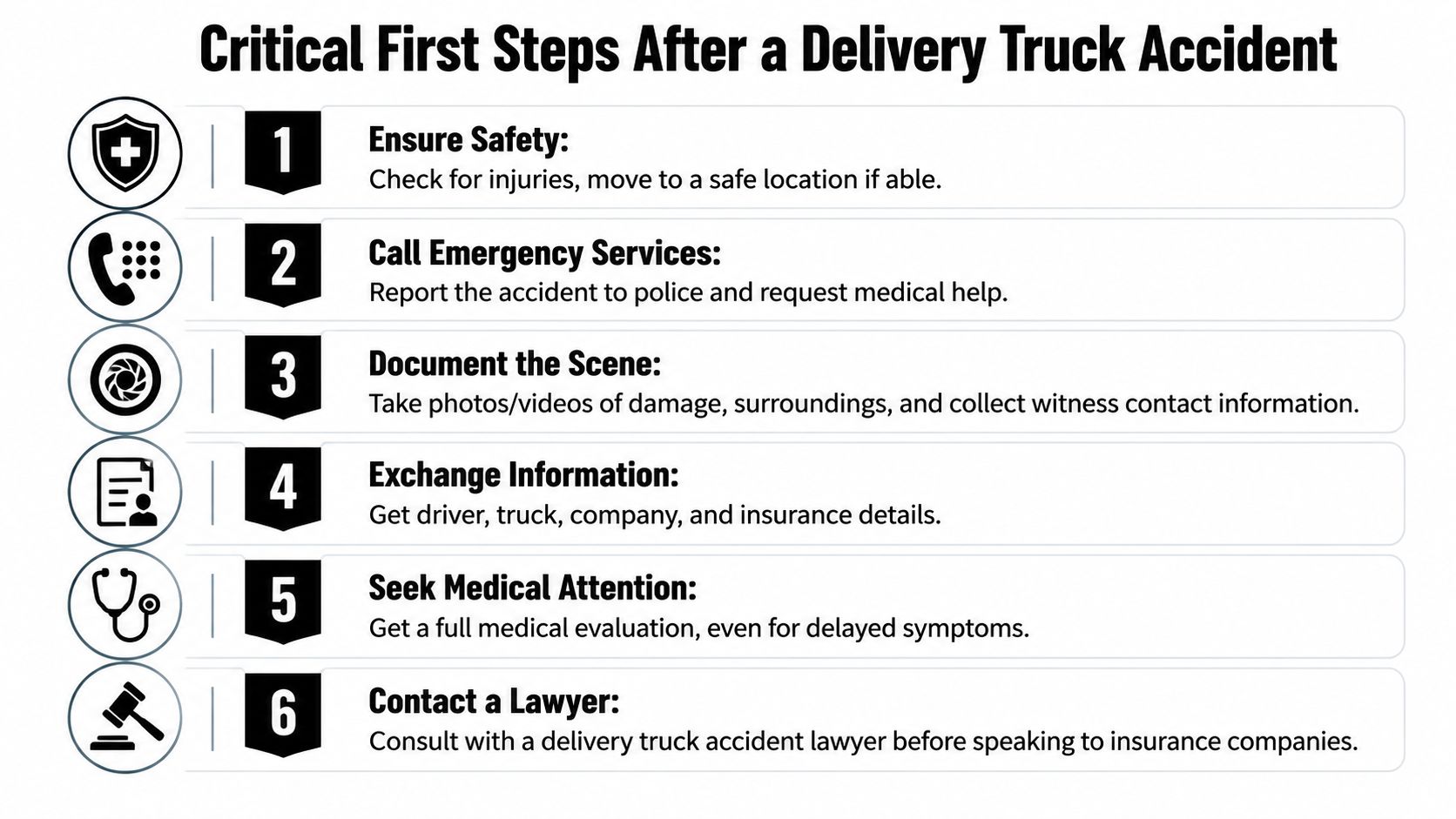
If you’re physically able, take these steps in order:
- Get to safety first. If your vehicle can move and it’s safe to do so, get out of active traffic. Turn on hazard lights.
- Call 911. You need police response and, if needed, emergency medical help. A crash report often becomes one of the first key records in the case.
- Accept medical evaluation. A lot of people say they’re “fine” because adrenaline is masking pain. That can change quickly.
- Take photos and video. Include all vehicles, the truck’s company markings, license plates, debris, skid marks, road layout, traffic lights, weather conditions, and visible injuries.
- Get witness information. Independent witnesses can help if the company later disputes what happened.
- Exchange basic information only. Get the driver’s name, employer, insurance details, truck number, and any identifying company information.
If the crash happened on a Houston freeway, try to photograph the delivery truck from more than one angle. Company logos, unit numbers, and trailer markings can matter later if the business claims the driver worked for someone else.
What not to say
People often hurt their own case without realizing it.
Avoid statements like:
- “I’m sorry.” It may sound polite, but it can be twisted into an admission.
- “I didn’t see him.” That’s speculation and can be used against you.
- “I’m okay.” If you later learn you have a serious injury, the insurer may point back to that moment.
- “It was partly my fault.” Texas fault questions should be answered after an investigation, not on the roadside.
Practical rule: Be courteous, but stick to facts. Tell police what happened. Don’t guess, don’t minimize, and don’t debate fault with the driver or the company.
What to do in the next few days
The claim doesn’t begin and end at the crash scene. The next steps are just as important.
- Follow your doctor’s instructions: Go to urgent care, the ER, your primary doctor, or a specialist, and keep every follow-up appointment.
- Start a file: Save discharge papers, prescriptions, receipts, wage records, photos, and messages from insurance adjusters.
- Report the crash to your insurer: Give basic notice, but keep it brief.
- Be careful with recorded statements: If the delivery company’s insurer calls, you don’t have to give a recorded statement on the spot.
- Get legal guidance early: A truck case can involve evidence that disappears fast.
For a more detailed checklist, review this what to do after a truck accident guide.
Why speed matters
Delivery truck cases often involve company records, onboard data, and employment documents. Those items don’t stay easy to access forever. A short delay can make a hard case harder.
That doesn’t mean you should panic. It means you should act with purpose.
Who Is Actually Liable for Your Delivery Truck Accident
Many people assume the case is only against the driver. Sometimes that’s true. Often, it’s only the beginning.

In a delivery truck case, the biggest mistake is looking at the crash too narrowly. The person behind the wheel may have caused the impact, but other companies may have created the conditions that led to it or may share legal responsibility.
According to this discussion of delivery truck accident liability and scheduling pressure, liability can extend beyond the driver to a staffing agency that placed the driver, a vehicle maintenance contractor, or even the company that loaded the cargo incorrectly. The same source states that driver reported unrealistically tight delivery schedules are associated with drivers' beliefs in safety laws/regulations and risk-taking behaviors.
The driver may not be the whole story
A driver may have been speeding, distracted, fatigued, or turning without enough clearance. But ask the next question. Why?
In a Dallas delivery route case, for example, a driver might be trying to hit an unrealistic set of stops before the end of the shift. If the company’s scheduling pressure pushed the driver to rush, skip breaks, or ignore safe driving practices, the business itself may be part of the problem.
Potentially responsible parties can include:
- The driver: for careless driving, distraction, fatigue, or other negligent conduct
- The delivery company: if it controlled the route, schedule, training, or supervision
- A staffing agency: if it placed an unqualified or unsafe driver
- A maintenance contractor: if poor inspection or repair contributed to brake failure or another mechanical issue
- A cargo loader or warehouse operator: if shifting or improperly loaded cargo affected control of the truck
- The vehicle owner: if the truck was owned by a separate company
Why this matters for your recovery
Finding every liable party can make a major difference. Severe injury claims often involve large medical bills, time away from work, future treatment, and long-term pain. If you only pursue one defendant too early, you may miss another source of insurance coverage.
That’s one reason experienced lawyers send preservation letters and dig into contracts, dispatch records, maintenance logs, and employment relationships.
A short video can help explain how these truck cases are investigated:
Corporate negligence can hide in plain sight
Some cases are not just about a bad driving decision. They’re about a bad system.
A company may pressure drivers to finish routes too fast. A contractor may cut corners on maintenance. A logistics provider may create confusion about who employed the driver and who insured the vehicle. Those layers can be frustrating for injured families, but they also create investigative opportunities.
A serious truck case often turns on records the public never sees on the day of the crash.
A simple example
Suppose a delivery truck rear-ends your SUV in Austin. At first glance, it looks like a straightforward driver-error case. Then the investigation shows the driver was placed by a staffing company, the truck was serviced by a third-party mechanic, and the route was managed by another logistics company that imposed an unrealistic delivery window.
That’s no longer a simple two-car insurance claim. It’s a multi-party commercial case, and it should be handled that way.
How to Build a Strong Claim and Calculate Your Damages
A strong claim has two parts. First, you prove what happened and who caused it. Then you show the full cost of what the crash took from you.

The evidence that can make or break the case
Truck cases aren’t built on guesswork. They’re built on records, data, and timing.
According to Finch McCranie’s discussion of trucking accident evidence strategy, lawyers who move fast to secure Electronic Logging Device data, maintenance records, and black box data can enhance their bargaining power in settlement by 30% to 40% because those records may reveal violations that help establish negligence.
That kind of evidence can include:
- ELD records: These can show driving hours, rest periods, and possible hours-of-service problems.
- Black box data: This may show speed, braking, and vehicle activity before impact.
- Maintenance records: These may reveal skipped inspections or known mechanical issues.
- Driver qualification files: Training, prior incidents, hiring decisions, and supervision can all matter.
- Dashcam footage: If available, this can help confirm lane position, traffic movement, and driver behavior.
Evidence warning: In commercial vehicle cases, key records may not stay available forever. The earlier a lawyer gets involved, the better the chance of preserving what matters.
Damages are more than just current bills
Many people undervalue their case because they only count today’s expenses. Texas law allows injured people to seek compensation for more than the emergency room visit and body shop estimate.
A delivery truck accident claim may involve:
| Type of damages | What it can include |
|---|---|
| Economic damages | Medical bills, rehabilitation, lost wages, reduced earning ability, property damage, future treatment |
| Non-economic damages | Pain, suffering, mental anguish, physical impairment, loss of enjoyment of life |
| Wrongful death damages | Losses suffered by surviving family members when a loved one dies from the crash |
If the crash caused a life-changing injury, a lawyer may also work with medical providers and vocational professionals to understand future care needs and the effect on your ability to work.
A real-world example of how this is calculated
Take an Austin teacher hit by a delivery truck on the way home from school. She suffers a back injury and concussion. At first, she thinks the claim is just about urgent care, car repairs, and a few missed workdays.
But months later, the picture looks different. She needs follow-up treatment, still gets headaches, struggles to drive, misses family activities, and can’t handle the same physical demands at work. A fair claim has to account for the whole impact, not just the first invoice.
That’s why lawyers gather records over time and compare early assumptions to the actual course of recovery. If you want a plain-English overview of valuation issues, this Texas settlement calculation article is a helpful starting point. For a broader look at how attorneys think about negotiation value, this guide for attorneys on settlements offers useful context.
Good documentation helps tell the truth
Keep a simple journal. Write down pain levels, missed work, sleep problems, medical visits, and the activities you can’t do now. That record can help show how the injury affects real life.
You don’t need perfect paperwork on day one. You do need consistency and honesty.
Dealing With Insurers and Understanding the Texas Legal Process
Insurance companies often sound helpful early on. That doesn’t mean their goals match yours.
After a delivery truck crash, an adjuster may call quickly, ask for a recorded statement, or suggest an early settlement before you know the full extent of your injuries. That’s not the time to make a rushed decision. In many cases, the insurer is looking for ways to narrow the claim, shift blame, or lock you into a low number before the evidence develops.
Common insurance tactics after a truck crash
You should be cautious if the insurer does any of the following:
- Pushes for a recorded statement: Your words can be taken out of context.
- Asks you to sign broad medical releases: The company may look for unrelated history to minimize your injury.
- Offers quick money: Early offers often arrive before future treatment needs are clear.
- Suggests you don’t need a lawyer: That usually benefits the insurer, not you.
- Blames you early: Texas fault arguments often require a careful investigation, not a snap judgment.
If an adjuster asks for something you don’t understand, pause. You’re allowed to say you need time and legal advice.
Texas fault and negligence in plain English
Texas personal injury law is based on fault. That means the injured person generally must show another party acted negligently and caused harm. Negligence can include unsafe driving, poor supervision, bad maintenance, or other careless conduct that leads to a crash.
Texas also follows modified comparative responsibility. In simple terms, you can still recover damages if you were partly at fault, as long as your share of responsibility is 50% or less. If you’re found partly responsible, your recovery is reduced to reflect that share.
That rule matters in delivery truck cases because companies often try to argue the injured driver changed lanes too late, braked suddenly, or failed to react in time. Those arguments need to be tested against the actual evidence.
How long do you have to file a claim in Texas
For most Texas personal injury cases, the statute of limitations is two years. That usually means you have two years from the date of the crash to file a lawsuit. Wrongful death claims also have filing deadlines, and some situations involve special timing issues.
Waiting is risky for two reasons. First, legal deadlines can bar a claim. Second, witnesses become harder to find and records become harder to preserve.
What the process usually looks like
A typical case may move through these stages:
- Investigation and treatment
- Evidence collection and document review
- Demand package and settlement talks
- Lawsuit filing if needed
- Discovery, depositions, and expert review
- Mediation, settlement, or trial
Some cases resolve through negotiation. Others need litigation before the other side takes the claim seriously. If your injuries are severe, or liability is disputed, court may become part of the path.
Families dealing with a fatal crash may also need guidance from a wrongful death lawyer Texas families can trust, especially when a company vehicle caused the loss.
Why You Need a Delivery Truck Accident Lawyer on Your Side
By the time someone considers hiring a lawyer, they’re already juggling pain, appointments, missed work, and nonstop insurance calls. In a delivery truck case, that pressure gets worse because the other side may include a commercial insurer, a corporate claims team, or several defendants pointing fingers at each other.
A lawyer’s job isn’t just filing paperwork. It’s protecting the case from the start, identifying every source of liability, organizing evidence, valuing damages, and handling the conversations you shouldn’t have to manage alone.
The fee question most people ask first
Yes, cost matters. Most injury clients are already under financial stress.
According to this explanation of truck accident contingency fees and settlement leverage, most personal injury lawyers charge 33% to 40% on a contingency fee. The same source states that firms showing trial readiness secure settlements 25% to 35% higher than firms with weak initial demands, and that a proactive lawyer can double the client’s net recovery compared with a reactive one, even when the fee percentage is the same.
That’s why the right question isn’t only, “What percentage does the lawyer charge?” It’s also, “What does this lawyer do to strengthen the case?”
What experienced legal help changes
A strong Texas personal injury lawyer can:
- Investigate early: preserve records before they disappear
- Handle the insurer: so you’re not pushed into harmful statements
- Identify all defendants: not just the driver in front of you
- Calculate damages carefully: including future losses, not only current bills
- Prepare for trial: because credible trial preparation can affect settlement talks
The guide on choosing a personal injury attorney can help you ask the right questions before you hire anyone.
The right fit matters
Not every injury lawyer handles truck cases the same way. A routine car wreck file and a delivery truck case are different. Commercial vehicle claims can involve log data, maintenance issues, layered contracts, and company policies that need close review.
If you’re comparing options, one practical step is to look for a firm that handles truck and motor vehicle injury claims in Texas, such as Law Office of Bryan Fagan, PLLC, and ask direct questions about investigation, case strategy, and communication.
If your collision involved a passenger vehicle instead of a truck, you may also need a Houston car accident attorney. If the injuries are life-altering, issues often overlap with catastrophic injury claims. And if a loved one died, surviving relatives may need help with a wrongful death case as well as the underlying crash investigation.
You deserve room to heal
After a violent crash, your energy should go toward getting better and helping your family stabilize. A lawyer can take over the legal burden so you aren’t arguing with an adjuster while sitting in a doctor’s office or trying to decode business records while recovering at home.
A truck crash lawyer Houston families can call should do more than chase signatures. The lawyer should give you clarity, protect your deadlines, and build a case that reflects what this wreck has really cost you.
Recovery takes time. But with the right help, it is possible.
If you or someone you love was hurt in a delivery truck crash, you can contact Law Office of Bryan Fagan, PLLC for a free consultation. We can help you understand your rights under Texas law, explain what evidence may matter in your case, and discuss next steps in plain English. You don’t have to sort through insurance calls, liability questions, and legal deadlines by yourself. Help is available, and recovery is possible.