Skip to content
A serious accident can change your life in seconds, but you don't have to face it alone.
If you're reading this after a head-on crash in Houston, Dallas, Austin, San Antonio, or anywhere else in Texas, you're probably dealing with more than pain. You're fielding calls from insurance adjusters, trying to understand medical instructions, worrying about work, and asking the same question most families ask after a violent collision. What happens now?
A head-on collision is one of the most violent events a person can endure. These crashes account for about 10% of all traffic deaths and nearly 20% of fatal wrecks on undivided highways, which is why experienced legal help matters so much in these cases, as noted in this overview of head-on collision risks.
What many people don't realize at first is that a strong claim isn't always just about the other driver. Sometimes the full truth involves road design, missing barriers, a work vehicle, a dangerous mechanical failure, or another party whose role isn't obvious in the first few days. A skilled head on accident attorney looks deeper, because your recovery may depend on finding every responsible party and proving the full impact this wreck will have on your life.
Your Life Changed in an Instant We Can Help
On a Texas highway, a normal day can turn without warning. One moment you're driving home. The next, an oncoming vehicle crosses the center line, airbags explode, glass breaks, and everything after that feels blurred together.

For many clients, the first days are the hardest. They remember the hospital, the pain, the fear of what doctors might say next, and the pressure from bills that don't pause just because life has been turned upside down. After a Houston freeway crash or a rural collision on an undivided road, families often feel like they have to solve everything at once.
That isn't your job.
What victims usually need first
You need a plan that restores order. In practical terms, that usually means:
- Medical stability: follow treatment instructions, attend follow-up visits, and make sure your injuries are documented.
- Protection from avoidable mistakes: don't guess about fault, don't minimize your pain, and don't let an insurer push you into a rushed statement.
- A clear legal path: identify who caused the crash, what insurance applies, and what evidence could disappear if no one acts quickly.
The first goal after a head-on crash isn't winning an argument. It's protecting your health, your records, and your options.
A compassionate Texas personal injury lawyer helps you move from chaos to clarity. That matters because head-on crashes often involve catastrophic injuries, long recoveries, and questions that don't have simple answers. Can you work again? Will you need future treatment? What if the police report missed something important? What if the driver who hit you was on the job, impaired, or driving a defective vehicle?
Why guidance matters so early
The days right after the wreck can shape the whole claim. Evidence gets lost. Vehicles get repaired. Witnesses forget details. Insurance companies build their files early, and they do it with their own financial interests in mind.
A good lawyer doesn't just prepare paperwork. A good lawyer becomes the person who steadies the situation, protects your claim, and starts building the truth while you focus on healing.
What a Head-On Accident Attorney Does for You
It's often assumed a lawyer steps in only if a lawsuit gets filed. In serious crash cases, that's too late to be the starting point. The essential work begins much earlier.
A Houston car accident attorney or Texas personal injury lawyer handling a head-on collision acts in three roles at once. Investigator. Advocate. Guide. Each role matters because these cases are rarely simple.
We take control of the claim process
Once you're represented, your attorney handles communications that can otherwise wear you down. That includes insurance calls, document requests, coverage questions, and the constant pressure to give quick answers before the full medical picture is clear.
In practical terms, that means your legal team can:
- Deal with adjusters: so you don't have to manage repeated calls while recovering.
- Collect records: police reports, medical charts, billing records, wage information, and photographs.
- Preserve evidence: before vehicles are repaired, digital data is lost, or scene conditions change.
This helps in ordinary car wreck cases, but it's especially important in a head-on crash where fault may be contested or shared among multiple parties.
We investigate beyond the obvious story
The first version of a crash isn't always the whole version. A driver may have crossed the center line, but why? Fatigue, distraction, prescription medication interactions, brake failure, poor roadway design, missing signage, or employer pressure can all matter.
A thorough attorney looks at questions like these:
| Issue | Why it matters |
|---|---|
| Road conditions | Missing warnings, poor lighting, or unsafe layout may point to additional liability |
| Vehicle condition | Brake or steering problems can change how fault is evaluated |
| Employment status | A company may share responsibility if the driver was working |
| Third parties | A bar, contractor, or manufacturer may belong in the case |
We help you make decisions that protect your future
Not every case should be pushed to court immediately. Not every settlement offer should be rejected either. The key skill is knowing what works, what doesn't, and when to apply pressure.
For example, accepting money early may feel like relief, but it can hurt you if doctors later identify a lasting disability. Waiting without a strategy can also backfire if key evidence disappears. Your lawyer weighs those trade-offs and gives advice based on the facts, not guesswork.
Practical rule: If the insurer wants a fast resolution before your treatment path is understood, that usually benefits the insurer more than you.
This is also where related claims matter. A head-on crash may overlap with car accident cases, catastrophic injuries, truck collisions, or a wrongful death claim if a loved one didn't survive. Families often need coordinated advice, not fragmented answers.
Recovering Every Dollar You Deserve Under Texas Law
Compensation isn't about trying to profit from a tragedy. It's about making sure the wreck doesn't leave you carrying costs and losses that someone else caused.
In Texas, a head-on collision claim usually includes two broad categories of damages. Economic damages cover the financial losses you can document. Non-economic damages address the human impact of what happened to your body, your routine, and your family life.
The losses people see first
These are usually the easiest to recognize because bills start arriving quickly.
You may have a claim for hospital care, surgery, follow-up treatment, medication, rehabilitation, mileage to appointments, lost income, and reduced earning ability. If your car was destroyed, property damage becomes part of the immediate picture too.
After a Dallas-area crash, for example, a person with a fractured leg and neck injury may miss weeks or months of work. The claim isn't limited to the ER visit. It should account for the full course of care and the income interrupted by the wreck.
The losses many people undervalue
A major gap in many claims is failing to account for long-term disability and diminished quality of life, as explained in this discussion of head-on collision compensation issues. That's one of the biggest mistakes injured people make when negotiating on their own.
Think about what changes after the crash:
- Pain that stays: chronic neck, back, shoulder, or nerve pain
- Daily limitations: trouble driving, lifting, sleeping, or caring for children
- Emotional harm: anxiety, trauma, and fear of getting back on the road
- Life changes at home: needing help with chores, mobility, or personal care
- Future needs: therapy, adaptive equipment, home changes, and ongoing treatment
If you can't return to the activities that once shaped your life, that loss matters. If your marriage, parenting, or independence has been affected, that matters too.
For readers trying to understand practical strategies for increasing personal injury payouts, one of the most important lessons is simple. The strongest claims don't stop at current bills. They document how the injury changes the future.
How comparative fault affects your recovery
Texas law also looks at whether each party shares responsibility. That's why evidence matters so much. If an insurer tries to pin too much blame on you, your recovery can be reduced.
A helpful starting point is understanding how comparative fault works in Texas injury cases. In real cases, that issue can come up when an insurer argues you were speeding, distracted, or could have avoided the crash. Sometimes that's fair. Often it isn't. The difference comes down to proof.
Before valuing a case, it helps to hear a straightforward legal overview from a Texas injury attorney:
A careful damages presentation connects every part of your claim. Not just what you've paid, but what this crash has taken and what it will keep costing if you don't recover full compensation.
How We Investigate to Prove What Really Happened
A police report matters, but it isn't the finish line. In a serious head-on crash, it's only one piece of the case.
Strong investigation answers the questions that decide liability. Which vehicle crossed the center line? Did the other driver brake? Was there a steering input? Did a mechanical failure play a role? Was a company involved? Did road conditions make the crash more likely?
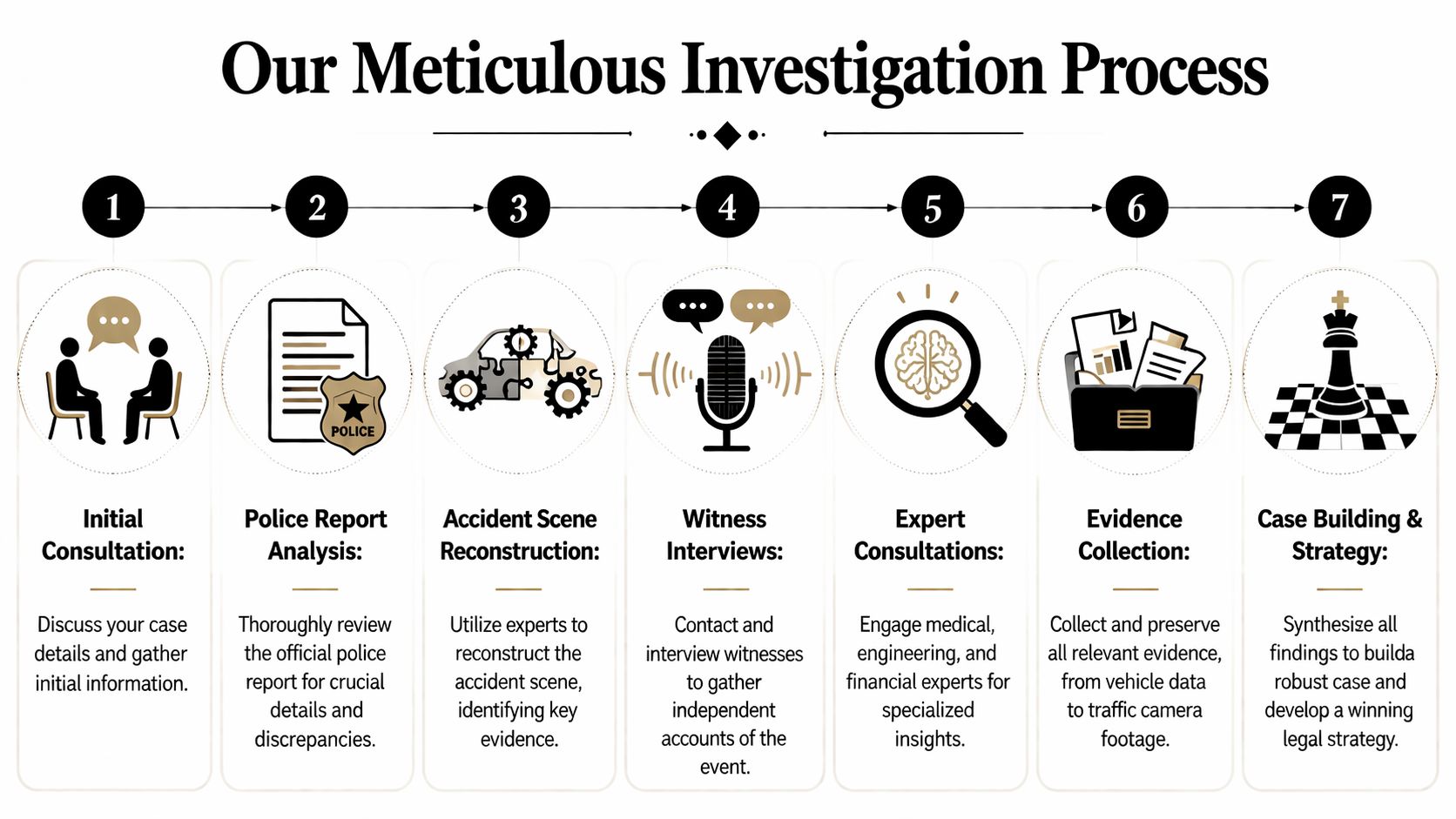
The evidence we look for early
In modern head-on collision cases, attorneys use a vehicle's Event Data Recorder, often called the black box. That data can show vehicle speed, braking, and steering inputs in the seconds before impact, and this explanation of EDR evidence notes that it can create powerful proof of negligence and may increase settlement values by 40-60%.
That matters because head-on crashes often produce conflicting stories. A driver may claim they swerved to avoid something. An insurer may argue both drivers moved into the same lane. EDR data can test those claims against what the vehicle recorded.
Other evidence often includes:
- Scene evidence: gouge marks, debris patterns, road edge damage, and lane position clues
- Vehicle damage patterns: front-end overlap can support or contradict each driver's version
- Witness accounts: especially from people with a clear view before impact
- Digital evidence: dashcam footage, nearby surveillance, and phone use records when available
- Medical records: injury patterns sometimes support how the crash occurred
Why reconstruction can change the case
Some cases turn on details that aren't obvious to the naked eye. Accident reconstruction experts use measurements, photographs, data downloads, and technical modeling to explain how the collision happened.
If you'd like a plain-English look at that process, this page on the role of an accident reconstruction expert witness is a useful reference. Reconstruction can be especially important when the other side argues shared fault or when a driver is unavailable to explain what happened.
Sometimes the best evidence doesn't come from what someone remembers after impact. It comes from the physical facts that were present before anyone had time to shape a story.
Looking beyond the wrong-way driver
Many claims are underbuilt in such situations. The obvious defendant may not be the only one.
Consider a few real-world patterns:
| Hidden liability issue | What it can mean for your case |
|---|---|
| Company vehicle crash | The employer may be responsible for the driver's conduct |
| Defective brakes or steering | A manufacturer or service provider may belong in the claim |
| Dangerous road layout | A public entity or contractor may need to be investigated |
| Overservice of alcohol | A third party may share liability in some situations |
After a Houston-area collision involving a delivery driver, for instance, the legal issue may extend past the person behind the wheel. Work schedules, dispatch records, maintenance logs, and company policies can all matter. After a rural crash on a dark undivided road, signage, road markings, lighting, or barrier design may deserve close review.
Behind the scenes, legal teams also need systems for organizing large volumes of records, photos, and intake documents. Tools that streamline legal workflows can help sort incoming materials efficiently, and firms such as the Law Office of Bryan Fagan, PLLC use structured case-building processes to move from raw evidence to a coherent liability theory.
What doesn't work is relying on the police narrative alone and assuming every answer is already in the file. What works is pressure-testing every part of the story until the evidence lines up.
Navigating Critical Texas Accident Laws
Texas law affects your case in ways that can help you or hurt you, depending on how early you act and how well the claim is handled. Three rules matter in almost every head-on collision case.
How long do you have to file a claim in Texas
Texas injury claims are controlled by filing deadlines called the statute of limitations. In plain terms, you don't have unlimited time to sue.
Waiting is risky for two reasons. First, the legal deadline can bar a claim if it's missed. Second, evidence tends to get weaker over time. Vehicles are sold, repaired, or salvaged. Records become harder to locate. Witnesses forget details.
If a crash caused a death, families may also need to explore a wrongful death claim. That's one reason people looking for a wrongful death lawyer Texas often reach out quickly after a fatal wreck. Early legal review helps protect the case while the family focuses on immediate needs.
Comparative responsibility in Texas
Texas follows a comparative fault rule. Under Texas's comparative fault rule (TPC §33.001), you can still recover damages even if you were partially to blame, as long as your fault is not 51% or more, according to this explanation of Texas comparative fault in head-on collision claims.
That rule matters because insurers often try to spread blame. In a head-on case, they may argue you were distracted, driving too fast for conditions, or failed to react. Some of those arguments have merit in some cases. Others are negotiation tactics dressed up as legal analysis.
A strong response usually depends on disciplined evidence work, especially when the crash scene is complicated.
If the insurer says you were partly at fault, don't assume they're right. Fault arguments are often starting positions, not final answers.
UM and UIM coverage can become essential
Some drivers don't carry enough coverage. Others don't carry any. In a severe crash, that creates a major problem because serious injuries can quickly exceed the at-fault driver's policy.
That's where uninsured/underinsured motorist coverage may come into play. Your own policy may provide an additional path to compensation if the other driver lacks sufficient insurance or leaves the scene. These claims still require proof, documentation, and careful communication. Your insurer may still challenge value or liability even though the policy is yours.
If the collision involved a commercial vehicle, a truck crash lawyer Houston families trust will also look closely at layered insurance policies, employer coverage, and contract relationships. Those details can make a large difference in what recovery is available.
Fighting Back Against Insurance Company Tactics
Insurance adjusters aren't calling because they want to make your life easier. They're doing their job, which is to protect the company's money.
That doesn't make them villains. It does mean you should be careful.

The tactics that show up most often
A few patterns appear again and again in serious crash claims:
- Recorded statement requests: adjusters often ask for one before you know the full extent of your injuries.
- Quick settlement pressure: early offers may sound helpful but often arrive before future care is understood.
- Delays and repeated documentation requests: some claims are slowed down until the injured person feels exhausted enough to accept less.
- Selective reading of records: insurers may highlight one note that helps them and ignore the broader treatment story.
If you're unsure how to handle those calls, this guide on what to say to insurance after an accident can help you avoid common mistakes.
Why representation changes the balance
Representation matters because the insurer now has to deal with someone who understands claim value, evidence, and negotiation strategy. According to these personal injury claim statistics, claimants who hire an attorney receive settlements that are, on average, three times higher than those who handle claims themselves, and 85% of all money paid out by insurance companies for bodily injury claims goes to claimants represented by a lawyer.
Those numbers reflect something simple. Serious claims are hard to value and harder to prove without help.
A lawyer also knows when not to rush. Some cases should settle. Many do. But a fair settlement usually comes after the evidence is built, not before.
You Don't Have to Face This Alone Your Path Starts Now
A head-on collision can leave you feeling like your life has split into two parts. Before the crash, and after it. That feeling is real. So is the uncertainty that comes with medical treatment, missed work, family stress, and the pressure of dealing with insurance companies while you're still trying to recover.
You don't need to solve every issue today. You do need to protect yourself.
The right legal approach does more than demand money. It identifies every responsible party, preserves the evidence that matters, calculates both current and future losses, and pushes back when insurers or defense lawyers try to shrink the value of your case. In a head-on collision, that work can include investigating road conditions, black box data, employer involvement, defective parts, and the long-term effects of catastrophic injury.
If you've lost a loved one, the path may include a wrongful death claim. If you're living with lasting injuries, the path may involve future care, reduced earning ability, and compensation for the ways your daily life has changed. Either way, you deserve clear advice and honest answers.
Recovery is possible, even if it doesn't feel close right now. With the right support, you can create stability, protect your future, and take the next step with confidence.
If you were hurt in a head-on crash, or your family is grieving a fatal collision, Law Office of Bryan Fagan, PLLC is available to talk through your options in a free consultation. You can get answers about fault, insurance, deadlines, medical documentation, and the next steps for a car accident, truck crash, catastrophic injury, or wrongful death claim. There is no pressure and no upfront fee to learn where you stand. Legal help is available, and you don't have to carry this alone.