Most Texas personal injury lawyers charge no upfront fee and work on a contingency fee, which usually means 33% to 40% of the settlement or verdict. If your lawyer doesn't recover money for you, you usually don't pay an attorney fee.
A serious accident can change your life in seconds, but you don't have to face it alone. If you're sitting at your kitchen table with hospital papers, missing work, and wondering whether legal help is one more bill you can't handle, you're asking the right question.
The phrase personal injury lawyer texas cost sounds simple, but what many clients want to know is this: What will I receive at the end of the case? That is the number that matters. Not just the fee percentage. Not just the settlement headline. Your real concern is your final check, and that depends on attorney fees, case costs, and how the contract handles both.
You Have Been Injured Can You Afford a Lawyer
After a wreck, calling a lawyer isn't usually driven by excitement to start a lawsuit. Instead, the motivation comes from relentless bills amidst a life that has slowed down. Maybe your car is totaled. Maybe you're trying to heal. Maybe a spouse or parent is asking how the family is supposed to carry all of this at once.
That fear is real. It also keeps many injured people from getting help they could afford.

Why the cost question matters so much
When people hear "lawyer," they often picture hourly bills, retainers, and invoices arriving every month. That is not how most Texas injury cases work. In most personal injury claims, the lawyer's pay depends on whether money is recovered for the client.
That changes the conversation. Instead of asking, "Can I pay a lawyer today?" you can ask, "Will hiring the right lawyer help protect what my case is worth?"
Practical rule: The cheapest legal option isn't always the one that leaves you with the most money. In injury cases, the better question is what your net recovery may look like after the case is resolved.
One data point makes this easier to understand. According to Texas settlement data summarized by Team Justice, people represented by lawyers recovered an average of $77,600, while those who handled claims themselves recovered $17,600. The same source states that plaintiffs who negotiated aggressively recovered an average of $42,500, compared with $11,800 for those who accepted the first offer.
Why many injured Texans wait too long
People often delay because they don't want to "make a big deal" out of the accident. Then the insurance company starts asking for statements, medical records, or a quick settlement. At that point, the pressure builds fast.
A Houston freeway crash is a good example. You may think fault is obvious because the other driver rear-ended you. But the insurer may still challenge your treatment, question whether all of your pain came from the collision, or push you to settle before you know the full extent of your injuries.
If you want a closer look at how this payment model works, this guide on contingency fee lawyers near you in Texas is a helpful next step.
How a No Win No Fee Lawyer Really Works in Texas
You are hurt, work is uncertain, and the phone keeps ringing with bills. In that moment, hourly legal fees can feel out of reach. A no win no fee agreement changes the timing of payment. Your lawyer gets paid from the recovery if the case succeeds, rather than charging you by the hour while the case is still unfolding.
A contingency fee works like a share of the result. You and the lawyer agree on the percentage at the start of the case. If there is no recovery, the lawyer does not collect an attorney fee. If money comes in, the fee is taken from that recovery based on the written agreement.
The part that matters most to many clients is simple. The fee percentage affects the final check you receive. So does the point in the case where it resolves.
In Texas, personal injury lawyers commonly charge 33% to 40% on a contingency fee basis, according to this Texas fee overview from Rad Law Firm. The same source notes that pre-suit settlements often use a lower percentage, while cases that require litigation often move to a higher percentage. Texas also does not set a statutory cap on these fees in ordinary personal injury cases, but the fee still must be reasonable under the Texas disciplinary rules.
That range makes more sense if you compare two paths.
An early settlement usually means the lawyer investigates the crash, gathers records, values the claim, and negotiates before filing suit. A litigated case adds more moving parts, such as filing the lawsuit, written discovery, depositions, motion practice, expert work, and trial preparation. More work and more risk often mean a higher percentage under the contract.
Here is where clients sometimes get confused. A higher fee percentage does not automatically mean a worse result for you. If stronger legal work increases the settlement enough, your net recovery can still be higher after fees and costs are paid. The number to focus on is not just the fee. It is what lands in your pocket at the end.
A simple example shows why. If one lawyer settles a case early for less money at a lower fee, and another lawyer pushes the case further and recovers much more at a higher fee, the second option may still leave you with a larger final check. That is why it helps to review the full math, not just the percentage on the first page of the contract.
Your fee agreement should spell out three points in plain language:
- the percentage if the case settles before suit
- the percentage if a lawsuit is filed
- whether case costs are deducted before or after the fee is calculated
That last point can change your net recovery in a meaningful way. It is one reason clients should read the agreement carefully and ask for examples using real numbers. For a closer explanation of how firms set these percentages, see this guide to Texas accident lawyer fees.
This payment structure also gives injured Texans access to legal help during a cash crunch. After a serious wreck in Dallas, Houston, or anywhere else in Texas, families are often trying to keep up with treatment, rent, and lost income at the same time. The timing issue is similar to other legal costs that can feel overwhelming up front, such as DebtBusters' Chapter 7 cost breakdown. In both settings, the question is not just what the service costs on paper. It is how the payment structure affects your financial outcome.
A clear fee agreement should feel understandable before you sign it. If it does not, ask the lawyer to walk through the math step by step. A good lawyer should be able to show you how the fee works and what that could mean for your final recovery.
Attorney Fees vs Case Costs What Is the Difference
A lot of confusion starts here. A client hears "one-third fee" and assumes that number covers everything. Then the settlement arrives, costs are deducted too, and the final check is smaller than expected.
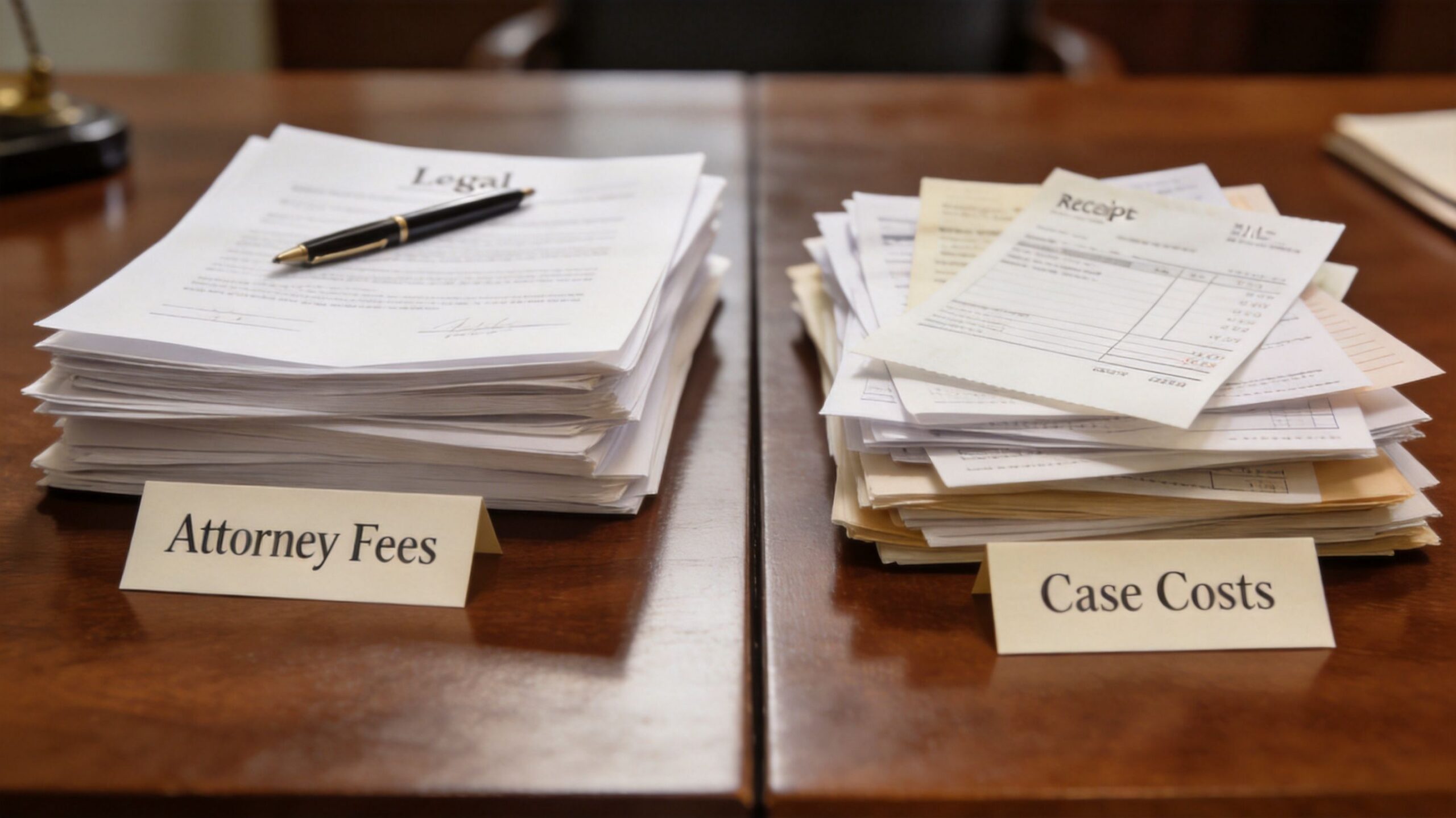
The clean way to separate them is this:
Attorney fee is what you pay the lawyer for the legal work and the risk of taking the case on contingency.
Case costs are the out-of-pocket expenses used to build, document, and prove the claim.
That distinction matters because your net recovery depends on both. If you only focus on the fee percentage, you are only looking at one slice of the math.
A simple comparison helps. The fee is the contractor's charge for doing the job. Case costs are the price of lumber, permits, and inspections needed to finish it. In a personal injury case, both can come out of the settlement, but they are not the same charge.
What counts as a case cost
As detailed in WVM Law's cost guide, common case costs can include:
- Court filing fees
- Deposition transcript charges
- Expert witness fees
- Medical records and billing records
- Investigation expenses
- Service of process and related litigation expenses
Some of these costs stay modest in a straightforward claim. Others rise quickly if liability is disputed, multiple witnesses need to be questioned, or an expert must explain how the crash happened or how the injury affects your future.
Why these costs exist
A strong injury case usually needs proof from outside your own testimony. In a Texas truck wreck case, for example, the lawyer may need crash reports, driver logs, company records, photographs, medical records, and sometimes an accident reconstruction expert. Those expenses are part of building the file that supports settlement value.
This video helps explain the difference between legal work and the expenses used to support the claim.
Why clients should ask about costs early
The best question is not just, "What percentage do you charge?" Ask, "What case costs do you expect, will your firm advance them, and are they deducted before or after the fee is calculated?"
That last part affects the check you receive.
If you want to see how those deductions work in plain English, this guide on how to calculate a car accident settlement in Texas walks through the numbers step by step.
People under financial strain usually need the same kind of clarity in other legal matters too. If your injury has also created debt pressure at home, DebtBusters' Chapter 7 cost breakdown shows a similar split between professional fees and separate case expenses. The labels are different, but the budgeting question is the same: what comes out of pocket, what gets advanced, and what reduces the amount left for your family at the end?
A Real-World Example How a Settlement Is Calculated
You settle your case and hear a number that sounds like relief. Then the next question hits: what will the final check to your family be?
That is the number most clients care about. The settlement amount matters, but the net amount matters more.
Gross fee versus net fee
A settlement works a lot like a paycheck. The top-line number is not always the amount that reaches your bank account. First you have to know what comes out, in what order, and under what contract language.
One contract term deserves close attention. Is the contingency fee calculated on the gross settlement, or on the net amount after case costs are deducted? That detail can change the amount you receive even if the settlement amount stays the same.
MAS Law explains this gross-versus-net issue with a simple example. In a $60,000 settlement with a 33% fee and $3,000 in costs, the client's recovery changes depending on how the fee is calculated:
| Calculation method | Result for client |
|---|---|
| Fee on gross settlement | $37,200 |
| Fee on net after costs | $38,190 |
Same case. Same settlement. Same costs. Different final check.
The difference is $990. For many families, that is a car payment, part of a month's rent, or money that helps cover follow-up treatment.
A simple Houston crash example
Take a common Texas scenario. You are hurt in a Houston freeway collision, the other driver is at fault, and the claim settles before trial. The settlement number is only the starting point. To estimate your take-home amount, you have to run the math in the right order.
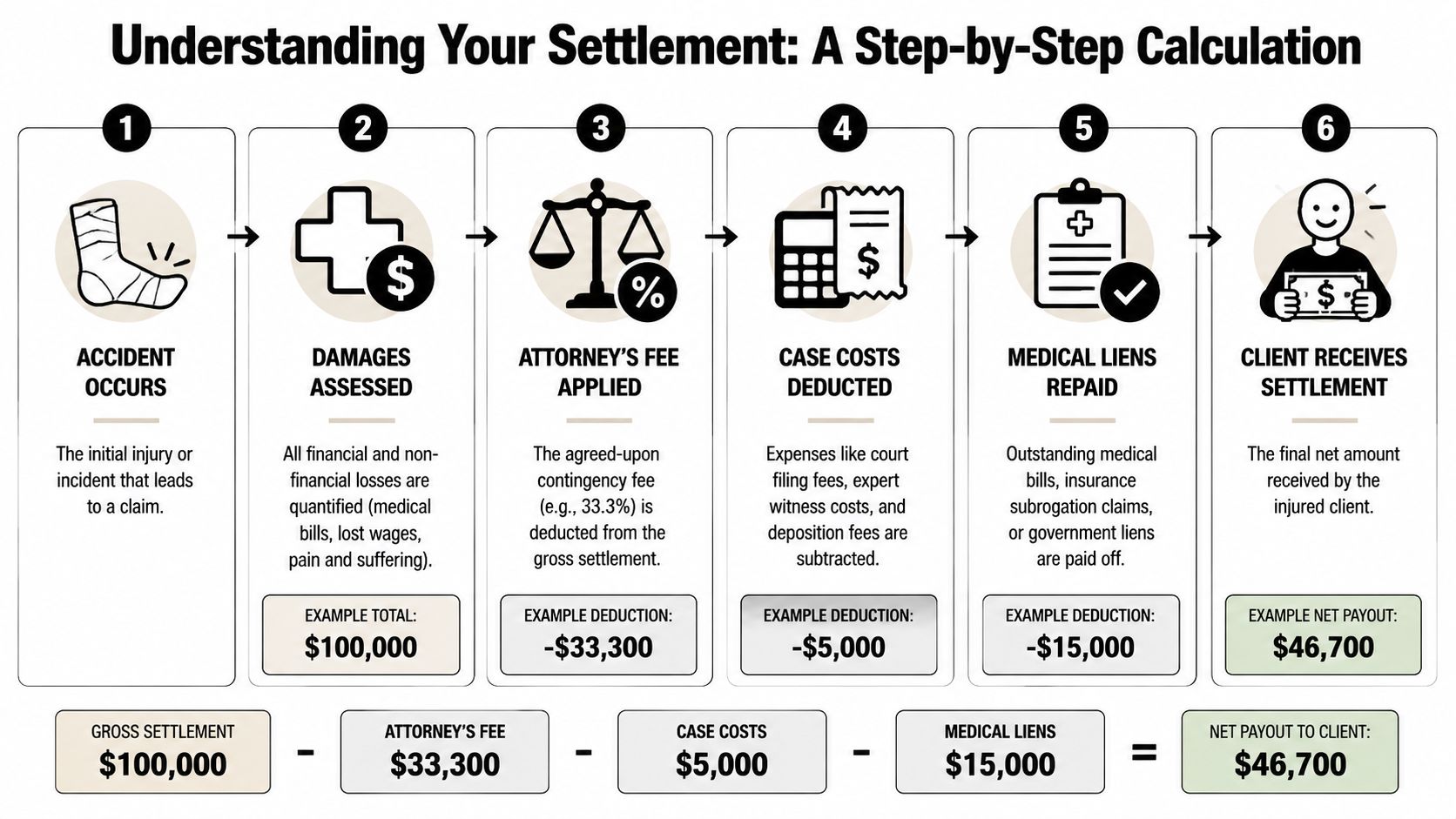
Most settlement statements follow this path:
- Start with the total settlement
- Subtract case costs if the contract calls for that first
- Apply the attorney fee based on the contract language
- Pay medical liens or reimbursement claims that must be resolved
- Issue the remaining balance to the client
That order matters. If the fee is taken before costs, your net can look different than it would under a contract that deducts costs first. If a medical provider, health insurer, or government program has a valid reimbursement claim, that can reduce the final amount too.
This is why two clients can both say, "My case settled for the same amount," and still walk away with different checks.
Why no careful lawyer promises your exact net amount on day one
Clients often want a clear number at the first meeting. That is understandable. After an injury, you may be trying to plan rent, groceries, missed work, and medical bills all at once.
A careful Texas personal injury lawyer usually cannot give an exact take-home figure that early, because several parts of the math may still be unknown.
At the start of a case, your lawyer may not yet know:
- How much treatment you will need
- Whether the insurance company will dispute fault
- Whether expert review will be necessary
- What liens or reimbursement claims may apply
- Whether the case will settle early or require a lawsuit
The better question is not just, "What is your percentage?" It is, "Based on what we know today, what deductions are likely, and how are they applied under your contract?"
That question gets you much closer to the number that matters. If you want to see the math in plain English, this guide on how to calculate a car accident settlement in Texas walks through the process step by step.
What Factors Influence Your Total Legal Costs
The same settlement amount can lead to two very different take-home checks.
That usually happens because the work required to build and prove each case is different. Legal fees may follow the same percentage in two files, but case costs can change based on how much evidence, medical proof, and outside help the lawyer needs to move the claim toward a fair result. If you focus only on the percentage, you can miss what really affects your bottom line.
Injury severity often affects the final math
A minor injury claim usually costs less to develop than a case involving a traumatic brain injury, spinal cord damage, or permanent limitations. Serious injuries often require a larger set of medical records, more detailed doctor opinions, and a clearer projection of future care.
A simple way to view it is this. A small repair job and a full home rebuild do not use the same budget, even if both start with damage. Injury cases work in a similar way. As the harm becomes more serious, the proof usually has to become more detailed.
That can increase case costs. It can also increase the value of the claim. The question is not just whether more money is being spent. The question is whether that spending helps support a stronger recovery and a better net result for you.
Disputes about fault can raise costs
Some cases are straightforward on liability. Others are not.
If the insurance company argues that you caused part of the crash, your lawyer may need to gather more witness statements, photos, vehicle data, crash reports, or expert analysis. Under Texas comparative fault rules, those disputes matter because blame can affect what you recover. They also matter because answering them can require more work and more expense.
This is one reason clients should ask two separate questions. First, what might it cost to prove the case? Second, how could that proof protect or improve the amount left in my final check?
The type of defendant can change the budget
A claim against one private driver is often simpler than a claim against a trucking company, delivery fleet, or business with several insurance policies. Commercial cases may involve company records, driver logs, maintenance history, and faster, more aggressive defense efforts.
The same idea applies in fatal injury cases. A wrongful death claim may require added proof about family relationships, lost financial support, and the full effect of the loss on surviving relatives.
More complexity does not automatically mean a bad case. It means the lawyer may need more tools to build it well.
Timing can affect costs too
Waiting can make a case more expensive to prove. Witnesses become harder to reach. Photos disappear. Video footage gets overwritten. Records scatter.
Early action often protects both the case and the client's net outcome. If evidence is preserved early, your lawyer may be able to prove key points with less effort than if the case sits for months and important proof has to be reconstructed later.
Practical steps after an accident include:
- Get medical care promptly: Your health comes first, and medical records often become a major part of proving damages.
- Save documents and photos: Keep bills, repair estimates, names of witnesses, and any communication from insurers.
- Use caution with adjusters: Early statements and quick offers can affect both liability disputes and settlement value.
- Speak with a lawyer sooner rather than later: A Texas personal injury lawyer, a Houston car accident attorney, or counsel for guidance for car accident cases and related claims can often preserve evidence before it is lost.
In the end, total legal cost is not just about how much work a case requires. It is about whether the money spent on that work helps produce a stronger recovery after fees, costs, and other deductions are applied. That is the number most clients care about, and it is the right number to ask about.
Your Questions About Personal Injury Lawyer Costs Answered
By the time individuals reach this point, they are not asking abstract questions anymore. They are asking family-budget questions. They want straight answers they can trust.

Do I really pay nothing upfront
In most Texas personal injury cases, yes. The lawyer's fee is usually contingent on a recovery. That means you generally do not pay an upfront attorney fee to get the case started.
You should still ask one more question during the consultation: How does the firm handle case costs? Some firms advance them and recover them later from the settlement. The fee agreement should spell that out clearly.
What happens if the case is lost
The attorney fee is usually tied to a successful recovery. If there is no recovery, there is usually no attorney fee. But you should never assume every part of every contract works the same way.
Ask the lawyer to explain, in plain English, what happens to advanced case costs if the case does not succeed. A transparent answer is a good sign.
Are contingency fees negotiable
Sometimes clients ask this because they want to be careful, not because they are trying to bargain. That is fair. You are allowed to ask questions about the contract.
The more useful conversation, though, is often about net outcome, not just the headline percentage. A lower fee does not always mean a better final result if the case is underdeveloped, undervalued, or settled too early.
Why can't a lawyer tell me exactly what my case is worth in the first meeting
Because too many important facts are still unknown. A lawyer may not yet know how long treatment will continue, whether surgery will be needed, whether lost income will grow, how the insurer will defend the claim, or whether experts will be necessary.
That uncertainty is common in:
- A Houston car accident attorney's case load, where injury symptoms can evolve over time.
- A truck crash lawyer Houston matter, where company records and liability disputes may take time to uncover.
- A wrongful death lawyer Texas claim, where damages can be personal and more complex to document.
- A catastrophic injury case, where future care and long-term impairment are central issues.
What should I do right after an accident if I'm worried about legal costs
Start with the basics and protect both your health and your claim:
- Get medical treatment: Follow through with care and keep your records organized.
- Don't rush into a settlement: Quick offers may come before the full picture is known.
- Limit insurance conversations: Be polite, but careful. Do not guess or minimize symptoms.
- Preserve evidence: Save photographs, discharge papers, invoices, and wage-loss information.
- Get legal advice early: Early guidance often helps people avoid mistakes that are hard to fix later.
The first consultation is not only about whether you have a case. It is also about whether the fee agreement makes sense for your situation.
How do I know if a lawyer is being clear enough about cost
A good explanation should answer these questions without dodging:
| Question | Why it matters |
|---|---|
| What is the fee percentage before suit and after suit? | You need to know how case stage affects cost. |
| Are costs advanced by the firm? | This affects whether you must pay out of pocket while the case is ongoing. |
| Is the fee calculated on the gross or net amount? | That term can change your final recovery. |
| What deductions may come out of the settlement besides fees? | Medical liens and case costs affect your check. |
| Who can explain the closing statement to me at the end? | You should be able to review the math line by line. |
If the answers are vague, keep asking. You are not being difficult. You are being careful.
Recovery after a wreck or sudden loss rarely feels orderly. There is pain, paperwork, pressure from insurance companies, and the constant fear of getting one decision wrong. Clear financial answers help bring some calm back into the process.
If you or your family need clear answers about hiring a lawyer after a crash, you can schedule a free consultation with Law Office of Bryan Fagan, PLLC. Whether you need help from a Texas personal injury lawyer, a Houston car accident attorney, or guidance after a truck or wrongful death case, the firm can explain your options in plain language so you can focus on healing. Recovery is possible, and legal help is available when you're ready.