Most Texas personal injury lawyers charge a 33.3% contingency fee if your case settles before a lawsuit is filed and 40% if litigation is required, which means you pay nothing unless you win. That fee usually comes out of the recovery, not out of your pocket, but your final amount also depends on case expenses and medical liens.
A serious accident can change your life in seconds, but you don't have to face it alone. If you're reading this after a crash in Houston, a truck wreck near Dallas, or the loss of a loved one anywhere in Texas, you're probably dealing with more than pain. You're dealing with bills, missed work, calls from insurance adjusters, and a lot of uncertainty about what happens next.
That's why so many injured people search for contingency fee personal injury texas how it works. You want a straight answer. You want to know whether you can afford a lawyer, what the lawyer gets paid, and what you'll receive at the end of the case.
This topic matters because legal fees are only one part of the picture. In many cases, the bigger surprise isn't the percentage. It's how expenses and medical liens affect the money that finally reaches you. A good Texas personal injury lawyer should explain that clearly before you sign anything.
You Don't Have to Face This Alone After a Texas Accident
After a serious collision, individuals often don't feel like they're making legal decisions from a position of strength. They're trying to get through the week. One hospital bill arrives. Then another. Paychecks stop or shrink. The insurance company starts asking for statements before you've even had time to understand your injuries.
That pressure makes many people assume they can't afford a lawyer. In Texas personal injury law, that's usually not how it works. The contingency fee system exists so injured people can pursue claims without paying a large retainer upfront.

Why this system matters
The ethical foundation of contingency fees in Texas is tied to access to justice. Since the adoption of the Texas Disciplinary Rules in 1990, this model has helped injured people bring claims without needing massive upfront legal payments, as explained in this discussion of how contingency fees work in Texas.
That matters in real life. If a delivery truck hits your SUV on a Houston freeway, the company behind that truck may have an insurer, investigators, and defense lawyers involved quickly. A contingency fee arrangement lets you hire counsel without first coming up with a retainer that most families don't have available after a wreck.
Your lawyer takes the financial risk with you. If there is no recovery, there is no attorney fee.
The bigger picture after an accident
A fee agreement is only one part of a Texas injury claim. You also need to understand the legal rules that shape whether you have a case at all:
- Fault and negligence: Texas personal injury cases usually turn on who caused the accident and whether that person failed to use reasonable care.
- Comparative responsibility: If both sides share blame, your compensation can be affected.
- Statute of limitations: You don't have unlimited time to file a claim, so waiting too long can hurt your rights.
- Insurance pressure: Adjusters often move quickly, especially in car and truck cases, before the full value of the claim is clear.
If you've been injured, focus first on medical care, preserving records, and avoiding rushed settlement decisions. Whether you need a Houston car accident attorney, a truck crash lawyer Houston, or a wrongful death lawyer Texas, the core idea is the same. You shouldn't have to choose between getting legal help and paying your everyday bills.
What Is a Contingency Fee Agreement
A contingency fee agreement is a written contract between you and your lawyer that says the lawyer gets paid only if there is a recovery in your case. Recovery usually means a settlement or verdict. No recovery means no attorney fee.
The easiest way to understand it is this: your lawyer is investing work, time, and money into your claim with the expectation of being paid only if the case succeeds. That aligns your interests. You want the strongest outcome possible, and so does your lawyer.
How it differs from hourly billing
In other kinds of legal matters, a client may pay by the hour or provide a retainer upfront. Personal injury cases are different because injured people often can't absorb that kind of cost while they are recovering.
With a contingency fee:
- You don't pay upfront legal fees
- The lawyer's payment depends on the result
- The firm usually advances case costs during the claim
- The fee comes from the recovery, not from monthly invoices
That structure is one reason personal injury law is more accessible than many people assume.
Why lawyers use this model
A good claim takes work long before any money is recovered. A lawyer may need to gather records, review photos, analyze insurance coverage, communicate with witnesses, and build a damages picture that includes medical care, lost income, and pain and suffering.
In a practical sense, the lawyer is saying: we'll put in the work now and get paid later only if we achieve a result.
Think of it this way: the lawyer isn't selling hours. The lawyer is backing your case.
This is also why contingency arrangements are common in injury cases but not in every area of law. When someone is hurt by another driver's carelessness, a drunk driver, a distracted driver, or a commercial trucking company, the person bringing the claim often needs immediate legal help but has the least ability to pay for it upfront.
How this fits into a Texas injury claim
A contingency fee agreement doesn't replace the legal issues in your case. It just answers the payment question. Your claim still depends on proof.
For example, after a Houston freeway crash, your lawyer may need to show:
- The other driver or company owed you a duty to act reasonably.
- That duty was breached through negligent conduct.
- The breach caused your injuries.
- Your losses can be documented.
In wrongful death and catastrophic injury cases, those same principles still apply, though the damages are often more complex. If you've been hurt in a wreck, don't let fear about legal fees stop you from asking questions. The payment model is designed to make help available when you need it most.
Understanding the Standard Fees and Case Expenses in Texas
The standard numbers matter, but they aren't the whole story. If you're comparing lawyers, you need to understand both the fee percentage and the case expenses.

The standard Texas contingency fee
In Texas, the standard contingency fee is 33.3% of the gross recovery if the case settles before a lawsuit is filed, and 40% if litigation is required, with the example of a $100,000 pre-suit settlement producing a $33,300 fee, under a structure governed by Rule 1.04 of the Texas Disciplinary Rules of Professional Conduct, as described in this overview of Texas personal injury lawyer costs.
Common structure: 33.3% before suit, 40% after suit
If you'd like a broader overview of the topic, this guide on how much a personal injury lawyer costs in Texas is a useful companion.
Why the percentage can increase
The jump from pre-suit to litigation doesn't mean a lawyer is charging more for no reason. Once a lawsuit is filed, the case usually becomes more expensive and more time-intensive. Pleadings must be prepared, deadlines must be met, discovery begins, and the work required to move the case toward trial grows substantially.
For you, the practical takeaway is simple. An early fair settlement can reduce friction and cost. But if the insurance company refuses to act reasonably, filing suit may still be the right move because it can be necessary to pursue the full value of the case.
What case expenses are
Attorney fees are not the same as case expenses. Expenses are the out-of-pocket costs needed to develop and present the case.
These can include:
- Medical records charges: Providers often charge for copies and records production.
- Filing fees: Courts require payment to file a lawsuit.
- Depositions: Taking sworn testimony can involve reporter and transcript costs.
- Experts: Some cases need outside professionals to explain injuries or liability issues.
The key point is that the law firm usually advances these costs while the case is ongoing. You don't usually pay them as they arise. They are then reimbursed from the settlement or verdict if the case succeeds.
A short video can help make that distinction easier to visualize.
What to read before you sign
Before you sign a fee contract, read the language carefully and ask direct questions about:
| Issue | Why it matters |
|---|---|
| Fee percentage | You need to know whether the percentage changes after filing suit. |
| Expense handling | You should know what costs the firm may advance. |
| Calculation method | You should understand how the final distribution will be shown to you. |
| Written terms | The agreement should be in writing and easy to follow. |
If a lawyer can't explain the fee agreement in plain English, keep asking until you get a clear answer.
How Your Final Settlement Is Calculated A Real-World Example
This is the part many people care about most. Not the headline percentage, but the net amount that lands in your hands at the end.
Take a hypothetical Houston truck crash. A driver is rear-ended by a commercial vehicle on a freeway. The victim gets treatment, misses work, and hires a Texas personal injury lawyer on a contingency fee. The case eventually settles.
The order of deductions matters
In a typical Texas personal injury case, the distribution follows a sequence. Case expenses are deducted first, the attorney's fee is calculated on the gross settlement, and medical liens are then paid. In the example provided by the Texas law library guide on attorney's fees, a $200,000 settlement with $10,000 in expenses and a $60,000 lien results in a $66,600 attorney fee and a $63,400 net recovery to the client.
That's why clients need more than "one-third" as an answer. They need a full settlement sheet.
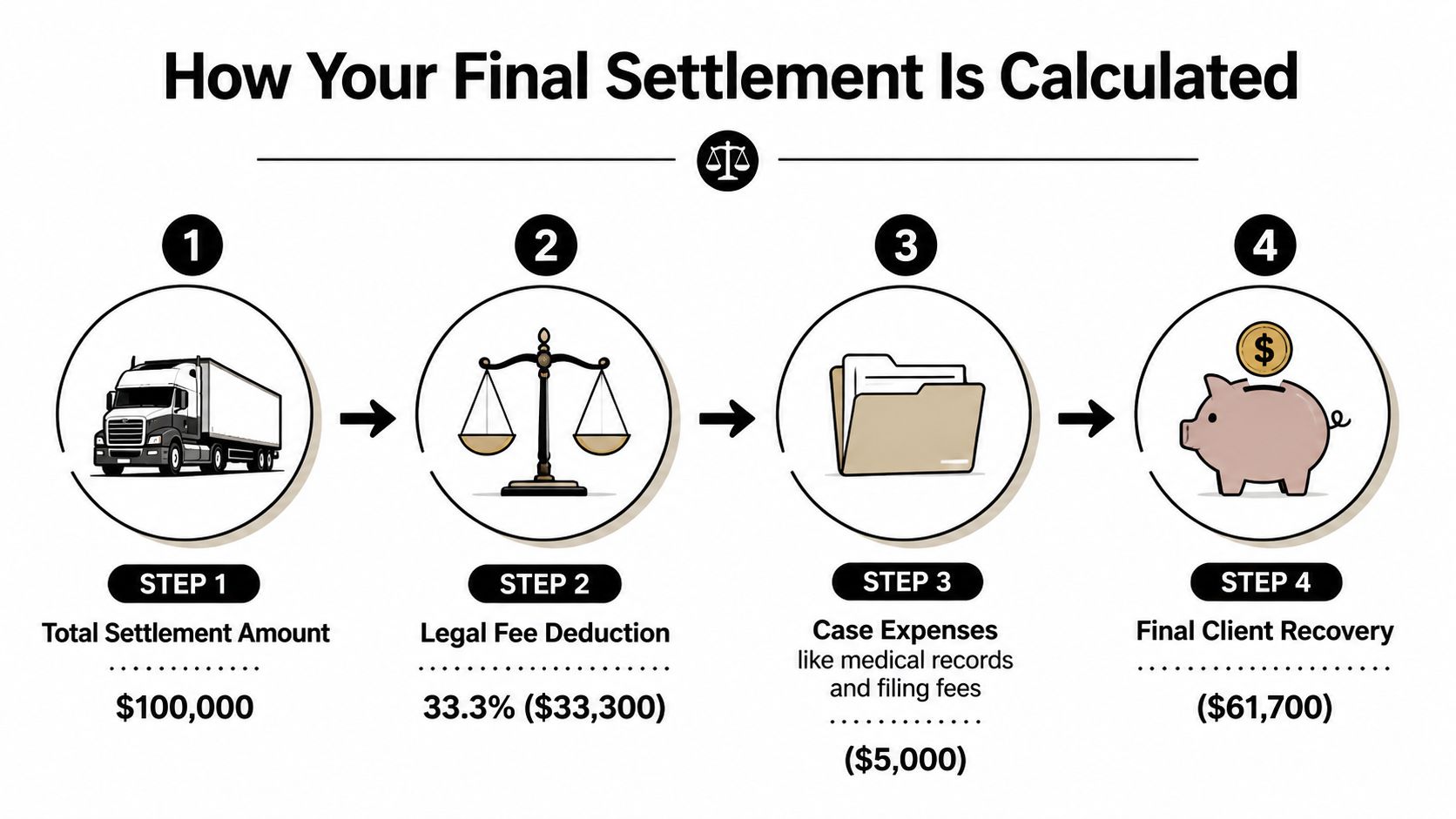
A step-by-step example
Here is the example in plain language:
- Gross settlement: The case resolves for $200,000.
- Expenses come out first: Case expenses total $10,000.
- Attorney fee: A 33.3% fee on the gross amount equals $66,600.
- Medical lien: A lien of $60,000 must be paid.
- Client net: The injured person receives $63,400.
That sequence surprises people because they often expect the attorney fee to be calculated after all other deductions. In many Texas fee agreements, that's not how it works.
Ask for the distribution in writing before you sign the final settlement papers. You should know every deduction and why it appears.
Why medical liens create confusion
Medical liens and reimbursement claims are one of the most misunderstood parts of a settlement. If a hospital, insurer, or benefit provider has a valid claim to repayment, that amount can reduce what you take home.
In real life, this means two cases with the same settlement amount can produce very different net recoveries. One client may have minimal lien exposure. Another may have substantial treatment balances that must be resolved from the same settlement fund.
That doesn't mean the case was mishandled. It means the math of a personal injury recovery has more moving parts than is commonly expected.
A practical example from everyday life
After a Houston freeway crash, someone might hear, "Your case settled." They assume relief is immediate and complete. But the actual financial outcome comes only after the final accounting. That's when fees, advanced expenses, and medical claims are all addressed.
A careful lawyer should walk through that accounting line by line. If you don't understand the numbers, stop and ask. This is your money and your recovery.
The Legal Protections for Your Contingency Fee Agreement
A contingency fee agreement isn't just a casual understanding between you and a lawyer. In Texas, it exists inside a regulated ethical system designed to protect clients from unfair charges and unclear terms.
That matters when you're injured and vulnerable. You're signing documents at a time when you may be in pain, out of work, or grieving a family member. The agreement should be transparent, readable, and specific.

What Texas ethical rules are meant to do
Texas lawyers are governed by professional conduct rules that require fees to be reasonable. In practical terms, that means a lawyer can't invent a fee structure that takes advantage of a client.
You should expect a written agreement that explains how the fee is determined and how funds will be distributed when the case ends.
Protection that matters: a written fee agreement gives you something concrete to review, question, and keep for your records.
What you should look for in the agreement
A sound fee agreement should answer basic questions clearly:
- How is the fee calculated? You should know the percentage and when it changes.
- How are costs handled? You should know whether the firm advances expenses.
- What happens at settlement? You should receive an accounting, not just a bottom-line number.
- Who signs it? Both you and the attorney should be part of the written agreement.
These safeguards are especially important when injuries are severe and the financial stakes are high, such as catastrophic injury or wrongful death claims.
Insurance and legal planning often overlap
Many accident cases also reveal bigger insurance issues. A person may learn too late that the at-fault driver carried limited coverage, or that their own policy options were not what they thought. Before an accident happens, it helps to understand basics like finding the right automotive coverage so you're better positioned if a claim ever arises.
For injury victims, that overlap between insurance and legal rights is one more reason not to sign anything blindly. A clear fee agreement is part of a larger picture. It helps you make informed decisions while your lawyer handles the claim.
Key Questions to Ask Before Signing a Fee Agreement
Many people ask the wrong first question. They ask only, "What's your percentage?" That's important, but it isn't enough.
A smarter question is, "What will my net recovery probably depend on?" That gets closer to the main issue. Fees matter. Expenses matter. Liens matter. So does the lawyer's willingness to explain each one clearly.
A hard truth about liens
A common concern is how medical liens can reduce a settlement. In this example from a Texas contingency fee agreement breakdown, a $50,000 settlement with a 33.33% fee of $16,665, $5,000 in expenses, and a $10,000 medical lien leaves the client with $18,335.
That example is sobering, but useful. It shows why clients shouldn't focus only on the fee percentage. A lower-looking fee doesn't automatically mean a higher take-home amount if liens and expenses aren't addressed carefully.
If you're comparing lawyers, this resource on how to pick a personal injury attorney can help you evaluate more than just marketing claims.
Questions worth asking in the first meeting
Bring these questions to any consultation and write down the answers.
- How do you handle medical liens? Ask whether the lawyer actively works to resolve and negotiate them before distribution.
- How are case expenses tracked? You want to know whether you'll receive an itemized ledger.
- What happens if the settlement is modest? Ask directly how the firm handles a recovery that may not leave much after deductions.
- Will you show me a sample closing statement? A transparent lawyer should be comfortable explaining what a final distribution looks like.
- Who will answer my questions during the case? Communication problems often create as much stress as financial confusion.
A good fee agreement doesn't just state a percentage. It helps you understand what happens to the whole settlement.
Ask about low-settlement situations
Another question people hesitate to ask is this: what if the case settles, but not for much?
Ethical Texas lawyers will often reduce their fee in a small-settlement situation so the client receives a meaningful recovery, and Rule 1.04 requires fees to be reasonable, as explained in this discussion of what contingency fee means in practice.
That doesn't mean every low-value case works out the same way. It means you should raise the issue upfront rather than assume the standard formula will answer every situation fairly.
Watch how the lawyer answers
The answer matters. The tone matters too.
If a lawyer rushes past your questions, avoids specifics, or treats fee questions like a nuisance, that's useful information. By contrast, a lawyer who explains the process calmly is showing you how the relationship may work after you hire them. The Law Office of Bryan Fagan, PLLC handles Texas personal injury matters on a contingency-fee basis, and like any firm you consider, should be asked these same direct questions.
Take the First Step Toward Recovery and Justice Today
A contingency fee arrangement gives injured Texans something they often need immediately after a crash. Access to legal help without upfront attorney fees. That can make the difference between facing an insurance company alone and having an advocate who can investigate the case, document damages, and push for a fair result.
The most important lesson is this: don't judge the financial side of a case by the percentage alone. Your final recovery may be affected by expenses, medical liens, and the stage at which the case resolves. Clarity at the beginning prevents painful surprises at the end.
What you can do right now
- Get medical care: Your health comes first, and your records also help document the claim.
- Save every document: Keep bills, discharge papers, photos, wage loss information, and insurance letters.
- Be careful with adjusters: Don't guess about your injuries or rush into a recorded statement.
- Ask direct fee questions: Make sure you understand expenses, liens, and final distribution.
- Speak with a lawyer early: Timing matters in personal injury and wrongful death cases because evidence doesn't wait.
If you're dealing with a car wreck, a commercial vehicle collision, catastrophic injuries, or a fatal crash, legal help may be available on a no-win, no-fee basis. If you want to explore your options, this page about contingency-fee lawyers near you is a helpful next step.
Recovery is possible. You don't have to solve the legal and financial side of this alone. With clear information and the right support, you can make decisions from a place of confidence instead of fear.
If you were hurt in a Texas crash and want clear answers about fees, liens, insurance, fault, negligence, comparative responsibility, or filing deadlines, contact the Law Office of Bryan Fagan, PLLC for a free consultation. Whether you need help from a Texas personal injury lawyer, a Houston car accident attorney, a truck crash lawyer Houston, or a wrongful death lawyer Texas, you can talk through your options with no obligation and no upfront fee.